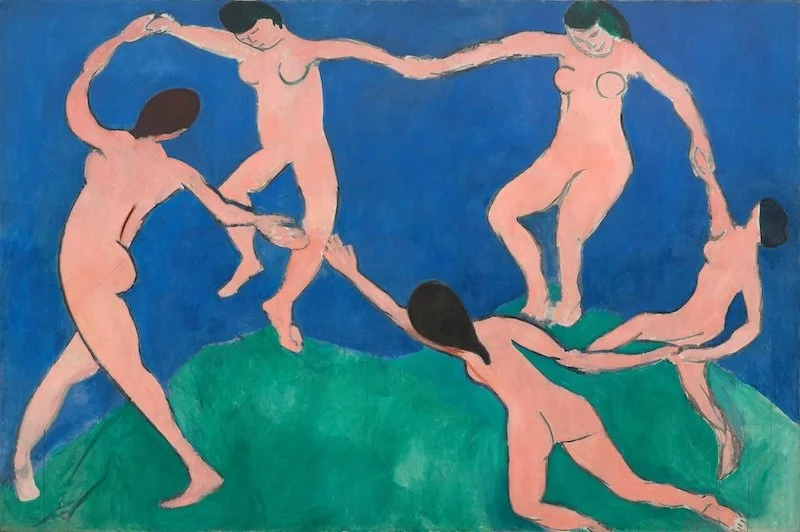
Henri Matisse, La Danse I. Image courtesy of Wikimedia Commons.
This is the author’s response to the five previously-published essays engaging her new book.
It is an occupational hazard of writing about voice and transmission that one might not recognize one’s own until it is echoed back from the other side of the room. Or to try out another sensorial metaphor: it can take the generous gaze of trusted colleagues to reflect back the broader shape of one’s project. These reviews have shown me not only what I was looking at when writing Body Language, but where I was standing when I looked.
Resisting the Archaeological Metaphor: Beyond Logocentrism and Devolution
In her own book, The Poetics of Prophecy, Yosefa Raz reminds us that the philological corners of our field remain captive to an archaeological metaphor. In this long-dominant critical paradigm, the textual surface is treated as debris, the encrustation of later dogma or scribal material that as scholars we are to clear away with the spade of historical criticism in search of an elusive, pristine interiority. This paradigm is as old as modern philology itself.[1] Francis Bacon, in his essays on how to extract wisdom from ancient texts, argued that antiquity itself was a veil cloaking timeless truths, truths to be purified from their antiquated form into the rational language of modernity.[2] For Bacon, “In the old times...the world was full of all kinds of fables, and enigmas, and parables, and similitudes,” not to conceal ancient “truths” but in an antiquated language that appealed to “primitive” understanding.[3] Even with all our shifting theoretical frameworks and inquiries, Bacon’s orientation has remained largely in place: that the goal of philology was to clear the debris. But what if it’s the so-called debris that we are after? What if the goal is not to make ancient voices conform to our expectations, but rather to expand our own understanding of human meaning-making so that we appreciate them?
Both Raz and Nathan Mastnjak rightly ask how it is that our discipline arrived at an understanding of language so thoroughly at odds with the texts themselves. The roots of this estrangement lie in the evolutionist frameworks that came to the fore in 18th-century literary history and their institutionalization in 19th- and 20th-century practices of higher criticism. Where an earlier scholar like Gerhard von Rad accurately observed the material efficacy of the Hebrew word, he could only make sense of it within a framework in which it was a vestige of a “primitive” mentality that could not distinguish idea from actuality. Later, under the sway of Walter Ong’s psychodynamics of orality, writing was indexed as a technology that supposedly restructured human consciousness away from the sensory body and toward abstract thought.[4] This developmental trajectory mirrored Wellhausen’s devolutionism, where the inscription of the law marked a fracture point, the ossification and “death” of living prophecy.
Where my last book, Beyond Orality, set out to dismantle these evolutionist frameworks, Body Language attempts to show what such a dismantled framework can look like. The ancient Israelite thought world did not operate with a disembodied logos. Speech, for them, was an embodied, social, and material entity that was produced in the physical body, stored in the interior space of the body (לב), emitted through the throat, and projected out into the world as both ephemeral sound and tangible speech-object that altered the physical and social landscape. Speech was an active technology designed to store, project, and perpetually re-embody vocal presence.
The Kinesthetic Body: Instruction, Power, and the Lineage of Succession
This reconceptualization is most clearly seen in the social mechanics of instruction. As Anne Katrine de Hemmer Gudme has shown in her extension of Chapter 3 to the broader Deuteronomic framework, divine command demands embodied performance. Instruction is designed to modify, protect, and regulate the physical bodies of the instructed, producing tangible rewards that—in Gudme’s apt articulation—swell their wombs, sustain their flesh, and order their daily steps.
As I articulate in Chapter 3, instruction operates as an asymmetrical discourse where an authoritative figure deposits material words into the internal organs of a silent, subordinate hearer—an educational transaction, yes, but also an exercise in kinesthetic alignment. In my recent collaborative work with Benjamin G. Wright (forthcoming), we have expanded this dynamic into a broader theorization of ancient transmission: behavior is a path and succession is a line.[5] Paternal and pedagogical transmission functions as a kind of support system, where the aging father (instructor) deposits speech into the body of the son (student) so that his vigorous, upright body can act as a physical crutch to maintain the deteriorating frame, name, and reputation of the predecessor from collapse.
This framework, visible across Proverbs, Ben Sira, and the Ugaritic tale of Aqhat (where a dutiful son must literally hold his father upright when he is “full of wine”), exposes the vulnerability of this lineage. The son, who becomes the father, needs to depend on the compliance of a subordinate (their own future son) who may at any time choose to deviate. This is the anxiety that runs from Proverbs through Ecclesiastes: it is the dread of intergenerational collapse, that the younger body might choose to not tread the established path.
Prophetic Mediation, Trauma, and the Limits of Inscribed Voice
These mechanics of the body in a way resolve the paradoxes of prophetic literature, as Mastnjak and Anathea Portier-Young raise. Both Mastnjak and Portier-Young have wrestled in their recent books with understanding prophecy and prophetic literature against our own inherited frameworks, and much of what I have written on the topic is indebted to their insights. Contrary to the long-standing notion of the prophet as divine mouthpiece, the phenomenon looks more like a kind of embodied translation of overwhelming immortal power that the human prophet performs using their mortal flesh. Portier-Young points compellingly to moments where voice is shattered by violence and trauma, as in Ezekiel’s vision of the valley of dry bones (Ezek 37). As Ingrid Lilly has shown, bones serve as the hard interior core of kinship.[6] In Ezekiel 37, the physical reassembly of those scattered bones precedes the return of the breath, and prophetic speech is the material catalyst that can reassemble the fractured lineage. Even when violently disassembled, the social body can be revoiced and made upright once again. But I want to return to Portier-Young’s challenge: If ancient texts are conceptualized as bodies, how can we navigate the limits of this medium when texts cannot see, feel, or “speak back” to us? Here we must draw again from the media environment of the ancient Levant. As seen on monumental inscriptions, an inscribed object does not need to possess sensory perception to act. As we learn from Timothy Hogue, it operates through deictic presence. It physically confronts the reader within a shared spatial field, staking a claim, asserting authority, and compelling the reader’s own body into a kinesthetic replication and public witnessing.
The Relational Sensorium: Gender, Presence, and the Work of Personification
Dorothea Erbele-Küster reminds us that attending to embodiment necessitates that we sharpen our own hermeneutics of presence. In the sanctuary of Shiloh, Hannah’s moving lips and silent throat are not interiorized moments of prayer, but as I argue in the book, a physical libation—an offering of her sustaining breath when all conventional efforts have been otherwise exhausted. Similarly, violently silenced and dismembered bodies, from Abel’s blood screaming out of the ground to the Levite’s concubine’s limbs in Judges 19, can still speak out through their remains. Bodies continue to exercise agency, this is how they can demand retributive justice.
This brings me to the crucial question of gender raised by Portier-Young and Raz: how does the gendering of voice shape the representation of performance? In a recent study of personification in biblical poetry, I trace how this trope operates as a tool of enfleshment.[7] I am particularly interested in how personification gives abstract concepts and polities a body, face, and voice to situate them within a dynamic web of relational obligations. When the biblical authors feminize collective polities, like the sister cities Oholah and Oholibah in Ezekiel 23, or Daughter Zion in Lamentations, they use marriage, kinship, and vulnerability to translate geopolitical catastrophe into something personal and intimate. In Proverbs 1-9, the personification of Lady Wisdom and her rivals (Folly, the Strange Woman) deliberately uses identical spaces (the Street Corner, the Public Square) and overlapping language (“seeking” and “finding,” and calling out to the פתי, the “uninitiated, naïve”). The two figures are not compared through abstract definitions; rather, they are enfleshed as competing suitors. This mirroring strategy forces readers to discern, to determine which suitor is life-giving and which might lead them to ruin.
Inscribed Speech as Living Technology
Tracing these ideas across Body Language and its subsequent outgrowth shows, I think, what is at stake here. When we reconstruct the legendary figure of Solomon, whose expansive inner body (רחב לב) was equipped to hoard thousands of proverbs and songs like material treasures (1 Kgs 5:9-12), we can see how ancient collections were physical, material, and somatic. The king’s body was the king’s library.
Inscribed text functioned for the biblical authors as an active, durable technology of speech—a vessel that was configured to store the material voices of ancestors and Israel’s God, so that these voices might continue to command, confront, and inhabit the voices of future generations. Moving past our inherited frameworks in this way allows us to reenter this ancient sensorium, where the text remains an enduring interlocutor entangling us in its perpetual web of relationships.
Jacqueline Vayntrub is Associate Professor of Hebrew Bible at Yale Divinity School. She is the author of Beyond Orality (2019) and Body Language: Voice, Embodiment, and Textuality in the Hebrew Bible (2026), and co-author (with Matthew Suriano) of a forthcoming volume on ancient Hebrew funerary inscriptions. Her current projects include a monograph on biblical concepts of transmission, the historical reception of Hebrew verbal art as material “word-objects,” and a commentary on the book of Ecclesiastes.
[1] See Sheldon Pollock, “Philology in three dimensions,” Postmedieval 5/4: 398–413.
[2] Francis Bacon, “De Sapientia Veterum,” 1609. 403, 405.
[3] Ibid., 407.
[4] See Vayntrub “Technologies of the Word: Material Transmission and the Next Turn in Biblical Studies.” Vetus Testamentum. Forthcoming.
[5] Vayntrub and Wright, “On Lineage and Transmission: Rethinking Early Jewish Instruction.” In Early Jewish Literature, edited by Benjamin G. Wright. Early Jewish Literature. Atlanta: SBL Press. Forthcoming.
[6] Ingrid E. Lilly, “The Fertility of Bones: Towards a Corporeal Philology of Reproduction,”
HBAI 8 (2019): 432–47
[7] Vayntrub, “Fleshing Out Ideas: The Relational Mechanism of Personification in Biblical Poetry.” In My Heart is Astir with a Good Word, edited by Yannik Ehmer and Bernd Schipper. Library of Hebrew Bible/Old Testament Studies. London: Bloomsbury. Forthcoming.