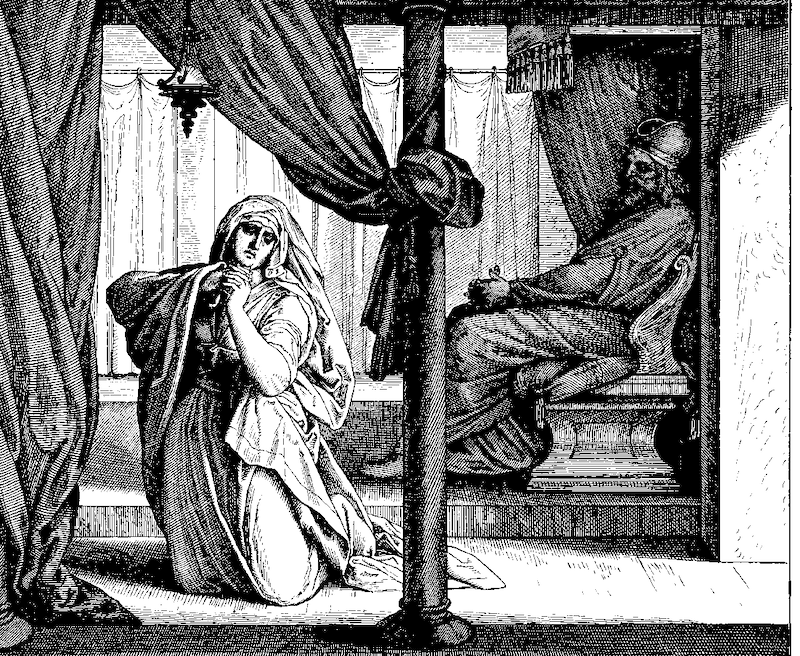
Hannah’s Prayer, by Julius Schnorr von Karolsfeld. Image courtesy of Wikimedia Commons.
This essay was part of a 2025 SBL Conference Book Review Panel devoted to Body Language: Voice, Embodiment, and Textuality in the Hebrew Bible, by Jacqueline Vayntrub.
Jacqueline Vayntrub’s monograph on the embodiment of ancient biblical voices is written with embodied rigor. Just as bodies communicate, so too do texts. Vayntrub is not only a compelling writer, but also an engaging speaker. Her assertion, which runs through the book, that speech is effective as it resides within bodies (e.g. pp. 33,76,109) resonates powerfully throughout her work on body language and embodiment. It prompts me, at the outset, to share one consequence of such an approach, which aligns with my own: attending to embodiment reshapes both our research methods and the questions we ask. As Vayntrub explains in the opening pages:
In this book, I argue that speech performances, in the voices that (re)embody them and the texts that house them, were understood as material things—objects that would be produced and stored in the vessel of the human body to be sent to future readers, who would share their mortal, corporeal fate (p. 1).
We share with ancient readers the condition of embodied and vulnerable human existence. In what follows, my observations arise from my intellectual rootedness in the German-speaking continental tradition, as well as from my research on anthropology and trauma studies. Accordingly, I have organized my review around two thematic strands: first, methodological questions; second, intersections with (biblical) trauma studies. I conclude by considering the impact of this book on contemporary discussions in anthropology.
1. Methodology: Material Studies, Philology, and the Body
Vayntrub’s research interest in body language is at least twofold: On the one hand, she examines how the voices of ancient writers, singers, prophets, and cities are embodied in biblical texts. On the other hand, she investigates how their voices become embodied anew in the reading process. Consequently, Vayntrub brings together philology, performance studies, and theories of embodiment. In other words, the research question concerning the embodiment of language reveals that the concepts of corporeality, textuality, aesthetics, and performativity are tightly interwoven in the biblical text.
This reminds me of observations made within the field of reception aesthetics, which emphasizes that reading texts is a performative act foregrounding the aesthetic dimension. Take, e.g., the didactical function in commemoration and aesthetic features of the acrostic Psalm 34. The psalm anchors the cognitive learning process in embodied sensory experiences through its multiple address to the senses. Moreover, her approach stresses the social dimension of reception aesthetics and integrates it with questions of embodiment. Insights from material studies, philology, and performance studies converge smoothly, without dedicating lengthily separate chapters to the theoretical framework. As readers, we implicitly learn, page by page, how her approach works.
The well-written monograph invites readers to listen to the voices of paradigmatic figures, such as the wicked and the wise in Proverbs, as well as to the voices of material substances, such as the blood of Abel shed by Cain. The latter serves as the opening example through which Vayntrub demonstrates the materiality of speech and argues that speech is stored in the body—even in the bodily fluids of a dead person (pp. 13-15). The account in Genesis 4 embeds a concept of speech’s re-embodiment. As a deceased body, Abel no longer possesses the capacity for speech production; a cry for justice becomes possible only through some form of re-embodiment. By absorbing his blood, the ground re-embodies Abel’s liquefied remains and acts on his behalf, cursing his murderer Cain:
“What have you done? The voice of your brother´s blood cries out from the ground. And now you are cursed by the ground, which opened its mouth wide to receive your brother’s blood from your hand. For when you work the ground, it will no longer give you its power” (Gen 4:10–12).
Reading the story of Abel’s murder, Vayntrub emphasizes not only that “his blood cries out on behalf of his deceased person,” but also that the re-embodiment of the dead is made possible through the textuality of the account itself (p. 109). Such a reading has considerable potential, not least because it can be productively linked to a range of recent discussions, including debates on more-than-human agency, the interaction between so-called animate and inanimate subjects, and material philology. The embodied voice, and the body as a site and source of both vitality and vulnerability, constitute the point of departure for Vayntrub’s analysis.
2. Reading with a hermeneutics of presence and embodiment
The second observation stems from the quest for the silenced/silent female voice within feminist and trauma studies. It is thrilling that “Silent Speech” (pp. 43ff) is addressed as well. The issue is tackled through Hannah’s voiceless and embodied petition. In 1 Sam 1:13 we read “Hannah was talking to herself, only her lips moved but her voice could not be heard, thus he took her to be drunk.” The Hebrew term sãpâh stands for lips, speech and language. Lips are an inward and outward organ, and by analogy also the rim of a body in general. They are a communication tool. The lips are a sensory organ for taste, speech, touch. Hence, open, moving lips may also have a sensual erotic appeal. One may add that the verb which is used for the movement of the lips refers to a quivering movement (nûa‘: quiver, tremble, totter) to strengthen the argument of the author. Hannah’s body language is shaky as her lips totter. Eli was not able to read her lips, perhaps because they were moving too fast. Silent prayer was unusual, and is taken by Eli as a sign that she is not sober. Maybe he was also not supposed to understand the prayer, as it was directed towards her heart (lēb). Instead of a hermeneutics of absence which annihilates Hannah’s voice, and risks not paying attention to her tottering lips, Vayntrub advocates in her close reading a hermeneutics of presence:
“The reading brings us from a hermeneutic of absence, asking, “What is Hannah thinking in her silent petition?” to a hermeneutic of presence, asking, “What materially does Hannah have left to offer Yhwh if she has exhausted all other means to exhibit devotion?” (47)
This is striking. It means that Hannah’s pouring forth of her nepeš, her being, herself, as an offering for God is perilous not because the other might not understand it, but because Hannah stakes herself in the act.
This brings me back to the quest of how to interpret the silence of silenced and mutilated wo/men and whether language fails to represent traumatic experiences. I am compelled to read other stories, such as Judges 19 on the dismembered voiceless nameless woman, with such a hermeneutics of presence, and a stress on the materiality and voice of mutilated bodies such as Abel’s blood and body. The nameless woman in Judges is not able to lift her voice: “‘Get up,’he said to her, let us go.’ But there was no reply (Judges 19:28). However, in a hermeneutics of presence she speaks up despite her being so violently silenced and dead (“and there was the woman, his concubine, lying at the entrance of the house, with her hands on the threshold“ Judges 19:27b); indeed, the distribution of the members of her body at the end of the story presupposes this (Judges 19:29-30).
Let me conclude with one further insight that I gained from this inspiring book for current discussions of the inner self and the body in German-speaking scholarship. Contentious issues, such as the interpretation and translation of the central term nepeš, are handled with ease. Vayntrub surveys a range of renderings of nepeš, including “‘being,’ and ‘breath,’ and ‘organ of breathing,’ that is, the ‘throat’ or ‘gullet.’ The term can also designate, in a more abstract sense, ‘desire,’ deriving from the notion of the gullet, and ‘vitality,’ deriving from the ‘life-breath’” (p. 45). Hannah’s pouring out of her nepeš, her ‘life-breath’ (1 Sam 1:13) is interpreted as “a dedication of the very material that sustains her—short of pouring out her own blood on the altar—offering her breath, poured out as a libation.” (p. 47) This may serve as yet another example to bring into the ongoing continental discussion of whether the Hebrew Bible knows a concept of an inner self. Biblical texts as these may remind those who are engaged in the debate not to neglect the embodied self. Hannah’s prayer provides an instance of a biblical character speaking to themselves, while firmly grounded in bodily experience and materiality. I hope that the German-speaking circle devoted to anthropological questions will engage with Body Language and draw deeply from its reservoir of insights into embodiment. The monograph prompts reflection on how the practice and teaching of exegesis and Hebrew Bible studies might change if we were to begin with the vulnerable body and embodied speech rather than with a universalizing, disembodied concept of reason or mind.
Assoc. Prof. Dr. Dorothea Erbele-Küster holds a teaching and research position in Gender, Diversity, and Biblical Literature at JGU Mainz. Hermeneutics, the role of embodiment in biblical anthropology and trauma literature are among her primary research interests. In “Verführung zum Guten” (Stuttgart, 2019), she presented a study on the relationship between ethics and aesthetics in biblical literature.