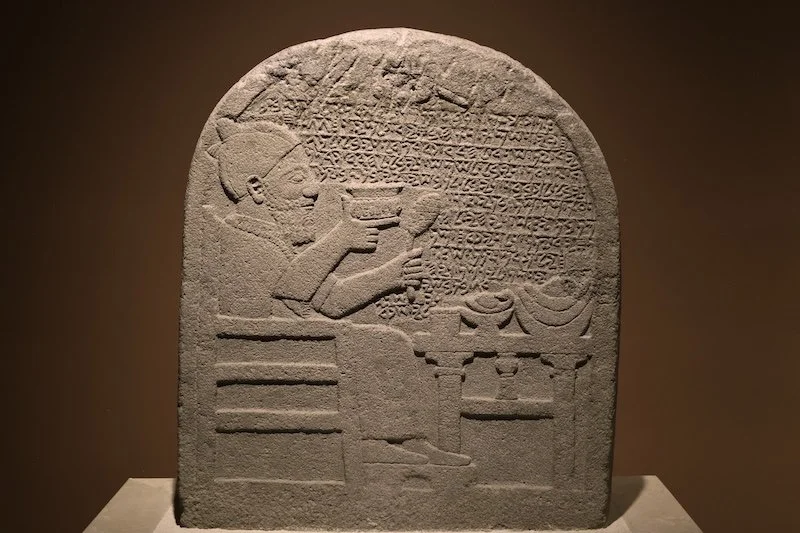
Kuttamuwa’s Grave Stele, Image courtesy of Wikimedia Commons
This essay was part of a 2025 SBL Conference Book Review Panel devoted to Body Language: Voice, Embodiment, and Textuality in the Hebrew Bible, by Jacqueline Vayntrub.
In Body Language: Voice, Embodiment, and Textuality in the Hebrew Bible, Jacqueline Vayntrub sets out to recover an ancient Israelite ontology of speechmaking. What did ancient Israelite authors think speakers were doing when they spoke? What did they think they were doing in representing speech with the written word? As Vayntrub points out from the start, a large measure of the difficulty is recognizing the urgency of the questions to begin with. Modern biblical scholarship has so thoroughly internalized a theory of representation as mimesis, “imitation,” that asking questions about native Israelite understandings of speechmaking hardly arises.[1] According to this common-sense conception, representations of things are nothing more than imitations of those things. Between the thing and its representation stands an unbridgeable metaphysical chasm. The representation of speech in writing does nothing more than imitate speech in an unspoken, written form.
These ideas about representation are nearly everywhere assumed but rarely taken up for examination. But as Vayntrub points out, a glance outside the Hebrew Bible suggests the possibilities of different ontologies of representation at play in ancient West Asia. Recent work on the crafting of images in Mesopotamia, for instance, suggests a notion of representation in which the image is a manifestation of the thing represented, not simply an imitation of it.[2] What Vayntrub proposes is a reappraisal along the same lines of the ancient Israelite understanding of representation in accounts of speechmaking.
Vayntrub’s central claim is that the literature of the Hebrew Bible conceptualizes speechmaking as constituting a corporeal reality centered on the embodied voice. Her claim is not merely that speechmaking was thought of as inherently a matter of human (or divine) bodies with voices, but rather that the embodied voice conceived of as a material object is the irreducible core of the ancient Israelite understanding of speech. Once voiced, words are material things in the world. This nexus of body and speech brings words in closer relation to realities than a theory of mimesis can account for and bestows on words and speech an essential efficacy. Speech embodied in voice does not merely represent a thing; it is, in some way, akin to the thing. The counterintuitive nature of the claim leads Vayntrub to proceed inductively. Through philological analysis of biblical idioms and close readings a variety of texts, she asks us to take seriously what the texts actually say about speechmaking.
Before turning to discuss the significance of this book, I want to address a minor complaint. The argumentation, in my view, moves too quickly from the problem in scholarship to the solution. Let me hasten to point out that I do not think this move significantly detracts from the overall argument, but it does to some extent obscure how the book fits into the field. On the one hand, Vayntrub does take the opportunity throughout the book to point out the general failure of scholarship to adequately account for the Hebrew Bible’s own conceptions of speech. In Chapter 2, for example, she notes the tendency of contemporary scholarship to dismiss the somatic character of biblical idiom as “mere metaphor,” as well as the scholarly tendency to impose on the texts a mind-body division that is foreign to them.[3] Nevertheless, it would have been helpful to give some account of how the field developed an understanding of representation that is so thoroughly at odds with what she finds at work in the texts themselves.
The need for such an account comes into focus when we notice a certain affinity between Vayntrub’s account of representation and that of an earlier generation of scholars. Consider Von Rad’s contrast between our modern understanding of words and those held by ancient peoples:
Indeed, our conception of the word, as that which conveys an intellectual meaning, seems to be the complete opposite of the conception which we must suppose existed in the cultural state represented by the myth. There, a word is much more than something which indicates and designates a certain object; it is quite the reverse of a label attached to an object at a later stage.[4]
Though using different terminology than Vayntrub, Von Rad here rejects the assumed applicability of an account of language as mimesis to ancient texts: the word is not attached to an object at a later stage but intrinsically bound up in it. Von Rad’s distinctions are of course mired in an orientalizing perspective that the field of Biblical studies rightly seeks to overcome. In Von Rad’s view, this conception of language reflects a failure on the part of the ancient Israelites to properly distinguish the spiritual and material such that they are “also unable properly to differentiate between word and object, idea and actuality. … In a way which defies precise rational clarification, every word contains something of the object itself. Thus, in a very realistic sense, what happens in language is that the world is given material expression.”[5] Or as he goes on to say, in the ancient Israelite conception, a word once spoken could be conceived as “an objective reality endowed with mysterious power.”[6]
It is important to underscore the fact that Vayntrub is not saying the same thing as Von Rad. Nevertheless, a kind of affinity can be seen when she concludes, for instance: “But speech did not only have an effect on people and things, doing things with words. As a material object, speech constituted a vital and material presence in the world on its own.”[7] Similarities can also be perceived in their perspectives on the nature of names. Von Rad says, “A man’s name was not looked on as something additional to his personality … on the contrary, it contained an essential part of his nature … he was therefore particularly exposed to the baleful influence of magic by its use.”[8] In a similar vein, Vayntrub says, “One’s name is an extension of one’s body, and as a proxy of their person, one’s name functions as a material object that can be enhanced, damaged, or even erased.”[9]
In my view, noting these points of contact helps to situate Vayntrub’s overall contribution. Von Rad observed real phenomena in the text, but his analysis stopped at a rejection of those phenomena as vestiges of the primitive background out of which Israel was emerging. Vayntrub succeeds where Von Rad failed in large part due to her thoroughly theorized examination of the underlying conceptual framework related to the voice and embodiment. In this way, she avoids the paternalistic orientalism that characterizes Von Rad’s work—and indeed much of the work of that generation. A question that Vayntrub’s book raises is how the field moved from the approach of Von Rad to a situation where native theories of language have been rendered all but invisible to modern scholarship. I would have liked to see this traced not because it is strictly necessary for the argument, but because I think it places her overall achievement in important relief.[10]
That minor complaint aside, Vayntrub makes a strong case throughout the book that the authors of the Hebrew Bible thought differently about the nature of language than we tend to. Until we attend to that difference, we are bound to misunderstand them at a pretty fundamental level – even to misunderstand what they thought they were doing when writing and reading the texts we study. The implications of this retrieval are wide-ranging. Rather than rehash her arguments, in what follows, I would like to highlight the productiveness of Vayntrub’s work by drawing attention to particular ways that it can intervene in discussions of prophetic literature and prophetic speech.
As she points out, many approaches to the prophets center on the notion of the prophet as a mouthpiece or spokesperson for God. This basic approach might capture something of what goes on in prophetic texts, but it also overlooks ways that the texts underscore the significance of the prophet’s own agency, personhood, and body. Vayntrub examines the prophetic word with attention to the implicit theories of communication and representation it embeds and notices several things that disrupt the conventional depiction of prophets as mere messengers. First, she points to the phenomenon of blurred attribution in the prophets: the sometimes-vexing difficulty of determining with whose voice the prophet is speaking. She suggests that this blurring is at least in some cases a feature rather than a bug, a crucial aspect of ancient Israelite thinking about the nature of prophecy.[11] Prophetic speech, according to this understanding, by its very nature blurs the lines between prophet and God. The nature of prophetic speech, therefore, crosses otherwise distinct boundaries and shares characteristics of both human speech and divine speech. This suggests the potential for prophetic speech to share in a certain kind of efficacy that is otherwise presumed for the speech of God. Indeed, in certain cases the prophets themselves seem to be imbued with considerable power.[12] They carry in their bodies and in their voices a kind of power so potent that both kings and gods are often at pains to try to keep it under control.
The divine voice is indeed understood to be powerful and effective, and Vayntrub raises the intriguing question of why it requires the human mediation of a prophet. Her answer is that the human prophet translates the otherwise unintelligible divine voice. As an example of the latter, she cites Ps 29, where the divine voice is embodied in the all too effective—but unintelligible—thunderstorm. In prophetic discourse, by contrast, the prophet is able to translate the “unintelligible divine message to an intelligible mortal speech.”[13] Vayntrub’s specific proposal here has considerable explanatory power, but her overall approach might also suggest that something more can be said about prophetic speech. In Vayntrub’s analysis, speech is an object that is effective because it emerges from the body. Divine speech as depicted in Gen 1 for instance, is not the exception that proves the rule, but rather a paradigm for the entire ontology of speech. The text presumes a God with a body, and the effectiveness of his speech in creating the world is a function of his body; human speech is different in degree. but not in kind.[14] Given her overall analysis, it would seem possible to extend Vayntrub’s model of embodied speech to view prophetic speech as a modality for rendering divine speech effective. On the one hand, ancient Israelites imagined an embodied deity and could tell stories of mythic times past when the deity spoke the world into existence or addressed Israel directly from the top of the fiery mountain. But in a world where God does not regularly speak in these ways, and one where speechmaking is thought of as effective because it is embodied, the silence of God could potentially pose a conceptual and theological problem. It seems possible that the prophetic voicing of divine speech is at least a partial solution to this problem; it allows divine speech to become a sensible thing in the world, to emerge from a body, albeit a prophetic one, and so to be perceived as an undeniable thing in the world, and therefore effective. In Isa 55:11, God declares “so shall my word be that goes out from my mouth; it shall not return to me empty, but it shall accomplish that which I purpose, and succeed in the thing for which I sent it.” Vayntrub’s analysis could be taken to suggest that this text implies that the way the divine word goes out into the world is through the mouth of the prophet. The prophetic word not only translates the divine word so as to make it intelligible, but also materializes it through the prophetic voice and so renders it effective. The otherwise elusive divine word gains material concreteness through the prophetic utterance.
Also rich with implications is the analysis of inscribed monuments in Chapter 6. This chapter confirms Vayntrub’s overall analysis by demonstrating the strangely efficacious nature of inscribed objects; they are not merely a matter of preserving memory but are conceptualized as bodies capable of perpetual speech. Absalom’s מצבת, “standing stone,” effectively perpetuates his name and presence in the way that the son that he never had would have. This pillar is not simply an imitation of Absalom, but an agent in its own right that engages in one very specific form of speechmaking: remembering the name of Absalom. Its form of representation is not mere mimesis, but rather a form of presence.
As usual, the payoff in Vayntrub’s analysis here is not merely a fresh and convincing way of thinking about monument-making. The dynamics of speech and object at work in monuments extends to the transmission of written tradition more generally. The writing of a text is not merely about the preservation and stabilizing of words; it’s about their voicing.[15] Like the speaking monument, the text engages in its own mode of presence and embodied speechmaking. The written text, therefore, is not severed from speech but rather conceptualized as a reembodying of it.[16] These observations have potentially significant implications for nuancing our understanding of prophetic books. A series of persistent questions surrounds this topic. Why did the words of the prophets become books? Why did the personas of prophets become the locus for scribal prophecy? Vayntrub’s discussion of the nexus of speech and written text could suggest that the purpose of prophetic books extends beyond the desire for mere preservation or for the coopting of authority. Given Vayntrub’s observations about the inherently embodied nature of speech, the creation of prophetic books could also involve a desire for the perpetual activation of prophetic speech across time. If there is any truth to the idea that prophetic utterances had power, the textualization of prophetic speech in a prophetic book could be a way of keeping that power alive by embodying the powerful prophetic voice after their death. The prophetic book stands in for the absent prophetic body and continues to speak the powerful words attributed to the prophet.
The measure of a book is not only in its success at mustering arguments in support of a thesis, but rather in the fruitfulness of its approach and its potential for raising questions and providing perspectives well beyond its own bounds. Body Language is such a book, convincing in its argumentation and brimming with implications and potential for further work.
Nathan Mastnjak is an Assistant Professor of Hebrew Bible at the University of Notre Dame. His most recent book, Before the Scrolls: A Material Approach to Israel's Prophetic Library (OUP, 2023) examines the material forms of prophetic literature prior to their formations as single book-scrolls.
[1] Jacqueline Vayntrub, Body Language: Voice, Embodiment, and Textuality in the Hebrew Bible (Yale University Press, 2026), 2.
[2] Vayntrub, Body Language, 2, 11.
[3] Vayntrub, Body Language, 16–17.
[4] Gerhard von Rad, Old Testament Theology. Vol 2: The Theology of Israel’s Prophetic Traditions (New York: Harper, 1965), 80.
[5] Von Rad, Old Testament Theology, 80.
[6] Von Rad, Old Testament Theology, 85.
[7] Vayntrub, Body Language, 109.
[8] Von Rad, Old Testament Theology, 83.
[9] Vayntrub, Body Language, 40.
[10] Vayntrub treats these issues more fully in Jacqueline Vayntrub, “The Materiality of Speech in Ancient Hebrew Instruction,” Prooftexts 16 (2025): 228–248.
[11] Vayntrub, Body Language, 75–79.
[12] See my discussion in Nathan Mastnjak, “Jeremiah’s Laments as Effective Speech,” JSOT 47(2023): 431–454.
[13] Vayntrub, Body Language, 84.
[14] Vayntrub, Body Language, 24–25.
[15] Vayntrub, Body Language, 118–120.
[16] Vayntrub, Body Language, 133.