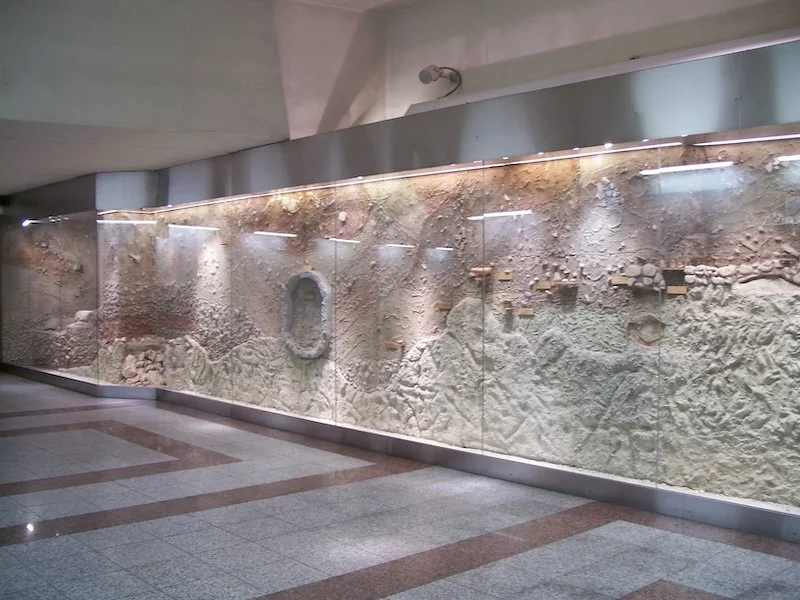
Archaeological stratification in the Athens Metro, Dafni Station. Image courtesy of Wikimedia Commons.
This essay was part of a 2025 SBL Conference Book Review Panel devoted to Body Language: Voice, Embodiment, and Textuality in the Hebrew Bible, by Jacqueline Vayntrub.
Jacqueline Vayntrub’s Body Language has a dialectical relationship to the pervasive metaphor of archeological excavation, which has indelibly shaped both the way we practice biblical scholarship and the way we encounter the self in modernity. On the surface – so goes the metaphor – we see ruins and dust, but if we dig deeper, with our spades and shovels, we can uncover valuable treasures, columns and temples, sense and vitality. Consider for example, the way Charles Augustus Briggs (of Brown-Driver-Briggs fame) described the work of biblical criticism in 1901:
“The valleys of biblical truth have been filled up with the debris of human dogmas, ecclesiastical institutions, liturgical formulas, priestly ceremonies…Historical criticism is digging through this mass of rubbish…searching for the rock-bed of the Divine Word, in order to recover the real Bible” (my emphasis, Briggs, 1901, 53).
Just five years earlier, Sigmund Freud uses a similar archeological metaphor to describe the “excavating” work of psychoanalysis; that is, the process by which memory, and more broadly, interiority, is discovered and recovered:
“Imagine that an explorer arrives in a little-known region where his interest is aroused by an expanse of ruins, with remains of walls, fragments of columns, and tablets with half-effaced and unreadable inscriptions.” The explorer enlists the help of the half-barbaric natives to help him dig deeper, “clear away the rubbish, and beginning from the visible remains, uncover what is buried.” (Freud: 1896, 192)
On the one hand, Body Language wants to get away from assumptions about the interiority and depth of biblical texts and characters, to better to read the surface of the text. Vayntrub charges us to take language literally, rather than metaphorically. Instead of trying to explain away the odd physicality of biblical language, Vayntrub invites us to hear “the performing voices that speak from the texts” (p. 4) on their own terms.
On the other hand, Vayntrub’s account of biblical speech moves from reading a flattened mimesis to an almost-magical embodiment of language, the human voice reconstituted in the text. This embodied voice parallels Mesopotamian “image-making as a manifestation of the real,” (p. 2) paradoxically bringing us back to the materiality of archeology. Behind the two dimensionality of the written text, we learn to see and hear vessels, bodies, limbs, presences, and absences. Vayntrub builds on James I. Porter’s suggestion that voice expresses “a kind of eloquence of the body even when the body is not visibly present.” (2010: 94, quoted on p. 5) Underneath the dynamics of ancient texts, which includes an interplay of sound and sense, oral and written – “lies a buried voice that animates them” (2010: 311) – so back we go to the archeological metaphor!
Vayntrub’s revelation of the richness of the biblical text reminded me of another formulation of the archeological metaphor from The Art of Biblical Poetry by Robert Alter. Alter speaks of his readings of biblical poetry as “an effort of loving restoration.” “Biblical poetry,” he says,
never had to be literally unearthed, but in the changing cultural light of three millennia some of its nicely shaded colors have faded, and its intricate designs have by stages been abraded and obscured by the shifting sands of preconception and misconception. In the worst cases, these accreted deposits of later theological and historical views and aesthetic values alien to the original texts have prevented readers from seeing that there was poetry here (1985: 204).
Perhaps we could read Alter’s version of the archeological figure as a more precise, subtle act of material restoration; rather than digging in exotic desert sands, looking for Indiana-Jones-worthy treasures, we are carefully brushing over Old Masters with horsehair brushes.
In the same way as a painting can lose its original vividness, Vayntrub argues that the corporeality of biblical speech has been obscured, covered over in the dust of centuries of misunderstanding. Embodied discourse is not mere metaphor, but rather a complex and intricate aesthetics and even philosophy of language. The accretion of this dust or sand can be a figure for the imposition of a Cartesian mind-body division on ancient texts with a very different conception of the relationship of mind to body. That is, in Body Language the “embodied language” that we have dismissed as “a simple flourish” (p. 9) or been unable to see, is now revealed in full color.
I read Vayntrub’s book as an Alterian act of “loving restoration.” We can now see the “body language” of the Bible in vivid color; we encounter a language alive with pleasure and pain – animated and saturated with gestures and breath. To transfer this metaphor from the visual to the aural: texts that were silent black letters on white paper now hum, cry, and sing, have skins and other organs, can be recharged with life as they move through the body and through social bodies.
I want to give some of my favorite examples of the way the text came alive for me, the proof of the pudding for the book’s argument.
One such moment was in re-reading Jonah’s petition to God from the belly of the fish. Vayntrub argues that speechmaking must be read as relational – between two bodies, or in the case of Jonah’s prayer, three bodies: God, Jonah, and the big fish. At the end of Chapter 2, Jonah is vomited unto dry land, which is conventionally read as divine salvation in response to his prayer. But Vayntrub encourages us to regard the fish itself as listening to Jonah’s psalm and comically vomiting up Jonah in relation to Jonah’s words. Perhaps the fish, as Vayntrub suggests, is responding with physical disgust to Jonah’s patchwork of clichés about salvation, which ring hollow in Jonah’s mouth, or in the fish’s ear.
Another “restorative” effect of Body Language is to defamiliarize texts that seem familiar; the interpretation adds more darkness, rather than shedding light. Vayntrub argues, for example, that Hannah’s so-called “silent” prayer is not merely the passive absence of voice. Rather, it is an embodied physical gesture: “Hannah’s voiceless presentation to Yhwh could…amount to a dedication of the very material that sustains her—short of pouring out her own blood on the altar—offering her breath, poured out as libation…So, whatever Hannah is depicted doing with her lips—whether performing a libation of the breath or something else altogether—her voiceless petition is striking precisely for its strangeness” (p. 48). In reading this section of the book I was not merely imagining the words in my head, but actively trying to shape my breath, voice box, lips, throat into the possible unsounded sound Hannah was making.
The value that this richer, more colorful description of speech and body brings to biblical studies is immense. I’m thinking of my own work on Ezekiel and the way it is in dialogue with Body Language. In The Poetics of Prophecy, I read the face, the panim, as a leitwort in the Book of Ezekiel: “the image of Yahweh’s absent, averted face creates a kind of photographic negative throughout the text in a proliferation of difficult faces, a rhizomatic landscape that blurs the smashed faces of idols with smashed bodies, prophetic masks, the fallen and ashamed faces of refugees, and hybrid four-faced creatures, all of them appearing as indistinct reflections in the water of the Chebar canal.” (Raz 2023: 115) With the gift of insights from Body Language, I see that in some sense I was trying to describe a small part of the elephant without seeing the elephant in its entirety: the way corporeal language permeates and gives vitality and authority to the biblical speech act.
***
If the “controlling archeological metaphor” (Kugel 1990: 156) of biblical scholarship is primarily a nineteenth century trope or fantasy, Vayntrub summons an older “controlling metaphor” of retrieval from the soil, a Romantic and perhaps medieval fantasy about words as dormant creatures, sleeping giants. She quotes William Empson: “All languages are composed of dead metaphors as the soil of corpses, but English is perhaps uniquely full of metaphors of this sort, which are not dead but sleeping.” (1930: 14 quoted on p. 14) These sleeping corpses seem like the stuff of Beowulf or of William Blake’s giant Albion, the sleeping Spirit of England. Following Empson, Vayntrub suggests scholarship can “reawaken” dead metaphors, showing us how closely tied biblical metaphors are to actual anatomy and sensory experience. She describes the process of re-awakening corporeal Hebrew metaphors as passing through English vernacular, historically shaped by the fantastically literal translations of the King James Version and their extensive influence on English. These English translations function as a kind of gateway into the vitality of the Hebrew speech, through phrases like “And he took up his parable”; “to find favor in the eyes,” and “by the skin of one’s teeth” (pp. 14-16).
Yet, perhaps acts of “loving restoration” – returning the bright colors, the weight, the gestures into a written language that seems “fleeting and ephemeral” (p.111) also expresses modern anxiety about words that have lost their potency, their possibility to shape reality. This twentieth-century melancholia is famously expressed by Auden’s “In Memory of W.B. Yates”:
For poetry makes nothing happen: it survives
In the valley of its making where executives
Would never want to tamper, flows on south
From ranches of isolation and the busy griefs,
Raw towns that we believe and die in; it survives,
A way of happening, a mouth.
(Auden 2007: 88)
The grand promise of “poetry” in Auden’s elegy is diminished to mere survival in a world governed by “executives.” Poetry’s inability to act, to effect political action, is perhaps, more broadly, emblematic of the inefficacy of the written word. Yet its bare life is precisely in its somatic gesture, something happening in the mouth. It’s not a sleeping giant, but it contains some small kernel, a spark that can be revived. In some ways, Vayntrub’s project allows us “solve” the modern melancholia about written speech. As opposed to a division between oral, authentic, embodied language, and the distant, abstract, ephemeral, and often powerless written word, the philosophy of language derived from reading the biblical text on its own terms allows us to have a written word that is embodied, warm, intimate, concrete, breaking down the old binaries between oral and written speech.
***
A final remark on gender: though references to gender and sexuality permeate the book, I wanted to hear more about the way gender shapes the embodied language the book describes. Does it matter if a woman or man is speaking or hearing language? Does the voicing or inflection or significance change when actual organs and inner spaces are shaped differently? As an example of this kind of work on language and embodiment, in “The Gender of Sound,” the classicist and poet Anne Carson considers the “bad sounds” women make, the way these unpleasant and uncivilized sounds epitomize the raw and the formless and must be regulated in Ancient Greek culture. As she writes, “putting a door on the female mouth has been an important part of patriarchal culture from antiquity to the present day.” (1992: 121) Carson speaks of a principle of self-control that is applied to (proper) use of language. In contrast, “there is something disturbing or abnormal about the use of signs to transcribe upon the outside of the body a meaning from inside the body which does not pass through the control point of logos, a meaning which is not subject to the mechanism of dissociation that the Greeks called sophrosyne or self-control” (1992: 128). To me, Body Language suggests a different aesthetic or practice of speech, one that does not pass through Cartesian categories, through logos. And in this sense, Body Language seems like a deeply feminist project.
Yosefa Raz is an Associate Professor at the University of Haifa.
References
Alter, Robert 1985. The Art of Biblical Poetry. Basic Books.
Auden, W.H. 2007. Selected Poems, ed. Edward Mendelson. New York: Vintage International.
Briggs, C.A. 1901. General Introduction to the Study of Holy Scripture. New York: Scribners.
Carson, Anne 1992. Glass, Irony and God. New Directions.
Empson, William 1930. Seven Types of Ambiguity. London: Chatto and Windus
Freud, Sigmund 1962 [1896]. The Aetiology of Hysteria. Standard Edition (Vol.3, pp. 189–260). London: Hogarth Press.
Kugel, James L. 1990. “The Bible in the University,” in The Hebrew Bible and its Interpreters, Vol. I, ed. William Henry Propp, Baruch Halpern, and David Noel Freedman. Winona Lake, IN: Eisenbrauns.
Porter, James I. 2010. The Origins of Aesthetic Thought in Ancient Greece: Matter, Sensation, and Experience. Cambridge: Cambridge University Press, 2010.
Raz, Yosefa 2023. The Poetics of Prophecy: Modern Afterlives of a Biblical Tradition, Cambridge University Press.