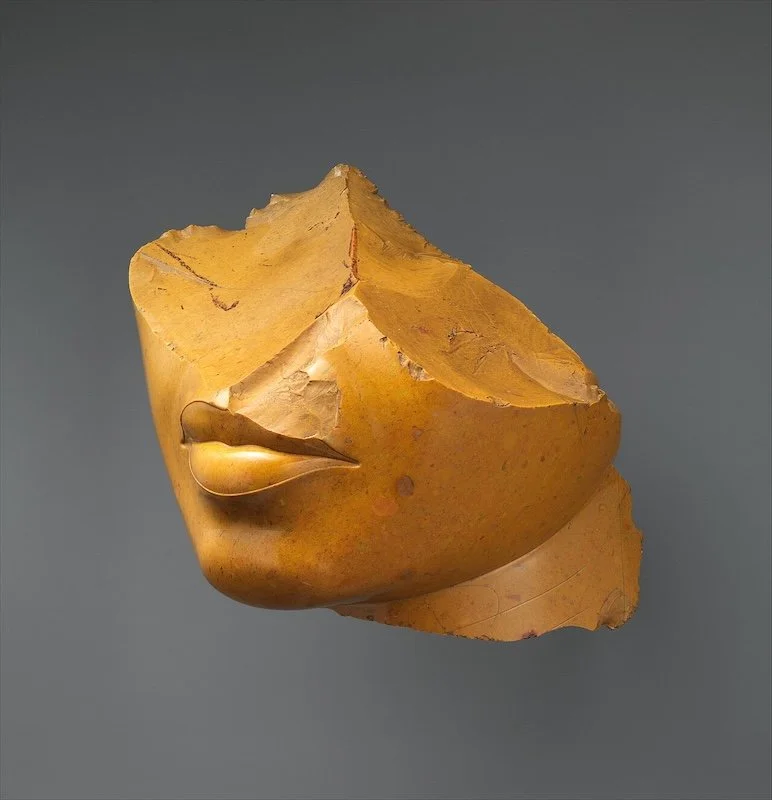
Fragment of a Head of a Queen, Metropolitan Museum of Art. Image courtesy of Wikimedia Commons.
This essay was part of a 2025 SBL Conference Book Review Panel devoted to Body Language: Voice, Embodiment, and Textuality in the Hebrew Bible, by Jacqueline Vayntrub.
In her important first book, Beyond Orality: Biblical Poetry on Its Own Terms, Jacqueline Vayntrub proposed that poetry’s defining feature in the Hebrew Bible is its “voicing as speech.”[1] At the conclusion of that book, Vayntrub limned a future study that would focus on “the embodied voice,” plumbing connection between text and body through voice’s relation to performance, memory, and materiality.[2]
Her book Body Language: Voice, Embodiment, and Textuality in the Hebrew Bible undertakes just such a study. It is accordingly deeply continuous with Vayntrub’s earlier work, even as it pursues a new set of questions and engages an expanded set of conversation partners.
Among these conversation partners is Italian feminist philosopher and cultural theorist Adriana Cavarero, whose influential 2005 monograph For More than One Voice: Towards a Philosophy of Vocal Expression counterposed the embodied, material particularity and relationality of the voice to the disembodied and “devocalized logos” elevated within traditional western philosophical and political discourses.[3]
Cavarero’s work has shaped the fields of voice studies and performance studies. Among those influenced by Cavarero is dance studies scholar Sondra Fraleigh. She writes,
Voice is not other than body. It dances between sound and source across the same states of being and becoming the body holds. In venture, body is world, just as voice is world. And if the world is wide, it is likewise specific in cultural frames. Because of this, we find a trove of voices to believe in, or we shrink from voice and our world also shrinks.[4]
Fraleigh insists on the risk, uncertainty, and instability of “voice as body.”[5] She also foregrounds voice’s dialogic capacities, its dynamism, and its capacity to enter, expand, and forge links within the world.
Vayntrub examines similar dynamics in her new study, but takes a further step. Through a focus on text as body and body as text,[6] Vayntrub advances an account of bodily presence in and through the textualized voice and voiced text.
Voice makes moral and relational claims. It anchors awareness in the particular. The textualized voice and voiced text lay claim to the attention of their audiences in ways that defy apathy, demand engagement, and render the past both vivid and urgent. This relational dimension and particularity of voice are major themes in Vayntrub’s Body Language. She summarizes, “biblical authors configured their texts so that they would continue to speak, that future audiences would read them as manifestations of a speaker’s embodied voice, with all the complex relational mechanics entailed in engaging a speaker’s name, biography, reputation, deeds, bodily gestures, and ultimately presence.”[7]
Chapter 1 of Body Language introduces the voice of Abel, or, more accurately, the voice of Abel’s blood. But when God calls Cain’s attention to the voice that cries out from the earth, God does not use Abel’s name. Instead, God invokes relationships. The voice that cries out is “the voice of your brother’s blood” (Gen 4:10). The person it cries out to is God, or, in God’s discourse, “to me.” This doubly relational assertion accompanies, as Vayntrub argues, “an appeal for justice” and elicits from God a sentence upon Cain.[8]
Abel’s blood provides for Vayntrub an example of the body’s “embodied, social, and material nature.”[9] Vayntrub later reaches back further still to the role of God’s voice in creation, helpfully emphasizing the concreteness and material effects of divine speech and action in both the P and J creation narratives.
In conversation with Vayntrub, I want to explore two sets of texts not analyzed in Body Language that I think help to extend its arguments regarding the embodied relationality of voice. In response to each, I offer a set of questions for Vayntrub.
The first set of texts, from Genesis, raises the question of whose voices are heard and whose ignored or avoided. Both within the biblical story worlds and in the perspectival shaping of biblical texts and canons, voices have been sifted and selected, excluded and included, marginalized and centered. These choices have embodied, material, moral, and relational implications.
The first voice that is named as such in the book of Genesis is God’s. Translations commonly render it the “sound” of God’s moving about in the garden. But the detail I am interested in is Adam’s response to that voice or sound: he hides (Gen 3:10). In so doing, Adam seeks to evade the moral and relational challenges of an encounter with God.
A few verses later, God condemns Adam for listening to the wrong voice, namely the woman’s (Gen 3:17). Later, in Gen 16, Abram listens to the voice of Sarai (16:2), setting in motion a sequence of events that result first in Hagar’s flight and then in the expulsion of Hagar and Ishmael. In chapter 21, God affirms that Abraham should listen to the voice of Sarah (21:12). But attention is later brought to the voices of Hagar and Ishmael. Hagar lifts her voice, weeping as her child nears death (21:16). The voice God hears, meanwhile, and that elicits angelic response and divine promise, is the voice of the child (21:17 x2).
These examples of the voices of Eve, Sarai, Hagar, and Ishmael raise the question of whose voice matters. Embedded in that question are dynamics of gender, identity, and power. The selectivity that ultimately produces the canon of the Hebrew Bible seems to have profound effects in relation to whose voices find flesh in text, whose voices perdure, whose voices later audiences may hear and attend to, and how those voices speak. Body Language attends to the voices of women, including Naomi, Tamar, and Hannah, and briefly addresses questions of gender in its treatment of Song of Songs.[10] I would welcome further reflection on the gendering of voice and the ways that gender shapes the representation, characteristic features, and differential valuations of performance in the texts analyzed in Body Language. A further and related set of questions relates to power. How is voice related to power? How does this nexus of voice and power relate to inclusion and exclusion in the shaping and transmission of these texts and the broader canon(s) and corpora in which they have been preserved?
The second set of texts I focus on are from the book of Ezekiel. Within a broader treatment of the synesthesia of vision and voice, Vayntrub briefly considers Ezekiel 1, noting that the vision report’s rich description of God’s chariot turns hearers into “seers.”[11] The blending of sensory modalities reflects an altered capacity for perception of divine realities, as Vayntrub powerfully observes.
Such synesthesia portrays, too, the category-defying nature of those divine realities and the complex shape of revelation itself. At Ezek 1:28, as Vayntrub notes, Ezekiel reports hearing a speaking voice. But only a few verses earlier, Ezekiel hears what is perhaps a different kind of voice, one that is distinctively embodied: it is the voice of wings (Ezek 1:24, 25). Ezekiel compares the roaring, overpowering voice of the wings of the ḥayyôt, or living beings who impel the divine chariot, to three other kinds of voices: the voice of many waters, the voice of Shaddai, and the voice of an army encampment (1:24). The noun qôl, “voice,” occurs five times in this one verse, matched elsewhere only by Jer 25:10 and 33:11 (cf. Jer 7:34 and 16:9, 4x each, with similar themes present). The thematic linking of voice and vision could not be more marked. But the similes also link kinds of voices: divine, elemental, human-military, and the voice of the guardian Mischwesen who simultaneously defy approach, guard the sacred, convey divine presence, and wreak destruction.
It could be argued that the voice of the wings should be understood not as a literal voice, but simply a sound, as the word qôl often designates. The wings are loud, beating the air with such force and frequency that it resembles the roar and buzz of a tornado, or the waters of a flood. Ezekiel hears this rumbling voice of the wings again at Ezek 3:13 where it is joined by the voice of the chariot’s wheels (in this verse, qôl is repeated three times).
Yet. Deploying William Empson’s notion of “sleeping metaphors,” Vayntrub urges her reader not to dismiss as mere metaphor the body language of the Hebrew Bible.[12] Vayntrub documents dialog within the very body, wherein the body’s very core becomes a locus of conversation.[13] Divine words are placed within heart and mouth.[14] Words are spoken by lips and mouth and tongue.[15] If we take seriously Ezekiel’s body language, we see that wings, too, speak.
Ezekiel repeatedly links the roar of the wings to voices that speak. The comparison at Ezek 1:24 to the voice of Shadday suggests something more than raw sound or white noise. It suggests that this voice of the wings is also a speaking voice. It may indeed be the speaking voice in 1:28-29 and 2:3-8 that commands Ezekiel to stand on his feet and eat the scroll and issues the prophet’s charge. In Ezekiel 3 the voice of the wings and wheels indeed speaks: “Blessed is the Presence of the LORD, in his place” (3:12 NJPS). The wings, and the wheels, too, speak words. The ḥayyôt and ophanim pronounce praise and blessing through the movement of divine bodies, making the very heavens into a vocal tract. In turning the apparatus of speech inside out and joining it to the bodily means of locomotion, they simultaneously turn language and meaning inside out and underscore the dynamism of divine speech.
Cavarero has noted that in philosophical traditions shaped by Plato, the embodied voice becomes a barrier to truth, “the acoustic filter that impedes the realm of signifieds from presenting itself to the noetic gaze.”[16] Here, while the particular, embodied, located and locating voice of the wings of the ḥayyôt and the rumbling ophanim may overwhelm and defy simple apprehension, this voice is nonetheless revelatory.[17] It does not impede meaning but reshapes it. It also constructs relationship and shapes encounter.
Later in Ezekiel, it is the very bones of Judah’s slain that give voice. Their voice is described as a rattling, as each bone joins once more to its corresponding bone (Ezek 37:7). By contrast with the voice of the wings and wheels, which are animated by spirit (Ezek 1:20–21), the voice of the bones does not form words. No spirit or breath is yet in them. Yet it is Ezekiel’s act of prophecy that makes it possible for them to issue their rattling sound. That is, in Ezekiel 37, a chain of speech acts—first God’s, then the prophet’s—produces the particular material effect of giving voice to the dead. While they do not yet have words, the bones are here active, not passive, cooperating in their own reassembly. In analyzing this passage, Daniel L. Smith-Christopher engages with Teresa Godwin Phelps’ monograph Shattered Voices: Language, Violence, and the Work of Truth Commissions.[18] For Phelps, “pain, violence, torture, suffering, and oppression” produce a fragmentation of voice, body, and social self.[19] Through storytelling, the fragmented body and social self are reconstituted.[20] While Smith-Christopher does not reflect on the voice of the bones, one might argue that the noisy process of reassembly participates in a complex and collaborative act of revivification and recovery that is also a reclaiming of voice. This example focuses attention on ways in which trauma and suffering shape the representation and embodiment of voice. A question accordingly arises for me: In the sources analyzed in Body Language, where and how might we witness the shattering of voice, and where its reassembly? What is the prophet’s role in relation to such shattered voices, and how might the concept of shattered and reassembled voices be helpful for study of a prophet like Ezekiel or for the prophetic corpus more broadly?
I conclude with a final, broad question followed by a word of deep appreciation.
It could be argued that while the textualized voices Vayntrub studies continue to speak to us, and a history and future of performances inflect their voices ever new, yet these voices do not as readily speak back to us. In her conclusion, Jackie engages directly with Socrates’ emphasis in the Phaedrus on the fixed and static character of a written text.[21] Jackie’s contrasting emphasis on the dynamism of performance and the text’s capacity to mediate presence is well argued, and I am convinced with Jackie that texts do speak.[22] But, to a significant extent, separated from organs of perception, such as ears, eyes, nose, and skin, the speakers they invite us to remember, imagine, and hear cannot hear, see, smell, or feel us. Perhaps I remain too deeply mired in the dichotomous thinking this book aims to complicate and dismantle. I would nonetheless welcome further reflection on this possible limitation and difference between textualized voice and organically living voice and discuss whether and how it shapes the embodied poetics she describes.
Body Language is fresh and creative. It ranges widely across the Hebrew Bible, dancing across diverse genres of wisdom, prophecy, narrative, and song. It also engages with reception history and draws our attention to material artifacts like amulets, scrolls, and memorial stones that variously attach to, represent, extend, and presence human and divine bodies alike. Centering performance within and beyond the text, Vayntrub upends conventional wisdom about the relationship between text and body. In so doing she counters persistent dualisms of mind and body and of text and spoken word. Body Language is sure to be a reference point in future studies of embodiment, performance, and poetics.
Anathea Portier-Young is Professor of Old Testament at Duke Divinity School.
[1] Jaqueline Vayntrub, Beyond Orality: Biblical Poetry on its Own Terms (Routledge, 2019), 14.
[2] Vayntrub, Beyond Orality, 219.
[3] Adriana Cavarero, For More than One Voice: Towards a Philosophy of Vocal Expression (Stanford University Press, 2005), 42.
[4] Sondra Fraleigh, “Never Just the Body: Etudes Between Voice and Dance,” in Somatic Voices in Performance Research and Beyond (Routledge, 2020), 37.
[5] Fraleigh, “Never Just the Body,” 37.
[6] Vayntrub, Body Language, 118.
[7] Vayntrub, Body Language, 5.
[8] Vayntrub, Body Language, 14.
[9] Vayntrub, Body Language, 14.
[10] Vayntrub, Body Language, 97.
[11] Vayntrub, Body Language, 91, 100.
[12] Vayntrub, Body Language, 14–16.
[13] Vayntrub, Body Language, 20.
[14] Vayntrub, Body Language, 21–23.
[15] Vayntrub, Body Language, 45–46.
[16] Cavarero, For More than One Voice, 42
[17] On the overwhelming power of divine sound, see Vayntrub’s analysis of Psalm 29 in Body Language, 83–84.
[18] Daniel L. Smith-Christopher, “Deconstructing Terror in Ezekiel: The ‘Valley of Bones’ Vision as Response to Trauma,” in Ezekiel: Current Debates and Future Directions, ed. William A. Tooman and Penelope Barter (Mohr Siebeck, 2016), 408; Teresa Godwin Phelps, Shattered Voices: Language, Violence, and the Work of Truth Commissions (University of Pennsylvania Press, 2004).
[19] Phelps, Shattered Voices, 71
[20] Phelps, Shattered Voices, 57.
[21] Vayntrub, Body Language, 119, 131–2, referring to Plato, Phaedrus, 275d.
[22] Vayntrub, Body Language, 133.