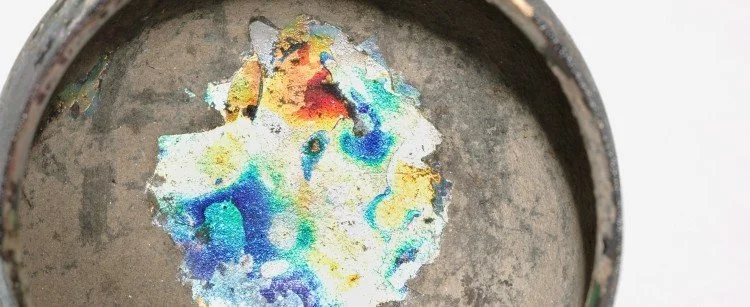
Image citation: Roman goblet, Cleveland Museum of Art, Gift of J. H. Wade 1923.953 [Image Source].
This essay was part of a 2026 NAPS Conference Book Review Panel devoted to Things Unseen: Essays on Evidence, Knowledge, and the Late Ancient World by Ellen Muehlberger. Read the full forum here.
By now, if you have read the other posts in this forum or even just the preface to my book, you know that Things Unseen is built around a gimmick. I have always liked the kinds of books that had started out as lectures in an invited series, and as I started doing more of my own writing, I really liked the register and tone they seemed to license in their authors. With no invitation on my desk, though, and none in the mail, I decided to just skip ahead to writing a book as if it had started out as a series of lectures. Strictly speaking, then, my book is a fake.
Faking it got me something, though. Trying to fit in this genre of books-from-lecture-series enabled me to take on a certain voice—mine had to sound at least a little like it had once been lectures to a general audience, thus authoritative yet easy, maybe even breezy, exploratory, musing. Ironically, producing that voice took a lot of work; as one panelist pointed out during the Q&A in Chicago, the conversational feel of the book can fool readers into thinking otherwise.
With made things, there is the surface that is visible—sparkly and iridescent, like the Roman jar on the cover of the book—and then there are the working components of the thing. The image with this post is a shot of the interior of that same sparkly jar, the part you don’t see on the cover of the book; it is almost entirely rough, gray in color, all but a spot of the iridescence worn away by its use over time to reveal the workaday substance that both holds the jar together and holds whatever is placed inside.
As a made thing, a book comprises not one, but two sets of working components. There are the pieces of the book itself as you see it: the chapters, images, bibliography. But then there are the book’s prior versions, earlier iterations that were both necessary for its development at a specific moment and then ripe for the trash. Some of the first versions of this project centered on recognition (anagnorisis) as a formal trope in ancient literature and its afterlife as a foundational concept in late ancient Christian theology. There was a short-lived version centered on physical appearance and verification (and I still wonder how ancient people could know that someone truly was who they claimed to be); another earlier collaborative project was meant to sound out the meaning of the category “person” in early Christian and rabbinic literature. Those books had to be conceived, and then put aside, for this one to exist.
However much a project may sparkle by the end, it takes a long time to articulate something worth pursuing. The only way to do it is to try, and then try again, without any guarantee about when the trying can stop. I usually say that I started work on Things Unseen after I had submitted the final manuscript for the book before it, but in truth, I have been worrying the core issues that appear in its chapters for much longer than that. A decade ago, I published a piece about how modern scholars have seen, or not seen, Simeon the Stylite, based on what they made of the evidence in Theodoret of Cyrrhus’s Religious History; five years ago, I examined the historicity of the Roman martyr named Perpetua, arguing the prospect that her famous “diary” was evidence not of her experience, but of a later Christian imagining her experience. Those articles surely could have gone into this book as chapters, and maybe they should have, but honestly, adding them would have fouled the bit! I will say they are forethoughts of this book and good traveling companions for it.
Things Unseen has had other companions along the way, too, in the form of readers, interlocutors, and commentators. Earlier workshops generated lots of conversation, constructive and at times quite intense. The panelists here have taken it in all directions, riffing on its arguments, at times arguing back, moving ideas to new eras to see how they might fit and testing them out in new literatures. It has been a privilege to have such a wide range of engagements with this little book, and I hope that you find it in something to spur you on in your next project.
Ellen Muehlberger is professor of History at the University of Michigan