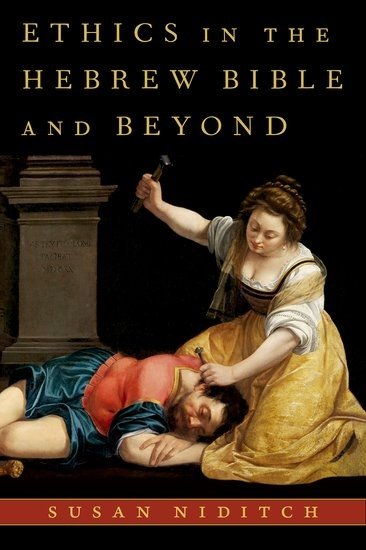
Susan Niditch, Ethics in the Hebrew Bible and Beyond. Oxford: Oxford University Press, 2023.
The Bible’s authors “frequently call upon those who receive their messages to choose the good” (1), notes Susan Niditch, but this call doesn’t get us very far. The challenge of exhibiting moral conduct in one’s life sits downstream from a more vexing one: “to be able to differentiate between the bad and the good when faced with particular circumstances and situations” (1). Those who seek moral guidance from the Bible are faced with a further challenge: how does one interpret, distill, and apply the sheer variety of ethical views contained in these diverse texts in order to apply them to one’s life?
Niditch’s book sets out to guide the reader as they take on the last of these challenges by offering a set of studies that touches on a range of ethical topics. Prior to the studies themselves, Niditch introduces the volume by offering an overview of some methodological issues that inflect one’s study of ethics in the Hebrew Bible as well as an overview of recent work on the topic. The body chapters then follow, each of which takes up a different ethical issue: religious ethics; capital punishment; war; resistance to and collaboration with oppression; leadership; gender and sexuality; reproduction; the economy; and the environment. Within each individual chapter, the structure is fairly consistent. Niditch begins with a treatment of one or more biblical passages that speak to the issue in question before then turning to the reception of this passage or issue in Jewish tradition, usually but not always including both rabbinic literature along with one or more contemporary interpreters. The “beyond” in the book’s title is thus present in each chapter, and the book is in this way situated firmly in both biblical studies and Jewish studies.
These wide parameters leave a distinctive mark on the book, and one notices quickly that individual chapters can read quite differently from one another with respect to both their thematic and chronological scope as well as their hermeneutical approach. As Niditch herself notes, “The chapters in this book are largely self-standing” (166). Whether one appreciates or is frustrated by this will depend on the reader – is it “expansive” or “uneven”? “Wide-ranging” or “disjointed”? – and I sensed at various points both advantages and drawbacks to this aspect of the volume.
On the one hand, the inclusion of a range of material and approaches in various chapters ensured that each chapter felt fresh as it allowed for different angles on different questions. In ch. 4, for example, “A Study in Political Ethics: Resistance to Oppression or Collaboration,” Niditch takes a decidedly social-scientific lens to the biblical texts. Drawing on sociologist Barrington Moore’s work on obedience and revolt, Niditch offers readings of Moses and Gideon as leaders of resistance, emphasizing especially the themes of leadership and buy-in (and particularly the lack thereof) among members of the resisting group. “The stories of Moses and Gideon thus suggest,” she concludes, “authors thoughtfully grappling with issues that arise in resistance movements…” (72). She extends Moore’s work to address the theme of acceptance of divine punishment in Jeremiah and Ezra, noting with Moore that people often “do not desire major change even in the midst of oppression” (74). Niditch thus draws upon sociological work into how resistance movements tend to operate, reads the biblical text with this framework in mind, and draws out implications related to the texts’ authors in a way that illuminates nicely a set of biblical texts.
In ch. 6, “Ethics of Gender and Sexuality,” by contrast, the approach is quite different. Niditch begins by offering a close reading of Gen 1 that attends to the dynamics of gender in the episode. She here (97) builds upon Deryn Guest’s [sic] reading of tehom, “the deep,” as “a queer form,” one that defies the deity’s imposition of boundaries in the Priestly creation, and extends this to the creation of ’adam as male and female in God’s image at Gen 1:27. Niditch notes that readers attentive to gender even in this single verse have produced from it a variety of meanings: it “provides not only an empowering model for women’s equality to men from a second-wave perspective” (99) given that male and female are created together in Gen 1 in contrast to the story in Gen 2, “but also a more capaciously inclusive variety of imagery” (99) in that the verse can be read to suggest that the deity “encompass[es] traits of maleness and femaleness” (98). These two perspectives on the verse then give way to the discussion of it in Genesis Rabbah 8:1, including R. Shmuel bar Nahman’s reading of “the first human as a double-faced being whom the deity then split into two separate beings, each with their own body” (100) as well as the interpretation of R. Jeremiah b. Leazar that this first ’adam is androgynous (אַנְדְּרוֹגִינוֹס). Correlating these pairs of ancient and modern readings thus allows Niditch to argue with respect to contemporary debates around gender that whether one sees in the episode a second-wave feminist assertion of women’s equality or claims around non-binary identity, “the tradition allows for such appropriation and reapplication” (104). The lens here is informed more by literary theory and gender studies than any historical-critical tool as is the case in ch. 4, and here with clear and interesting payoff.
My point here is that these two chapters read very differently in terms of their methodological underpinnings, and that each of them is effective. Read together, they demonstrate the advantage that lies in Niditch’s decision to marshal different hermeneutical tools as she reads for various ethical themes in the biblical text, as not every issue is equally illuminated by recourse to the same method.
On the other hand, though, the inconsistency in approach can also be disorienting at times. Between the two chapters mentioned above sits a 13-page chapter on “forms of leadership.” Rather than being a comprehensive account of kings, judges, priests, sages, prophets, warriors, etc., the chapter offers a reading of the book of Judges that pushes back against the tendency to view the book as “justify[ing] and valoriz[ing] the institution of the monarchy” (82). Niditch draws out the anti-monarchic sentiment found elsewhere in the Deuteronomic History (84-87) before turning to Judges itself where she finds the same point of view (87-92) alongside the pro-monarchic strand that others tend to lift up. She thus concludes: “This talented narrator is attuned to traditional patterns, deeply appreciates the stories, and saves them. There is no consistent, heavy-handed polemic in Judges, pro- or anti-monarchic” (92). The chapter then concludes with an overview of two women leaders in the Bible: the “negative model” of Athaliah and the positive Queen of Sheba. This chapter is unique in the book in that it does not engage with either rabbinic literature or contemporary issues, and it is worth noting too that it is not so explicitly related to biblical ethics. It addresses obliquely the question of what makes a good leader and puts forward an argument for how the book of Judges answers this question, but it seems involved in a scholarly debate in biblical studies to an extent that is not found elsewhere in the book. It is useful for that purpose, but I wouldn’t describe it as offering a stand-alone treatment of the ethics of leadership in the Hebrew Bible.
This leads to another potential drawback of the volume, which has to do with the extent to which it engages with other synthesizing work in the area of biblical ethics. The introduction to the volume provides a good overview of much of this work, but it is telling that the vast majority of bibliography cited in this overview does not appear again across the body chapters. This was noticeable, for instance, in ch. 3 where Niditch addresses the ethics of war. In a passage discussing the troubling practice of ḥerem annihilation in the Hebrew Bible, Niditch raises the possibility that the divine command for ḥerem stems from a psychological desire to let humans off the hook for killing: “If God… is thought of as demanding this sacrifice,” she writes, “then these wars are by definition just” (56). This is only true, however, if one adopts the perspective that the deity’s actions are the primary moral standard, and this was a topic of debate in antiquity. Sometimes called the “Euthyphro dilemma”, it was an open question whether divine commandments are good because gods command them or, alternatively, gods command things that are good according to some independent, external standard. Niditch assumes the former, but the latter opens the possibility that divine commands are in fact not good. This question comes up in other work on biblical ethics (across John Barton’s Ethics in Ancient Israel, [1] for instance), and the lack of engagement with it here is partly illustrative of a feature of the book as a whole in that the studies do not tend to engage with larger discussions of ethics in biblical scholarship.
These critiques notwithstanding, the volume’s coverage of the Hebrew Bible and beyond allows for a very engaging read. Moving deftly between the Bible and its ancient Near Eastern contexts, rabbinic literature, and a variety of contemporary contexts – from Gentileschi to the Tree of Life synagogue shooting to the 1981 film Yentl to halakhic infertility in contemporary Haredi communities – Niditch has here assembled a rich set of essays that take ethics in the Hebrew Bible as their starting point while moving well beyond the source material. These studies, in Niditch’s words “point repeatedly to the complexities and ambiguities faced in the arena of moral choice, and various contributors to the tradition, ancient and modern, reach different conclusions in a variety of settings” (166). The book succeeds in drawing out these conclusions, and its breadth ensures that it will be a worthwhile read for a range of specialist and lay readers.
James Nati is an Associate Professor of Hebrew Bible and Early Judaism at Santa Clara University.
[1] Barton, John. Ethics in Ancient Israel. First edition. Oxford University Press, 2015.