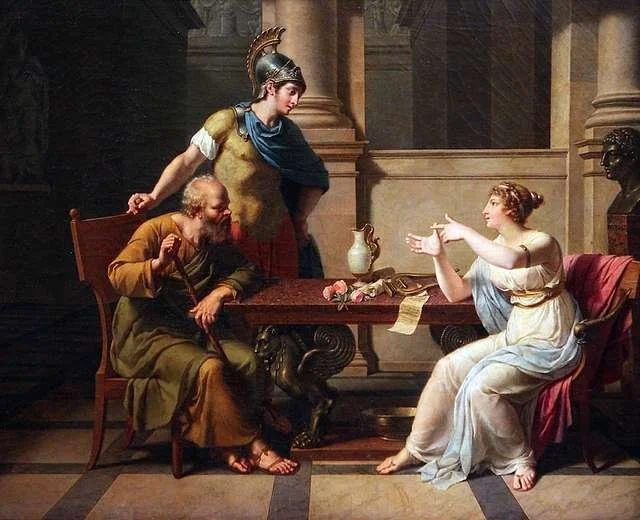

Nicolas-André Monsiau, Aspasia Conversing with Socrates and Alcibiades (1801), Musée Pouchkine [Wikimedia].
This essay was part of a 2026 NAPS Conference Book Review Panel devoted to Things Unseen: Essays on Evidence, Knowledge, and the Late Ancient World by Ellen Muehlberger. Read the full forum here.
As I started reading Ellen’s book, a viral meme from a few years ago popped into my head:
PhD student, circa 2020: “Here’s a limited argument I made based on years of specialized research. Hope it’s Okay!”
Philosopher dude, circa 1770: “Here are some Thoughts I had in the Bath. They constitute Universal & Self-Evident Laws of Nature. FIGHT ME!”[1]
It’s the philosopher’s spirit that animates this collection of essays: less hedging and more hacking. Fewer footnotes, more forays.
A thread of modern literary theory runs through this book: that the texts and images early Christians produced – their accounts of women (Chapter One), of forcible home entries (Chapter Two), and of the authorship of worrisome letters (Chapter Three) – did not reliably represent reality to their readers, or even back to themselves, and certainly not to us. These were, instead, constructions designed to meet their authors’ own needs. So many Things are Unseen. Even the Fayyum images discussed in the fourth and final chapter aren’t (obviously) photographs of historic individuals. But they might not even be portraits that point reliably to anyone out there. They are more akin to Rembrandt’s “tronies”: paintings of fictitious individuals (p. 153).
And we are no different. When we look at these Fayyum images, we tend to see what we want (e.g., racial admixture, colonial legacy). Indeed, we like to live in purposeful ignorance around images and texts like these, precisely so that we can speculate, improvise, and produce pseudo-knowledge, all under the warm sun of wonder. We want to feel all the feelings. But these too are manufactured by the puppeteers who have preceded us, and by ourselves, who live willingly in the dark about details that, if we cared to know them, would disenchant (pp. 155-157). The book concludes with a quick genuflection to almighty context: this will shed real knowledge, or as real as we can hope to get, about the tricky past (p. 156).
In the third chapter Ellen revisits an argument she has made elsewhere: the tendency among Christian writers to engage in “perpetual adjustments” of the past. This adjustment was, in her words, the
. . . penchant for inventing the textual, ritual, and material evidence necessary to authenticate the emerging narrative Christians were creating about their past. Edicts were drawn up and attributed to emperors who did not issue them, making them say what should have been said; stories were made up and then set in the past in order to justify emerging anti-Jewish politics as something original to Christianity and necessary for Christian piety; diaries were invented to provide audiences with the experiences of martyrs long commemorated in ritual; visions were recounted to place emerging late ancient Christian ideas about the dead in the mouths of venerable first-century figures; documents were composed to portray church organization as timeless, stable from the very earliest moments when followers of Jesus gathered; and existing texts were expanded and shaped to match the needs of the moment (pp. 112-113).
I find this claim persuasive. That this phenomenon occurs in our sources is, I think, beyond doubt. That it wreaks havoc with the historian’s desire to reconstruct the past as it was is obvious.
I struggled the most with the first chapter. Not that there weren’t mansplainers or echo chambers in the ancient world. As then, so now. But the interpretation of the exercise of ēthopoeia left me a bit puzzled. In my mind, this assignment was as much about breaking stereotypes as it was about reinforcing them. It wouldn’t have been much of an exercise if students simply foisted cliches on speakers. A Christian version, “What Hades would say when Lazarus is raised from the dead on the fourth day,” asked students to think very specifically and appropriately about a scene in John’s gospel (Jn 11:1-44).[2] Now for indefinite persons – such as the farmer or the prostitute or the coward – stereotyping was unavoidable (as one textbook has it, the student must pay attention to “the character generally belonging to cowards”[3]). But a conventional speech was probably not enough to get an A. The student had to individualize the type. Here is the advice Aelius Theon of Alexandria (first century CE) gives: “one should have in mind what the personality of the speaker is like, and to whom the speech is addressed: the speaker’s age, the occasion, the place, the social status of the speaker; also the general subject which the projected speeches are going to discuss.”[4] The point is, even with a type, the student was asked to imagine a character somewhere on a scale between the sui generis and the stereotypical. Presumably the teacher gave you trouble if you went too far one way or another.
Ellen takes us to an important source – the Anonymous Sequel – that shows just how much nuance and insight its author, presumably a teenage boy, could muster in imagining a speech that a prostitute who had come to her senses addressed to her pursuing lovers. Not all women are made to speak this way, and Ellen is impressed by it: “The imagined speech is genuinely the most ethically complex late ancient text I have encountered, with respect to gender, to sociability, to the powers of exclusion” (p. 33). I am similarly struck, as well as by other women in early Christian stories. These stories were usually composed by men, who nevertheless had their characters express agency, defy convention, assume male prerogative, and even stick it to the (male) clergy: a Thecla, a Perpetua, a Pelagia, a Mary of Egypt. Are there stereotypes here? Tropes? Yes and yes. But also individuality and diversity. Even more to the point, in stories like these, female characters often became vehicles for disseminating important criticisms. They weren’t always stratagems to block new information from coming in.
To whom is this book addressed? As I was reading, I imagined its central lesson, delivered in a lucid prose, landing very well in my undergraduate classrooms. This book will certainly be useful for blossoming historians who need to be alerted to the traps sets by the documentarian’s mindset which is so pervasive among our students, young and old. I suspect even those of us who have been doing this for a while need to be reminded that things were not always as they seemed.
A second, and related, question: just how perpetual was perpetual adjustment? Is this a part-for-whole situation: not just a regularly occurring feature of the archive, but its overriding quality? I am not sure Ellen weighed in on this matter. For my part, I suspect the former, not the latter: that our sources – and often one and the same author – often swung on a pendulum between representing reality in high and low fidelity ways. Scribes are a good example of this phenomenon. In recent decades scholars have built whole careers around the observation that scribes manipulated wording to solve the problems they found in texts. At the same time, this wasn’t the baseline disposition of scribes – not even close. Overall, whether viewed collectively or individually, scribes re-presented texts as they found them, even when these conflicted with the needs of the moment. The adjustments among scribes were not perpetual, but sporadic. The scholar of the variant knows at least two things: that adjustments happened, but also that they didn’t happen.
If our students need to learn that these sources often reshaped their subjects, the more experienced scholar, I think, needs to understand why this didn’t happen all the time. What kind of framework can we come up with that both acknowledges and pushes back against the insight of modern literary theory that propels this book?
My last question: is the bending of reality in the ways here described always bad? At times, it felt like this was the vote. I suspect many of us instinctively think this too is a problem – that our sources are too opportunistic, that they misrepresent and manipulate. But our instincts have also been conditioned. Scholars of early Christian studies usually have history and/or theology as their main disciplinary homes. Together we’re more akin to courtroom lawyers than performance artists. The past as it was really does matter to us. But we, not they, live in a world that sharply separates the humanities and the arts: our respective departments are usually not housed in the same college; humanities departments drill students in critical thinking, less creative thinking; our books go into libraries, while objects of art are displayed in museums. If I’m writing a novel, even a novel laced with patriotic schmaltz to commemorate the nation’s semiquincentennial anniversary, the National Endowment for the Humanities will reject my application and send me to the National Endowment for the Arts (which, in turn, will inform me that their Creative Writing Fellowship was cancelled this year). But many late antique authors straddled the humanities and the arts because the grammarians and sophists who trained them were also continually straddling these worlds.
Take Ephrem’s Commentary on Exodus. Much of it is paraphrastic, a faithful rendering of the biblical text. But it is not without its counterfactual moments. When Moses is concealed by his mother in an ark (as the Peshitta has it), Ephrem departs from the biblical text by adding to it. He invents a brief speech for Moses’ mother that is nowhere to be found in the text of Exodus. She has just returned to her home after putting Moses out on the water. What would a mother do in this situation? Ephrem has her kneeling and sobbing, directing a prayer to God against a man, a tyrant – against the Pharaoh: “You blessed our people so that they would multiply. . . But Pharaoh’s scheme is that . . . the seed that you blessed will die out altogether.”[5]
For most modern readers trained to examine biblical texts with regard to their actual wording and context, Ephrem distorts, invents, fantasizes. (And is perhaps misogynistic too: who are you to tell us what she did, said, and felt?). But we can also see it another way. The point here is not to get the past right, to reconstruct the historical mother of Moses, but instead to get Ephrem’s audience right. He adjusts the biblical story because, in a specific light, it is deficient. He wants his audiences to identify far more deeply than the text invites them to do with a grieving mother who finds herself in an especially precarious state: her son and her people face imminent extinction. Do they care? And what will come next? These are the things Ephrem wants readers then and now to see. This doesn’t seem so bad.
Peter W. Martens is the C. L. and H. Steber Professor of Early Christianity at Saint Louis University.
[1] Authored by Grace Mallon and widely shared on “Ethics in Bricks” (@EthicsInBricks on X/Twitter) on Feb 6, 2020.
[2] Nikephoros Basilakes, Rhetorical Exercises, Ethopoeiae 10 (The Rhetorical Exercises of Nikephoros Basilakes: Progymnasmata from Twelfth-Century Byzantium, trans. J. Beneker and C. A. Gibson, Dumbarton Oaks Medieval Library [Cambridge, Mass.: 2016], 195).
[3] Nicolaus the Sophist, Preliminary Exercises 10 (trans. G. A Kennedy, Progymnasmata: Greek Textbooks of Prose Composition and Rhetoric, Writings of the Greco-Roman World [Atlanta: 2003], 165).
[4] Aelius, Exercises 8 (Ibid., 47-48).
[5] Ephrem, Comm. Ex. 2.1 (The Exodus Commentary of St Ephrem, trans. A. Salvesen [Piscataway NJ: 2011], 14).