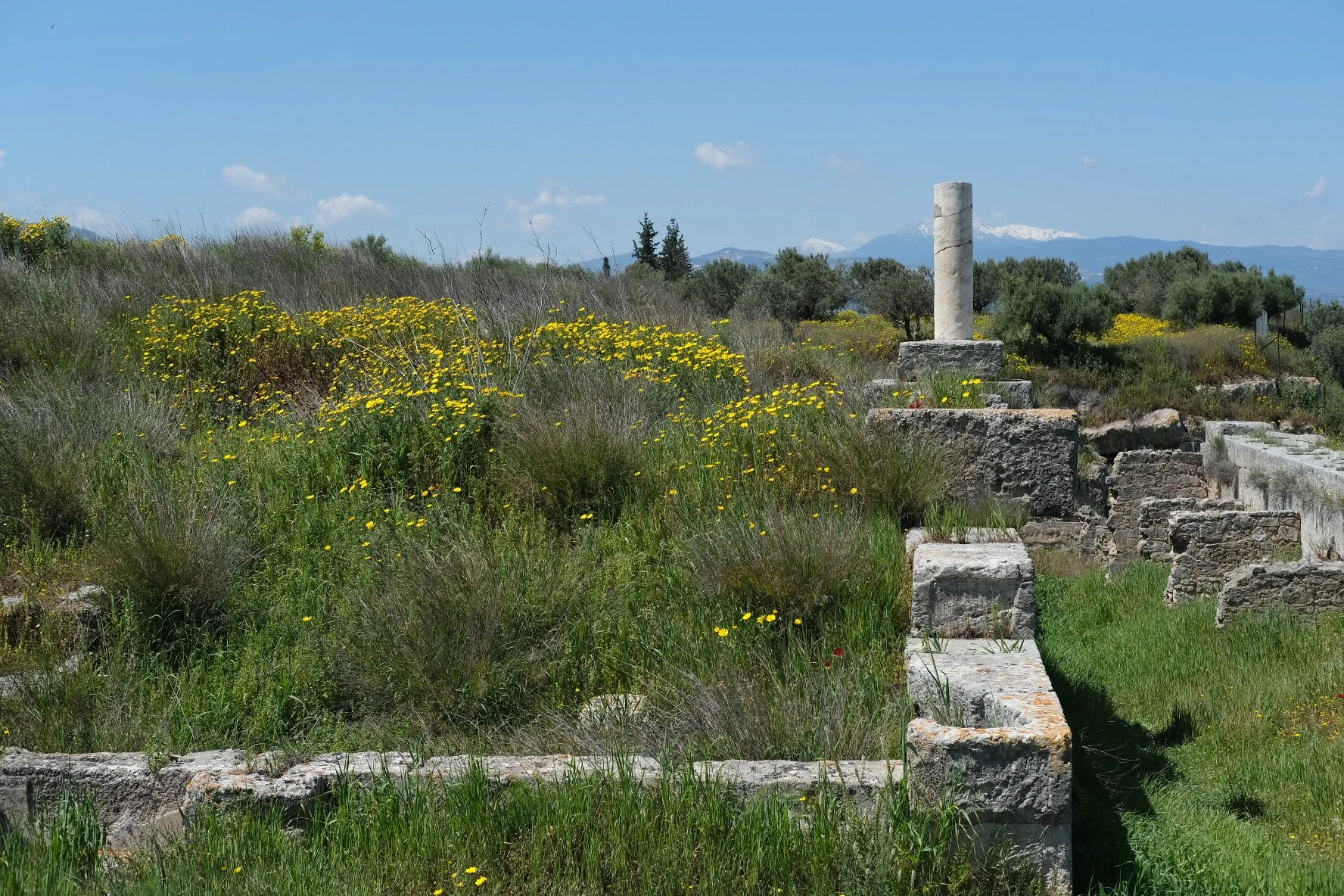
Image courtesy of John Penniman.
This essay was part of a 2025 NAPS Conference Book Review Panel devoted to Earthquakes and Gardens: Saint Hilarion’s Cyprus by Virginia Burrus. Read the full forum here.
Virginia Burrus entered my life like an earthquake. Like so many students first encountering the study of early Christianity, The Sex Lives of Saints rocked my world. I was scandalized, I was shaken—and I knew she was right. I have been building from those ruins since. And I have been lucky enough to have her continued help.
Sometimes things must be destroyed. This is the difficult truth that Earthquakes and Gardens confronts us with. Burrus even urges us “to cultivate the skill of falling to pieces as a necessary aspect of living and growing” (p. 152). This certainly seems right to me. Perhaps Earthquakes and Gardens is also saying that sometimes destruction is not only necessary but good. That shaking and crumbling is a better way to be in the world than the stability we have come to crave. Burrus asks whether religion may be one source of such destruction: “is religion a technique for producing being-quakes, for unsettling certainties, for breaking open human subjects and the closed, static worlds that we build out of a futile desire to keep ourselves safe?” (p. 153). Does religion push us to let go?
For me, Earthquakes and Gardens is a book about control. It asks: What if we loosened our grip? What if we defied our desire to master and dominate, to manage from a safe distance (p. 22)? What if we “renounce[ed] stasis as a goal, and accept[ed] unpredictability as a starting point” (p. 71)? What if we refused our impulses “to simplify and reduce the complex and layered stories—to subject the ambiguities and excesses of our texts and objects to the certainties of our histories and archaeologies” (p. 30)? What if instead of frantically holding things together, we let them fall apart? What if we challenged completeness, certainty, and a certain kind of storytelling?
In this spirit, Burrus once again introduces a new method for the study of hagiography, one that embraces fragmentation and resists wholeness (p. 26). She intentionally chooses only a few snippets of text from which to build this book. In our current cultural climate of more is more, this may prove frustrating to readers. Embarrassingly, it frustrated me, too, at first. We scholars of late antiquity already have so little with which to work; why would you choose to work with even less? But Burrus, in writing Earthquakes and Gardens proves herself a true ascetic. Both renunciatory and indulgent, Earthquakes and Gardens performs the form of sainthood.
And this method bears much fruit. Burrus unearths in The Life of Hilarion glimpses of a different way of living. One that resists possession, perhaps even of life itself. One that relinquishes control when it seems most dire, most reasonable, even most saintly, to grasp onto it. Even when there are demons in your garden.
But Hilarion, like all ascetics, has a complicated relationship with control. Burrus suggests that Hilarion may be a different kind of curator, a kind of do-nothing gardener. Having finally settled down and contented himself with his haunted garden, “he let himself be gradually absorbed by the background, vast and ancient, of which he was equally a part. Maybe this is what he had been yearning for all along” (p. 113). And she suggests that in his plant-like conviviality he may even be a good model for morality. “The project of human ethical formation may be framed as a kind of becoming-plant” (p. 129). But all is not “compromise and collaboration” in the plant world (p. 130). Nature can be gnarly. Plants often compete with one another for survival—some even wage a kind of chemical warfare, poisoning their neighbors to defend their territory.
Hilarion, too, is not always so accommodating. “Hilarion gave orders that a pyre should be built for it and after sending up a prayer to Christ, he called the serpent forth and commanded it to climb the pile of wood. He then set fire to the pyre. Then, while all the people watched, he burned the huge beast to ashes.”[1] We must hold the Hilarion of the mountaintop garden in tension with Hilarion the “dragon-slayer and earthquake-tamer” (p. 15). Perhaps he yearned all along to retire to his garden (p. 113). But even once retired “those in need of healing or advice continued to seek and to find him and to receive his attention” (p. 113). He lives with his own demons, but presumably, he casts out those of others. Sometimes he lives among the wilding plants, and sometimes he does what it takes to keep humans safe, even if it pisses off the sea, which resists his dominating hand, “seething for a long time and apparently furious at this obstruction.”[2] At times, Hilarion decidedly does not relinquish control.
Hilarion intervenes. He destroys and heals, however reluctantly. He does this in ways that far exceed most human capabilities. Hilarion does far more than the relatively modest grasping of the seismologist or archaeologist or historian—he conquers the earth.
Earthquakes and Gardens encourages us to see a balance in the Life of Hilarion. According to Burrus, this hagiographical tale does not forbid human intervention but rather urges contentment with playing a part in a much larger whole. It pushes us towards the attitude of Hilarion of the garden: shaping without dominating, living among others and in place. More often, we should accept the earthquakes; more often, we should be the do-nothing gardener. But this balance also seems difficult to attain.
How do we negotiate “human vulnerability, and also human culpability” (p. 69)? How do we know when to let go of control and when to intervene? How much intervention is too much? When is destruction necessary, and how can we know that it is? When do we accept or even encourage “falling to pieces,” and when do we rage against the raging sea? When do we pull the weeds? When do we kill the dragon? And when do we content ourselves with living among the demons?
These questions also tempt me towards more troubling questions: to what extent is this balance even possible? Can Hilarion’s fruit abstinence atone for so many apples surreptitiously tasted? Can we really be a part of things? Or does “the privilege and the burden of consciousness and the capacity to anticipate and plan” necessarily alienate us (p. 130)? To what extent is becoming-plant possible for us at all?
These are the questions that Earthquakes and Gardens makes me ask. But I have started to suspect that Earthquakes and Gardens is asking even more radical questions. Not “when do we slay the dragon and when do we live among the demons?”, not even “is this balance even possible?”, but “to what extent can we tell the difference?”
My questions bring us back once again, though in a negative sense, to the specialness of humans. I have taken an intentionally non-human-centered re-telling of The Life of Hilarion and brought humans back to the fore. Burrus seems to suggest not that we think less of ourselves but that we think of ourselves less. That perhaps we are less special than we like to imagine.
Earthquakes and Gardens reveals so much of our control to be an illusion. It shows how our lack of control connects us to the past, human and nonhuman alike. Despite our technological advances, sometimes the earth shakes and destroys us. Unlike Hilarion, we cannot tame earthquakes, not even close. As Burrus explains, earthquakes resist even our impulses to catalog and predict (pp. 58-59). Written in the midst of COVID, this book also reminds us that despite our “efforts to control the global pandemic,” pandemics kill, just as they always have (p. 70). Our lack of control reveals that we are a part of things, whether we like it or not. We are located and embedded in the muck; we do not float above. And this is good. As her chapter on remoteness reveals, if there is nothing beyond our control, we are hopeless.
Not only can earthquakes still come upon us at any moment, but perhaps we cannot even contain ourselves, the text suggests: “Ostensibly controlled and contained, the garden always exceeds its bounds; indeed, it reveals vegetal life itself – all life, perhaps – as uncontainable” (p. 117). Perhaps.
This brings us to some of the central tensions at the heart of this work: between curated and wild, natural and cultural, and, crucially, between active and passive. All of which Burrus would at least like to shake, if not entirely topple. Instead of asking how we can know when to destroy and when to coexist, when to control and when to accept, Burrus probes the very tension between active and passive, between letting things fall apart and destroying. Burrus states at the outset of the book, “under the pressure of a highly selective reading, the text falls to pieces. This occurs all the time. But what happens, I wonder, when we actively encourage that process of textual decay” (p. 8). In other words, Burrus ruined the Life of Hilarion. By the end, she asks: “Have I broken the text into pieces or has it cracked along its own fault lines?” (p. 151). And crucially qualifies: “these are not mutually exclusive options.” Put differently, Earthquakes and Gardens is not just urging us towards a kind of “becoming-plant.” It also reveals the ways in which we are already plant (p. 129). The ways in which we are life, uncontainable and uncontrollable, just the same as everything else.
Burrus urges us to curate earthquakes, but I also wonder if she asks us to consider whether we might be more earthquake than curator. How much of our control is an illusion? How different are we from the rest of the world? How different is our agency from that of dragon or earthquake or fruit tree? Or as she asks elsewhere: “What is a human being, anyway?” And if control is less possible than we realize, does that also mean that our destruction is more like that of earthquakes than we realize? What, then, of ethics? What, then, of asceticism?
Paige Spencer is a PhD Candidate in Religion at Syracuse University.
[1] Jerome, Life of Hilarion 39 (Trans. Carolinne White, Early Christian Lives [London: Penguin Books, 1998], 111).
[2] Jerome, Life of Hilarion 40 (White, 111).
[3] Virginia Burrus, “Sheltering in Place: The Solitude of Hermits,” Romanic Review 114, no. 1 (2023): 25.