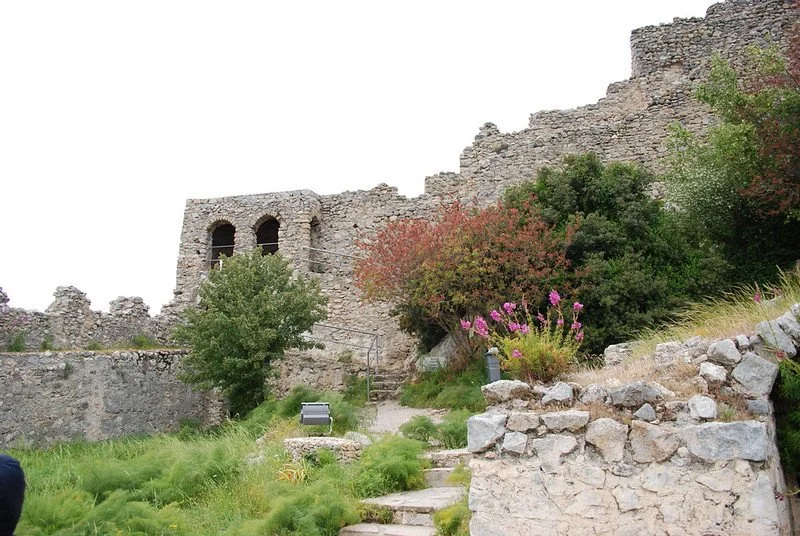
Saint Hilarion Castle, Cyprus. Image Source: Flickr.
This essay was part of a 2025 NAPS Conference Book Review Panel devoted to Earthquakes and Gardens: Saint Hilarion’s Cyprus by Virginia Burrus. Read the full forum here.
Gardens and earthquakes enliven Virginia Burrus’s 2023 book alongside a variety of hauntings. I have never felt an earthquake, though I have slept through a few small tremors. I grew up in the Ozarks, live in the hills of eastern Pennsylvania, and work in the highlands of New Jersey; I live atop old earth. I am familiar with gardens. My earliest memories of my grandmother are working alongside her to tend her table garden as the Missouri sun weighed upon us, the soil of the garden dark and wet, the clay surrounding it cracked and white. I lived on the edge of woods among a people who, one would think, would be attuned to climate change and the delicacy of life. Except, for us, life wasn’t. Nature was hard, biting, stinging, invasive. The work of hacking back the woods was bitter and hard and always, always temporary. Like the demons of Luke 11:24-26, the demonic wild never really left. In my present, suburban life, we are pulling out aging ornamental gardens and replacing them with native, pollinator-friendly, low-water permaculture gardens to both the delight and chagrin of some neighbors. I am perhaps most familiar with ghosts and the voices of the dead and demonic. More of that later.
Animated by deep, tectonic energies, Virginia Burrus’s 2023 Earthquakes and Gardens: Saint Hilarion’s Cyprus is, on its surface, a collection of essays arising from close reading of Jerome’s Life of Hilarion. Jerome’s hagiography follows Hilarion’s career in Palestine and also his final journeys. Hilarion, frustrated by his fame and crowds, craves privacy and sets out to visit the grave of Anthony in Egypt. Drawing admirers again, he is hounded from the eastern Egyptian deserts, to the coast, on to Sicily, and then, ultimately, to Cyprus. Arriving in Cyprus, he performs a miracle to stave off a tsunami following a severe earthquake. eventually he moves inland to the mountains, high up, among the rocks traversable only by “crawling on hands,” to a hidden, unkept garden alongside ruins (of a temple?) and haunted by demons.[1] Burrus writes that Jerome’s Hilarion “has provided my point of departure, again and again. But I have not pursued a return to that soil with the aim of producing a definitive or authoritative interpretation of the text, or even its rendering of Hilarion’s Cyprus.” Instead:
This book has followed the drift of reading. ... It has launched itself onto an ocean of possibility. There the literal and figurative are no longer clearly distinct, any. ... [W]e should ... attend to the agency and mobility of texts themselves. Have I been reading Life of Hilarion or has it been reading me? Have I broken the text into pieces or has it cracked along my own fault lines? Have I staged its encounters with other artifacts, or have the fragments found each other? These are not mutually exclusive options (p. 151).
A little further on, she describes the project as an “experiment in open and amateurish reading” (p. 151).
If one took “open and amateurish” to mean “acritical” or without theory, that would be an error. To be obvious, the book presumes, by performance, Kristevan Intertextuality. It also cannot be fully understood, I would argue, without deep familiarity with Affect Studies. It would also be an error to think the work does not betray deep, deep competence with the conventional skills of a first-tier critic of the literature of late antiquity. Burrus contributes significantly, I think, to an array of conventional questions: where was Hilarion’s hermitage and what are the relative merits each claim; what associations, if any, with Aphrodite’s cult and holy shrine at Paphos lie buried in Hilarion’s ruins; what is our best guess for the date and severity of the earthquake(s) and tsunami which occur at Hilarion’s arrival on Cyprus? Burrus’s close reading of Jerome’s rhetoric highlights his dependence on Homer – not only in the work’s invocation and travelogue, but in its imitation of the lyric flow and synecdoche of Homer’s poetry.
The sense of “open and amateurish” most applies to Burrus’s intentional performance of unruly reflections, a genuinely undisciplined (in every sense) mode of reading. Training as a scholar, especially training as a scholar of antique Christian texts, quickly and firmly disciplines against secondary, god-forbid contemporary, association with a text, to avoid eisegetic infection, to prefer local meanings and senses, to wonder at most what an ancient reader might make of any given document but excise as completely as possible what the modern, actual reader experiences – to see texts as dead things. Texts may be reimagined via analysis, but they, themselves, are dead – at best. More accurately, they are stony fossilized remains.
Burrus wildly and intentionally reads Jerome and Hilarion forward alongside contemporary art, histories of cartography, and modern sciences of geology and seismology. She cites artifacts and photographs from affiliated but not scholarly-verified sites in Cyprus. She speaks to climate change, ecology, the traumas of the Anthropocene, pandemic, permaculture, “remoteness,” modern Gaza, the limits of science, impermanence and uncertainty. With so much attention to what ideas and implications emerge out from this ancient text, what do I learn about Jerome’s Life of Hilarion itself? Perhaps, honestly, those areas I just mentioned conceded, very little. At least in the ways “knowing” is often presented in professional, disciplined, scholarly works. But, if I may put it crudely, I largely do not care.
I should pause and clarify. I very much do care about the arguments that roil out from this book. Burrus’s rhetoric may effect the chaos of an earthquake or the wild spread of an unkept garden, but the shoots and shuddering, by the end, feel remarkably precise. In the end, I am precisely tuned to care most about the way Burrus diminishes the particularity of Jerome, or Hilarion, or Cyprus. I am given a view that becomes geologic in timespan and “everyplace” in proximity. I care, through Jerome’s Life of Hilarion, if not about it. This is a much larger task.
Burrus cares very deeply about what she is reading. That this concern is so evident from her extra-disciplined, undisciplined reading awakens, of course, sharp questions about the merit of such discipline in the first place. Faced with challenges as dire and global as climate change, why wouldn’t concern manifest as we read? Why doesn’t it occur more often? Burrus never suggests that Jerome’s Hilarion speaks directly to her own concerns; instead, like aftershocks, it reverberates beneath and around them. It rhizomatically invades and blurs the cultivated borders of our scholarly gardens. It haunts.
Drawing specifically from Derrida’s notions of Hauntology and spectrality, “metamodernist” criticism in-and-of literature and art is an emerging conversation of the post-post-modern, characterized by Affect, (auto)biography, storytelling and reception (Ananda and Storm 2021, Dempsey 2023). The “meta-“ is, of course, taken from Plato’s metaxy, specifically its dual senses of alternation between opposing poles, an intentional vacillation between modernity and postmodernity. In the words of Vermeulen and van den Akker, the
“…metamodern oscillates between the modern and the postmodern. It oscillates between a modern enthusiasm and a postmodern irony, between hope and melancholy, between naïveté and knowingness, empathy and apathy, unity and plurality, totality and fragmentation, purity and ambiguity...[T]he metamodern negotiates between the modern and the postmodern” (Vermeulen and van den Akker, 2010: 5677).
Burrus’s Earthquakes and Gardens is metamodern criticism. It is a ghost story about how the specters of Jerome, Hilarion, and Patristic scholarship haunt modern crises and concerns.
It is a haunted book. Burrus discloses she was writing during pandemic and while grieving the loss of both her parents. The reflections on mortality and finitude, on open spaces and wildness, on earthquakes that shatter lives into ruins and mark the liminal shifts between pagan and Christian worlds take on new significance. Her images include the remains of ancient bodies lost in the destruction of Paphos, of decrepit collections of (leather-bound) books become homes for mice, of cartography for travel deferred or fantasized. The book, like Hilarion’s garden amidst the (earthquake created) ruins, is surrounded by whispering spirits and groaning demons, disembodied and disconnected voices from a metamodernist metaphysics that chatter, howl, and murmur over the shoulder of both Jerome and his reader.
Since childhood I have struggled with hypnopompic sleep paralysis, a condition where the atonia of REM sleep persists as I wake. I awake fully aware and conscious, but physically incapable of moving. The condition, which can last for several minutes, was most common during my adolescence, but has persisted into adulthood, with episodes even now in my “middle years.” Persistent sleep paralysis, when not the result of traumatic injury or chemical interaction, is most commonly associated with sleep apnea (which I don’t have) or how one’s brain processes stress and anxiety, generally associated with serotonin reuptake (my flavor).
As a boy, then as a teen, it terrified me. During episodes, I often sensed a presence in the room with me, someone physically sitting on the bed, touching me, or leaning over me. The first incident occurred shortly after the death of my grandmother. I was convinced it was her ghost. What troubled me most was my inability to turn to look at her. I found her presence comforting, a persistence beyond death, but I could not turn to see her and could only imagine what the spirit sitting on my bedside looked like. She did not speak to me, and I could not speak to her; we could only commune by proximity. I told no one about this for years. In time, my nightly visitors expanded to include a brother who had died in infancy and then my mother who died in my first year of seminary. Now, of course, I know and understand the condition, and, while I know there are no actual ghosts beside me, it still disorients me, occasionally annoys me. For perhaps a third of my life, I lived convinced, fully convinced, that somehow the dead came to me and woke me from sleep, and this was simply something one had to put up with. I felt it within my body, as sure as any motion or sensation I might have as I am writing these words. I admit I do not understand earthquakes, but I do understand hauntings.
My reading of Earthquakes and Gardens is haunted by my own discipline(s), including Biblical Studies. Cyprus is also the setting of Acts’ account of Saul and Barnabas's first missionary trip. The pair arrive on the island at Salamos and walk along the shoreline, 90 miles, to Paphos, stopping along the way. In Acts 13:6-12, they arrive in Paphos, where they begin teaching to great effect, intriguing the local Roman proconsul Sergius Paulus. They meet a Jewish magician named Elymas, whom the text also identifies as Bar-Jesus. Elymas becomes a nuisance, resulting in a rebuke from Saul. Perhaps a little inspired by the name of Sergius Paulus, certainly not to be outdone by a Jewish opponent with multiple names, Acts choses this moment to reveal Saul is “the one also Paul” (ho kai Paulos). Kai here pulling double duty, noting both Saul’s second name and the fact that we are now in a pericope suddenly flush with Pauloi(!). Paul rebukes Elymas / Bar-Jesus, accusing him of being haunted by, possessed by a diabolos (presumably the source of his magic), and strikes him blind. Sergius is “amazed.”
Paphos, spirits, travels, the coast of Cyprus, and a transitional age, as well as a heavy-handed metaphor. Specifically, the Jewish mage, named “son of Jesus” who does not recognize the messiahship of Jesus, is struck blind by God, a pointed and polemical narrative move. Resonances between this passage from Acts and Jerome’s Life of Hilarion abound. We could add Luke’s vaguely Homeric travelogue. Paul makes a brief cameo in Earthquakes and Gardens with reference to Saint Paul’s Pillar – a ruined column from an ancient theater, repurposed into the colonnade of a basilica, marking the post to which Paul was tied and scourged.[2] What to make of this odd little vignette? What does it haunt? What metamodern narratives can we tease out of it?
Honestly, I do not know. Biblical stories were planted deeply within me by both my mother and grandmother. As a boy, these stories were, as often as not, my bedtime tales – particularly stories from Acts and the life of David. Both my grandmother and mother periodically return to me, to sit on my bedside again. In the intervening years, as I have learned the real cause of these visits (as the list of visiting spirits has also expanded, including even beloved birddogs), there is an odd sort of comfort in them. I am very much not the young man who I was; In complex ways, I am also multiply named and known. But they, and their stories, still find me. I do not know what metamodern reading may eventually emerge from my reading(s) of Paul and Acts. When it does, if it does, I hope it will have the resonance of Virginia’s reading of Jerome’s Life of Hilarion. It will not have her skill, complexity or insight. Nothing I have written does, but it will have freedom to wander, to inhabit remote and wild spaces, to shake and undulate, to spread out and thrive as a result of her work, giving me permission to read wildly and listen to whispering spirits.
Robert Paul Seesengood is the Associate Dean of Academic Affairs and Teaching Professor of Bible and Cultures at Drew Theological School of Drew University.
Works Cited
Ananda, Jason and Josephson Storm. Metamodernism: The Future of Theory. Chicago: University of Chicago Press, 2021.
Burrus, Virginia. Earthquakes and Gardens: St. Hilarion’s Cyprus. Class 200: New Studies in Religion. Chicago: University of Chicago Press, 2023.
Dempsey, Brendan Graham. Metamodernism: Or, The Cultural Logic of Cultural Logics. New York: ARC Press, 2023.
Vermeulen, Timotheus and Robin van den Akker. “Notes on Metamodernism.” Journal of Aesthetics & Culture 2, no.1 (2010): 5677.
[1] Burrus’s book focuses on gardens and earthquakes. Like each, it is border shattering – gardens are fecund and wild, invaded and invasive; earthquakes are sudden and disruptive, liminal and omnipresent. Earthquakes and Gardens is most aptly named. The book’s organization is intricate and ordered. Arranged in four parts, parts one and two form epilog and coda, a description of the project (with a review of, and introduction to, Jerome’s text) to begin, and a closing reflection on “an ocean of possibility” that considers the book’s themes and draws out its implications and intentions. Parts two and three are each divided into two sets of three essays each, both vaguely intersecting with the theme of Hilarion’s Cyprian hermitage. Part two’s essays revolve around Paphos; part three’s essays address the Mountain.
Part two on Paphos has the essays: “Poetry and Place,” “Curating Earthquakes,” and “Life in Ruins.” In the first, Burrus opens with a comparison between the Jerome’s prose and Homer’s poetry, noting that fragments of Greek and Pagan poetry appear, transfigured, in Jerome. She uses this insight to pivot to Paphos in classical poetry with a focus on its association to Aphrodite. “Curating Earthquakes” explores the question of which earthquake Jerome invokes in Life of Hilarion and modern scholarship attempting to estimate the severity and extent of ancient earthquakes (noting the limits even of assessing or predicting modern events). The urge is almost irresistible to see the earthquake, which destroyed Aphrodite’s temple, likely occurring at the closure of a Pagan world transitioning into a Christian one. Almost irresitible. Burrus resists and, instead, turns to artifacts from a fallen Paphos (including skeletal remains of a young family who died during the disaster) and modern art that explores planetary time and change. In the final essay of the group, “Life in Ruins,” Burrus examines the extant ruins found on Cyprus, particularly honing in on the repurposing of stone and art from ancient temples and theaters into Christian places of worship before, again, turning to contemporary instillation art that examines passage of time, transition(s) and the loss and remaking of worlds.
Part three’s essays turn toward Hilarion’s retreat itself: “Geographies of the Remote,” “Entropic Gardens,” and “Literary Cartographies.” “Geographies,” to my reading one of the most Covid-infected of the book’s chapters, examines the idea of wildness and retreat. What is “wild” or “remote,” as illustrated by Hilarion’s journey, is more a question of essence rather than geography. Burrus, once again, turns to an array of modern art installations to consider space, isolation, and wildness. In “Entropic gardens,” Burrus initially examines Hilarion’s untended garden home (with contrast to Anthony’s very carefully managed, Egyptian garden), along with detours into the role of mountains as water towers, the garden art of Masanobu Fukuoka, permaculture, and urban gardens that reclaim industrial wastelands. The final, “Literary Cartographies” opens, again with Life of Hilarion and its travelogue for Hilarion (from Gaza to Egypt to Sicily and on to, and inland at, Cyprus). Burrus notes the parallels, again, to Homer, but also to the idea of travel, distance, her own long-deferred travel to Cyprus, the various claimants for Hilarion’s retreat and the intersection between reading and travel, the fantastic exploration of space.
[2] Never mind that Acts never mentions such an event, and it has to be surmised from the fact that Acts does not account for all five of Paul’s claimed scourging in 2 Cor. 11:24.