Introduction
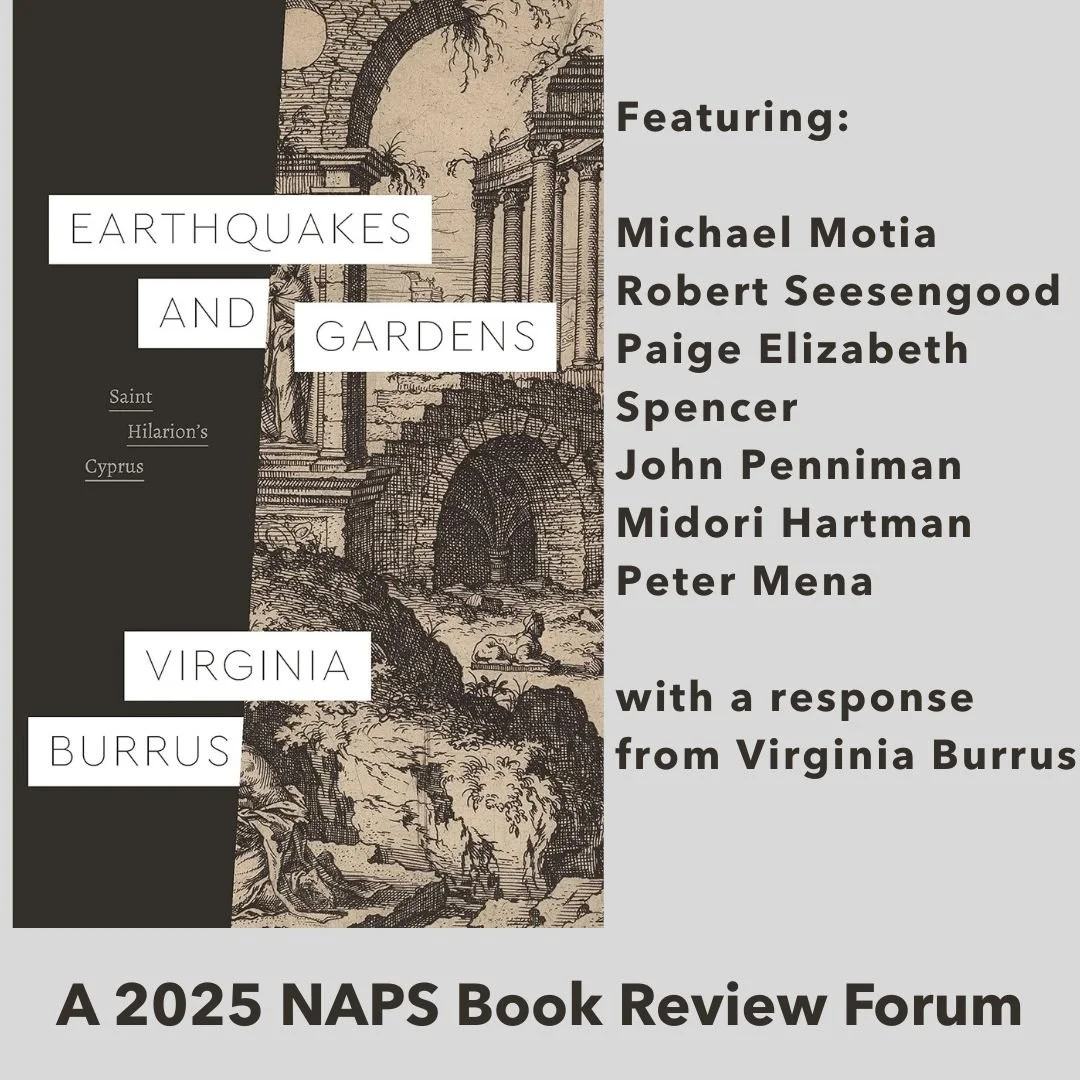
It is truly a professional and personal honor to collect and introduce the following essays in this forum. They are, at first glance, like many other forums; a review of the most recent monograph by a respected scholar working in the disciplines relevant to this publication—more specifically in this instance, the following essays will engage with Virginia Burrus’ Earthquakes and Gardens: Saint Hilarion’s Cyprus. But in planning this review for the 2025 annual meeting of the North American Patristics Society (NAPS), there was, as is often the case, so much more context for this excellent forum.
In the Spring of 2023, upon learning of Virginia’s upcoming retirement, Jenny Barry and I began thinking of ways we could mark the occasion and honor and celebrate the scholarship of our mentor and the undeniable indelible mark she has made in the fields of Late Antiquity. Ultimately, in consultation with Virginia, we began to plan two special sessions for the following NAPS meeting. NAPS has been a congenial and productive gathering for many scholars in the field, but for Virginia (a past president), and for many of her students, NAPS feels more like a home for our work and for ourselves. This is no minor point. For scholars like myself, scholars of color, queer scholars, and, for women scholars too, academic spaces, conferences in general, can be very unwelcoming and unsafe spaces. That NAPS can, at times, feel like a home for many of us, is in no small part because of the scholarship, collegiality, mentorship, and leadership that Virginia has fostered and demonstrated over many years.
Jenny and I recruited our dear friends and colleagues, Christy Cobb and Mido Hartman—all of us Virginia’s students—and we organized the book review panel that is presented here in this forum as well as a panel dedicated to the breadth and influence of Virginia's scholarship. Each of these panels beautifully and elegantly demonstrated the debt scholars of Late Antiquity owe to Virginia’s contributions which have shaped the field.
I want to close this very brief introduction by picking up a strand of thinking (in my mind, at least) that runs through Earthquakes and Gardens, each of the essays here (including Virginia’s response), and was a general theme in the conversations prompted by both NAPS panels dedicated to Virginia’s scholarship: that is, to put it too simply, her historiographic interventions. As each of the following essays allude to, Earthquakes and Gardens is many things, but crucially, it is a meditation on historiography. What is history? Why and how do historians do the work of writing history? What is the role of the historian in such processes? —are questions central to the book’s argumentative thrust. At its outset, Virginia writes “[T]he book is a methodological experiment in the close reading of small bits of text…Since I am the one staging them, my own experiences and sensibilities will inevitably be strongly in play. These are not only close readings, then. They are also intimate readings that require me to give something of myself and invite you to do so too” (p. 8). The giving of herself, along with the simultaneous invitation to her readers, her students, her colleagues, to also give of themselves, is, in my opinion, the greatest gift Virginia has offered any of us willing to read with such vulnerability. More to the point, Virginia crystallizes the idea that the historian is no mere objective observer.
During the Q&A portion of one of the NAPS sessions (my mind cannot recall which one with precision), Mike Chin asked to hear from any of Virginia’s students present who could speak to this question of historiographic contributions. (Mike’s question was not phrased in this way at all, but this is what my mind heard and focused on!) I volunteered a brief anecdote that I will repeat here. When I was preparing to propose my dissertation and complete a prospectus for it, I met with Virginia to discuss what I would be interested in working on. I mentioned to her that I had an interest in reading the work of Chicana feminist and theorist Gloria Anzaldúa, along with Christian hagiographies from late antiquity, in order to look for borderlands (in the Anzladúan sense) in the descriptions of the late ancient desert. I was surprised to receive Virgina’s enthusiastic support. I had imagined that my idea was in need of correction, nuance, or outright dismissal. I had assumed that I missed the mark in doing history, and I would be swiftly pushed into something more recognizable as a dissertation in the history of Christianity. What I have come to learn over the eleven years since I completed that dissertation and developed my own scholarly trajectory is that Virginia understood quite well that history writing was and is always self-reflexive. And more importantly, rather than lament the idiosyncratic nature of such historical writing, we have much to learn from approaching history through the eyes of any careful reader and through the various interpretive windows available to that historian.
In this way, Virginia’s scholarship resonates with what Anzaldúa referred to as autohistoria-teoría. For Anzaldúa, this kind of writing is historical in context and purpose, but it blends personal narrative, art, and other aspects of one’s own spiritual-mythical meaning-making in their renderings of the past. And, according to Anzaldúa and those who follow her style of writing, this methodology is expressly decolonial in its comprehensive approach. As such, on the one hand, these methods are fundamental to the goals of humanistic inquiry and especially attuned to calls for more inclusive and justice-centered scholarship in all disciplines. On the other hand, as a method, this kind of writing is problematized, rejected even, by some anxious historians of religion.
Virginia raises the issue herself at the close of Earthquakes and Gardens. I quote her here at length because again, I believe this kind of historical writing is vital for the moment we currently inhabit. She writes:
In making such a suggestion about the sacredness of place, does this book speak not only about religion but also from within religion—speak religiously, that is, even theologically? If so, what does this say about the relation between religion and its study? The academic discipline of religion has worked hard to extricate itself from the suspiciously authoritarian and often partisan assertions of theology. It has also had reason to be wary of what Steve Wasserstrom calls ‘religion after religion’—the secularized mysticism enshrined by some twentieth-century historians of religion. But do we need to fear a style of scholarship for which the methodological starting point is sympathy rather than alienation, curiosity rather than judgment, a sense of affinity rather than suspicion, with regard to the religious? Obviously, I think not (p. 155).
I, too, think not. And now, possibly more than ever before, the task of reconstructing our histories demands that we do so with care and with honesty.
Earthquakes and Gardens, like so much of Virginia's oeuvre, has done precisely this. Her work continues to inspire attention to reading the past in ways that bear on our present and on our future. But more than that, the reason I will forever remain immensely grateful to my teacher and mentor, is that she writes into (and therefore makes evident for her readers) the “oceans of possibility” she names in the closing chapter (p. 155). What is important, especially for non-white queer scholars like myself, is that our work, our ways of thinking and knowing, only become legible in the fields of Late Antiquity when respected and established scholars like Virginia gesture towards these oceans.
Peter Anthony Mena is Associate Professor of Theology and Religious Studies at the University of San Diego.
Panelists
Dizzying Scales of Sacredness: On Supplements, Absorption, and Transcendence
Virginia Burrus’ Earthquakes and Gardens asks readers to wander on its “ocean of possibilities,” to make connections that help us drift along deep, ancient currents. For me, her monograph evoked the film Spring, Summer, Fall, Winter, and Spring, specifically the opening images of an isolated monastery floating on a lake circled by mountains.
Spoliating the Fathers: On Burrus, Ruins, & the Self-Reflective Gesture in Late Antiquity
In Earthquakes and Gardens, Burrus pulls a few short lines from the very end of Jerome’s Life of Hilarion and applies immense analytical pressure to them. It is a mode of historiography as spoliation. Fragments of the hagiography are placed alongside and nested within a range of modern material.
Building a Garden Nest: Burrus’s Hagiogeography of Jerome’s Hilarion
Earthquakes and Gardens is a geopoetic intervention into the field of late antique hagiography. Using the idea of recursive connection to a locus—a place—that is also a time, a feeling, a sensation—Burrus invites us to see other connections beyond ancient hagiography and into other quasi-historical imaginariums.
Sometimes things must be destroyed. This is the difficult truth that Earthquakes and Gardens confronts us with. Burrus even urges us “to cultivate the skill of falling to pieces as a necessary aspect of living and growing.”
Haunted Reading(s): A Response to Earthquakes and Gardens
Gardens and earthquakes enliven Virginia Burrus’s 2023 book alongside a variety of hauntings. I have never felt an earthquake, though I have slept through a few small tremors.
Earthquakes and Gardens Forum: A Response
Earthquakes and Gardens is a deeply idiosyncratic book. It is experimental in a number of ways, and experiments do not always succeed—certainly not for every reader. So I am especially grateful for these generous responses, which do not merely offer critical commentary but also take the book’s experiments further, thinking and feeling and moving with the text, and thereby making it more and better.