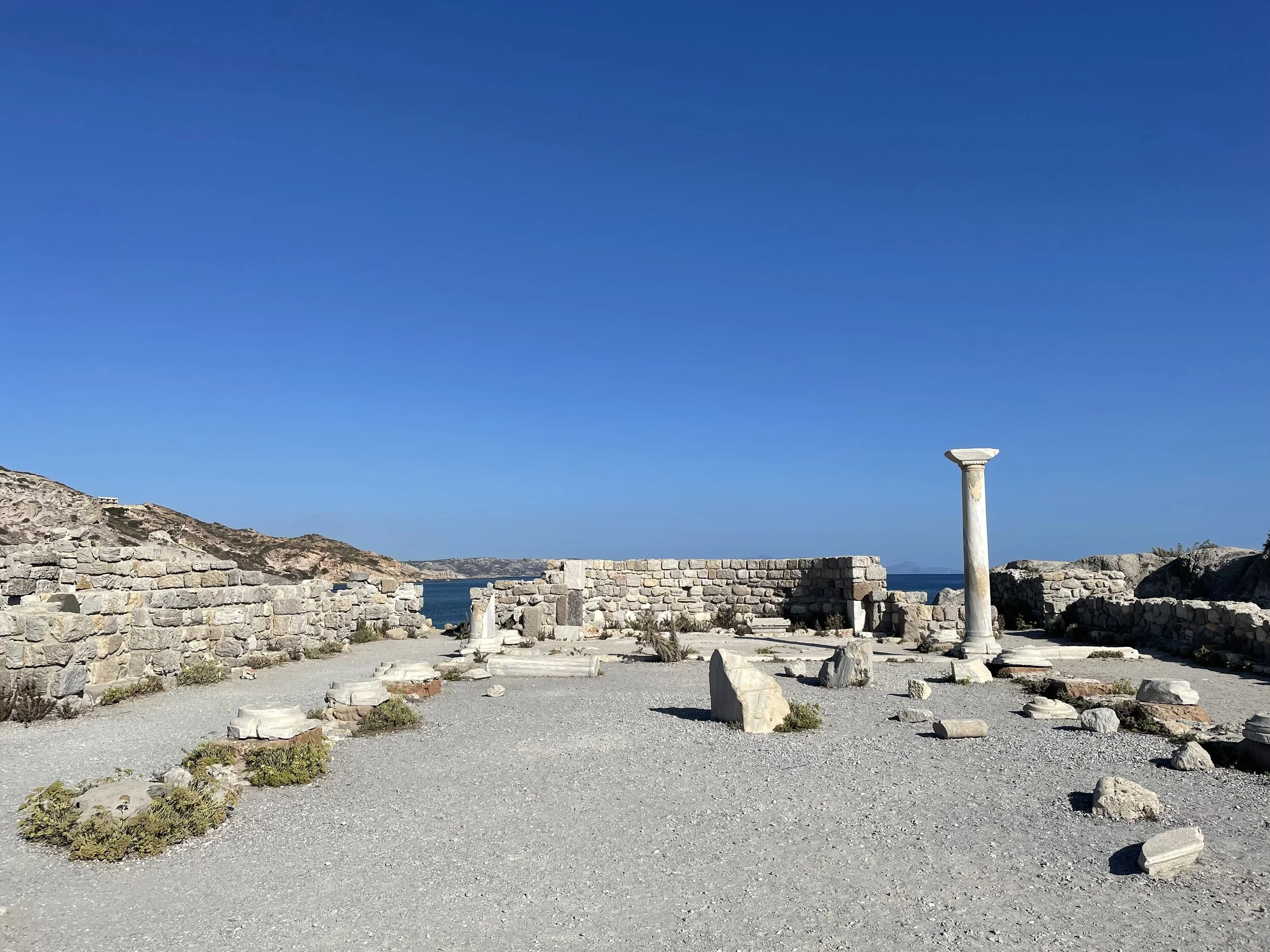
Image courtesy of John Penniman.
This essay was part of a 2025 NAPS Conference Book Review Panel devoted to Earthquakes and Gardens: Saint Hilarion’s Cyprus by Virginia Burrus. Read the full forum here.
Earthquakes and Gardens is a deeply idiosyncratic book. It is experimental in a number of ways, and experiments do not always succeed—certainly not for every reader. So I am especially grateful for these generous responses, which do not merely offer critical commentary but also take the book’s experiments further, thinking and feeling and moving with the text, and thereby making it more and better.
The central experiment of the book, as it seems to me now, is methodological. I wanted to create, performatively, a particular experience of reading and of engaging the past. On the one hand, I wanted to show what we are always doing anyway, to bring that ordinariness to the surface: as historians (and also more generally as humans), we are constantly mobilizing our own experiences and feelings and insights in order to reimagine past worlds that are now present to us only in bits and pieces; those past worlds in turn help us make sense of our present. On the other hand, I wanted really to lean into all that, not only to make these processes more evident but also to intensify them. Deliberate fragmentation and anachronistic juxtaposition were my main tools in that endeavor.
A significant provocation for this experiment was an installation by the Danish artist Sissel Marie Tonn called The Intimate Earthquake Archive. I encountered it in the high desert of West Texas—a landscape I love—as part of the exhibition “Hyperobjects,” curated by Laura Copelin of Ballroom Marfa in collaboration with the well-known ecocritic Timothy Morton. Tonn’s work grew out of the stories of personal loss, anxiety, and uncertainty conveyed by residents of Groningen, Holland, who have been deeply affected by ongoing local earthquakes caused by natural gas extraction. In response to their plight, Tonn and her collaborator Jonathan Reus drew on the archives of the Dutch Meteorological Institute to create an interactive artwork. They fit twelve sandstone core samples from the Groningen region with radio transmitters that emitted data drawn from specific local earthquakes; the slender rock cylinders were then suspended in an open space through which visitors could wander freely, wearing noise cancelling headphones and specially engineered vests equipped with both skin- and bone-conduction transducers. When one approached the suspended core samples wearing a vest, compositions of vibrations rippled through one’s body, a sensation felt both in the depths and on the surface; each core sample allowed one to experience a different earthquake. It was not a simulation but something more uncanny than that: the human body became a kind of walking seismograph.
As it happens, I had experienced a very large earthquake in California when I was thirty, and Tonn’s artwork not only activated those memories, while linking them with ecological issues that interested me, but also brought me back to Jerome’s Life of Saint Hilarion. I never really think about the earthquakes in that text, it struck me suddenly. I just read right past them. What would it take to make those earthquakes move us again as readers, and what would happen if they did?
So the book emerged as a kind of triangulation between me, fragments of a late antique hagiographical text, and works of art, many of them contemporary, that stimulated and mediated my interaction with those fragments. When I say fragments, I mean two brief passages from Jerome’s Life of Hilarion describing sites on the island of Cyprus—a ruined city (the focus of Part I of the book) and a garden on a mountaintop (the focus of Part II). When I say works of art, I mean poetry and fiction, visual and performative art, buildings and gardens and maps and more. And when I say me, I mean memories and emotions and sensations and thoughts and associations and judgments and questions. I was very aware that I was the one staging this performance and that my readers would have to be willing to go along with me. I also knew that I was as likely to get in the way for some readers as I was to provide an effective conduit for others.
I should perhaps add that I wrote the book from beginning to end between March of 2020 and January of 2022, across the span of the pandemic, much of which I spent as a Fellow at the Clark Art Institute in Williamstown, MA, and also that my parents, who lived in Houston, TX, died during this time, as did my husband’s father, and other loved ones experienced great challenges and disruptions as well. So there is a lot of attention not only to nature and to art (given the setting) but also to grief and consolation in this book, which focuses on themes of destruction and resilience, ruination and the resurgence of life. At least that’s how I frame it on page 7 and in the blurb on the back.
I hope this is helpful as an introduction. Now let me turn to the responses to the book gathered here, for which (I must say again) I am so very thankful. I take them in the order in which they were presented to me, and I shall not even try to hit all the main points. There is so much insight in these papers—they are so much more than “responses” in the usual sense—and no one needs me to repeat what they already say better. So my own responses-to-the-responses will be very partial and incomplete, but I hope they will capture something of my deep appreciation.
“Here’s one place Burrus’s ocean of possibilities carried me.” With these words, Mike Motia begins in medias res, as the book does: “Here is how I remember it” (p. 3). At the same time, Mike’s opening line also echoes the last line of the book: “A place … is an ocean of possibility” (p. 155). Drawing us immediately into the landscape of a magical South Korean film from 2003, he allows resonances to emerge both with Jerome’s Life and with my reading of it, highlighting the “flickers of ecstasy” that “motivate and ground calm understanding,” and ultimately landing on the fruitful concept of “absorption as transcendence.” Oddly, perhaps, film is one medium that doesn’t appear in the book, but it might have, as Mike helps us see; it happens that I too know and love “Spring, Summer, Fall, Winter, and … Spring,” and this supplement to the supplement that is Earthquakes and Gardens seems to me satisfyingly continuous with the text. Commenting on how the book works by exploring resonance and affinity between artifacts (perhaps a better framing than “juxtaposition” above), Mike also performs it himself. And in an especially lovely move, he links the approach back to Jerome as well, asking—and showing us--how the ancients created their own resonance chambers.
Responding to another crucial aspect of the book, Rob Seesengood positions it deftly in relation to several theoretical conversations, one of which—“metamodernism”—I must admit is new to me, and I am intrigued by this diagnosis of a condition of oscillation between modern earnestness and postmodern playfulness. This seems almost embarrassingly on target as a characterization of much of my work and tracks a kind of theology-theory oscillation as well. But I am even more struck by Rob’s own performative autobiographical voice, through which he engages “haunting” (of Jerome’s garden and as an aspect of the book itself) by telling a story of his own ghostly visitations (grandmother, brother, mother) as well as discussing how his discipline (biblical studies) haunts his own reading of the book and its places. In particular, Rob’s poignant evocations of his family members resonates with the book’s opening—a distant memory of my infant son, rocked by an earthquake—and a passage near its end—a recent memory of my father’s death, which rocked me profoundly. His use of autobiographical voice thus calls attention to and amplifies my own, opening a delicate dialogue.
Paige Spencer is, like Mike and Rob, attuned to the performativity of the book, discovering in it a kind of miming of Hilarion’s asceticism—in its fragmentation and supplementation, “both renunciatory and indulgent.” At the same time, she asks probing questions about its ultimate message. What is the take-away, so to speak? Where I have identified “destruction and resilience” (etc.) as the key themes of the book (see above and p. 7), Paige also detects a preoccupation with the dichotomy of control and letting go. The book may at first seem to advocate simply letting go, trusting in a “plant-like conviviality” to emerge, yet the model of gardening (never mind Hilarion as dragon-slayer) suggests a presence of conflict and competition, as well as a need for a degree of intervention, she argues rightly. “How do we know when to let go of control and when to intervene?” she asks. Pivoting again, Paige wonders if the question itself assumes too much agency: perhaps the point is not to let go, or to find the right balance of letting go and intervening, but to recognize that control is illusory. “What, then, of ethics? What, then, of asceticism?” she asks in conclusion. Yikes! I suspect that the book does not so much offer an answer as continuously pose the question, perhaps in the kind of “metamodern” oscillation Rob discusses.
In addition to offering another helpful framing of the methodological experiment in which we are all engaged—“historiography as spoliation”—John Penniman’s essay raises important questions about the place of self-reflectivity in the book and its particular relation to ruined landscapes. Like others, John takes a layered, performative approach, engaging in self-reflection regarding his own practices of self-reflection as he explores these questions, not without humor. “For a time, I was in the habit of taking pictures of myself that included, in the background, tourists taking pictures of themselves near ruins.” His approach is layered and performative in another sense as well. Whereas Mike highlights (and performs) the role of literary and artistic supplementation and Rob of autobiographical supplementation, John turns to theoretical supplementation, adding another layer to my own conversation with Susan Stewart’s The Ruins Lesson. (He also pulls in Don DeLillo’s White Noise and Teju Cole’s “Take a Photo Here,” but I’m trying to keep this simple!) As they are for Paige, the stakes for John are ethical. “Are there better and worse ways to be students of the ruins lessons?” He draws our attention not to the lost past but to the promised future—“a spoliated future.” Perhaps moving toward the future involves thinking “with late antiquity, even within late antiquity, more than about it,” with as much self-awareness and honesty as we can muster about what we are doing and why.
In the final essay, Midori Hartman’s opens by invoking Italo Calvino’s notion of “a first city [or place] that remains implicit” as a point of comparison or orientation for those other places that are explicitly named and described. Places and the relationships among them are central for the book’s self-proclaimed “geocritical” reading, and I am fascinated by this concept. What is that implicit “first place” for Earthquakes and Gardens? What would it mean to explore Palestine (as opposed to, say, Rome or Egypt) as the “first place” not only for Hilarion but also for Jerome and even for me as author? I was living in Jerusalem the first time I visited Cyprus and began to reengage Hilarion’s sojourn on that island. Jerome writes from Bethlehem, of course, and Hilarion’s journey begins in Gaza and both does and doesn’t return to that point. In the book, I touch on Gaza only very briefly, and with great sadness, at the end of the last chapter. It almost wasn’t included but hovered like a ghostly presence over the manuscript, and I had to let it touch down somewhere. I want also to thank Mido for taking in the full sweep of the book’s six little chapters and for the gift of the nest as a way to hold them all together—an image that is not native to Jerome’s text or my book but seems very much at home in their gardens nonetheless.
Let me confess, by way of postscript, that these reflections resemble but are by no means identical to the ones I spoke at the conference where this panel was originally assembled. I cannot explain how, but I lost the original text—an unprecedented experience. Perhaps I didn’t want to have the last word. Or I was embracing transience. Or I’m just getting old!
Virginia Burrus is the Bishop W. Earl Ledden Distinguished Professor Emerita of Religion at Syracuse University.