This essay is part of a 2025 AJS Conference Session devoted to Bavli studies. Read the full forum here.
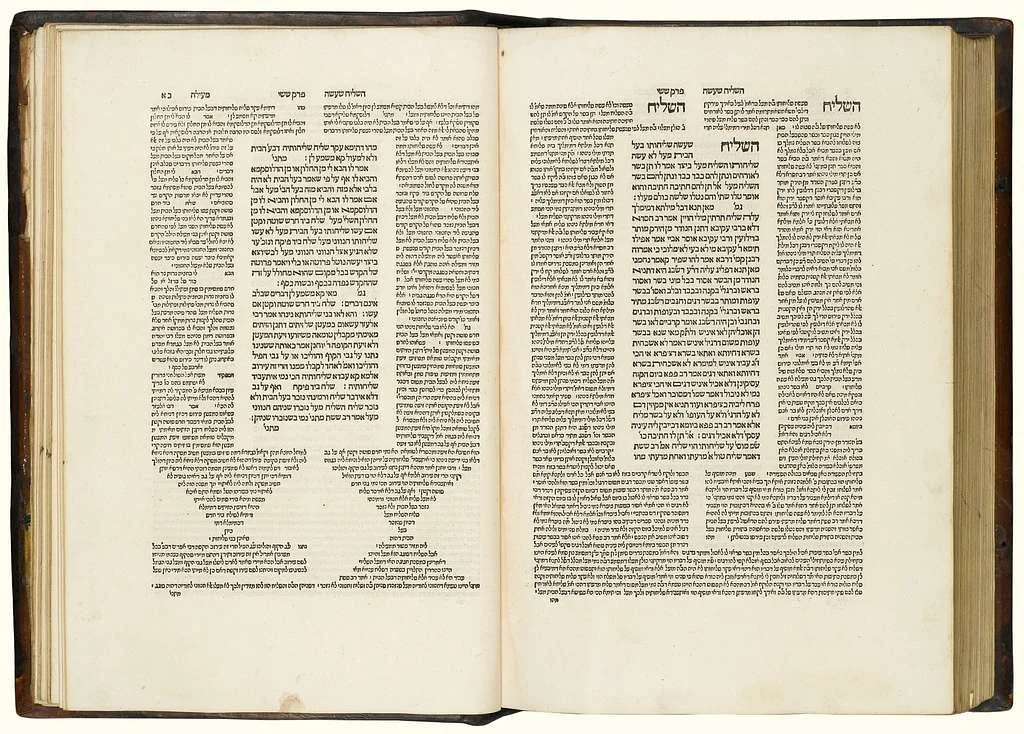
The panel asks a deceptively simple question: what is the Babylonian Talmud? At first glance, the answer seems obvious. The Talmud is a book, a textual object, something one can take down from a shelf and consult, as readers have done for centuries. Yet the moment one presses the question – how and when did the Talmud come into being, who produced it, what was its intended purpose, how it was transmitted, used, and understood, and what forces shaped it along the way – the notion of a book or even a discrete work distorts more than it reveals. As Augustine of Hippo said about the concept of time in his Confessions: if no one asks what it is, we seem to know perfectly well; when asked to explain it, we no longer do.
If the Talmud resists definition, one way to bring it into sharper focus is to approach it historically. Whatever else it may be, the Talmud is unmistakably a historical artifact in several senses. It is, first, the product of a social movement, of the rabbinic circles that surfaced and developed over the centuries of the Talmud’s formation, groups for which the Talmud remains the principal surviving record. Second, the Talmud emerged in distinct and overlapping intellectual, religious, and cultural milieux that left their imprint on rabbinic modes of reasoning, literary forms, and legal discourse. And finally, the Talmud took shape within a particular historical setting, fashioned by the political structures, material conditions, and broader environment of the late antique Near East in general, and Sasanian Iraq in particular.
Curiously, however, modern scholarship has largely proceeded as though the Talmud lies beyond the reach of historical inquiry. Even as contextual approaches to the Talmud – especially attention to its religious and cultural milieux – have attracted a growing community of scholars and incorporated an expanding range of comparanda, the historical study of the Talmud continues to be treated as a topic of interest rather than as an essential methodological orientation. It occupies a position not unlike that of studies of rabbinic conceptions of the afterlife or angelology: a legitimate subject of inquiry, yet not a foundational point of departure. Historical analysis is thus rarely regarded as indispensable to Talmudic study in the way that philology is; instead, it remains a specialized line of investigation within the broader field.
The marginal position to which history is consigned is evident in several recent biographies and overviews of the Talmud, such as Kraemer, A History of Talmud, Wimpfheimer, The Talmud, Mayer and Rosen-Zvi, The Talmud [Hebrew].
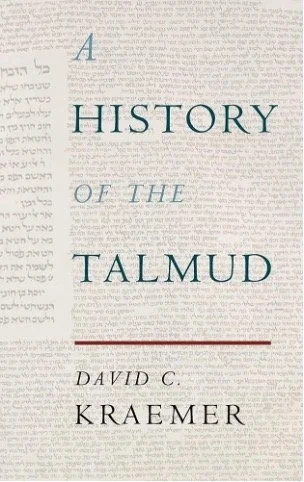

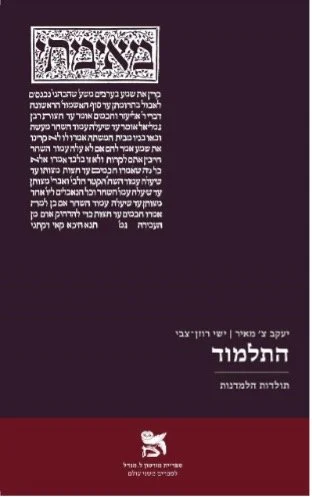
These works gesture toward the lived realities of the rabbis, but largely as background, rarely integrating such themes into the conceptual framing of their projects. As a result, the story they tell about the Talmud remains primarily one of rabbinic discourse and literary form, as though these developed in relative isolation. Historical inquiry remains largely at the margins, invoked in brief gestures toward local color rather than allowed to inform, in any substantive way, our understanding of the Talmud, the rabbis, and the world they inhabited.
If the Talmud has so often been situated beyond the scope of historical inquiry, it is worth asking how that assumption came to take hold, and why the field now appears poised for a reorientation. To be clear, my aim is not to insist that every project on the Talmud must be primarily historical or comparative in focus. Rather, it is to suggest that, as our methods have sharpened and our comparative horizons widened, it has become increasingly difficult to imagine serious scholarship on the Talmud that does not stand to gain from sustained historical analysis. We may, in fact, be approaching a moment in which historical literacy – like philology before it – ought to be regarded as a basic expectation of rigorous Talmudic scholarship. If that is the case, then the question before us is not only what the Talmud is, but also what forms of training, institutional support, and scholarly practice are necessary to render that question newly intelligible.
How We Got Here:
The contextual study of the rabbis and the Talmud is as old as the Wissenschaft des Judentums itself. From its inception, scholars operated around three core assumptions about Babylonian Jewish society: first, that it was autonomous, a testament to Persian feudalistic tolerance; second, that it was deeply hierarchical, governed by a power-sharing arrangement between the Exilarch and the rabbis; and third – and consequently – that Jews dwelt largely in social and cultural isolation.
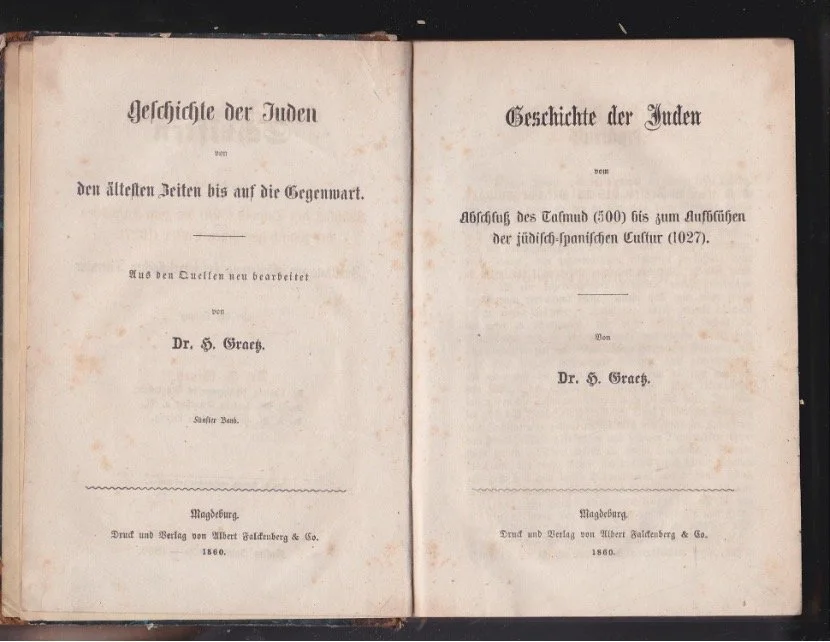
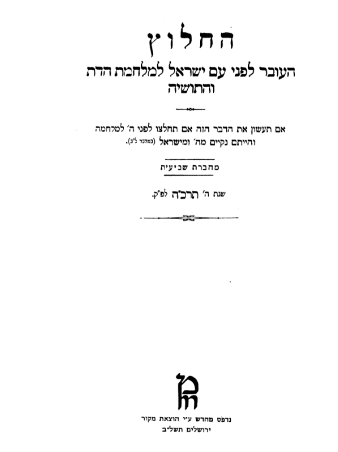
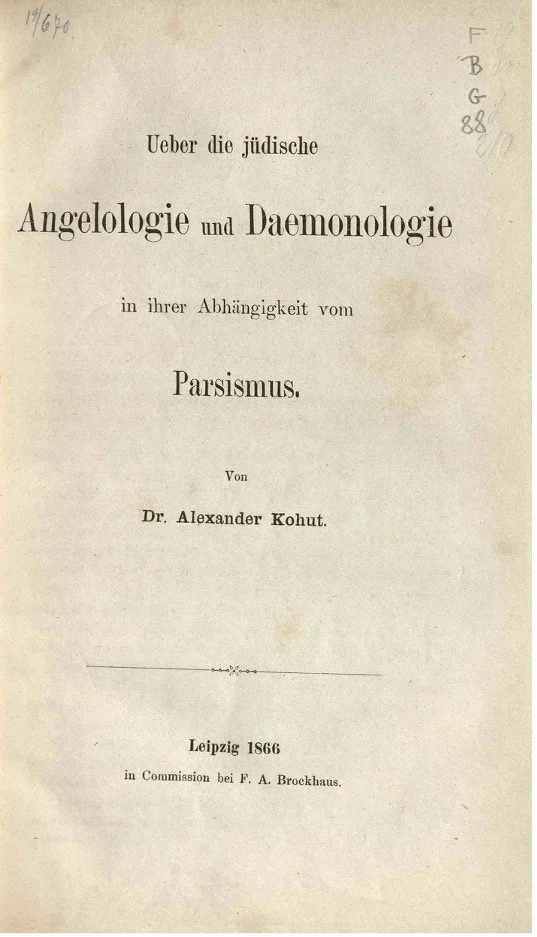
This tripartite sketch already appears in Heinrich Graetz’s Geschichte, though in the ensuing years there remained considerable disagreement about its particulars. In 1865, for instance, in the pages of HeḤalutz, Yehoshua Heschel Schorr urged “the wise men of the generation and their students and their students’ students and anyone who delves into the written and oral Torah according to the critical (המתונה והמיושבת) approach: Pay attention to the books of the Persians, their religion, laws, habits and customs...” Because, he insisted, “the Persians excel in the quality of tolerance (טאָלירנץ) even to this day,” they fostered an atmosphere that encouraged Jewish engagement with Persian customs and ideas. A year later Alexander Kohut published his dissertation, situating Jewish angelology and demonology within a Persian context. For Kohut, however, Persian influence was not the product of Sasanian tolerance but rather of Zoroastrian zeal, which curtailed Jewish autonomy and more forcefully impressed both its political authority and religious forms upon Jewish life.
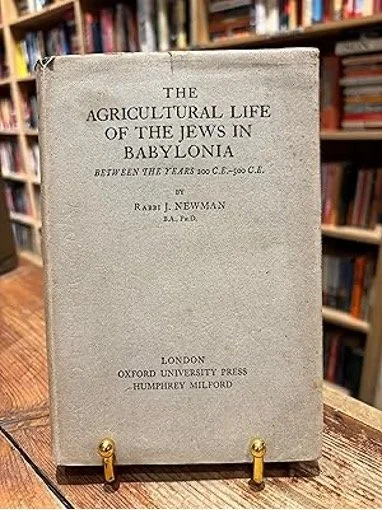
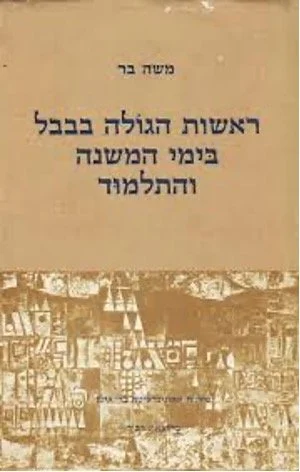
Once the model of Jewish autonomy took root, scholars increasingly approached the rabbis through internalist methods alone. Julius Newman, for instance, in his 1932 study of Babylonian Jewish agricultural practices, explicitly invoked Jewish autonomy – and the dominance of the rabbis – to justify his near-exclusive reliance on the Bavli. Social-historical study of Babylonian Jewish society likewise proceeded almost entirely from the pages of the Talmud itself. Moshe Beer, for example, recalibrated the relative balance of power between the Exilarch and the rabbis, taking Jewish autonomy for granted. The result was a methodological circularity: drawing exclusively on the Talmud, scholars reproduced its portrayal of a largely self-contained Jewish, and mainly rabbinic, world. And while the study of Palestinian rabbis has long been animated by the question of “rabbinization” – how a marginal movement came to achieve broader authority – no parallel inquiry was directed at the Babylonian rabbis, whose dominance was simply presumed as a feature of Jewish autonomy (on which see my piece here).

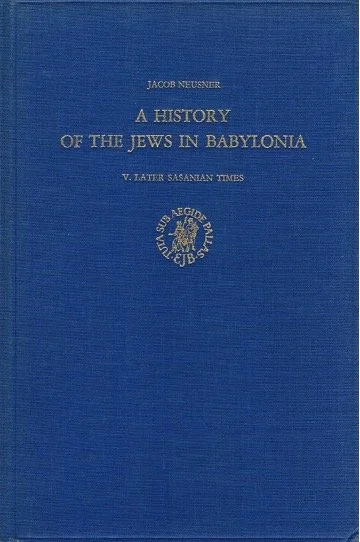
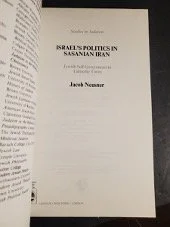
Jacob Neusner’s five-volume History of the Jews in Babylonia, the first original narrative history of Babylonian Jewry since Graetz’s more impressionistic account, marked a radical shift in scope and ambition, but not a substantive departure in its basic plot points. Like his predecessors, Neusner remained deeply positivistic: even when he did question the historicity of his sources, it was typically in order to recover an underlying historical kernel, not to challenge their evidentiary potential altogether. But unlike them, he significantly expanded the range of comparanda: he engaged Sasanian history directly, personally translated Zoroastrian texts, and integrated other groups, such as Syriac Christians and Manichaeans, into his account. Yet despite his breadth, Neusner ultimately buttressed the notion of Babylonian Jewish autonomy, and its siloing effect on the Jews.
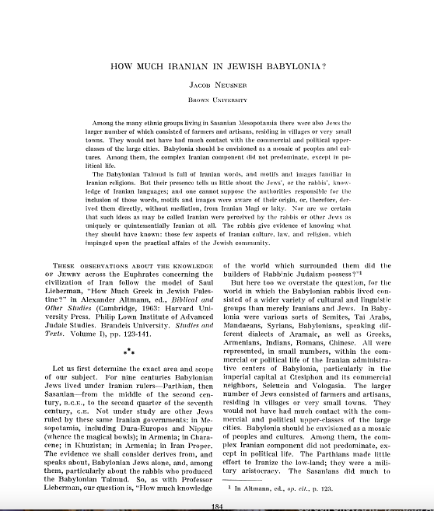
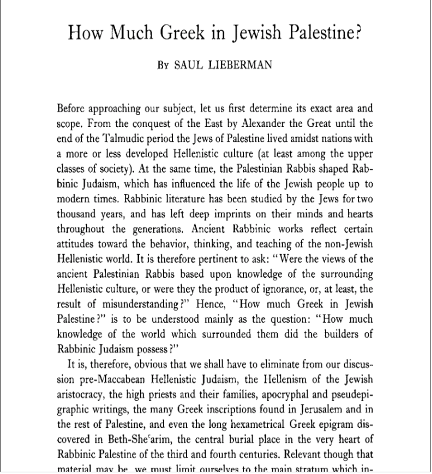
Indeed, five years after publishing his volumes, he penned the essay “How Much Iranian in Jewish Babylonia,” an allusion to his teacher Saul Lieberman’s influential article “How Much Greek in Jewish Palestine.” In the case of Babylonia, Neusner argued that the answer to the question was: not much. In his view, “The rabbis give evidence of knowing what they should have known: those few aspects of Iranian culture, law, and religion which impinged upon the practical affairs of the Jewish community.” It was not worth studying the broader cultural context in which Babylonian Jews flourished because, in Neusner’s view, there was no such context.
Philological trajectories in the field compounded the insulating effects of the autonomy paradigm. Neusner again played a key role here; he drew attention to the so-called synoptic problem in rabbinic literature, the discrepancies and contradictions between parallel traditions across compilations which signaled editorial tendentiousness and literary artifice.
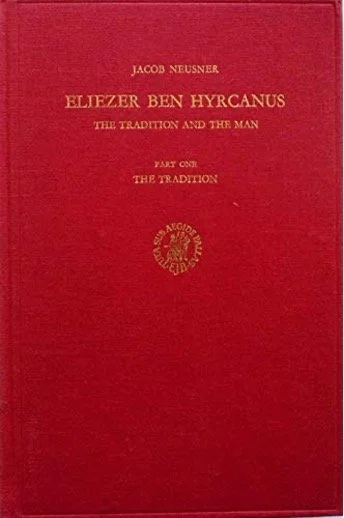
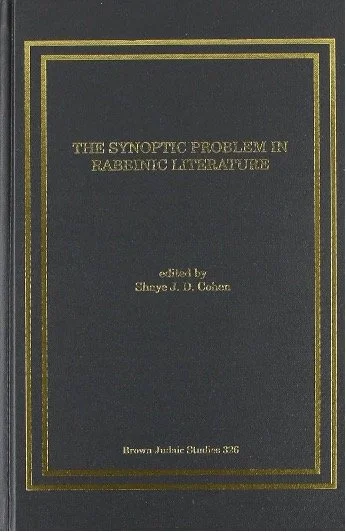
This insight was reinforced by the compositional-historical work of David Weiss Halivni and Shamma Friedman, which exposed extensive redactional activity within the Talmud, including the reshaping, and at times even the fabrication, of earlier, even attributed, traditions. Such findings significantly undermined efforts to take these materials at face value and as such, the possibility of straightforward historical reconstruction. The growing availability of manuscript evidence – thanks to new discoveries, publications, and later digitization – further undermined confidence in Talmudic attributions. These trends, amplified still further by the broader literary and discursive turns in the humanities, rendered transcript theories and positivist approaches to the Talmud untenable. The housing of rabbinics positions mainly in more theoretically inclined religious studies departments (again due in part to Neusner’s influence) further lent history a decidedly dated and outmodisch air. Narrative histories such as Neusner’s became obsolete, even as their basic claims about Babylonian Jewish society persisted, if the details were still subject to debate (e.g. Isaiah Gafni).
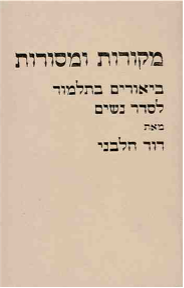

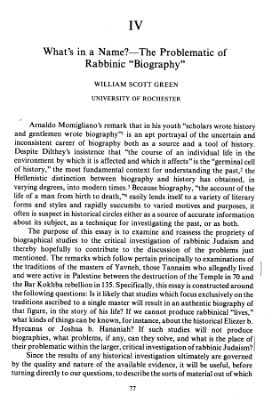


In the decades that followed, historical work on the Talmud all but ceased. One major exception was Neusner’s student David Goodblatt, who wrote what remains the most important social history of the nascent Babylonian rabbinic movement. Although largely internalist in orientation, Goodblatt did not operate within the autonomy paradigm; indeed, even if he did not draw this conclusion explicitly, his analysis has the potential to unsettle it. His central thesis was that the early Amoraim operated in small local study circles, while large, centralized academies were a later Geonic retrojection, upending the received history of the Babylonian rabbinate. His conclusions were later fortified by Jeffrey Rubenstein, who, drawing on the methods of Halivni and Friedman, demonstrated that while the Amoraim indeed flourished in study circles, the Bavli’s editorial layer – or stam – already began assuming and retrojecting the existence of larger academies.
Goodblatt’s work, with Rubenstein’s refinement, represents a kind of terminus for the social history of the rabbis. The Amoraic-to-Editorial transition became the single historical inflection point that subsequent works readily embraced. Historicization, such as it was, remained focused mainly on the editorial layer, and primarily on its internal cultural, intellectual, or literary features. Even so, little effort, however, was devoted to historicizing the institutional transition from study circles to academies; scholars instead resorted to abstractions like “scholasticism,” sidestepping questions of historical causality even while noting highly suggestive correspondences between the near-contemporary processes of rabbinic and Syriac Christian institutionalization.
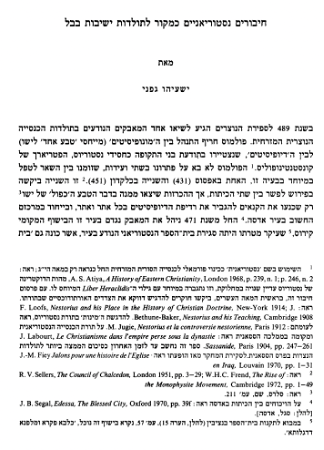
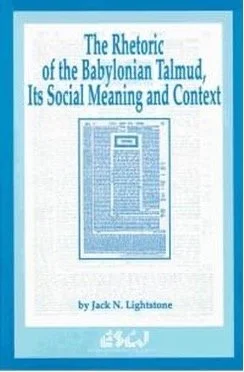
The result was a pronounced compressing of Babylonian Jewish history into two broad periods: early and late, study circles and academies, Amoraim and editors/stammaim. Even within this divide, reconstructing the world of the Amoraim came to be viewed as naïvely positivist, while the later editors drew most of the field’s attention, the opposite, I should note, of Shamma Friedman’s intention of identifying the editorial layer so as to facilitate retrieval of authentically Amoraic materials.
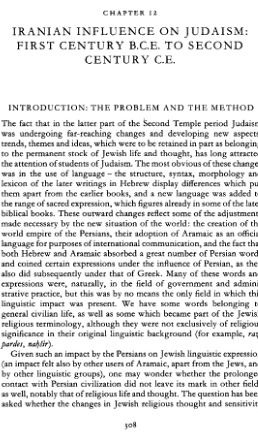
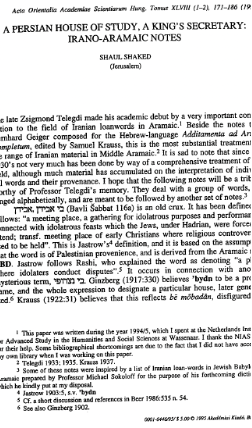
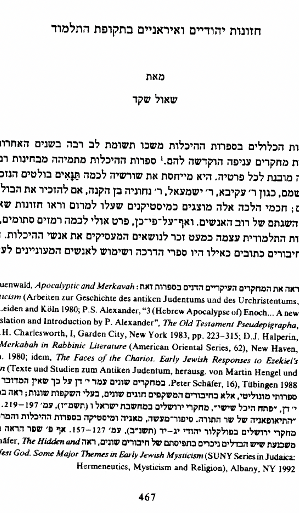
At the turn of the millennium, two scholars – Shaul Shaked in Israel and Yaakov Elman in the US – revived interest in the Talmud’s broader context, though focusing narrowly on comparisons with Iranian and Zoroastrian literature, much as Schorr had done over a century earlier. As an Iranian philologist and linguist, Shaked’s pathbreaking work was not grounded in a systematic historical framework for understanding the rabbis. Instead, it concentrated on loanwords and phrases as signs of Jewish immersion in the surrounding culture, without attempting to characterize that immersion in a more programmatic way.
By contrast, Elman’s work was, somewhat paradoxically, explicitly predicated on the assumption of Jewish autonomy. Elman thus saw contact as exceedingly rare; it was mainly the result of deliberate engagement by a select few rabbis who, as normative authorities, possessed the unusual ability to step outside pristine Jewish isolation and seek out interlocutors.
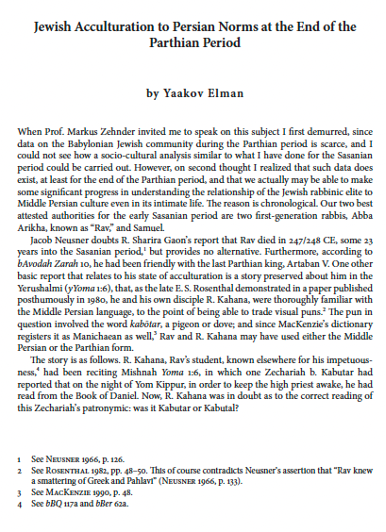
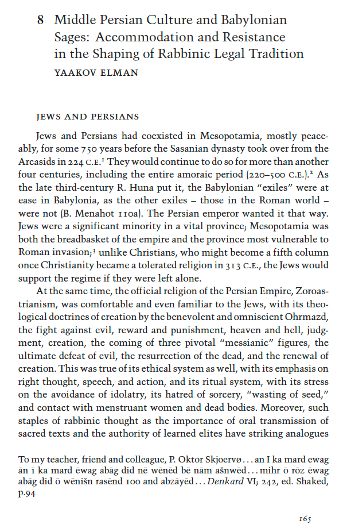
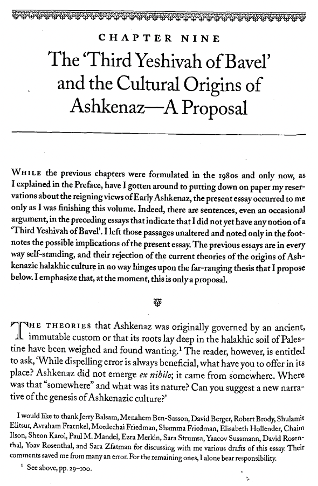
Elman reasoned that such rabbis would have sought dialogue with counterparts who shared a similar social position and set of interests, which drew him to Zoroastrian priests and their literature. Because Elman assumed contact to be direct and limited to deliberate rabbinic engagement, he was mainly on the hunt for “smoking gun” parallels, leaving little room for more diffuse forms of cultural osmosis. His adherence to the autonomy paradigm further shaped his view that Babylonian rabbis held sharply divergent attitudes toward what he understood as voluntary and deliberate contact with non-Jewish elites, an internal tension that, in his account, rose to the level of a veritable Kulturkampf. This notion was later taken up by Haym Soloveitchik in his “imaginative” construction of what he called a “third yeshiva,” allegedly founded by a group of Babylonian rabbis who, dismayed by their colleagues’ engagement in interreligious dialogue, felt compelled to abandon Babylonia altogether.
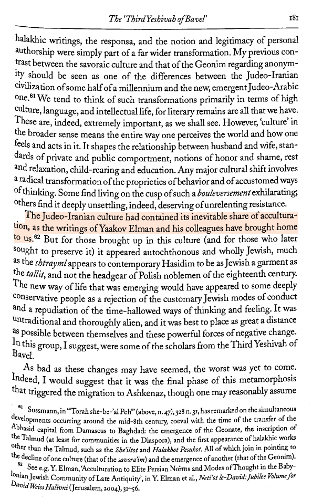
In short, the presumed autonomy of the rabbis allowed “comparison” to be cordoned off as a niche rabbinic, and therefore scholarly, pursuit. Comparative work was treated as a curiosity: interesting insofar as it showed, in Elman’s case, that rabbis could engage in a highly specific mode of contact, but ultimately limited in significance, just as Neusner had asserted.
In the early 2000s, students of Elman and Shaked began to recalibrate both assumptions and methods. Elman’s approach was more firmly grounded yet subtly challenged by his student Shai Secunda in his first book, which sought to anchor rabbinic–Zoroastrian contact in a more concrete cultural and social terms.
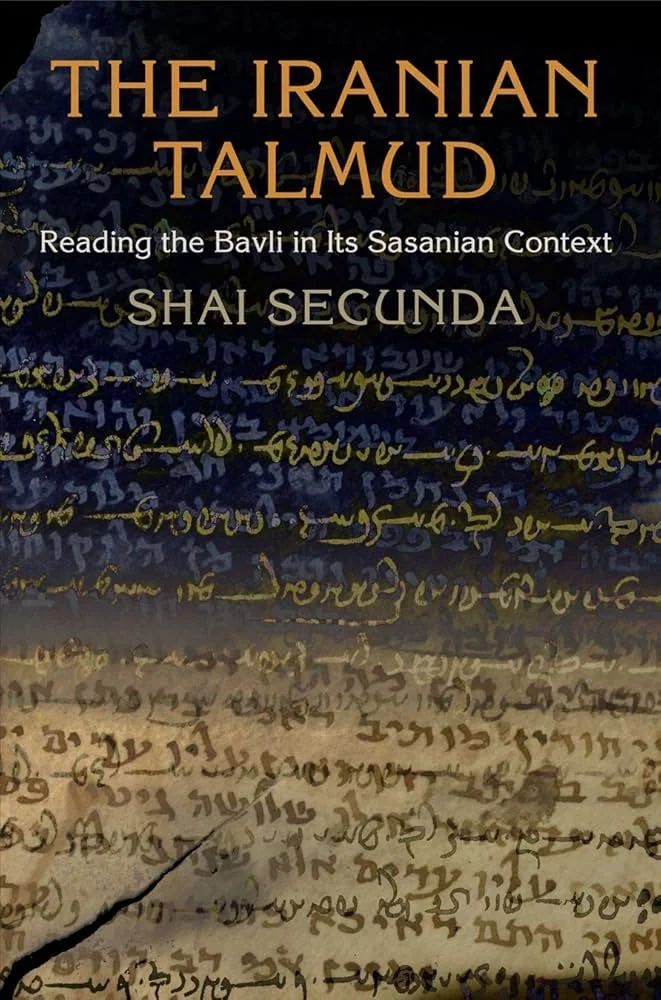
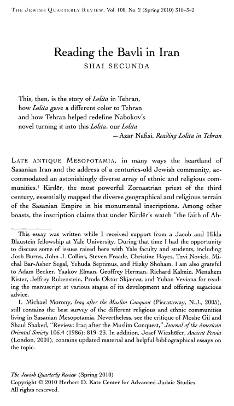
Secunda even ventured to identify specific institutional settings for interreligious encounter, most notably in his treatment of the Bavli’s elusive references to a certain Bei Abedan, a proposal that, in my view, leaves the phenomenon very much an explanandum. In his conclusion, however, Secunda called for a shift away from the search for “smoking gun” parallels toward more diffuse models of cultural exchange, though he articulated this move largely in literary-theoretical terms, especially under the rubric of “intertextuality.”
Within a parallel intellectual trajectory, Geoffrey Herman turned his attention to situating Babylonian Jewish society within its broader political context. He demonstrated that the exilarch was far less powerful than earlier scholarship had assumed, yet still a central figure within a largely autonomous Jewish society, what he memorably described as a “prince without a kingdom.”
As the assumptions underpinning the autonomy paradigm began to fray, however slightly, they provoked a reactionary backlash. Robert Brody, for instance, reaffirmed the autonomy paradigm in a pointed critique of Elman and others that rests, in my view, on an outdated understanding of Sasanian society and the rabbis, an argument he reiterated just this year.
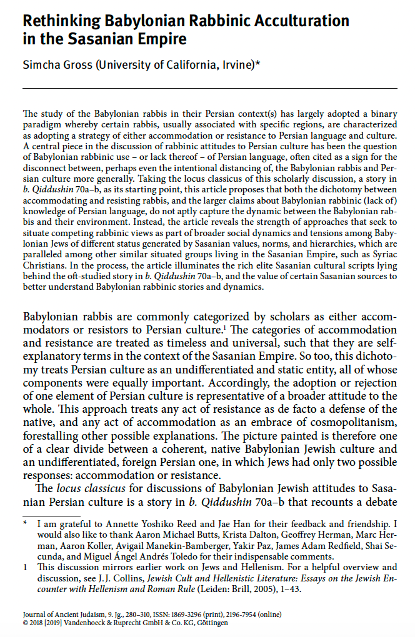
But the cat was out of the bag. Once the contextual study of the Bavli gained some scholarly legitimacy, new work explored a wider range of comparanda and employed an increasingly sophisticated array of analytical methods. Richard Kalmin, Jeffrey Rubenstein, and others adduced Syriac, Armenian, Manichaean, Mandaean, ancient Mesopotamian, and other materials to understand rabbinic culture.

Concurrently, Sasanian sources were plumbed to illuminate specific textual units and to address larger historical questions.
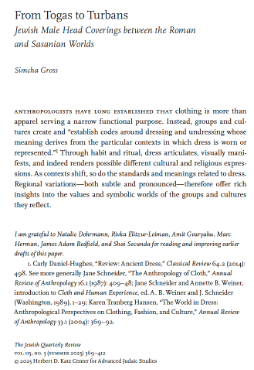
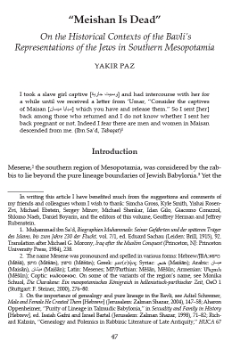
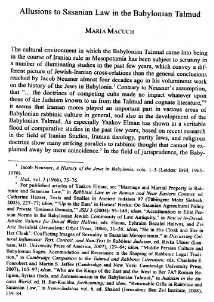
Some of these works eschewed the search for direct “smoking-guns” in favor of other modes of interaction.
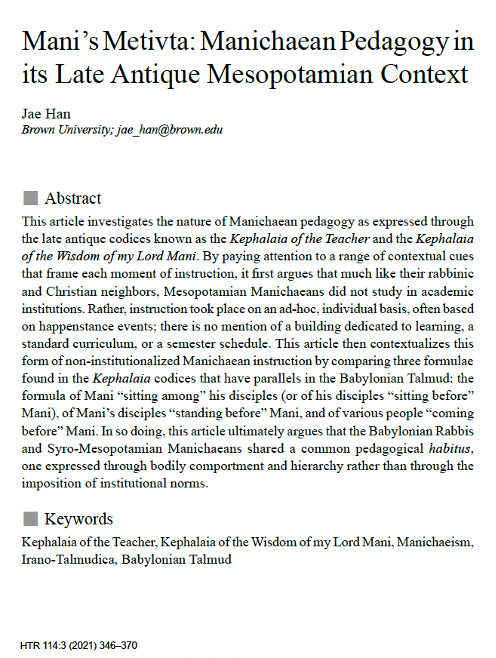
Simultaneously, challenges to the autonomy paradigm and its correlates came from other corners of the field, especially the study of the incantation bowls.
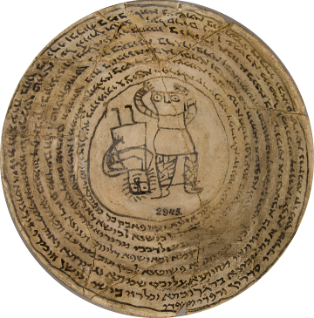
Building on Shaul Shaked’s pioneering work, scholars such as Avigail Manekin-Bamberger demonstrated the bowls’ significance for understanding the Talmud, the rabbis, and Babylonian Jewish society.

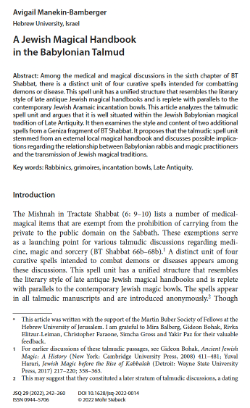
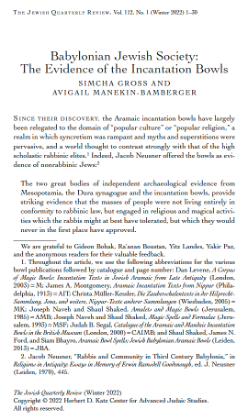
As rabbis – and even rabbinic traditions – were identified on a growing number of bowls, and as distinctly bowl-like phenomena were identified within rabbinic texts, the notion of rabbinic enclosure atop an autonomous Jewish hierarchy grew increasingly untenable.
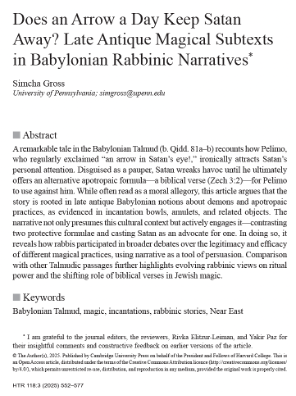
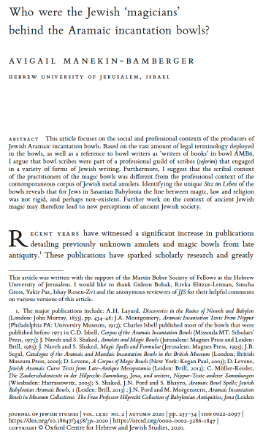
The bowls further reveal extensive interaction across communal boundaries. Scribes borrowed traditions with ease: Christian motifs such as the Trinity appear on Jewish Babylonian Aramaic bowls, Babylonian rabbis surface on Syriac bowls, and clients patronized scribes of diverse backgrounds.
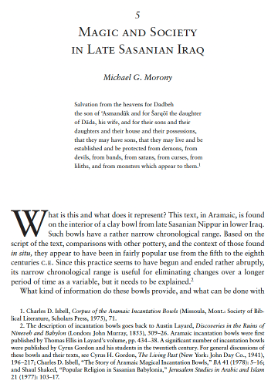
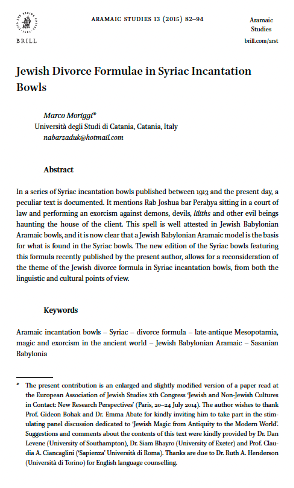
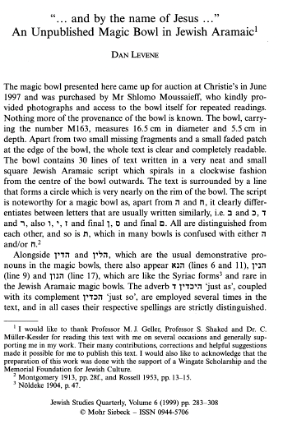
Taken together, this evidence demanded a reconsideration of the cultural and social history of the rabbis, and of Babylonian Jews more broadly.
And since no scholar worth their footnotes would pass up an opportunity to plug their own research, I’ll briefly insert my recent book into the narrative, which tackled the trinity of received historical assumptions head-on.
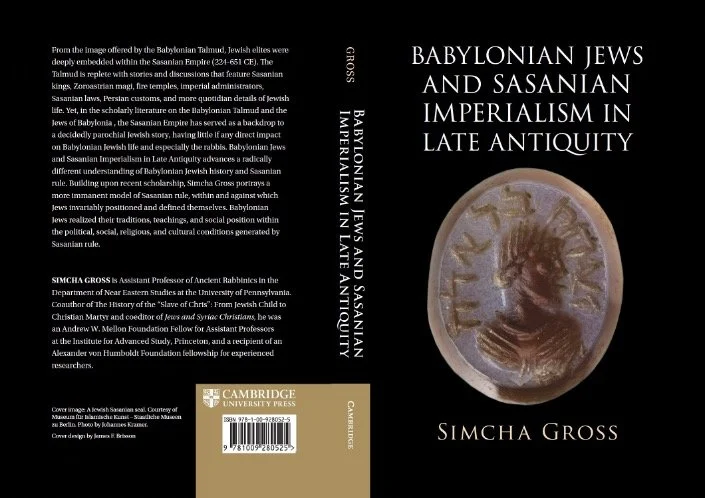
Building on this rich body of scholarship – and engaging in parallel developments in the study of the Sasanian Empire and the rabbis’ Syriac Christian neighbors – I argued that Babylonian Jewish society was, in fact, deeply embedded within the Sasanian world: neither autonomous, nor centralized, nor socially siloed. Methodologically, I demonstrated how the rabbis can be illuminated through recourse to a wide array of sources and comparative approaches, including the triangulation of similarly situated subject populations to reconstruct both their shared conditions and the distinct strategies by which they navigated them.
Thus, the corpus of available comparanda has expanded; indeed, it has now been mapped with considerable thoroughness. A range of methodologies for comparison and historical analysis is now at our disposal. And the conceptual models that once justified the segregated study of the Bavli are no longer tenable.
The historical study of the Bavli can therefore no longer be treated as a secondary pursuit. Like any other literary work, the Talmud must also be read within its political, social, and cultural ambit. Such an approach corrects for latent – and ultimately unsubstantiated – historical assumptions that continue to shape many aspects of the field. At the same time, it offers new lines of approach to familiar questions and opens novel avenues of inquiry. I will conclude by sketching four such directions:
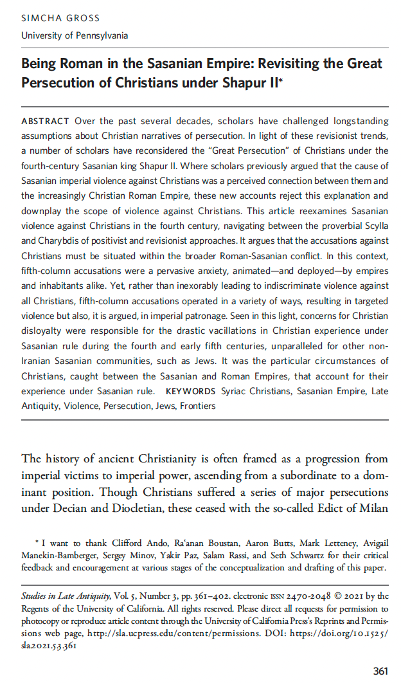
First, we must embed rabbinic discourse within its Sasanian cultural and legal environment. Subjects long treated as internal to rabbinic thought – attitudes toward non-Jews, polemics against idolatry, and messianic or apocalyptic imaginaries – all resonate with contemporaneous currents. Likewise, domains such as marriage, divorce, and household regulation come into sharper relief when compared with late antique legal and cultural discourses in the Sasanian world, as has already been done to illuminating effect in the study of Syriac Christian family and civil law.
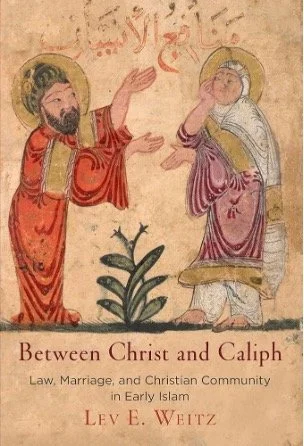

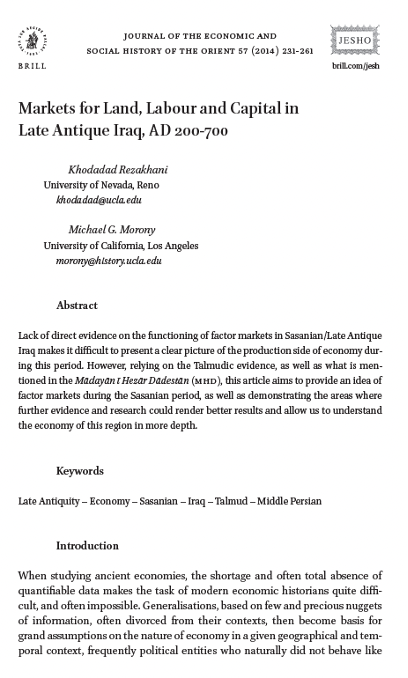
Second, we can ask how the rabbis and the Talmud engaged with their material, social, and political conditions. Rabbinic law and narrative can be read against the concrete and often quotidian realities that shaped daily life: irrigation and canal management, landholding and tenancy, agricultural routines, commercial networks, and other economic infrastructures. Christine Hayes, one of the conveners of this panel and editors of the volume it honors, rightly cautioned against a deterministic approach to such matters, but she would be the first, I suspect, to affirm that such work, when pursued responsibly, remains essential.
Third, we must reconsider the social position of the rabbis within this new model of Babylonian Jewish history and within emerging accounts of Sasanian society. Their authority can no longer be presumed to rest naturally atop a centralized Jewish hierarchy. Following Goodblatt, far more attention must be devoted to understanding how Amoraic circles operated organizationally and pedagogically, and how the move toward institutionalization unfolded, especially in relation to contemporaneous Syriac schools and monasteries and the Zoroastrian Herbedestān. We must ask how rabbis attracted and sustained followings, and what rabbinic law looked like in practice. In short, it is time to pose to the Babylonian rabbis – whose influence ultimately proved far more enduring – the question of rabbinization that has so productively reshaped the study of their Palestinian counterparts over the past several decades.
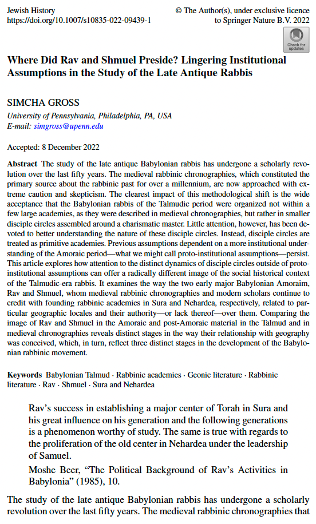
Fourth and finally, we might productively invert the question and ask what the rabbis and the Talmud can teach us about their broader world: about institutional, cultural, economic, and social developments in Babylonia, or about the impact of Sasanian law and administration on different groups. Pursuing such questions allows the Bavli to speak to concerns that extend beyond rabbinic, or even Jewish, studies. In doing so, it invites new interlocutors into the conversation.
We stand, in short, at an exciting watershed, one that invites us to approach the Bavli not as an isolated intellectual artifact but as both a product of, and a participant in, the increasingly complex world of late antique Mesopotamia. To adopt this perspective is to move historical inquiry from the margins of Talmudic scholarship toward its methodological center, reshaping not only how we read the text but also how we train the next generation. Only then might the Talmud come into clearer focus as the visible trace of the social worlds, intellectual traditions, and historical conditions that gave rise to it.
Simcha Gross is Associate Professor of Ancient Rabbinics in the Department of Near Eastern Studies at the University of Pennsylvania.