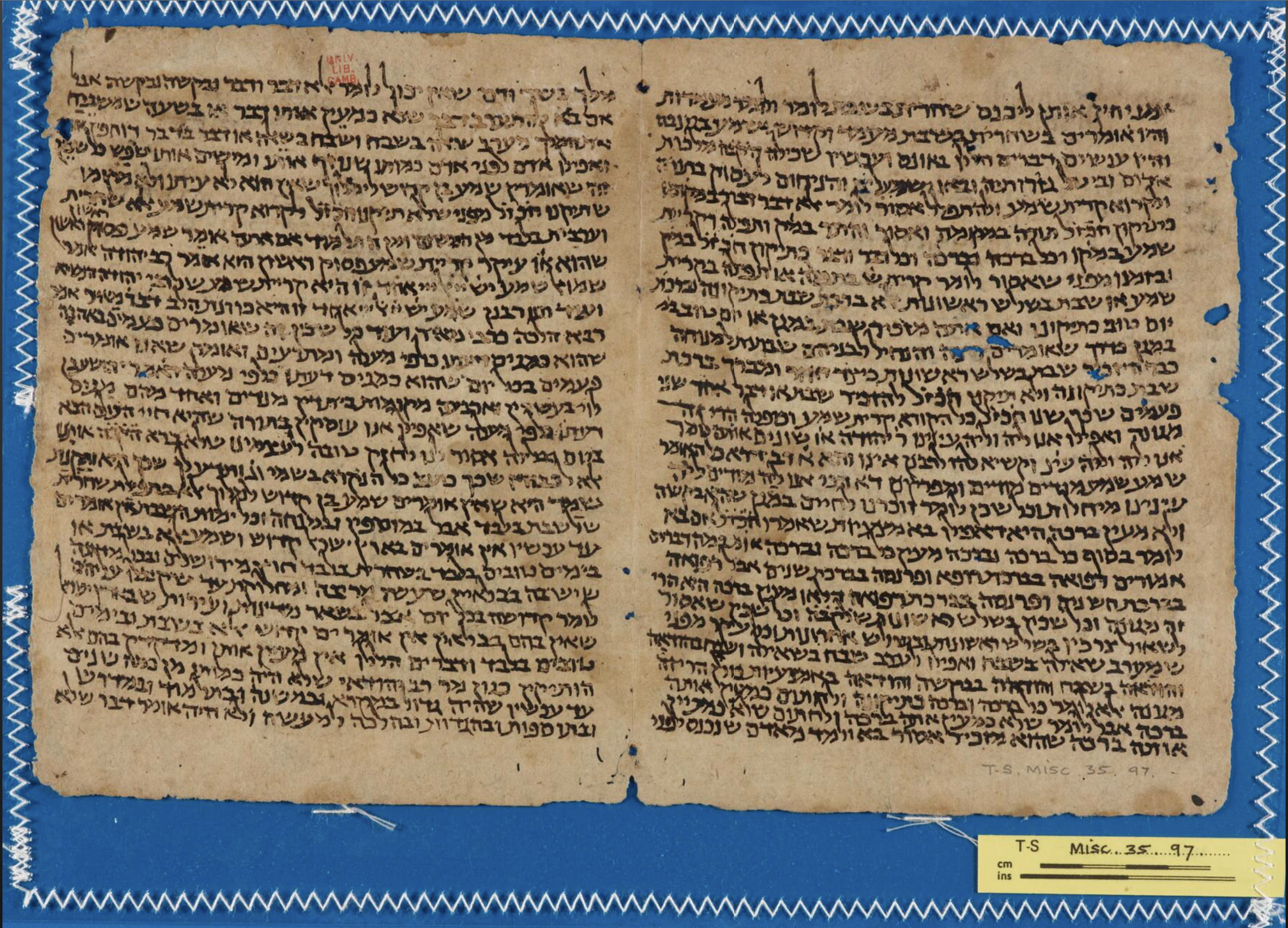
Pirqoi b. Baboi, Cambridge University Library Cambridge England Ms. T-S Misc. 35.97
This essay is part of a 2025 AJS Conference Session devoted to Bavli studies. Read the full forum here.
For the historian of the Jewish Book, the Babylonian Talmud presents a variety of problems, both exciting and unique. When Jews are referred to as “the People of the Book,” that book is undoubtedly the Bible. But, to a certain extent, the place of the Bavli in the Jewish canon is higher than even the Bible itself. Although it is not ritually read in synagogue service, and though it is not inscribed on an outdated scroll, the Talmud is the text par excellence, a work that, ideally, all Jews should find a way to study. Playing on the metaphor of the “Sea of the Talmud,” Louis Ginzberg once remarked that “[w]e can practically say that Jewish literature in its entirety, for more than a thousand years, is nothing but a commentary on the Babylonian Talmud; it is the sea from which all rivers flow and to which they all return.”[1]
Or so the rabbis would have you think. The Talmud, we can all agree, is studied now by more Jews than ever before. This is because it is no longer just studied by Jewish men; because it has been translated into modern languages; because its study has been ritualized through the practice of Daf Yomi; because it is available in cheap print copies and in digital formats, and also because, quite simply, more Jews are now literate than ever before. From the vantage point of the 21st century, and even from the time that Ginzberg one hundred years ago, the Talmud is the book. But for much of Jewish history, these conditions did not exist, and the Talmud was only studied by a select few.
Thus, from the vantage point of the History of the Jewish Book, the study of the Talmud’s reception can focus on many things, but there are two main questions that it must deal with: One, which I just alluded to, is a question for the historian of the modern era, or perhaps even for the ethnographer, and this is the question of how the Talmud became a popular text after many centuries of it being a text of the elite.
The book historical question that I will focus on here is the question of the Talmud’s initial reception, of what we may call its canonization. And I mean this not in the sense of its coalescing as a work, though that is still profoundly unclear, but in the sense of how the Talmud became the most central work for defining what Judaism is and should be—well before, even a millennium before, it became a popular book and a part of popular piety.
After briefly tracing the history of this question’s treatment by scholars, I will give examples for further steps that can be taken in the study of the Bavli’s early reception. While much about this process is still unknown, we are now much better off than we once were, and the forthcoming publication of What Is the Talmud? is as good of an opportunity as any to take stock.
A History of the Question
In his sweeping account of Jewish history, Heinrich Graetz assumed that the Talmud always had sway over the Jews of Babylonia, at least from the time of the early Savoraim, who he describes as finalizing the Talmud so it can serve as a written, “practical code.”[2] The Talmud’s full acceptance came several centuries later:
By the expansion of the Islamic dominion from India to Spain, from the Caucasus far down into Africa, the authority of the Talmud was extended far beyond its original bounds; for the most distant congregations placed themselves into communication with the Geonim, submitted points of religion, morals, and civil law to them for advice, and accepted in full faith their decisions, which were based on the Talmud.[3]
Important to note here is the assumption, par for the course in scholarship of the late 19th and early 20th century, that the Jewish community was remarkably centralized, and that there was a high degree of rabbinic authority. So, once the Talmud was written, and thus more readily available, why not accept it as a canonical text? As is the case also in the work of Nehemia Brüll,[4] the shift in medium, from oral to written, which he and others figured to have taken place in the early 6th century, was enough to explain the immediate acceptance of the Talmud in Babylonia. All that was needed for its acceptance worldwide was a shift in political geography.
By the time that Salo Baron wrote his own history, a half a century or so after Graetz, the realization had fully settled in that the story of the reception of the Bavly was in truth a story of the success of the Babylonian rabbis following the rise of Islam. It is then that “the Babylonian leadership of exilarchs and geonim” who were “[r]evitalized” by the rise of Islam “undertook to unify… diverse groups under the exclusive aegis of the Babylonian Talmud.” This, he again argued, was facilitated by its commitment to writing, which Baron seems to date to the Islamic era. Importantly, Baron adds that the Babylonians sought “through suasion or threats,” to make the Talmud, “together with Scripture, the fountainhead of all Jewish religious and communal life.”[5] Thus, inspired in part by the discovery in the Cairo Genizah of Babylonian polemics like the Letter of Pirqoi ben Baboi, Baron’s main contribution here is the appreciation that the success of the Bavli is a product not only of the Geonic era, but of geonic persuasion.
It is Jacob Neusner who I think first articulated the problem of the Bavli’s reception best, already in 1974:
One question cannot be answered: at what point and in what way does the Talmud, which in its own day, at the time of its formation and composition, was the work of a handful of men, become the normal, not merely normative, for the entire Jewish people?[6]
Neusner continues by tying this more explicitly, for the first time, to the problem of “rabbinization”—that is, the more general spread of rabbinic normativity, hegemony, and authority. He emphasizes also that this is a problem of sources, particularly as we lack sources for much of the 6th through 9th centuries, during which time it appears that the dual processes of the Talmud’s acceptance and of rabbinization occurred.
In parallel to Neusner’s articulation of this problem, E.S. Rosenthal of the Hebrew University began his studies of the manuscript tradition of the Bavli.[7] This topic was mostly ignored by earlier scholars in the field of Talmudic Philology, largely because it was enabled only by the decades-long process of cataloguing and collating the Bavli’s manuscript traditions, a process that first began to bear fruits in the 1970s. This form of philological study as continued by Rosenthal’s students and descendants at the Hebrew University recognized the fluidity of the Talmudic text, and specifically, it saw a form of fluidity that spoke of the Bavli’s continued transmission as an oral text up through the Geonic period.
This school of scholarship, however, has only rarely offered an explicit history of the Talmud’s creation and reception. What is perhaps the most notable contribution of Talya Fishman’s 2011 book, Becoming the People of the Talmud: Oral Torah as Written Tradition in Medieval Jewish Cultures, is the argument that the conclusions of this philological study should be incorporated into the study of the Talmud’s reception. Fishman’s book raises several extremely important on this topic, and it should receive significant credit for placing the question of the Bavli’s reception squarely back on the scholarly agenda in for bringing it into dialogue with philological study.
Also significant is Uziel Fuchs’ 2017, The Geonic Talmud: The Attitude of Babylonian Geonim to the Text of the Babylonian Talmud, the product of the careful collection and assessment of hundreds of examples from throughout Geonic literature. It is crucial for the assessment of the reception of the text of the Talmud. But what I think it also draws out is that the reception and attitudes towards the Talmud’s text is but one aspect of the reception of the Talmud.
Finally, a more recent contribution to the study of the reception of the Bavli can be found in Yakov Z. Mayer’s chapters in his and Ishay Rosen-Zvi’s recent book The Talmud: A History of Learning (2025). While by nature only impressionistic, given its popular audience, I believe that Mayer’s contribution is nevertheless significant in that it charts how the reception of the Talmud should be written. Namely, Mayer shows that the reception of the Talmud must be addressed from a variety of angles, including: approaches to the text of the Talmud, à la Fuchs; the history of interpretation, à la Israel Ta-Shma[8]; past understandings of what the Talmud is, à la Fishman; and also, in light of the Talmud’s material history, as we see, for example, in David Stern’s contribution to the forthcoming What Is the Talmud? volume.
Now What?
Given all that has been done, now what? In the time that remains, I will map out some additional areas of inquiry into the reception of the Bavli that I believe should be pursued. I should say that these approaches may not directly speak to the question of rabbinization. At the current state of research, much more can be done with regards to the reception of the Bavli within rabbinic cultures. This is an important question within itself. And it is also possible that, in due time, it will help us better tackle the question of rabbinization.
The Palestinian Babylonian Talmud
The first topic that I think needs a renewed assessment is the question of the reception of the Babylonian Talmud in the Land of Israel. Mordecai Margulies, in the introduction to his posthumous collection of halakhic works from post-Talmudic Palestine, published in 1973, already recognized that a key element in the history of Palestinian rabbinic culture is the acceptance of the authority of the Babylonian Talmud.[9] Margulies mapped out significant ways in which the later of these halakhic works—and eventually also the very responsa penned by Palestinian Geonim!—relied on the Babylonian Talmud. In this context, Margulies turned to the evidence of Pirqoi b. Baboi’s letter, which describes Yehudai Gaon’s attempts in the mid 8th century to convince Palestinian rabbinic Jews of the correctness of the Babylonian tradition.[10] Pirqoi also mentions that adherents of the Babylonian rite lived in Palestine.[11] To be sure, classical rabbinic texts speak of Babylonians, and even of Babylonian synagogues, in Palestine.[12] But it does seem to be the case that there was a break in the connection between the two centers, which still needs to be understood better, and that something shifted in this regard in the 8th century, perhaps because of the rise of the Abbasids, and perhaps because of ensuing population migrations.[13]
In light of recent progress that has been made in the study of Palestinian rabbinic literature, I believe that more work can be done to trace the reception of the Bavli in Palestine. In recent years, several post-classical Palestinian midrashim have appeared in critical editions or have been the subject of philological studies. For example, Eliezer Treitl has shown that Pirqe de-Rabbi Eliezer—a Palestinian text of the eighth century—was influenced by the Babylonian Talmud.[14] Other scholars have similarly traced the influence of the Bavli on works that they have edited or studied, and it is high time to assess, comparatively, the extent of the Bavli’s influence on these post-classical midrashim. But we should proceed with caution. For at times this argument can be circular: while we would like to use these works as an opportunity to date and assess the reception of the Bavli in the Land of Israel, scholars of the midrashim have turned to the influence of the Bavli in order to date the works in question.
Similar work can be done with Palestinian piyyut. Here though the methodological issues are different: As Shulamit Elizur has shown, Piyyut is actually a faithful external witness for Palestinian traditions that are otherwise only known from the Bavli.[15] We must be careful to assess if a payetan is relying on the Bavli itself and not on a shared Palestinian source unattested in the surviving corpus of Palestinian rabbinic literature. To name just one example, albeit a rather complicated one, Ezra Fleischer pointed to a case in which a Palestinian piyyut may show signs of the influence of the Bavli in how it relays halakhot regarding the blowing of the shofar on Shabbat.[16]
The quasi-She’iltot text recently published by Simcha Emanuel is also relevant in assessing the Bavli’s reception in Palestine.[17] This remarkable 11th c. Italian manuscript, fragments of which were discovered by Emanuel in a Franciscan monastery in Graetz, contains a text patterned after the Shei’ilot that incorporates passages from both Talmuds. Fascinatingly, this text recasts the Bavli portions in Galilean Aramaic.
The publication of the quasi-She’iltot has encouraged scholars to rethink not just the reception of the Bavli in the Land of Israel, but also the way in which the Land of Israel functioned as a conduit for Babylonian knowledge to Europe. While there is no lack of evidence for direct connections between Italian rabbis and the Iraqi Geonim,[18] the evidence for some Babylonian knowledge coming via Palestine can further explain certain oddities about Rabbinic culture in Italy and Ashkenaz. And it can relieve us of having to rely on the existence of a fantastical “third yeshiva” in Babylonia.[19]
I will offer just one of many pieces of evidence that must be addressed as we reconsider the importance of Palestine as a conduit for Babylonian rabbinic materials: Several decades ago, Shamma Friedman identified a group of manuscripts of the Babylonian Talmud that evince orthographic tendences in line with Palestinian norms.[20] Might the ancestors of these manuscripts have been written in Palestine?
Much more evidence can be brought that concerns both the reception of the Bavli in Palestine and the notion that Palestine served as a conduit for Babylonian materials and practices. As we work towards better understanding why Palestinian Jews accepted the authority of the Bavli, it is necessary that we first properly collect and assess this evidence.
It is also important that we distinguish, to the best that we are able, between the reception of the Bavli and the reception of the authority of the Babylonian Geonim or of other Babylonian practices, primarily in the realm of liturgy. The evidence is out there—but we still need to go and collect it and assess the stories that it tells.
Studying The Babylonian Talmud when It Is Not the Babylonian Talmud
Before I conclude, I would like to very briefly address one other aspect of the Bavli’s reception for which we have significant evidence that needs to be reassessed. Specifically in the era in which the Bavli’s authority increased around the Mediterranean world, the manner in which rabbinic knowledge was accessed was often times not via the Bavli. Instead, the Bavli was accessed through epitomes, sermons, anthologies, and, eventually, monographs.
What did it mean for people to study the Bavli without studying the Bavli? I believe that many studies of the Bavli’s reception have failed to account for this question. To be fair, this is in part because the relevant scholarship was not yet available. But we now know a significant amount about many of these rabbinic genres and work. We know much more about Halakhot Gedolot[21] and the She’iltot[22]; about Alfasi’s Halakhot[23]; about Geonic monographs[24]; about the reception of Halakhot Pesquot—in three languages[25]! And increasingly, we know much more about the various anthologizing tendences of scribes and about how this relates to study practices.[26]
All of these works competed with the Bavli for the attention of potential readers. But more importantly, in basing themselves on the Bavli, these works also furthered the Bavli’s canonization. And it is time to look at them in concert, to see what they can teach us about this process.
Conclusion
In these brief remarks, I hope to have shown that there is still significant work to be done on the early reception of the Bavli. And I have attempted to show several avenues that I believe should be pursued. Fortunately, scholarship on many related issues has progressed significantly in recent years, and I hope that recent publications, like the forthcoming What Is the Talmud? volume will inspire this kind of research.
Yitz Landes is Assistant Professor of Rabbinic Literatures and Cultures at the Jewish Theological Seminary of America.
[1] Louis Ginzberg, ed., Yerushalmi Fragments from the Genizah. I. Text with Various Readings from the Editio Princeps (New York: The Jewish Theological Seminary of America, 1909), iii.
[2] Heinrich Graetz, History of the Jews, trans. Bella Löwy, VI vols. (Philadelphia: Jewish Publication Society of America, 1891-1898), III.6.
[3] Ibid., III.118.
[4] Nehemiah Brüll, “Die Entstehungsgeschichte des babylonischen Talmuds als Schriftwerkes,” Jahrbücher für Jüdische Geschichte und Literatur 2 (1876): 1–123.
[5] Salo W. Baron, A Social and Religious History of the Jews, 2nd ed., 20 vols. (New York: Columbia University Press, 1957-1993), V.180-181.
[6] Jacob Neusner, “Introduction,” in Understanding Rabbinic Judaism: From Talmudic to Modern Times, ed. Jacob Neusner (New York: Ktav Publishing House, Inc. and the Anti-Defamation League of B’nai B’rith, 1974), 5–26 (25).
[7] See, for example, E.S. Rosenthal, “The History of the Text and Problems of Redaction in the Study of the Babylonian Talmud” (Hebrew), Tarbiz 57, no. 1 (1987): 1–36.
[8] See Israel M. Ta-Shma, Talmudic Commentary in Europe and North Africa - Literary History, 2nd ed., 2 vols. (Hebrew; Jerusalem: The Hebrew University Magnes Press, 2000).
[9] Mordecai Margulies, Palestinian Halakhot from the Genizah, ed. Israel M. Ta-Shma (Hebrew; Jerusalem: Mossad HaRav Kook, 1973), 8–9.
[10] Ibid.
[11] See L-G Talmudica I.20 1r.
[12] See e.g. Genesis Rabbah 52:4 (ed. Theodor-Albeck, pp. 543–44), with Lee I. Levine, The Ancient Synagogue: The First Thousand Years, 2nd ed. (New Haven: Yale University Press, 2005), 400.
[13] On ties between these communities over the longue durée, see for now Zeʿev Safrai and Aren M. Maeir, “Ata Igarta Me-Ma’arava (‘An Epistle Came from the West’): Historical and Archaeological Evidence for the Ties between the Jewish Communities in the Land of Israel and Babylonia during the Talmudic Period,” The Jewish Quarterly Review 93, no. 3/4 (2003): 497–531; on Jewish migration following the rise of Islam, see Phillip I. Ackerman-Lieberman, The Fate of the Jews in the Early Islamic Near East: Tracing the Demographic Shift from East to West (Cambridge: Cambridge University Press, 2022).
[14] Eliezer Treitl, Pirke De-Rabbi Eliezer: Text, Redaction and Sample Synopsis (Hebrew; Jerusalem: Yad Izhak Ben-Zvi Press and The Hebrew University Department of Talmud and Halakha, 2012).
[15] See Shulamit Elitzur, “Lost Midrashic Traditions Embedded in Piyyutim” (Hebrew), in Mehqarei Talmud, Vol. 4, Part 1: Presented to Professor David Rosenthal on the Occasion of His Eightieth Birthday, ed. Shlomo Naeh and Yoav Rosenthal (Jerusalem: Magnes Press, 2023), 49–71 (50–51 fn. 2).
[16] Ezra Fleischer, “A Piyyut Describing the Blowing of the Shofar on Rosh Ha-Shana and Shabbat” (Hebrew), Tarbiz 54, no. 1 (1984): 61–66.
[17] Simcha Emanuel, Hidden Treasures from Europe, vol. 2 (Hebrew; Jerusalem: Mekize Nirdamim, 2019), 15-77.
[18] Avraham Grossman, “The Yeshiva of Eretz Israel: Its Literary Output and Relationship with the Diaspora” (Hebrew)," in The History of Jerusalem: The Early Muslim Period, 638-1099, ed. Joshua Prawer and Haggai Ben-Shammai (New York: New York University Press, 1996), 225–69 (246–47); Jefim Schirmann, “An Aramaic Piyyut of An Early Italian Paytan” (Hebrew), Lĕšonénu: A Journal for the Study of the Hebrew Language and Cognate Subjects 21, nos. 3–4 (1957): 212–19.
[19] Robert Brody, “On the Dissemination of the Babylonian Talmud and the Origins of Ashkenazi Jewry,” Jewish Quarterly Review 109, no. 2 (2019): 265–88.
[20] Shamma Friedman, “The Manuscripts of the Babylonian Talmud: A Typology Based upon Orthographic and Linguistic Features” (Hebrew), in Studies in Hebrew and Jewish Languages Presented to Shelomo Morag, ed. Moshe Bar-Asher (Jerusalem: The Center for Jewish Languages and Literatures, The Hebrew University of Jerusalem; The Bialik Institute, 1996), 163–90.
[21] Aharon Shweka, “Studies in Halakhot Gedolot: Text And Recension” (Hebrew; Ph.D. dissertation, The Hebrew University of Jerusalem, 2008).
[22] Aharon Shweka, “She’iltot d’Rav Achai and the Early Babylonian Homily” (Hebrew), Sidra: A Journal for the Study of Rabbinic Literature, no. 32 (2017): 145–202.
[23] See Ezra Chwat’s edition, available at https://alhatorah.org/Commentators:R._Yitzchak_Alfasi_(Rif)/0/he.
[24] See for example Neri Y. Ariel, “Rav Hai Gaon’s Jurisprudential Monograph Kitāb Adab al-Qaḍā: A Reconstructed Text from the Cairo Genizah,” Jewish History 37, nos. 3–4 (2024): 1–26; Menahem Ben-Sasson and Robert Brody, The Book of Testimonies and Legal Documents by Se’adyah Ben Joseph Gaon (Hebrew; Jerusalem: The Israel Academy of Sciences and Humanities, 2021); and Y. Zvi Stampfer, Laws of Divorce (Kitab al-Talaq) by Samuel Ben Hofni Gaon (Hebrew; Jerusalem: Yad Izhak Ben-Zvi, 2008).
[25] Joshua Blau and Simon Hopkins, Early Judaeo-Arabic In Phonetic Spelling Part II - Texts From The End Of The First Millennium (Hebrew; Jerusalem: Yad Izhak Ben-Zvi, 2024), 21–236; Yochanan Breuer, From Aramaic into Hebrew: The Method of Translation in the Book Hilkhot Re’u (Hebrew; Jerusalem: The Academy of the Hebrew Language, 2020).
[26] See for example Alexander Tal, “Between Talmud and Abridgment: A Genizah Scroll of BT Beitzah” (Hebrew), Ginzei Qedem 7 (2011).