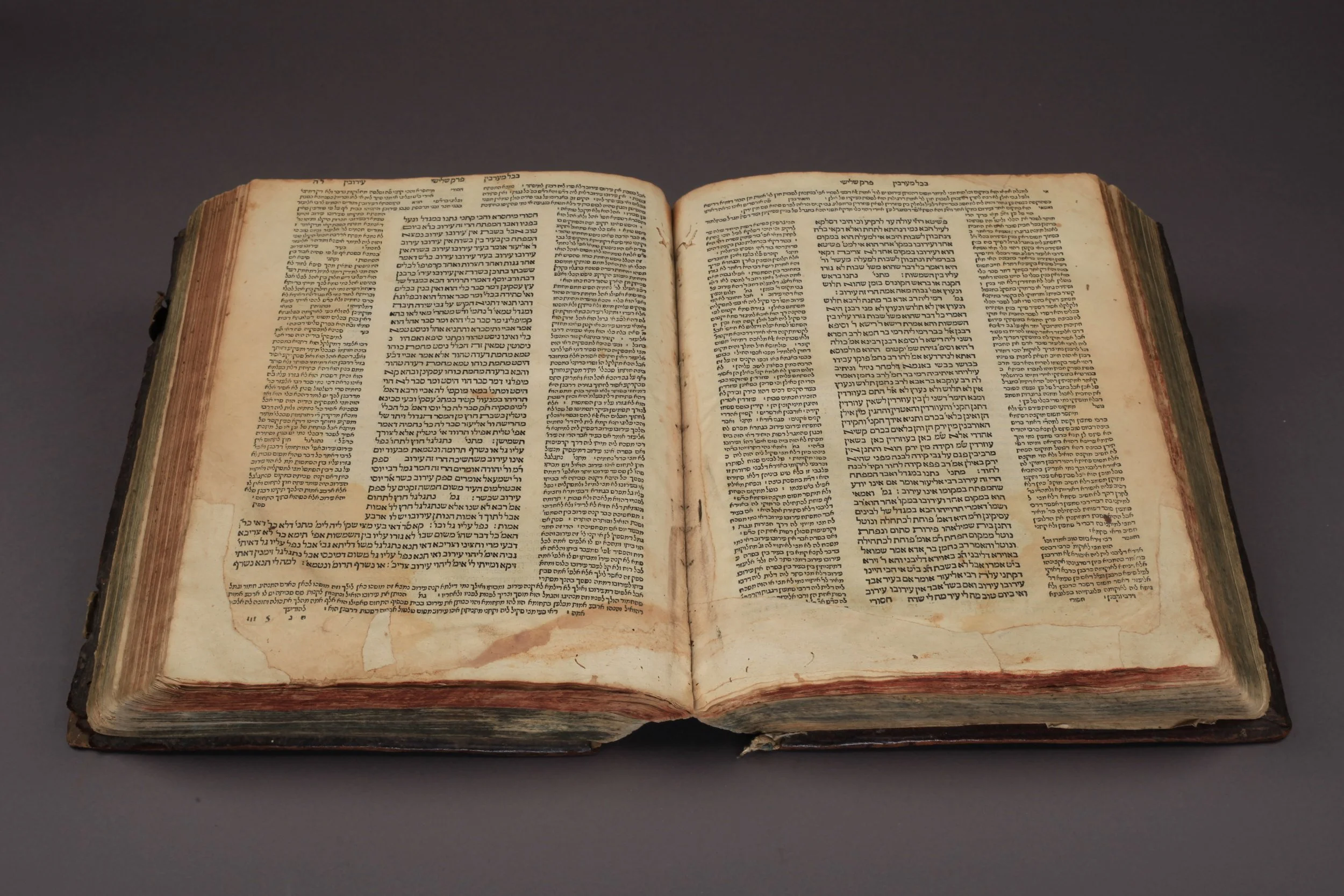
A volume of Talmud on display in the Jewish Museum of Switzerland in Basel. The volume brings together parts from the first two Talmud prints by Daniel Bomberg and Ambrosius Froben. CC BY-SA 4.0
This essay is part of a 2025 AJS Conference Session devoted to Bavli studies. Read the full forum here.
I’d like to begin by reflecting on the phrase “Bavli Studies,” which appears in one of the questions the panel’s conveners have composed for our consideration (“How might new conceptions of the Bavli point the field of Bavli Studies in new directions?”). What is “Bavli Studies”? I must admit that in all the years I’ve studied the Bavli, I never thought about what I was doing as being part of a field (or subfield?) called “Bavli Studies,” and I’m interested in pondering the label and its implications. An argument can be made for an expansive “Bavli Studies,” a category that includes any research project that touches on the Bavli, such as various types of historical reconstruction pertaining to the Babylonian Amoraim in their times and places—social, economic, political, cultural. But should such research agendas perhaps be more accurately subsumed under a category labeled “late ancient Irano-Jewish Studies,” “late ancient Babylonian Jewish Studies,” or even simply (depending on the project) “late ancient Iranian Studies”? Is it “Bavli Studies” when a scholar uses the Bavli (however methodologically careful and precise the work) as a source of data for research that is not about the Bavli per se? To me, “Bavli per se” means the study of the Bavli as a literary compilation in and of itself, whether at the macro level of the whole, or at any level down to that of the formation of the sugya or even the formulation of the Amoraic memra. An argument can therefore also be made for a more finely tuned “Bavli Studies” that is about the “Bavli per se.” The broad underlying question animating this finely tuned Bavli Studies would be: “What about this research contributes to our understanding of what makes the Bavli the Bavli?” Turning this finely tuned definition on myself for illustrative purposes, my book A Talmud in Exile: The Influence of Yerushalmi Avodah Zarah on the Formation of Bavli Avodah Zarah (2nd digital ed.; 2020) is most certainly Bavli Studies while Charity in Rabbinic Judaism: Atonement, Rewards, and Righteousness (Routledge; 2019) is most definitely not, although arguably (and hopefully, from my author perspective) the latter contains material that can contribute to Bavli Studies.
Bavli Studies and the Talmud’s Formation
The multi-decade surrender over the course of the twentieth century of various preconceived and inherited notions about the rabbis and the emergence and purpose of the Bavli has been salutary for Bavli Studies of this formative period. This surrender has allowed for and been accompanied by increased attentiveness to reading and analyzing the Bavli’s own text and reasoning inductively from those analyses about its formation. This attentiveness itself has also been refined. Much of the scholarship of the twentieth century (into the twenty-first) has revolved around a study of the ubiquitous, dynamic, and elusive Bavli stam—the identity of which (not necessarily of “whom”) continues to evolve in scholarly discourse.
Scholars have asserted explicitly or assumed tacitly that the Bavli stam—however they understand it—is the key to the Bavli’s formation. Ideas about the stam (or efforts to elide the stam) have emerged in academic discourses that do seem to be in tension with each other. Consider this non-exhaustive list of names of important scholars of the Bavli: Neusner, Halivni, Friedman, Hauptman, Kalmin, Brody, Vidas, Septimus. These scholars cannot all be right at the same time. In a related yet distinct inquiry, some of these as well as other scholars focus on the Bavli’s adaptation and reuse of earlier as well as contemporaneous sources or motifs.
Scholars have long recognized that the Bavli was certainly not formulated de novo in late ancient or early medieval Sasanian Iran. As just one example, Eliezer Segal published an article entitled “Anthological Dimensions of the Babylonian Talmud” nearly thirty years ago. To date scholars have examined the Bavli in relation to Second Temple literature, Yerushalmi, Tosefta, Tannaitic midrashim, Amoraic midrash compilations, Iranian law and lore, and Eastern Christian literature. Apropos, Shai Secunda is currently studying what he refers to as the Bavli’s “tangential” passages that range far beyond Mishnah commentary.
The idea of the Bavli as a compilation the creativity of which is expressed in large part through the incorporation and reworking of other sources invites comparison with other possible examples of late ancient compilations that may have also been formulated in this way. There are suggestive recent efforts to do just that (such as Monika Amsler’s recent book) with scholars drawing, among other methodologies, on the burgeoning field of book history.
The common thread running through all these projects on the Bavli’s adaptation of other sources is the scholarly realization that as creative as the Bavli is, that creativity is at least partly (a big part) expressed through the incorporation and reworking of other sources, whether texts or motifs. There are methodological variations within these various studies, and these variations exhibit both tension and complementarity. If we focus (again, non-exhaustively) on studies of the Bavli in relation to the Yerushalmi, there are methodological variations worth noting.
First, there have been pendulum swings between different ideas about what the appropriate level of analysis is: from comparing small units of text in both Talmuds to progressively larger ones, and more recently back again to smaller units of text, such as a very recent, learned study of Amoraic memrot shared by a pair of tractates in the two Talmuds. These different levels of analysis are not necessarily mutually exclusive, although they can be, if scholars operating at one level of analysis don’t keep an eye on the findings at the level above or below them.
Second, there also appears to be a pendulum swing about the nature of what is being studied and the direction of incorporation and reworking. As to the nature of what is being studied, Shamma Friedman’s (and others’) highly textualized model of “early talmud” (“talmud kadum,” although it also went by other similar names) that passed from the land of Israel to Babylonia is giving way to a dynamic model of transmission of “proto-sugyot” (smaller units) that constantly moved back and forth between and were repeatedly reworked within the two rabbinic centers.
This dynamic model sees textual incorporation and reworking as moving in two directions, with Babylonian reworkings influencing sages of the land of Israel as well as the reverse. The dynamic model seems to me to be a sort of contrapuntal model of rabbinic textual development: the independent melodic lines of the land of Israel and Babylonia become dependent on one another, remaining distinct while creating something new together. The dynamic model can be exegetically illuminating in discrete cases. I would also observe that it is a methodological approach befitting the internet era, in which texts of various sizes circulate constantly and are perpetually being de- and recontextualized.
The dynamic model, however, seems to me inadequate to explain large inter-talmudic parallel sequences of sugyot. These are cases in which a sequence of two or more sugyot in the Yerushalmi appear as a sequence in the Bavli, with the sequence as it appears there having demonstrably been reworked in what I and others have noted to be characteristic ways. One example of this I have recently studied is yYoma 1:1, 38a–c and bYoma 2a–14a’s adaptation and reworking of a large sequence drawn from it. In this case, the dynamic model of a constant back-and-forth between the two rabbinic centers is less convincing than the hypothesis of land of Israel material that was adapted and reworked in Babylonia (for details, see the forthcoming article).
The dynamic model is also less useful in explaining some phenomena associated with large inter-talmudic parallel sequences. One such pertinent associated phenomenon I’ve recently explored is what I’ve called the Bavli’s “reflective adaptation” of Yerushalmi material, specifically, the Bavli’s reflection on Yerushalmi legal thinking found in Zera’im and Kodashim sugyot (located in many Yerushalmi tractates) and its focused adaptation and creative application of that legal thinking in its own tractate Temura.
How can we answer the question: “What is the Talmud?” What do we (think we) know? I suggest we know at least five things: (1) The Bavli has no self-awareness as a compilation; (2) The Bavli is not obviously (or even “obviously not”) the product of the Babylonian Amoraim; (3) The Bavli is formulated in large part through the incorporation and reworking of other literary sources and motifs, not all of them rabbinic; (4) Babylonia produced the Bavli. Babylonia did not formulate midrash compilations outside of the Bavli, as did the land of Israel vis-à-vis the Yerushalmi; and (5) The Bavli reflects upon and selectively adapts a large quantity of texts, sequences of texts, and legal thinking found in the Yerushalmi. We do not know whether the Bavli as a whole was intentionally produced as a literary compilation, or even if there was intentionality in the production of discrete tractates (and whose was the alleged intention?). Focusing just on the Bavli’s relationship to land of Israel learning, the Bavli now appears—whether intentionally or not—as a successor to and master synthesis of Babylonian and land of Israel rabbinism. The Bavli’s production, in hindsight, also marks a transition from Jewish late antiquity to the Jewish early Middle Ages. This brings me to a few closing remarks about a second agenda item for Bavli Studies: a (necessary) focus on reception history.
Bavli Studies and Reception History
Reception history should be recognized as a subfield within Bavli Studies. Studying the Talmud’s reception history helps us answer the question “What is the Talmud?” from the perspectives of generations of post-talmudic scholars and non-scholars in various Jewish cultures. That is a big question, and there are still many smaller avenues of reception study, some of which have and do receive scholarly attention, and continue to deserve it: how medieval jurists used the Bavli stam as a legal source (or not); the interpretive history of particular tractates; the interpretive history of aggadah; the interpretive history of particular halakhic (legal) concepts in the Bavli; medieval interpretations of talmudic terminology and the possible halakhic consequences of that terminology (e.g., opting for stringent halakhic interpretation when a sugya ends in “teyku,” without resolution).
One broader avenue of reception study that may shed more light on “What is the Talmud?” than these discrete research topics is to trace how the Bavli became law in the Geonic period and later, a topic Ayelet Hoffman Libson has recently explored from within the Bavli itself. And, leaping from the Geonic period to the nineteenth century and then on to the present, the study of the nineteenth and twentieth-century de-legalization of the Bavli in certain streams of non-Orthodox Judaism (notably Reform Judaism) also deserves attention, along with the revival and continual raising of the Bavli’s profile in these streams of modern Judaism as religiously (and not just culturally) significant, even if not legally binding.
In conclusion, one major and simple contribution that Bavli Studies can make as a recognized (sub)field is to bring together scholars studying the Bavli’s formation and those studying its reception history. The resulting conversations and sharing of research will undoubtedly help us understand much better not just the origins, but the continuing long life and changing perceptions of, this core corpus of Jewish literature.
Alyssa M. Gray is the Emily S. and Rabbi Bernard H. Mehlman Chair in Rabbinics, and Professor of Codes and Responsa Literature at Hebrew Union College in New York City.