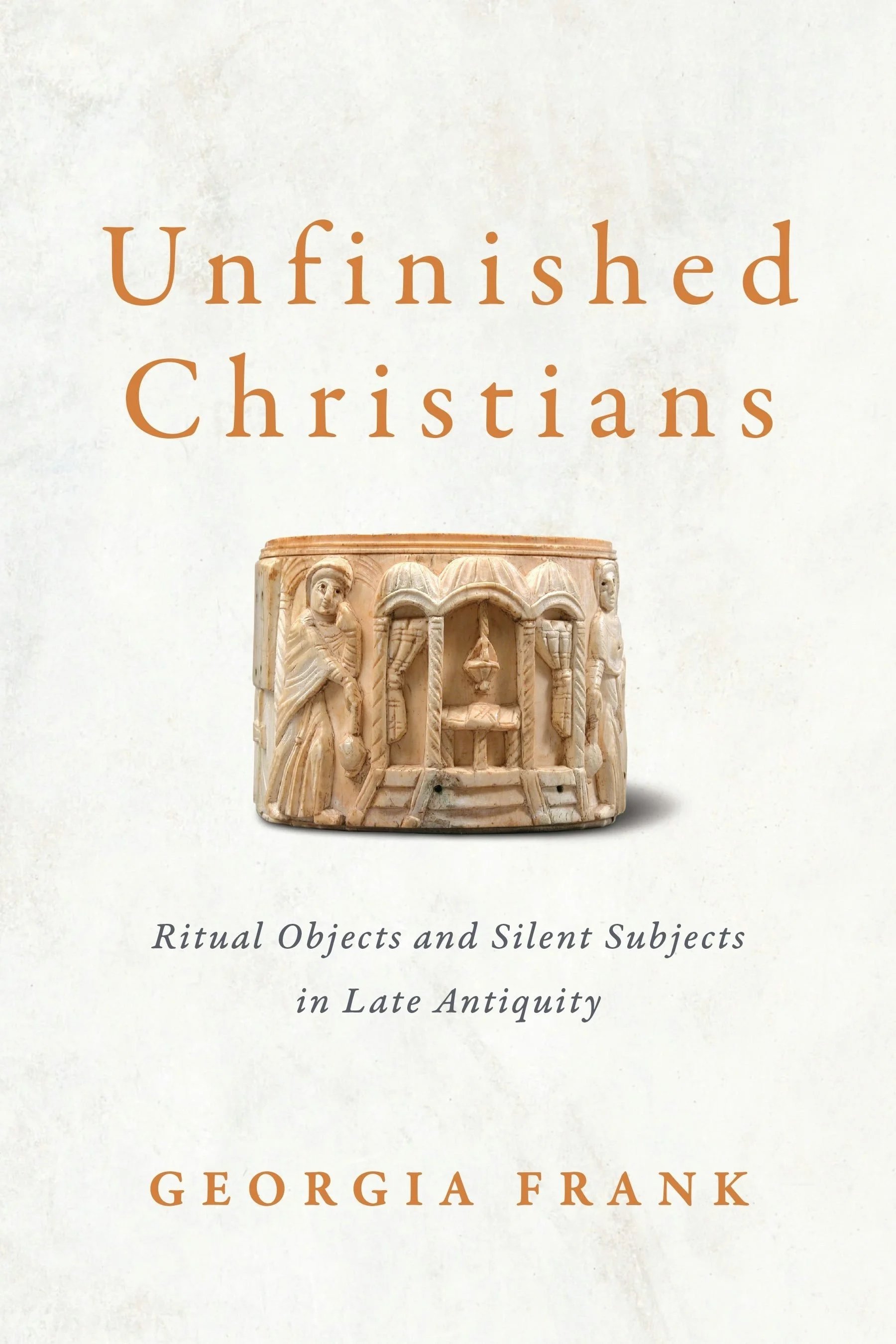
Georgia Frank. Unfinished Christians: Ritual Objects and Silent Subjects in Late Antiquity. Philadelphia: University of Pennsylvania Press, 2023. x + 193 pp.
It is de rigueur in the study of late antique Christianity to lament the elite bent of extant sources. Any attempt to reconstruct the religious landscape of this world must rely on texts and materials which are produced by a narrow slice of humanity—overwhelmingly the monied, the powerful, the literate, and the male. Scholars seeking to peek behind and beyond these perspectives to reclaim the excised voices of “ordinary” believers must confront not only a dearth of sources but also a methodological conundrum. How to find and contextualize, a historically rigorous account of those people to whom our sources pay little heed?
Georgia Frank’s Unfinished Christians offers a brief but substantial entrée into the sort of imaginative and critical reading such a project might require. What can we know, she asks, about the experiences of ordinary believers in antiquity? This project builds upon a larger historiographical tradition that has mined literary artifacts of the elite for traces of believers from across the social spectrum. In Unfinished Christians, Frank focuses on literary records produced in and for shared spaces, liturgical and otherwise, where ordinary Christians would have gathered for various religious rites. Such occasions of assembly provide Frank with an opportunity to reconstruct her ordinary believers, finding in the assemblage of bodies, objects, rituals, and sensations valuable hints about the experiences of the often overlooked, but certainly no less present, faithful.
In Chapter One, Frank lays out her methodological framework and introduces the scope of the project. She defines her “ordinary” subjects as the “nonordained, nonmonastic, and nonaristocratic men and women” who, whether enslaved or free, “did not renounce sex or choose voluntary poverty” (p. 2). Unlike “extraordinary” renunciants, Frank’s ordinary believers are characterized by more mundane concerns. Christian belief and practice in antiquity, Frank reminds us, functioned alongside profoundly earthly affairs like raising children, putting food on the table, and working jobs. We cannot imagine—as many late ancient preachers so clearly hoped—that religious obligations routinely outweighed all others for the massed faithful.
But how to reconstruct the spiritual lives of such folk? Frank draws on the work of sociologically and ethnographically inclined researchers in the field of “lived religion.” She is especially invested in the discipline’s effort to give “voice to non-leaders who may draw sustenance from a religious community or tradition, while engaging with other communities with ease” (p. 7). Embodiment and agency here loom large. By “rematerializing the past”—i.e., attending to the embeddedness of texts in a physical, material setting—scholars may tentatively reconstruct the more experiential dimensions of ordinary Christian life. This re-materialization also invites the reader to imagine how common believers exercised agency in religious settings, whether in wholehearted embodied participation, or in ways more tepid and peripheral.
On this foundation, Frank turns in Chapter Two to examine baptismal spaces and the catechesis that occurred in and around the sacramental event. Frank foregrounds the crafting imagery often utilized by teachers addressing catechumens and the newly baptized. She argues pedagogues “rhetorically remade the baptistery into a workshop… where craftspeople learned a skill through apprenticeship, cooperation, and long periods of training” (p. 22). Whereas the water symbolism of baptism emphasized the drama and finality of salvation (e.g., purification, death, etc.), workshop and crafting imagery intimated the iterative nature of the Christian life and drew upon the resonant logic of technē. Frank here parallels the archaeological evidence of collaborative workspaces—filled with tools, furnaces, unfinished objects, and other residua of manual labor—and baptism as a process and event. She musters evidence from a range of homiletic sources that encouraged Christians to see themselves as objects undergoing a patient, communal, and occasionally messy reshaping into something new. Rather than implying inertness, such imagery invited the believer to “imagine themselves as makers and objects” (p. 39); baptism began a lifelong experience of ongoing becoming in which believers continued the work on themselves that others had begun.
At this point in her argument, Frank considers what she calls portabilia, those objects which people carried or transported during processions like relics, crosses, masks, torches, and even living people (pp. 50-52). Focusing upon such items, Frank argues, helps us recover the agency of the lay individual in processional gatherings. Public processions were a communal means of sacralizing spaces, of proclaiming theological identities and commemorating and reenacting holy events. But they were also composed of manifold agencies, each expressed in the embodied and sensory “micropractices” (p. 41) of holding, bearing, setting aside, and lifting portabilia. In carrying, for example, the body of an ascetic, the ordinary Christian also proclaimed her body to the world as entangled in the physical, sacralizing process (p. 54). To be a Christian was to develop a certain “muscle memory” shaped by the material demands of processional rhythms (p. 56).
Frank turns, then, in Chapter Four to questions of emotion. What feelings might an ordinary Christian have experienced throughout a liturgical year? The chapter surveys the emotional rhetoric of sermons and lectionaries from major feasts of the life of Jesus (e.g., the Nativity, Holy Week, the Ascension). Frank argues that such feasts “engendered mixed emotions” in their audience, from grief and loss to love and joy, often within the same cycle. Thus, for example, Gregory of Nyssa in his homily on the nativity marries admonitions to joy at the birth of the Lord with ekphrastic depictions of the slaughtered innocents and their grieving mothers (pp. 58-63). Likewise, examining Palm Sunday homilies, Frank observes that grief, especially, could be an “open wound, which the homilist poked and reawakened” even amid more jubilant celebrations (p. 65). Such affective admixtures served to anchor believers in multiple sacred temporalities. An ordinary believer, crafted by the emotional range of the liturgy, might find herself at once overwhelmed by the elation of the resurrected Lord, and sorrow at his bodily sufferings on the cross. Overlapping emotions mediated the trans-temporality of Christian worship.
Chapter Five examines the experience of nighttime vigils, focusing on the sixth-century Romanos the Melodist’s depictions of the practice. Frank reads vigils spatially, as places where “darkness, imagination, ignorance, and a host of emotions commingle[d]” (p. 85). The night was often the space for dark and unsavory emotions—bewilderment, disgust, envy. These negative affects, Frank observes, were often gendered. Romanos’s nighttime “dark dramas” are filled with “effeminate underworld villains” and scheming women (p. 89). With negativity, nevertheless, came intimacy. Christian rhetoricians made use of the dark to invite believers into the hidden thoughts and conversations of biblical characters. What was unsettling in scripture could become the occasion for familiarity and catharsis among the obscured faithful.
Unfinished Christians is a beautiful, albeit brief, reconstruction of the sensory, affective, and embodied experiences of lay believers in late antiquity. Frank offers a way of gently wresting from elite sources the experiences of common people. Such a project begins, she notes in her conclusion, by recalling that elite ideas and practices were always heard and engaged by the non-elite. Nevertheless, this act of sympathetic and inverted reading is marked by the irreducible challenge of silence. The space between elite pronunciation and lay reception is ephemeral, and Frank’s argument often proceeds by suggestion rather than outright demonstration. It is difficult to draw clean lines between a sermon’s rhetorical aims and its precise effect on an audience; just because, say, Gregory of Nyssa evokes horror and mourning with his descriptions of murdered children does not necessarily mean we can posit an exact correlation in the emotional register of his audience. I wonder if Frank, in fact, allows for enough lay agency in ignoring and resisting the emotional-rhetorical regime of liturgical events. Furthermore, despite its subtitle, Unfinished Christians does not analyze ritual objects in any great depth. Frank relies mostly on second-hand descriptions of objects, often from ancient sources with their own agendas. The inclusion of a few close case studies of extant materials might have strengthened Frank’s argument, providing another avenue by which to consider lay experience and agency.
Ultimately, however, Unfinished Christians succeeds as a model of inspired inquiry and inventive scholarship. Frank reminds us that our extant sources can open onto experiential worlds that perhaps even their own authors did not entirely grasp. This work thus proves vital not only in offering an answer to what ordinary believers might have experienced but also in providing a way forward for scholars to continue engaging this generative question.
Ethan Laster is Assistant Professor of Theology and Church History at Oklahoma Christian University, and a Ph.D. Candidate in Theological Studies at Saint Louis University. His research focuses on monastic conceptions of prayer in the Christian East, with a particular interest in embodied and material forms of private devotion.