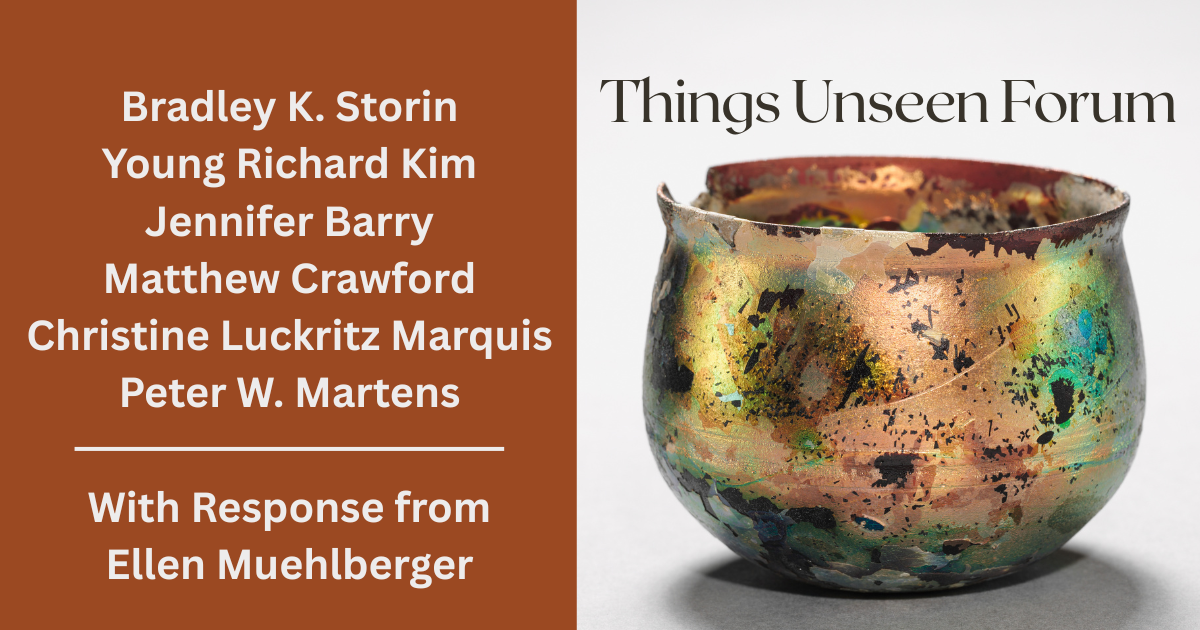
Ellen Muehlberger’s latest monograph, Things Unseen, reminds readers that knowledge is a product, the output of an intricate machine. The “Knowledge Machine” (to borrow the title of Michael Strevens 2020 book) is sophisticated, with as many cogs, regulators, pinions, gears, gimbals, switches, widgets, and valves as variation in the knowledge-products it creates.
by Jennifer Barry
Let’s begin where Ellen Muehlberger does. In the very first chapter, she introduces a scene that is deceptively ordinary: a boy, about fourteen, sitting in a classroom somewhere in the late ancient Mediterranean—Antioch, perhaps—who is working through an assignment. He is asked to compose a speech in character, to answer a question that is both precise and conceptually unstable: “What would a prostitute who has come to her senses say?”
I recall being a newly minted PhD, well over a decade ago, trading Syriac vocabulary decks with Ellen, whom I regarded as an established scholar in the field. Several years later, I received insightful comments from her on translations I contributed to the series Cambridge Edition of Early Christian Writings, which she and Brad edited. It is, therefore, an honor to return the favor today by engaging with her work in this forum. Let me also say I am pleased to see an entire session devoted to her book.
In the lead up to this conference, a very good friend at a similar career stage as me, texted to ask me about the new registration tiers for the North American Patristics Society. Registrants are asked to categorize themselves as “established,” “junior/standard,” or “senior scholar.” Without hesitation, I assured my friend that we were both “established,” although it got me to thinking about when we might be obliged to claim “senior scholar” and swallow its higher registration fee. Certainly, there was no doubting that we are not “junior,” even if I wrestled for a bit at what “standard” means.
Mummy Portraits and the White Gaze
In her latest book, Ellen Muehlberger asks us to sit in the tensive space between knowing and seeing. Throughout her faux-lecture series turned collected essays, she presses on how “ancient people knew differently.” While the first three chapters explore how late ancient Christians used what they “knew” to find evidence and create a vision of others and themselves, her fourth essay turns to our own engagements of the past. She eloquently shows how what we “see” – such as Egyptian Fayyum funerary portraits – offers us an illusion of “knowing” ancient peoples, when in fact what we witness is evidence of our own modern fixation on “individuality, essence, and truth in faces.”
By now, if you have read the other posts in this forum or even just the preface to my book, you know that Things Unseen is built around a gimmick. I have always liked the kinds of books that had started out as lectures in an invited series, and as I started doing more of my own writing, I really liked the register and tone they seemed to license in their authors. With no invitation on my desk, though, and none in the mail, I decided to just skip ahead to writing a book as if it had started out as a series of lectures. Strictly speaking, then, my book is a fake.
A thread of modern literary theory runs through this book: that the texts and images early Christians produced – their accounts of women (Chapter One), of forcible home entries (Chapter Two), and of the authorship of worrisome letters (Chapter Three) – did not reliably represent reality to their readers, or even back to themselves, and certainly not to us. These were, instead, constructions designed to meet their authors’ own needs. So many Things are Unseen.