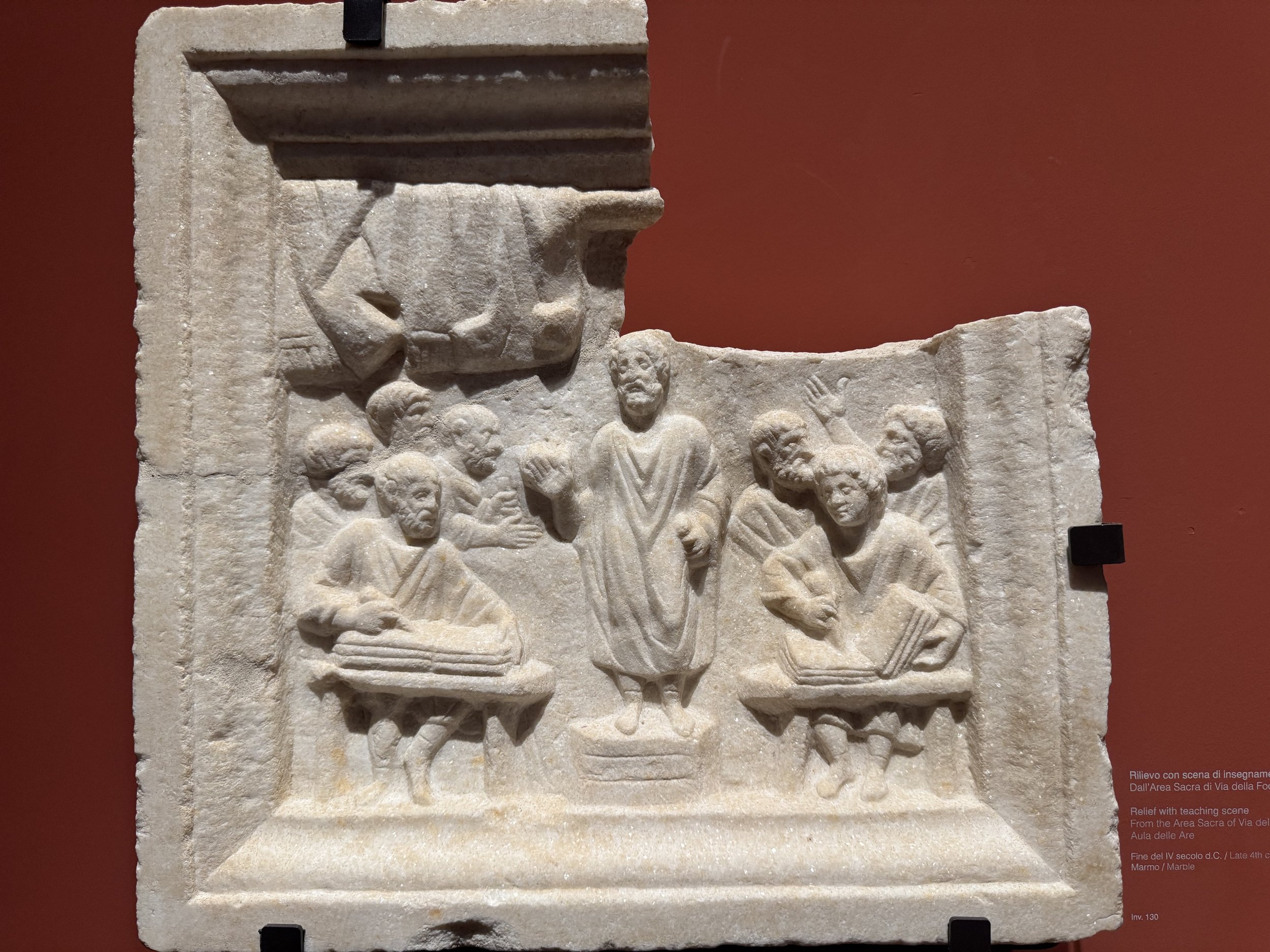
Relief of an orator, scribes, and an audience, late fourth century CE. [Image courtesy of the author].
This essay was part of a 2026 NAPS Conference Book Review Panel devoted to Things Unseen: Essays on Evidence, Knowledge, and the Late Ancient World by Ellen Muehlberger. Read the full forum here.
I recall being a newly minted PhD, well over a decade ago, trading Syriac vocabulary decks with Ellen, whom I regarded as an established scholar in the field. Several years later, I received insightful comments from her on translations I contributed to the series Cambridge Edition of Early Christian Writings, which she and Brad edited. It is, therefore, an honor to return the favor today by engaging with her work in this forum. Let me also say I am pleased to see an entire session devoted to her book. A colleague recently highlighted an increase in the number of book review sessions at the annual meetings for the North American Patristics Society in recent years. I think this is a positive trend, since it provides opportunities for sustained conversations about major contributions driving our field forward, as this book aims to do. In this response, I will devote my attention to Chapter Three of Things Unseen, first laying out its argument and then offering an assessment.
Like the rest of the book, the third chapter examines ‘things unseen’ in late antiquity, but the nature of the unseen object differs from those in earlier chapters. Chapter One concerns something that historically was present but was tragically overlooked – the personhood of women; Chapter Two highlights something real but typically unseen until violently made public by Christian intruders – the private space of one’s home, thought to reveal the state of one’s soul. In both of these cases, there was in fact a ‘thing’ that Christians at least thought they were seeing, even if they failed to do so or did so in deeply problematic ways. In contrast, Chapter Three argues for the existence of something that was unseen even by ancient Christians themselves, a new kind of being of such immense significance that its effects cannot be missed, even if we cannot glimpse it directly. Ancient persons themselves had no name for this new being, so Ellen offers us one inspired by the comic book character Dr. Manhattan: the “superfather” (p. 102, fn.21).
The chapter focuses on the Second Council of Constantinople held under Emperor Justinian in 553 and the way it positioned itself in relation to the legacy of Cyril of Alexandria. The account begins by noting that many scholars have ignored this council, while those who have studied it regard it as bizarre and lamentable (p.90-91). The chapter’s main claim is that once we insert the character of the “superfather” into the narrative, the ‘history’ of the council “make[s] sense” (p.119), with the lamentable or bizarre elements rendered explicable when set in their historical context. The kernel of the problem the chapter takes up is the fact that the council decreed the letter of Ibas to Mari, one of Justinian’s infamous “three chapters,” to be a forged text, despite the absence of prior suspicion of its authenticity and of any cogent argument adduced at the council to support this bold claim. This unprecedented development occurred, so Muehlberger argues, due to the elevation of Cyril from merely a father to a “transtemporal guarantor of orthodoxy” (p. 92), in short, a superfather. The chapter provocatively presents this as not merely a claim about literary discourse but instead ontology and metaphysics. This was the moment when ‘this new kind of being came into existence’ (p. 92), thanks to the ‘metaphysical structure’ in Justinian’s mind (p. 117-118, fn.64).[1]
What are the characteristics of a superfather? First, in place of a normal human body, the superfather exists as a body of texts curated by later readers that can expand as more texts are spuriously attributed to him. This later corpus has at most a loose connection with the historical figure and, in fact, it obscures him. Second, the superfather bends time around himself. As someone incapable of error, he must have anticipated later theological judgments with perfect accuracy and earlier texts must be read as mere precursors to his inerrant views. Anything the superfather said that conflicts with ideas later deemed authoritative and orthodox must be rejected as forgeries. Similarly, anyone who spoke against the superfather must, ipso facto, be incorrect. Hence, to return to the presenting issue, because Ibas criticized Cyril’s use of the phrase “one nature” (mia physis) but was declared orthodox by the Council of Chalcedon, his letter must be inauthentic.
With this summary of the key arguments in place, I turn now to my response. Ellen has presented the “superfather” as an attempt to make sense of puzzling historical material, so a good place to begin is to ask what degree of explanatory power this theory possesses. My overall sense is that, while this chapter rightly provokes us to reassess our standard accounts of Constantinople II, thinking of this event in terms of the influence of a ‘superfather’ is of limited utility, both because the category is too generic to have analytical purchase and because it obscures the most significant factors that influenced the outcome of Constantinople II.
Consider, first, the definition of the “superfather.” The characteristics highlighted here would apply to almost any ancient author, as understood by their later followers. Indeed, early in the chapter Ellen quotes Cyril’s own description of Athanasius as someone who could do no wrong and whose antiquated comments presciently addressed the current theological crisis. Is, then, Athanasius the first superfather or is Cyril, as this chapter argues?
Moreover, such attitudes are not distinctively Christian. Recently I was reading with our doctoral students the famous passage in which Plotinus asserts that his understanding of the three divine hypostases was exactly what Plato himself believed, though Plato never said so explicitly (Enneads 5.1.8). Plato, then, seems to have been a ‘superfather’ for his followers. Nor is this an exclusively ancient phenomenon. I suspect Ellen would agree with me that a certain strand of modern scholarship on ancient Christianity exhibits what the Australian philosopher John Passmore called ‘retrospective history,’ the tendency to evaluate all developments in intellectual history in light of the unparalleled genius of a single man whose ideas provide the standard against which all predecessors and successors are measured.[2] In other words, the superfather dynamic is a widespread tendency evident among both ancient and modern readers which has long been recognised, albeit not under that specific label, and it is not clear to me what new insight is gained by coining this term for it.
Furthermore, if another characteristic of the superfather is that he draws spurious texts to himself, creating a literary body that blots out the historical person, there are other candidates who are a much better fit. Yes, a fair number of spuria attributed to Cyril survive, but none of them played any role in Constantinople II and many, many more spuria were assigned to other figures like Athanasius and Chrysostom. On the contrary, the immediate reception of Cyril’s legacy shows an intense concern over the most minute details of his unquestioned corpus (see the Chalcedonian Florilegium Cyrillianum and Severus’ response in his Philalethes), not a desire to create new texts for him. Indeed, I know of not a single spurious text attributed to him in the period between his death and Constantinople II that played any role in the conciliar proceedings or the debates surrounding it. In short, the criteria this chapter adduces to distinguish the ‘superfather’ from the wider group of revered ‘fathers’ are too broad. Something more specific is needed if this category is to have analytical purchase.
In addition, the category of the “superfather” seems unsuited for the specific test case of Constantinople II when one considers several aspects of the history that are overlooked or misconstrued here. I bristle somewhat at the summary of the Council of Ephesus in the chapter’s opening as the place where ‘the nature of Christ’s human mother was established’ (p. 88); on the contrary, the issue debated there was the nature of Christ not of his mother. Yes, the conflict with Nestorius began as an argument over the propriety of calling Mary theotokos, but all participants in the debate understood the import of the term to be a claim about the person born from her, not about Mary herself.
Moreover, the chapter, like so many standard scholarly accounts of this debate, hinges on Cyril’s use of an Apollinarian forgery that included the phrase “one incarnate nature of the Word.” According to Ellen, Cyril argued “that all Christians should agree” in affirming the phrase, as if he made this the standard of orthodoxy (p. 100). However, Hans van Loon demonstrated in his 2009 monograph that Cyril was never particularly attached to it, nor did he attempt to impose it on anyone else.[3] The phrase does not even appear in his Third Letter to Nestorius, which was the target of Ibas’ critique. On the contrary, Cyril argued that the competing phrase ‘two natures’ should not be rejected simply because Nestorius used it.[4] It was actually Cyril’s more extreme supporters who latched onto the phrase and made it a shibboleth of orthodoxy, a tactic that proved to be so successful that many scholars today continue to assume incorrectly that mia physis was the hallmark of Cyril’s own Christology. Furthermore, it is not at all clear, as claimed here, that “everyone [at the time] recognized [Cyril’s usage of the phrase] as an anomaly” (p. 103) and that it was a “blatant misattribution” (p. 115). Rather, his quotation of the Apollinarian forgery as an Athanasian text went undetected for years and is not even clearly mentioned in Ibas’ letter.[5]
Now, it is true that Cyril’s legacy was controversial in the century between Chalcedon and Constantinople II, and the correctness of the phrase mia physis was no small part of that debate. However, rather than unpack the contested meaning of the phrase in this controversy, Ellen comments in a footnote (p.100, fn.18) that “narrating [the details] here does not seem to help my point,” presumably because, as she says elsewhere, when one is dealing with a superfather, “the more the name came to mean, the less the content of what was said underneath that name actually mattered” (p. 98). But it is question-begging merely to assert the details do not matter when a major part of the argument is precisely that the theological content is irrelevant for the historical material being analyzed. That case is not proven by this chapter, and it may well be that the content of texts instead becomes more important rather than less in the presence of a superfather, if we allow that category.
What were the most significant factors influencing the outcome of Constantinople II? I propose there were two. First, if anyone deserves the ‘superfather’ title in relation to this council, it was surely Justinian himself, though to do so we must redefine the term as a claim about historical influence and not metaphysics. For all the inadequacies of the “great man” approach to history, it remains true that some figures did wield enormous influence to determine the course of events, as clearly illustrated by this council. Some of what scholars have labeled ‘bizarre’ or ‘lamentable’ were the actions of an emperor who intervened to an unprecedented degree to ensure his desired outcome, yet Justinian plays a minor role in this chapter.[6]
The second factor was, in one sense, yet more powerful because it constrained even Justinian himself – the boringly bureaucratic conciliar acta. Richard Price’s introduction to his translation points us in the right direction: at the heart of this event is the question of how to interpret earlier councils, a problem that presented itself in a novel and acute form due to developments in the council as an institution.[7] We have to recall that not all councils produced acta. The first ecumenical council with surviving acta was Ephesus in 431. Chalcedon subsequently produced its own acta, which then circulated alongside those of Ephesus.[8] Hence, at Constantinople II, for the first time, an emperor and bishops had to deal with acta from two councils that had long been in circulation and were not in all respects easily reconcilable.
This explains why the case of Ibas was such a difficult circle to square. Cyril’s Third Letter had proven incendiary to those in the orbit of Antioch from the moment it was published in late 430 but, remarkably, by the time of Constantinople II it was regarded as unimpeachably orthodox by everyone, not only among Miaphysites but also eastern and western Chalcedonians.[9] It had attained this status not because it was written by Cyril the “superfather” but because it had been included in the acta from Ephesus which was accepted by all the participants in this debate.[10] Chalcedon, however, had confirmed the orthodoxy of Ibas, who had written one of the most public denunciations of the letter, though without commenting on the specific question of whether his critique of Cyril’s letter was legitimate.
Hence, by the mid-sixth century, the acta provided evidence that Chalcedon had approved the orthodoxy of someone who had condemned a canonical document from an earlier ecumenical council. What was one to do in this situation? Justinian did not have the option of setting aside the judgments of either Ephesus or Chalcedon, since the authority of both had been firmly entrenched through various strategies of memory-formation and textualization in the acta. Faced with this unprecedented situation, the Emperor resorted to an unprecedented measure, declaring Ibas’ letter to be a forgery. This was a creative strategy that neatly resolved the issue while leaving the authority of both acta intact. I suspect it was not persuasive to anyone at the time, but all the participants in the council went along with it nonetheless, probably because they had seen how Pope Vigilius had suffered for his recalcitrance in the face of Justinian over the previous six years. In other words, the bizarre turn this council took does indeed make sense when one inserts the “superfather” as an actor in the story, but the superfather was the Emperor, not Cyril, and it was not time that he bent around himself but the agency of the other actors involved.
But on a more fundamental level, the most influential force operating at this council was not something hidden, but something that had grown so obvious it could not be ignored – a complex textual archive consisting of the sedimentation of theological deliberation and political negotiation stretching back more than a century that could no longer convincingly be regarded as self-interpreting but which nonetheless was taken to represent a unified tradition. Hence, focusing on Cyril, or even Justinian, as the “superfather” risks individualising a structural and institutional dynamic that emerges in a new and condensed form at this historical moment and would have long lasting impacts.
My remarks here have admittedly been critical, but I hope fairly so. In closing let me once again thank Brad and Ellen for the chance to read this book and join the discussion since doing so has already helped me to understand better the history of what became the fifth ecumenical council and to think more broadly about the hidden forces at work in early Christian knowledge construction.
Matthew R. Crawford is a Fellow of the Australian Academy of the Humanities and a Professor in the Institute for Religion and Critical Inquiry at Australian Catholic University in Melbourne where he serves as Director of the Program in Biblical and Early Christian Studies. His current book project is a brief history of technological innovation in ancient Christian literary culture.
[1] Cf. p.113 “…the merely literary pass[ed] into the ontological.”
[2] “No historian, of course, can anticipate how philosophy will move, but the retrospective historian is committed to denying that it can move at all” (John Passmore, ‘The Idea of a History of Philosophy,’ in The Historiography of the History of Philosophy [Mouton & Col., 1965], 25).
[3] Hans van Loon, The Dyophysite Christology of Cyril of Alexandria (Leiden: Brill, 2009).
[4] See especially his ep. 44 to Eulogius in which he says one should not reject everything the heretics say, because some of what they say is true, specifically referring to Nestorius’ use of the phrase ‘two natures’. He goes on in the letter to argue that the Easterners express the same faith as him but use different terms to do so, though he finds their terms to be less exact and precise than the ones he prefers.
[5] On this point it is critical to distinguish between the heresiological accusation of being Apollinarian and Cyril’s use of the pseudonymous Apollinarian work. Nestorius and his allies claimed to have uncovered crypto-Apollinarians in Constantinople before Cyril ever involved himself in the conflict (see, e.g., Nestorius’ three letters to Celestine; cf. Matthew R. Crawford, ‘A Battle by Night? A Revisionist Account of the Early Stages of the Nestorian Controversy,’ JTS (2026): forthcoming). After Cyril published his Third Letter to Nestorius, they turned this accusation against him, though without any reference to his use of the pseudonymous text. In keeping with this strategy, Ibas’ letter accused Cyril of being an Apollinarian and it is possible that, when he asserts ‘Cyril even wrote like Apollinarius’ (Cambridge Edition of Early Christian Writings, Volume 3, p.727), he has in mind Cyril’s use of the Apollinarian source, but other interpretations are possible, especially in light of the fact that Ibas’ letter is not very precise. He claims that Cyril used the contested phrase ‘one nature’ in his Third Letter (p.728), when in fact it did not appear there.
[6] Justinian receives a passing mention in n.25 on p.104 and in a brief discussion about the legitimacy of posthumous condemnation on pp.117-18, but his domineering influence on the council is nowhere adequately reckoned with.
[7] Richard Price, The Acts of the Council of Constantinople of 553 with Related Texts on the Three Chapters Controversy (Liverpool: Liverpool University Press, 2009), 97-98.
[8] The Second Council of Ephesus in 449 with its acta had of course aspired to be an ecumenical council but had its judgments overturned at Chalcedon two years later.
[9] Price, The Acts of the Council of Constantinople of 553, 68-69. Cf. Price, The Acts of the Council of Constantinople of 553, 95.
[10] Possibly via interpolation. See Price, The Acts of the Council of Constantinople of 553, 67; Richard Price and Thomas Graumann, The Council of Ephesus of 431: Documents and Proceedings (Liverpool: Liverpool University Press, 2020), 220-21.