Most of my students will not be biblical scholars. Perhaps none of them will be. (I am not sad about that fact, by the way.) I hope, however, that they will engage with the Hebrew Bible after our introductory course together, or at least remember their time with it fondly. Present company excluded, most students do not remember writing research papers for class fondly, particularly research papers for compulsory introductory courses. Out of my deep desire to leave my students with positive lasting memories for the ancient texts that I love, I have permitted my students to present their research in forms outside of the traditional research paper. Out of all of the final project products my students have chosen to produce, my research-informed poetry has proven the most compelling way to present not only their capacity to do biblical research but their deep insights on biblical texts.
Assignment Structure
I structure the final project assignment to emphasize process over product and encourage risk-taking. Conducting research on the Bible is the cornerstone of the project. Over the course of a 14-week semester, the students work through a six-part assignment:
Reflect on Degree Objectives and Dream- Course and degree objectives occupy a part of the syllabus that students have become accustomed to skipping over on their way to figure out what products they need to produce by certain dates. Before my students begin dreaming about what product they might want to produce, I want them to think about the broader objectives of their degree and the course. (We spend a lot of time thinking about those as instructors!) Rooting themselves in the objectives, they can begin to dream about a project that can align with those dreams. In order to get their imaginations working, I provide them a list of ideas for their projects. I am surprised by how many students require strong encouragement to try something other than the traditional research paper. Adult learners can be intimidated to play and experiment.
Meet with the Instructor- Having reflected on the degree and course objectives and dreamed of potential projects, the students meet with me. My approach is to always say “yes” to their ideas even if I have to follow that “yes” with an “and” for ideas that are too simple or underdeveloped. In my experience, however, I often need to help students narrow their projects into something achievable in one semester. For students working non-traditional academic products, I work with them on how they can cite their research in the form they have chosen and what a draft looks like for their project. I assess students on their preparation for this meeting including the depth of their reflection on the objectives.
Develop an Annotated Bibliography- I expect students to reflect deeply on the quality of their sources and what role they play in their project. For students who are trying a style of writing or product that is new to them, I encourage them to add a resource on the form (e.g. a book on how to write a lyric essay or podcast). I assess the students on the quality of their source selection for their project and their assessment of the sources.
Draft- Students spend several weeks drafting their work. I encourage my students to be in touch as they work through various challenges in their projects. Reading and commenting on these drafts is by far the most labor intensive part of this assignment on the instructor side. It is worth the time to see the revised products (too often as professors we provide feedback and never know if the students read it).
Revise and Resubmit- Equipped with my copious notes, students set off to revise their work. I assess the students on the extent to which they incorporate the feedback and improve the quality of their draft. I offer less extensive feedback on the final project than I do on the draft.
Reflect- After submitting their final project, I ask them to complete a self-evaluation worksheet on the process they went through for their final project.
A note on assessment: I provide the students with a rubric structured around the various steps in the process at the beginning of the semester. I provide them feedback through that rubric after each step of the process. (See rubric linked above along with the description of the project.)
Context
I use this assignment in my introductory course on the Hebrew Bible in a graduate seminary setting. Students completing various degree programs take my course as either a required or elective course for their program. This assignment works well for instructors who want their course to be cross-listed for various degree programs. This type of assignment works best for small classes where the instructor has the capacity to conference with each student and maintain close contact with them as their project develops. This assignment does not work for Hebrew Bible courses that fulfill the research-writing component of an undergraduate curriculum. While I use this assignment primarily with graduate students, I have had undergraduate students from the college connected with the seminary. One of the poems I highlight below was written by an undergraduate student.
Highlighting Poetry
The assignment as described above might not work in every setting, but offering students the opportunity to respond to the Bible through poetry could be implemented in shorter assignments that do not take the place of the traditional research paper. I offer a few examples of how students have used poetry in their final projects below. All the student work featured is done so with their express permission.
Poetry is a particularly fitting medium for responding to the so-called “texts of terror” and building our students’ capacity for empathy.[1] In a book of poetry focused on the dual themes of memory and destiny entitled “The Silver Cord,” Cameron writes about Judges 19–20, the story of a Levite who dismembers his concubine. I appreciate how Cameron attempts to imagine the interior life of a character in the story who is never given a voice. Through his poem, Cameron re-members her by giving her memory.
Judgement
In those days
She would dream
About the wild olive trees
All around Jerusalem,
And she was glad
To have seen them once,
If only once, and not again.
If this was what
Being broken was like,
Then she had no answer
To what they all asked.
There were no simple things
About this world —it was
All unknown, and all a blurring
Weight upon her, heavy, and
Stone-like, as the sun standing
Still in the desert drifts.
So she did not wonder much
About this way of being—
But she did wonder, as she was
Being cut apart, if this was
What she was made for.
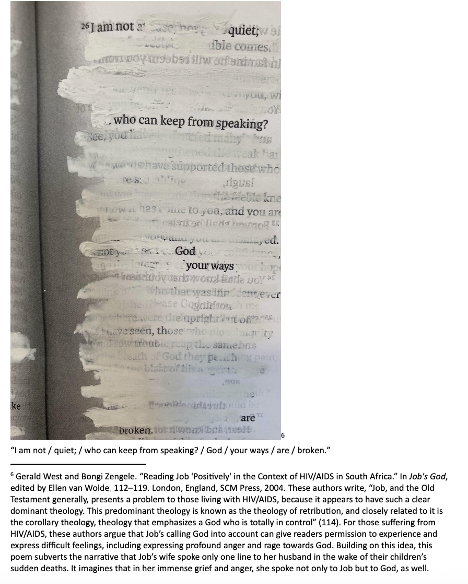
Poetry can also be used as a tool to explore under-developed characters in the Bible. One of my students, Meg, created a book of erasure poetry entitled “‘As Any Foolish Woman Would’: Found Poems from the Book of Job.” Meg approached the text with a series of questions focused on gender and grief. From there, in Meg’s words, “close readings of each page of the text opened opportunities to gather fragments of language into new constellations of meaning in conversation with the guiding questions above as well as with the sources listed in the annotated bibliography.” There are many things to love about Meg’s erasure poetry, but, for the purposes of this article, I want to highlight her clear use of research and the close reading of the text required to produce her poetry.
Finally, poetry gives students a place to creatively challenge biblical texts. In this poem, Jamie wrestles with the Akedah in a longer poem entitled “Sarah, Weeps.” Like Meg, Jamie cites her research at the end of the poem. Jamie’s research encouraged her to focus on the function of possessive pronouns in the Abraham cycle. Instead of merely identifying pronoun usage in the text through a research paper, Jamie demonstrated her understanding of what she read by playing with possessive pronouns in her poetry and exploring the perspective of a character that does not feature in Genesis 22. Her analysis of the research gives way to creativity in her original composition.
A sacrifice you made
Your only son, “my son” you say.
You claim him as your own
You are the protector of his heir, his legacy.
Abraham offers him to God, a sacrifice.
The patriarch steals the show.
Is it you that makes the real sacrifice?
Isaac, “my son”
Abraham unattached and glorified.
Conclusion
I opened with my explicit goal for this semester-long assignment: I want to leave students with lasting and fond memories of the text. It is a modest goal. My students who have written poetry not only leave the course with fond memories of the text, but they also leave me inspired as an educator to open up more creative spaces for students through my assignments. They have also shown me, as a researcher, that some biblical stories demand response in the form of a poem.
[1] Borrowing the phrase from Phylis Trible’s work Texts of Terror: Literary-Feminist Readings of Biblical Narratives (Philadelphia: Fortress Press, 1984).
Julianna K. Smith is Assistant Professor of Hebrew Bible at Earlham School of Religion.