In many ways, this book project began a number of years ago when I first read Judith Plaskow’s Standing Again at Sinai: Judaism from a Feminist Perspective as an undergraduate at Brown University. I was struck by Plaskow’s observation of the gap between women’s invisibility in our sacred texts and women’s knowledge of their own presence within Jewish communities. At Sinai, for example, Moses speaks only to the men, leaving women absent from the story of revelation even though women knew themselves to be participants in the community to which that story belonged. For Plaskow, this gap between women’s lived experience and the stories told about the Jewish past is not simply a problem of historical omission. It reveals how a tradition can render women invisible even as they participate in and sustain the communities that tradition describes. Plaskow emphasized the necessity of recovering women’s pasts in order to create a feminist present. Yet what remained with me for many years was the seeming fact of women’s invisibility in our textual history. These absences threatened to overwhelm my sense that women had always been present, and I felt them beginning to harden into a kind of historical truth.
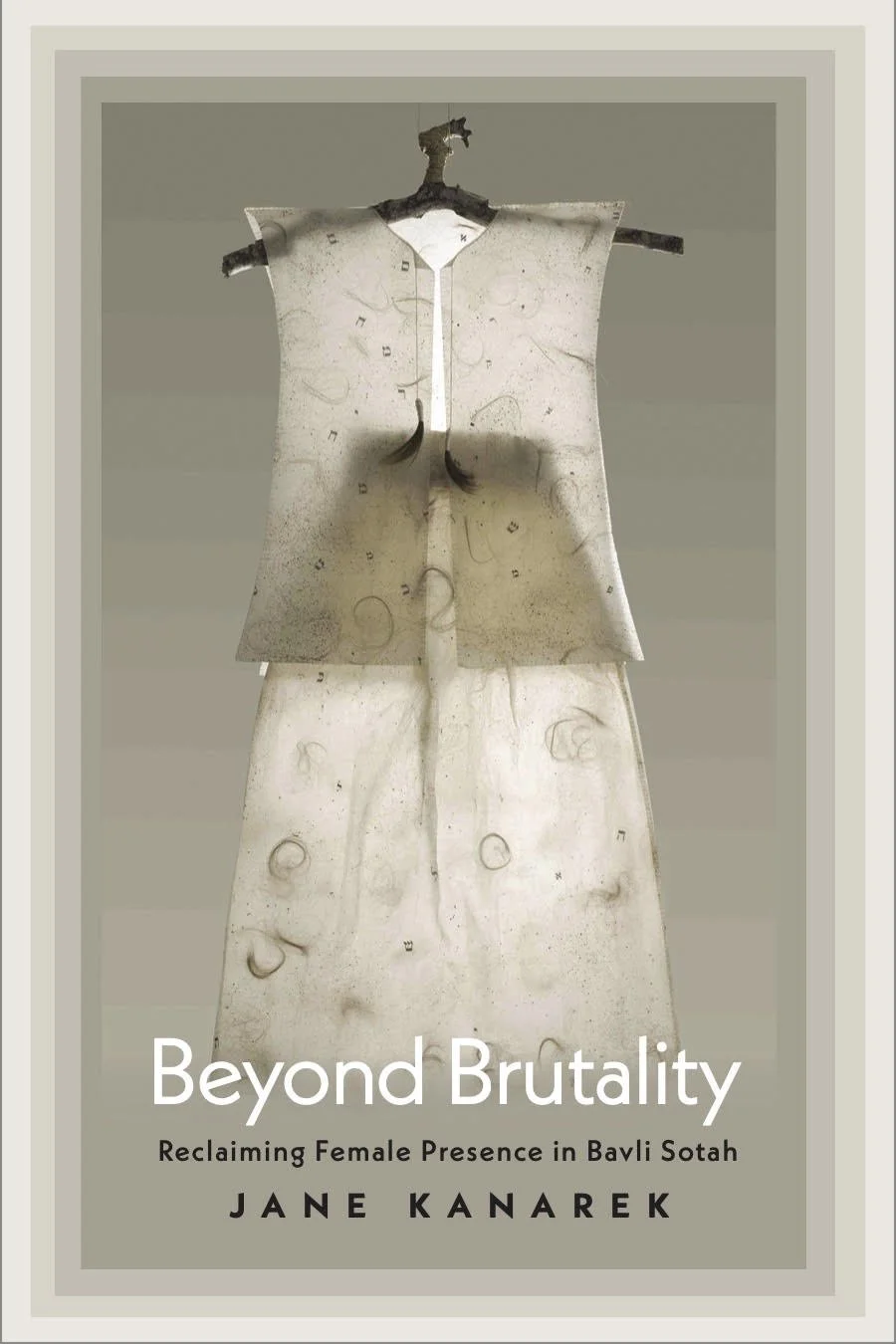
Beyond Brutality: Reclaiming Female Presence in Bavli Sotah reflects my scholarly journey over these many years of returning to a stance of assuming female presence. Rather than emphasizing absence, marginality, or invisibility, I choose to assume women's presence within rabbinic culture of late antiquity. As I studied tractate Sotah, researched and wrote this book, this assumption drove me to ask: What might shift in my understanding of the Babylonian Talmud, and of tractate Sotah in particular, if I began my study with an assumption of female presence? What scholarly assumptions might I have to rethink? What might I notice that I would have otherwise overlooked?
It may seem paradoxical to talk about noticing female presence in a tractate titled after a category of woman: the sotah, a woman accused of having sex with a man other than her husband. Yet this theoretical assumption of women's presence, combined with my decision to study the entire tractate rather than only the sections concerning the sotah ritual, proved surprisingly productive. It enabled me to notice and theorize female presence and absence; to see how the sotah and the sotah ritual help conceptualize Bavli Sotah as a literary whole; and to acknowledge the brutality and care that pervade the tractate.
I noticed, for example, that as Bavli Sotah reshapes the Mishnah’s discussion of the ritual in accordance with its own ideologies and concerns, it decenters memories of a historical Temple ritual and de-emphasizes female transgression. Bavli Sotah does not incorporate the mishnaic traditions about the gift of Queen Helene of Adiabene to the Jerusalem Temple of a golden tablet upon which the sotah portion was inscribed (M. Yoma 3:10) or the freed slave Karkemit who is forced to drink the bitter waters (M. Eduyot 5:6). Rather than reconstructing a historical memory of an accused sotah or imagining a female sotah into presence, Bavli Sotah imagines male biblical characters through the lens of the sotah.
For example, just as the merit of Torah study protects a guilty woman, suspending her punishment, so too the merit of Torah study protects David from assassination, despite his sin of sexual intercourse with Batsheva (B. Sotah 21a). Bavli Sotah mirrors the erasure of the words of Torah that occurs in the sotah ritual (Numbers 5:23) with the threatened erasure of Joseph's name from the stones on the high priest's ephod should he sin sexually with Potiphar's wife (B.Sotah 36b).
Alongside these portraits of transgressive men, I also noticed that Bavli Sotah commonly portrays women as righteous and caring. Among them are the righteous women for whose sake Israel is redeemed from Egypt (B. Sotah 11b), the daughter of Pharaoh who saves Moses from the Nile (B. Sotah 12b), the innkeeper who feeds and shelters travelers (B. Sotah 47a), and a mother who teaches her children Torah (B. Sotah 21a).
Yet when I recognized the ways in which Bavli Sotah portrays men as transgressive and women as righteous, I resisted the temptation to understand this as a simple reversal in which transgressive women are replaced by transgressive men. Instead, I make four interconnected arguments about the tractate.
First, that Bavli Sotah responds to and ameliorates the brutality of the mishnaic sotah ritual by teaching its audience that men, too, are sinful and attempting to make the sotah disappear. Second, as this tractate attempts to make the sotah disappear, it replaces her with a hypothetical model of a moral man and stories of mostly righteous women. Third, the sotah ritual overflows the boundaries of the ritual itself and weaves its way throughout the entire tractate, influencing and shaping a wide range of other topics and resurfacing the sotah. Fourth, Bavli Sotah engages in a process of mirroring, inverting the performative details of the sotah ritual and the notion of the destructive woman.
Reading through a lense of female presence enabled me to notice this tractate's literary and topical integration, an integration that includes the chapters on the sotah ritual as well as those about ritual language, the priest anointed for war, and the decapitated heifer (ʿeglah ʿarufah). This approach required reckoning with, rather than excusing, the brutality of the sotah ritual while also recognizing the ways in which Bavli Sotah subverts this brutal ritual as it presents its vision for a pious society.
I want to conclude with one of my favorite passages from the tractate, a brief story about two women debating about Torah, one that might easily have been overlooked:
And said R. Abbahu: "At first I would say that I was humble. When I saw R. Abba from Akko, who said one reason and his speaker said one reason and he was not angry, I said: 'I am not humble.'"
And what was the humility of R. Abbahu?
That the wife of R. Abbahu's speaker said to the wife of R. Abbahu: "Behold! Ours does not need yours. And that he bends down and stands up before him is merely to do him honor."
His wife went and told R. Abbahu.
He said to her: "What do you derive from her? Through me and through him the Most High will be praised." (B. Sotah 40a)
Although we might focus on R. Abbahu and R. Abba's humility, I ask that we shift our attention to these two women and the ways in which this story may be read through the lens of the sotah. The wife of R. Abbahu's speaker informs the wife of R. Abbahu that her husband (R. Abbahu's speaker) conveys his own words to the audience rather than those of the sage. When the speaker bends down to listen and then stands up to speak, he does so only to show respect to the sage. R. Abbahu’s wife reports this to her husband, who rejects her complaint.
Here, rather than a jealous husband and an accused wife, we find jealous women/wives alongside a male speaker who cheats his sage/master by presenting his own insights as the sage's. Instead of a husband competing with another man, two women compete over Torah. We might understand these two women as destabilizing the sotah ritual by shifting the locus of jealousy from husband to wife and from sexual transgression to Torah transgression. A version of this story found in a manuscript (MS Munich 95) even suggests that the final line may plausibly be read as the words of R. Abbahu's wife rather than those of R. Abbahu: "She said to her: 'What do you derive? Through me, through you, the Most High will be praised.''
For me, these two women serve as a fitting frame for Bavli Sotah. They challenge us to notice their conversation and they challenge us to notice that this tractate, which discusses a ritual that places men in control over women's bodies, also contains a story that describes women talking with one another about authority, Torah's transmission, and their place within rabbinic society. These women do not themselves directly contest the brutality of the sotah ritual. But they surely pushed me to consider how Bavli Sotah itself contains possibilities for alternative understandings of the past and suggests a way forward for a wider and richer understanding of the present.
Jane Kanarek is Professor of Rabbinics and Dean of Faculty at Hebrew College