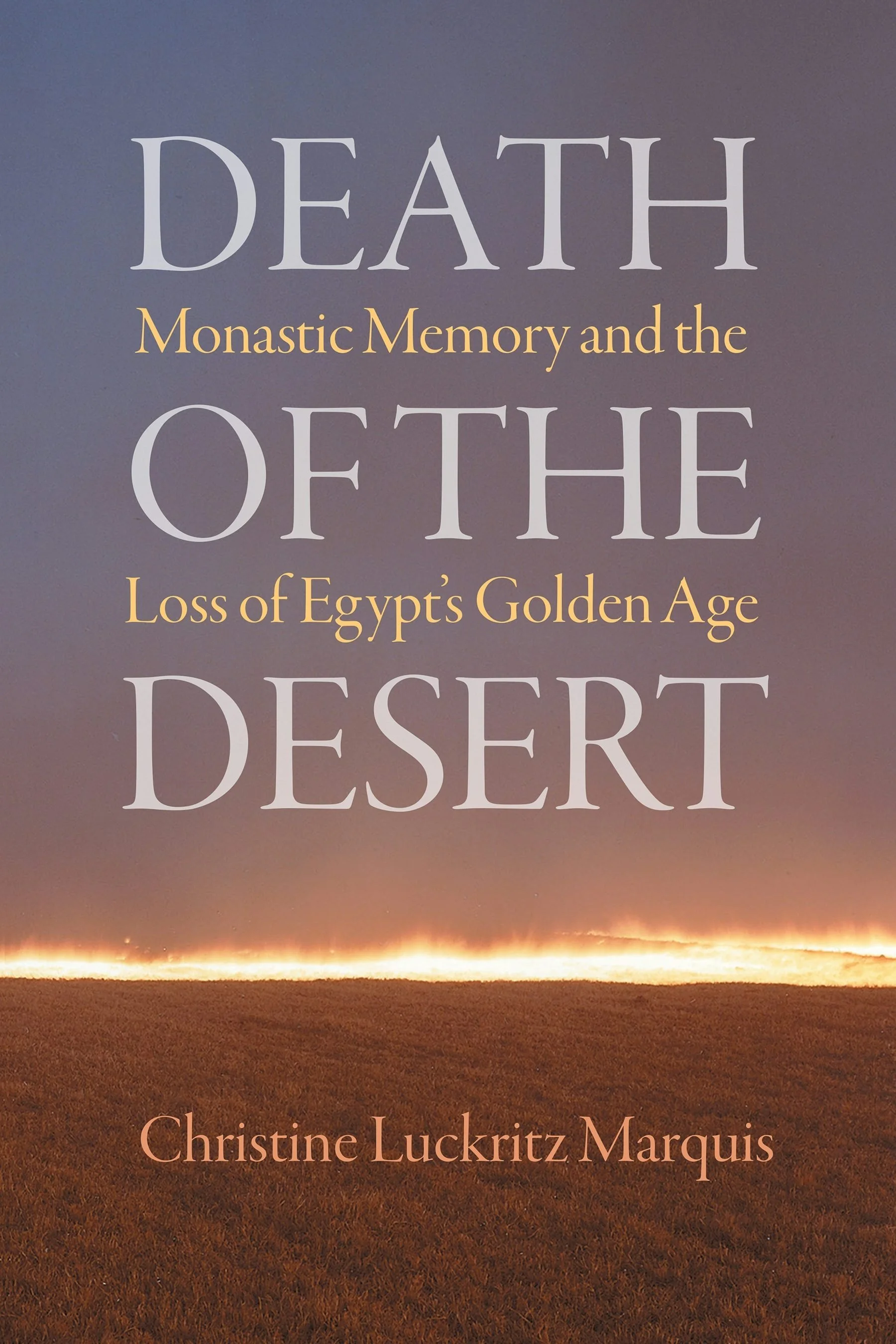
AJR is honored to host this review panel for Christine Luckritz Marquis’s Death of the Desert: Monastic Memory and the Loss of Egypt’s Golden Age (Philadelphia: University of Pennsylvania Press, 2022). You may find all the responses and the author’s response here.
As anyone who has written a book knows, it is truly a gift when others engage with your work. Thank you to Ancient Jew Review for the invitation and for hosting this dialogue. It is an especially gratifying experience to respond to the deep, thoughtful, and generous responses of these three colleagues. Ciara, Ellen, Rebecca, thank you for investing time in reading my book and in thinking alongside its arguments and places we might continue the conversation. To structure my response, I want to highlight a couple of things I hoped the book would do when I wrote it. Then, I express appreciation for particular things you have reflected back to me before replying to the primary question I see each of you posing.
My book sought to place the Origenist Controversy and Egyptian monasticism in more immediate dialogue, rather than as two separate scholarly discourses running parallel but rarely intersecting, as they often are. That was important to me because I was also committed to stressing the desert itself as a character in these narratives. And, as I offered close and complex readings of my sources, I sought to do so with a historiographical awareness of the ethical implications for our own time.
Ellen, thank you for your explicit engagement of my cover art: “where a single bright fireline separates the viewer and the grassland she stands on from the place the fire has already been, its details close but not quite visible on the other side of the destruction.” I negotiated for use and adjustment of Richard Misrach’s gorgeous photograph (during COVID no less) because I did want the image to resonate deeply with my argument about the desert. You saw that the art was also part of my argument about how we can and cannot see the past that has spread across the desert. Ciara, I am grateful to you for recognizing my insistence throughout the book “that the Sayings can only be understood by considering these three lenses [violence, memory, and race].” While different chapters highlighted aspects of the larger narrative I sought to weave, throughout I am gratified that you heard the call for a reframing of monastic history that reckons with these three threads. You saw them in each chapter and drew them together again as a “challenge” I offer to my readers. Rebecca, thank you for highlighting that “narratives are themselves integral to an unfolding event.” As you rightly gathered, I am as interested in our present moment’s narratives as I am in those of the past. We continue to wrestle with “our own demons that come from deciding what and how to remember, erase, and forget in interpreting the events and webs of relation around us.” While I finished writing the book in the midst of reckoning with racist legacies and Civil War statuary, our current moment only continues to press us to think about whose narratives are amplified and what healing or harm such amplification produces.
And now to the questions! Rebecca, you query “how successfully the memory of Theophilus was rehabilitated,” reflecting in your footnote that the negative accounts of Palladius, Ps.-Martyrius, and Socrates of Constantinople “still influence the way we describe (and teach) about Theophilus and his involvement in the Origenist Controversy.” As you note, Banev has been far more thorough than I in addressing this continued legacy of demonizing Theophilus.[1] And your reference to Theophilus’s treatment in the 13th century marginalia of Biblioteca Medicea Laurenziana Plut. 70.7 reflects that vein of treatment. There were two worlds my book was trying to straddle, the one that questions and critiques Theophilus – much of what Western scholarship has inherited from Latin and Greek sources – and the one that continues to deeply honor him – Egyptian Coptic and Syrian Christians revere him as a Saint. His death is included in the Coptic Synaxarion on Paopi 18, 404 CE (modern pronunciation Baba; Gregorian October 28). His entry remembers him as merciful, charitable, a student of his predecessor Athanasius, a discoverer of miraculous treasure, and a builder of many churches.[2]
Several seasons digging in the northwestern desert of Egypt made me keenly sensitive to the role that Theophilus and Egyptian monastic heritage play in contemporary Egyptian Christianity.[3] As a religious minority in a Muslim-majority country, the complexity of maintaining and preserving Christian identity means that any criticism of Theophilus and other heritage figures can be a quite sensitive situation. I thought quite a bit about the many ethical implications my work might have for not only Egyptian/Coptic and Syrian/Syriac studies within academic circles but also for these presently oppressed religious communities. So, when I was writing, I was truly trying to balance which “we” was considering Theophilus. He is totally rehabilitated from an Egyptian and Syrian Christian position. That does not erase your crucial point that he often is not taught or written about from such a perspective by many who consider themselves scholars of late antiquity. Thank you for raising this important question because it allows me an opportunity to reflect with more nuance on this contemporary tensive issue among those who honor and those who study in and outside a tradition.
Ciara, I keep turning over the question you pulled from my third chapter: “how scholars think about societal practices – such as damnatio memoriae – and how this phenomenon can occur on the individual level.” I acknowledge that this is one of the more speculative edges of my book, and intentionally so. Thank you for raising this part of the project because in some ways it’s among the things I am most invested in as a scholar. One of the struggles as I lived with this material first as a dissertation and then later transforming it into a rather different book was the tension between knowing some things did not make sense and trying to offer an alternative model that might be more historically accurate. Thus, I found myself wrestling with the limits of history as a field. How do we ask good questions when our material is scarce? Are responsible, necessarily somewhat speculative, workarounds possible? It was this professional identity questioning that helped me think through how we might begin to engage the Sayings of the Desert Fathers in ways beyond gnomic. I try in the book and elsewhere in my work to note when I shift from more solid evidence to what I like to call responsible historical imagining. I hope even when others disagree with my readings they consider the invitation to stretch the methods and questions we take up.
Ellen, you likewise picked up on the dynamic relationship between individual and communal I was exploring. You pressed me on the “need to grapple with the Christian literary tendency to over indicate violence,” asking whether “an instance of ‘violence’ against the self” might “be compared to the destruction of a public site of another tradition’s practices.” As you note, the field continues to wrestle with where, how, and when we delineate something as “violence.” I come down in the book quite clearly on violence as including language. Part of what I wanted to think through was precisely how commonly violent language appears in many texts and how often modern scholars have tended to overlook such rhetoric. I have continued to try to think through what it means to “over indicate violence.” What work (conscious and unconscious) does that literary habit do? Both to ancient authors/readers/hearers and modern scholars who read it?
I suspect I was and continue to be informed by our own historical context as I think through verbal violence. I wonder whether the erasure of memories/“facts” of one’s own past needs to feel violent to the perpetrator for it to produce violent results? Perhaps an individual monk trying to remove memories of his past life did not see his actions as self-harm, but those he may have left behind – a mother, a wife, children, enslaved individuals – may certainly have experienced his abandonment and denunciation of his past life as harm. And that the Sayings as reflective of a mostly male legacy so willing to erase large swaths of the past might invite us to ask who monks tend to demonize when they do so – here, the corpus clearly points to women, young men, and enslaved persons.
For my continued scholarship beyond the book, taking these experiences of past self-erasure as violence seriously has helped me reimagine how individuals marginalized by these actions might be reimagined back into the late ancient world. If we are looking for often obscured women, queers, and enslaved individuals – those most often subjected to violence then and now – we might well find glimpses of their realities by attending to how pervasive violence was. In “Divining Slaves in Late Ancient Egypt,” I argue against the scholarly tendency to view Egypt as a space not particularly prone to enslavement practices.[4] And, more recently, I have begun to join a growing body of scholars, such as Jennifer Barry, in addressing the role of gender violence in our sources and the scholar habits that continue to be informed by this violent legacy.[5] In “Better Off Dead: Violence, Women, and Late Ancient Asceticism,” I make the case for recognizing how often women and trans monks were accused in monastic sources of violence even as it was male monks who were in fact the main perpetrators.[6]
Christine Luckritz Marquis is Associate Professor of Church History at Union Presbyterian Seminary. Her teaching and research expertise explore early Christian communities and their practices, especially late ancient communities in Egypt, Syria, Ethiopia, and the Arabian Peninsula. Her interests include food, memory, and spatial practices, the role of violence in identity formation, racial and ethnic discourses, material culture, and Christian interactions with neighboring Christians as well as non-Christians, especially Jews and Muslims. Her first book is Death of the Desert: Monastic Memory and the Loss of Egypt’s Golden Age (University of Pennsylvania Press, 2022). The book explores how memory and spatial practices were transformed by acts of violence among Egyptian ascetics. She has also co-edited and translated The History of the Great Deeds of Bishop Paul of Quentos and Priest John of Edessa, Texts from Christian Late Antiquity volume 29 (Piscataway, New Jersey: Gorgias Press, 2010). She has also published book chapters, articles, and translations. She is currently researching the history of sources of sweetness and their relationship to understandings of the divine and afterlife.
[1] Krastu Banev, Theophilus of Alexandria and the First Origenist Controversy: Rhetoric and Power (Oxford: Oxford University Press, 2015).
[2] “السنكسار بابه 18,” السنكسار بابه 18: نياحة البابا ثيؤفيلس 23 - CopticChurch.net, accessed June 16, 2026, https://www.copticchurch.net/synaxarium/2_18.html?lang=ar.
[3] Here I would note the importance of Stephen J. Davis for me, both his mentorship during my time with Yale Monastic Archaeology Project and his scholarship, especially his The Early Coptic Papacy: The Egyptian Church and Its Leadership in Late Antiquity (Cairo and New York: American University in Cairo, 2004).
[4] Christine Luckritz Marquis, “Divining Slavery in Late Ancient Egypt: Doulology in the Monastic Works of Paul of Tamma and Shenoute,” in Slavery in the Late Antique World, 150–700 CE, eds. Christopher L. De Wet, Maijastina Kahlos, and Ville Vuolanto (Cambridge: Cambridge University Press, 2022) 149–69.
[5] Jennifer Barry, Gender Violence in Late Antiquity: Male Fantasies and the Christian Imagination (Oakland, CA: University of California Press, 2025).
[6] Christine Luckritz Marquis, “Better Off Dead: Violence, Women, and Late Ancient Asceticism” JECS 33.2 (Summer 2025): 305–34.