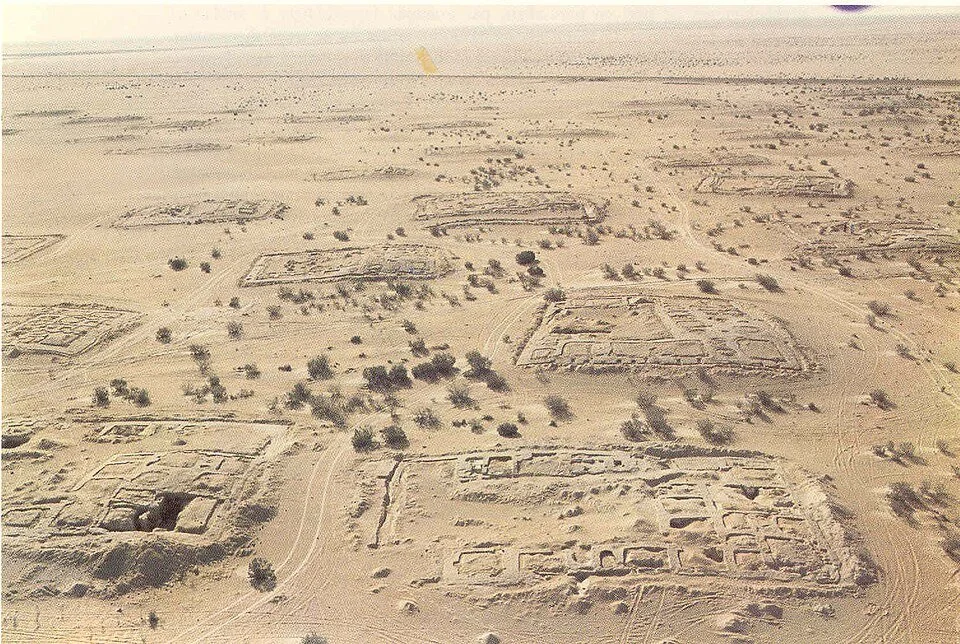

Remnants of the kellia (“cells”) in Egypt [Image Source: Wikimedia Commons]
AJR is honored to host this review panel for Christine Luckritz Marquis’s Death of the Desert: Monastic Memory and the Loss of Egypt’s Golden Age (Philadelphia: University of Pennsylvania Press, 2022). You may find all the responses and the author’s response here.
Evagrius of Pontus’s treatise On the Practical Life, written near the end of the fourth century, is a rich collection of advice for managing the rigors of his program of Christian discipline. Near the end of the text, he offers readers one more source of guidance beyond his teachings. “It is also necessary,” Evagrius wrote, “to make diligent inquiry of the upright ways of the monks who have gone before us and to correct ourselves with respect to these, for one can find many noble things said and done by them.”[1] In the text, what follows is a handful of examples of the imitable actions of past monks.
In ancient Christian culture, though, what follows is much larger—a veritable explosion of texts. Evagrius’s small collection of reports is just one early iteration of the genre that comes to be known as the Apophthegmata Patrum, or the Sayings of the Fathers. The Sayings existed by the hundreds in later antiquity. At the start, Evagrius’s selection already looks backward, representing models of success in the Christian life from the recent past. Later collections, made in the fifth and sixth centuries, look back from more distant, and distinct, perspective, as they drone a consistent note of nostalgia for a lost era, the “Golden Age” of monasticism referenced in Luckritz Marquis’s subtitle. That note is strikingly resumed on the book’s cover, where a single bright fireline separates the viewer and the grassland she stands on from the place the fire has already been, its details close but not quite visible on the other side of the destruction. Genres of literature proliferate for different reasons, but the commitment to memory in the face of loss, the impetus to preserve knowledge, surely propelled the collection of the Sayings traditions, their translation, and dispersion into different languages.
To track this kind of change in an ancient genre is hard enough; to do so while simultaneously using its texts as the basis for historical reconstruction is harder still. It requires a skilled, insightful scholar, and Luckritz Marquis is abundantly fit to the task. In the first chapter of Death of the Desert, she attends to the imaginative construction of the “desert” as an ideal impossible from the very start. It was, at once, “the place where monks lived, the space they wandered into, and the region where most were not able to survive.” She consistently tracks settler-oriented themes in the discourse of the desert, finding a sense of conquest and a thirst for domination, of others and of self, at its heart. Luckritz Marquis narrates how the project in such a “desert” was by necessity bellicose in nature, and she argues that the holiness claimed for monks involved should not cover over that nature or allow it to be separated from monastic aims. To pray and to sing in a land of demons is to launch an offensive, as her explications of prayer and psalmody in Chapter Two show. Living in that land requires a quick hand with respect to one’s own self, too. The third chapter traces how new practitioners were expected to erase their past relationships, to damn their own past lives. It juxtaposes these memory sanctions with the Christian bishop Theophilus’s destruction of the Serapeum. That “destruction” was, of course, partial, as any such damnatio is—the damned thing never actually forgotten, but left partially intact, to be remembered as forgettable. Next door to that is the practice of a monk who consistently recalls, then rejects, the life he had left behind, only to recall it once again. Luckritz Marquis documents the violent terms of forgetting for those who wished to become new in their discipline.
A key feature of Luckritz Marquis’s work in the book is her choice to discuss the violent acts, imagery, and discourse in early Christian monastic culture without varnish. In this, Death of the Desert joins an ongoing reckoning with the nature of violence in the late ancient Mediterranean world (and in early Christianity in particular). The book takes up multiple aspects of the conversation, asking: What is the relationship between piety (especially the innovative piety of the monastic project) and violence? What is the purpose of remembering violence, preserving it in carefully guarded literature, and what is the result of that remembrance? And, of course, the pragmatic questions: what is the origin of violence, what is its frequency, its reality? Her approach is at once enlightening and also perhaps too ready to see violence in words. A reader could fairly wonder whether an expectation to leave a past behind when starting a new program, even starkly put, is in fact an instance of “violence” against the self, or a violence that can be compared to the destruction of a public site of another tradition’s practices. The field as a whole continues to shake out what we mean when we say “violence,” how we might judge its frequency or its amplitude, considering that sources from Christian late antiquity often ruminated on suffering, on injury, and on outrage. I fully agree with Luckritz Marquis that it is imperative not to hide Christian violence, but readers also need to grapple with the Christian literary tendency to over-indicate violence. For the most part, Death of the Desert is more focused on the imaginative work of remembrance, how memory makes culture, tracing tropes of violence as the building blocks of culture. In this pursuit, it could sit very comfortably on the shelf alongside Elizabeth Castelli’s signal work, Martyrdom and Memory.
The third contribution of the book is a targeted historiographical intervention. Luckritz Marquis reconsiders the received scholarly position on just how, and why, the monastic communities outside Alexandria lost their cohesion. Scholarly reflections on the dissolution of places like Nitria, Scetis, and Kellia have sometimes reproduced the sense of nostalgia conveyed in the Apophthegmata, as they consistently think of the “desert” as a utopia, lost to the inevitable encroachments of the world. The most explicitly made case for this event occurs in Hugh Evelyn-White’s 1973 argument that a raid on Scetis by non-monastic people set the balance on its edge. As Luckritz Marquis contends, Evelyn-White’s explanation resonates with late ancient (and some modern) assumptions about the “barbarians” who disrupted Egyptian and North African communities; it has been a sort of baseline for talking about the monastic shift to Roman Palestine. In the fourth chapter, Luckritz Marquis deconstructs this argument, point by point, emphasizing the contingency of Evelyn-White’s readings of the evidence. Thus, Death of the Desert exemplifies a recent trend in the field, the impulse to reexamine the most basic “facts” about the development of early Christianity, like “barbarian raids extinguished the monastic culture of the desert.” In her careful, beautifully written reconstruction, the monastic decampment to Palestine originated not with outsiders, but with someone far closer to home: Theophilus the archbishop, whose calamitous visit is recounted by contemporary sources and remembered in later literature as the violent spark that started the fire. Thus, Death of the Desert is a model for other scholars who aim to reexamine the past we remember for early Christian monasticism.
Ellen Muehlberger is professor of history at the University of Michigan and editor of the Journal of Early Christian Studies.
[1] Praktikos 91(Robert E. Sinkewicz, trans., Evagrius of Pontus: The Greek Ascetic Corpus [Oxford: Oxford University Press, 2003], 112.)