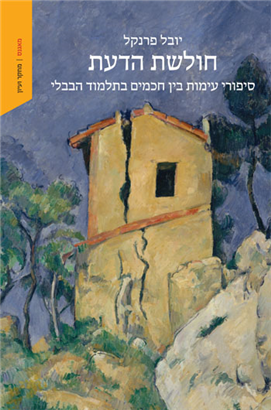
A Publication Preview of Yuval Fraenkel, The Fragility of the Mind: Confrontation Stories among Rabbis in the Babylonian Talmud (Magness Press, 2026), [Hebrew].
Interpersonal conflicts have always fascinated me. Both those represented in literature and those that unfold in life itself. What leads human beings to enter into conflicts so frequently? What happens in the gap between intention and understanding, between what a person seeks to convey and what another hears? Reflecting on this phenomenon often led me to ask what my own cultural tradition – the world of Jewish creativity across the generations – has to say about it.
Yet the more I thought about the question, the more difficult it became to identify any sustained engagement with it within this vast and diverse body of texts. One can certainly point to general ethical teachings concerning the importance of humility, the dangers of anger, and the value of living peacefully with others. But such statements always seemed to me to miss the most significant point. They treat conflict as a moral failure or a problem that could be avoided through better behavior. In doing so, they leave little room for the emotional forces that give conflict its power: humiliation, shame, wounded honor, and the desire for recognition and esteem.
When I began working intensively on Talmudic narrative, however, I realized that if there were any texts capable of addressing these questions, they were to be found precisely there. Talmudic narrative contains dozens of stories depicting conflicts between sages. These stories do not focus solely on the substantive or ideological issues at stake. They describe in detail the charged relationships that underlie the conflict, the complex dynamics through which it emerges, and the painful injuries that result from it.
Scholars have often approached these stories as accounts documenting the interpersonal disputes within the highly contentious world of the rabbinic academy. Yet the more deeply I immersed myself in them, the less satisfied I became with such a historical explanation. Even if these events did in fact occur, this alone cannot explain the immense cultural energy invested in their telling, nor the central place they occupy within the Babylonian Talmud, the canonical collection of Jewish culture. The fact that interpersonal conflict so intensely preoccupied the rabbis compels us to ask: Why did the storytellers of the Talmud choose to depict their heroes precisely in these moments? Why devote so much literary energy to sages who hurt one another, become angry with one another, or suffer humiliation at one another’s hands?
This question ultimately became the foundation of the book.
The first stage of the project involved identifying the relevant stories. This task proved far more difficult than I had expected. The Talmud is filled with representations of conflicts of many different kinds, and it is not always clear what qualifies a particular narrative as a “conflict story.” Yet as I gathered more and more examples, I began to notice that many of the more developed narratives shared a remarkably stable set of literary features.
First, the focus of the conflict is rarely a substantive or public issue. Rather, it is consistently an injury to the honor of one of the sages. Honor, humiliation, and interpersonal relationships drive the plot. Second, the injury is often unintentional. The offending sage does not seek to humiliate his colleague; rather, he does so through misunderstanding, information gaps, or a failure of communication. As a result, these stories acquire an almost tragic quality: the characters are drawn into conflicts that none of them intended to create. These stories unfold within a largely self-contained interpersonal world, detached from broader public or institutional realities.
One example is the story of Rav Papa and Rav Shimi (b. Ta’anit 9b):
Rav Shimi bar Ashi regularly posed difficult questions before Rav Papa.
One day, he saw him falling on his face in prayer and overheard him saying:
“May the Merciful One save me from the embarrassment caused by Shimi.”
From that moment onward, he imposed silence upon himself.
The story does not portray Rav Shimi as rude or aggressive. On the contrary, questioning one’s teacher fits comfortably within the dialectical culture of the rabbinic academy. Yet these questions become a source of embarrassment and humiliation for Rav Papa, who is unable to express this directly to his student – since any acknowledgement of the injury would only deepen his sense of inadequacy. Together with the student, we are granted access to a moment in which the teacher pours out his pain before God, and in that moment, we encounter the hidden vulnerability that may lie beneath the authoritative façade of the rabbinic master.
What is most striking about this story is that the discussion itself is of no interest to the narrative. We do not know what the questions were. We do not know who was right. We do not even know what subject was under discussion. The story directs all of its attention elsewhere: toward the emotional world that exists beneath the surface of scholarly discourse.
One of the most important insights to emerge during the construction of my corpus concerned precisely the stories that remained outside it. At the outset, I was convinced that Talmudic stories about conflicts among the tannaim (the Mishnah’s sages)– including some of the most famous narratives such as “the Oven of Akhnai” and Rabban Gamliel’s deposition – would occupy a central place in my study. Yet as the project progressed, it became clear that these famous narratives operate according to a very different logic from the stories that I had collected. Whereas the conflict stories examined in this book —stories featuring amoraic protagonists— focus on unintended injury, personal humiliation, and failures of communication between two individuals, Talmudic stories featuring tannaitic protagonists revolve around questions of authority and leadership. Their conflicts unfold in a broader public arena and frequently involve explicit practices of shaming and the exercise of power.
This discovery was both surprising and significant for me. It confirmed the stability of the literary patterns I had identified and suggested that these features were not accidental. Rather, they corresponded to the Bavli’s construction of two distinct literary worlds: the world of the tannaim and the world of the amoraim.
Having identified my corpus of sources and its literary features, I sought to understand how these stories create meaning for their readers. Here I drew upon tools from narratology and reader-response theory. My central claim is that conflict stories in the Bavli do not merely describe failures of communication; they invite readers to experience them directly. Through gaps in information, limited perspectives, and deliberate ambiguities, they place readers within the very conditions of misunderstanding in which the characters themselves operate.
From this perspective, it is difficult to understand these stories through the dominant paradigm in the study of rabbinic narrative, which views this literature as fundamentally moralistic and didactic. These stories do not divide the world into the righteous and the mistaken, nor do they invite readers to judge their protagonists. On the contrary, they reveal how limited human beings are in their ability to understand one another, and how easily conflicts can emerge from circumstances that none of the participants intended. Their significance lies in the direct encounter they provide with the limitations of human communication and with the complexity and fragility of the relationships that communication creates.
At the same time, I sought to understand what these stories reveal about the world of the amoraic academy and about the central place of honor within it. Contrary to approaches that associate personal honor primarily with pride or moral weakness, these narratives portray honor as part of a system of mutual dependence. They show how a sage’s sense of self is formed through the recognition of his peers. For this reason, an injury to his honor is also an injury to his identity.
The importance of honor is also connected to the relationship between the sage and the Torah that he creates. Rather than portraying the sage as a mere conduit for divine truth, these stories present Torah as emerging from the sage’s individual identity and as deeply bound up with his personality. Consequently, an injury to a sage’s honor is not merely an injury to the person himself, but also to the world of Torah learning and creativity associated with him.
Talmudic conflict stories, then, are not merely anecdotal accounts of the rabbinic past. They engage one of the most fundamental dimensions of human experience: the fragility of communication – and of the relationships that communication sustains. They remind us how deeply our identities and our sense of honor depend upon others, and how even our creative work is shaped by the recognition it receives from those around us.
This, ultimately, is why these stories continue to fascinate me. Not because they teach us how to avoid conflict, nor because they offer simple solutions to the tensions that arise between human beings. Their power lies precisely in their willingness to remain within complexity. They invite us to look closely at moments when communication fails, at the pain that emerges from misunderstanding, and at the profound mutual dependence through which our identities are formed. Nearly fifteen centuries after they were composed, they still illuminate something fundamental about the way human beings live together, wound one another, and seek – often unsuccessfully – to understand one another.