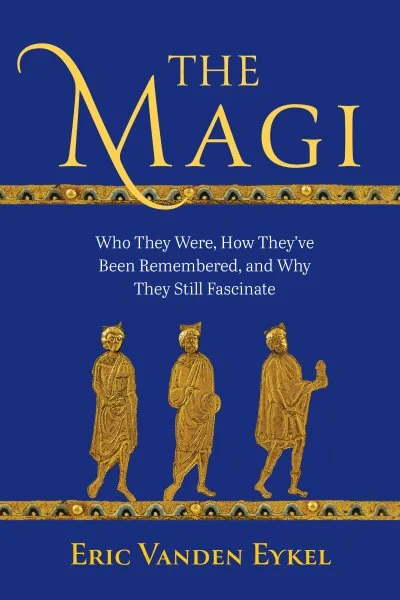
When I first started working on what would become my second book—The Magi: Who They Were, How They’ve Been Remembered, and Why They Still Fascinate (Fortress, 2022)—I honestly had no idea what I was doing or why I was doing it. Allow me to explain.
It was 2014, and I had just defended my dissertation on the Proto-Gospel of James[1] at Marquette University. I found myself back in the library, awed by the strange and somewhat dread-filled quiet that so often descends after years of doctoral work. It was finished. Well, in a way.
I had no job lined up, although I had applied to plenty. At some point, I had read some advice about rolling dissertation momentum into a new project—something short, sharp, and manageable. I found myself sitting in the same library research carrel that I had occupied for months, but it was mostly empty because all the dissertation books had gone back to the stacks. So, I figured, maybe it was time for some new books and a new project.
By the end of the day, I had checked out a pile of commentaries and monographs on the Gospel of Matthew, and I started combing through them to learn more about the curious figures who appear in Matthew’s second chapter: the Magi. These characters are often referred to as “wise men” or “kings,” and they come to Bethlehem from an undisclosed location in the east in order to pay tribute to the newborn Jesus. After they do this, they depart and are not mentioned again in Matthew’s Gospel (Matt 2:1-12).
My focus on the Magi wasn’t random; their cameo had come up at my dissertation defense, when one of my committee members asked why I hadn’t said anything about them, given that they appear toward the end of the Proto-Gospel. My answer was simple: most of my dissertation focused on the first three-quarters of the text, and I just didn’t have much to say about them at the time. But perhaps the Magi could be that “short and sharp” next project.
The Monotony of Consensus
As I made my way through commentaries on Matthew, I noticed that most of them repeated the same argument: the Magi were a cipher for speaking about “Gentiles,” and Matthew included them as a sort of prophetic foreshadowing of the fact that Jesus devotion would find deeper and more persistent roots among those outside the boundaries of a textually constructed “Israel.” In Matthew’s story, according to the commentaries, the Gentile Magi recognize the significance of who Jesus is, while the figures characterized as Jewish,—such as Herod the Great—rejected Jesus and wanted him dead.[2] Or so the argument goes. I was skeptical.
If generations of scholars had all landed on the same point, it seemed less like individual insights coalescing by chance and more like the recycling of an idea that may have seemed “good enough.” As I continued thinking about this reading, I began to suspect that the story of the Magi had become a placeholder for a theological point about Jews and Gentiles rather than a story worth attending to on its own terms. In many Christian interpretations, the Magi symbolize “good Gentiles” whose desire to worship Jesus marks the supposed replacement of Judaism by Christianity. Augustine of Hippo, for example, interprets the Magi story as a revelation of Jewish faithlessness and the dawn of faith and devotion among Gentiles (Sermon 201.1). That supersessionist framing, however, reduces the story to a prooftext for Christian triumphalism.
Matthew’s tale of the Magi has long invited speculation. When I turned from commentaries to the internet, the spectrum widened considerably. There I found claims that the Magi were alien visitors from space, time travelers, necromancers, even proto-Knights Templar. Amusing? Perhaps. Persuasive? Not so much. Still, this odd mix of boredom (in the academy) and absurdity (online) suggested to me that something important was missing between the two.
That “something,” at least for me, turned out to be reception history.
Turning to Reception
Rather than asking “who the Magi really were,” I became interested in how they had been imagined for two thousand years. From Matthew’s twelve terse verses, an enormous tradition had grown: apocryphal infancy gospels, patristic sermons, Renaissance paintings, Byzantine mosaics, Christmas cards, and even a James Taylor song.
Reception history opened up a new path of inquiry. Instead of trying to decide whether Matthew’s Magi were Persians, Arabs, Jews, or just “Gentiles” in the generic sense, I began to ask how different readers had changed details in their story, filled in the gaps, what they might have intended by doing so.[3]
To be sure, this was not a quick pivot. Not long after I began research for this project, I applied for and was then offered a position at a small liberal arts college in southwestern Virginia. The job started about four months after I applied for it, and the teaching load was heavy. After a cross-country move, my research and writing slowed. Still, I kept working as time allowed, and I kept notes and random scribblings in a three-ring binder on my desk. Over time, those notes suggested that I definitely had a book on my hands. But what sort of book?
At first, I thought this book on the Magi should be a traditional academic monograph. And it certainly could have been. But having published one already (in 2016), I knew how expensive and inaccessible such books could be. I wanted this project to be different: something my colleagues could learn from, but also something a non-specialist could pick up, read, and enjoy. With the help of a fantastic and patient editor at Fortress Press, I eventually shaped a proposal along those lines.
Then came the real challenge: writing. Also, a pandemic.
Writing as Not-Knowing
I started drafting The Magi at the start of the COVID-19 era. In many ways, it was the first time since graduate school that I had attempted any sustained writing. I had written a few book chapters and articles, but nothing of this scope. I learned quickly that despite a detailed and carefully crafted proposal, I still didn’t really know what the book was going to be about. The process of writing revealed how painfully provisional my ideas really were.
I organized the project in Scrivener, which allowed me to see an aerial view of the chapters while drafting. I would write, delete, reorganize, and start again. I began with a linear, chronological plan, but as the work unfolded a different structure emerged: Matthew’s Gospel moved to the center of the book, not the start, so I could better highlight what sorts of things informed Matthew’s story of the Magi, and then what sorts of interpretive moves the story set in motion. I found myself arriving at new insights that hadn’t previously occurred to me, and I also started noticing things that I hadn’t noticed before. One theme kept reappearing in later Christian interpretations of Matthew 2:1-12: anti-Judaism.
Back in the stacks at Marquette, I had already noticed that biblical commentators tended to fixate on the Magi as Gentiles, and that they often contrasted the receptivity of the Magi with Jewish rejection of Jesus. The Magi became the “good outsiders,” while Jewish characters were cast as “bad insiders.” As I immersed myself in the reception history of this story, from Christian apocryphal literature to patristic homilies, I realized how deeply this framing ran. Even in contemporary picture books meant for children, again and again the story was retold as a drama of Gentiles embracing the truth while Jews either turned away or tried to snuff it out. This interpretation was so omnipresent that I did find myself wondering if it wasn’t what Matthew had intended all along. But in the end, I remained skeptical.
At this point, I wondered what would happen to the argument of the book if I proceeded as if the question of whether the Magi were Gentiles was irrelevant to this story as well as Matthew’s larger narrative. I then began to ask, “Why did Matthew choose to call them magoi?” This particular Greek word was loaded in the first century. Herodotus and other ancient authors use it to refer to respected religious professionals from Persia (Hist. 1.132; 7.43; 7.113; 7.191). But others, like the author of Acts, use it as an insult to imply that someone is a charlatan (Acts 8:9; 13:6-8).[4] So why did Matthew choose this term? What’s the point?
Matthew certainly knew about the more pejorative senses of “magoi,” but I concluded that his understanding of this term was more in line with those of Herodotus and others who saw the role of magoi as more political in nature. They are, after all, they are in search of the one born “King of the Jews” (Matt 2:1-2). On my read, Magi in Matthew are not generic Gentiles. They are, instead, royal courtiers, figures within a king’s orbit. On the literary level, their appearance in Bethlehem confers royal status. They are there to pay tribute to the true king—not Herod, but Jesus.
In this way, the Magi story became less about “Gentiles versus Jews” and more about rival claims to sovereignty. Yet the reception history, especially in Christian preaching and teaching, has persistently cast it in ethnic or religious terms to reify the binary of the faithful outsiders versus the faithless insiders. This is where anti-Judaism enters in, often unexamined.
Writing as Thinking
None of this was clear to me in the early stages of my research, and I certainly did not set out to write about anti-Judaism in a book about the Magi. This part of the argument only emerged as I wrestled with my words, rewrote chapters, and let the process of writing reshape my thinking about the material I had (allegedly) become so familiar with.
Writing is thinking, and when I think about this project, and what I learned from putting it together, I think about this as the most enduring lesson. We sometimes think about writing as the final stage, the point where our ideas get polished and displayed. And yes, there is that. But often, writing is where ideas actually happen. Looking back at my early proposals and drafts, I sometimes chuckle—they bear little resemblance to the final book. But that isn’t failure. That is the work!
Amid the recent fanfare and controversy surrounding generative AI, it’s easy to forget what writing actually does. When I submitted The Magi—about nine months before ChatGPT made its public debut—we had not yet seen the technology’s uses and abuses. It can proofread, format bibliographies, and even produce respectable prose with a good prompt. But it cannot think. And if we hand over too much, we risk surrendering the work that clarifies our ideas. Writing isn’t just generating words; it’s how understanding is made.
Why the Magi Still Matter (to me, at least)
If writing about the Magi taught me anything, it is that interpretive certainty is often unfounded. The twelve verses about the Magi in Matthew do not invite final answers; they invite attention, patience, and the persistence to keep digging. In this way, the Magi become less a prooftext about Gentiles and Jews and more a pressure test for our reading and interpretive habits. The history of interpretation for the story of the Magi exposes how easily Christian interpretation drifts into anti-Judaism when “outsider versus insider” dynamics are allowed to stand in for more careful and intentional study.[5]
Reception history is thus a way of diagnosing how meanings travel and mutate, how sermons become assumptions, how art tutors the eye, and how the most familiar stories grow strange when they are subjected to interrogation. It also serves as a kind of corrective. By tracing how Christians have reused the Magi to congratulate themselves or to caricature their Jewish neighbors, we learn to resist those reflexes in scholarship, classrooms, and pulpits.
Just as important, this project taught me how writing works. Drafting The Magi was, for me, an exercise in realizing that writing is not merely the packaging of ideas but a laboratory to explore them. When the paragraphs of this book finally began to arrange themselves, they led me away from the boredom of consensus and the allure of novelty toward something more satisfying: a story about sovereignty, desire, and homage.
This matters more than ever in our age of machine-made prose. I am quite grateful for tools that catch typos and help with the formatting of bibliographies. But I hope that in this age we can hold on to the sense that the work of writing, while challenging, is ultimately part of the process that shapes and clarifies what we know and how we know it.
Eric Vanden Eykel is Associate Professor of Religious Studies at Ferrum College in Virginia. His research focuses on Christian Apocryphal Literature, religion and violence, and anti-Judaism.
[1] The Proto-Gospel of James is a second-century “infancy gospel” with stories about the birth and childhood of Mary.
[2] Raymond Brown makes this argument in his influential The Birth of the Messiah (New York: Doubleday, 1977), 188–96. Similar arguments can be found in Daniel J. Harrington, The Gospel of Matthew, Sacra Pagina 1 (Collegeville, MN: Liturgical Press, 1991), 42–43; Donald A. Hagner, Matthew 1–13, Word Biblical Commentary 33A (Dallas: Word Books, 1993), 28; and Craig S. Keener, The Gospel of Matthew: A Socio-Rhetorical Commentary (Grand Rapids, MI: Eerdmans, 1999), 98.
[3] In my own scholarship, I consider reception history to be an examination of how stories have changed and been adapted, but more importantly, I see these trajectories as enabling contemporary readers to better understand the dynamic interplay between text and interpretation, revealing elements of the text that only become visible through its history of use. Some books that I have found useful include E. D. Hirsch, Validity in Interpretation (New Haven: Yale University Press, 1967); Hans Robert Jauss, Toward an Aesthetic of Reception, trans. Timothy Bahti (Minneapolis: University of Minnesota Press, 1982); Wolfgang Iser, The Act of Reading: A Theory of Aesthetic Response (Baltimore: Johns Hopkins University Press, 1978); Emma England and William John Lyons, eds., Reception History and Biblical Studies: Theory and Practice (London: Bloomsbury, 2015); and Alison Jack, The Bible and Literature (London: SCM Press, 2012).
[4] Translations often obscure potential comparisons between “good” magoi like those in Matthew and “bad” magoi like those in Acts. English translations often render the magoi in Acts as “magicians,” while Matthew’s magoi are generally rendered as “astrologers” or “wise men.”
[5] Early Christian literature offers no shortage of insider/outsider rhetoric, and often at the expense of those marked as ‘outside.’ My claim in The Magi is that Matthew 2 neither requires nor rewards anti-Jewish construal of the story. That does not mean, however, that such readings are always projections; in many texts, anti-Judaism is an explicit component of the rhetoric. A feature, not a bug.