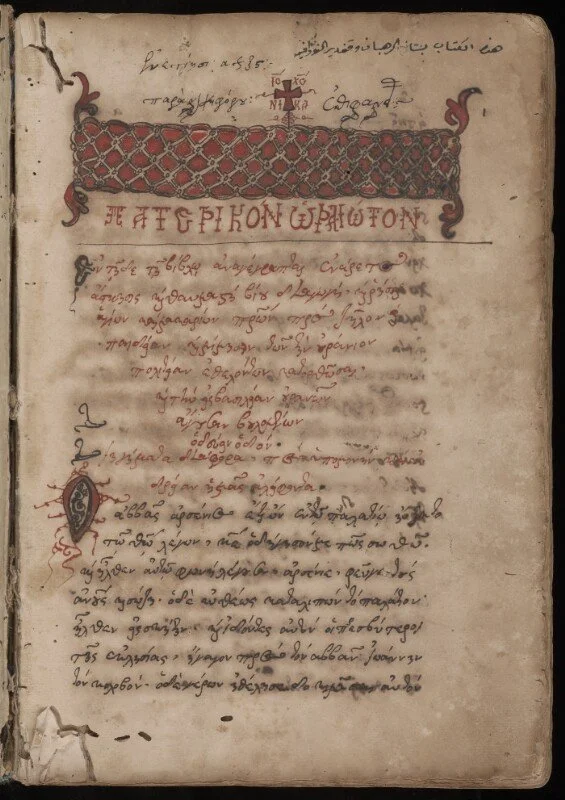
Greek manuscript of the Apophthegmata Patrum dating to the 1700's. Part of the Kenneth Willis Clark Collection of Greek Manuscripts (David M. Rubenstein Rare Book & Manuscript Library, Duke University).
AJR is honored to host this review panel for Christine Luckritz Marquis’s Death of the Desert: Monastic Memory and the Loss of Egypt’s Golden Age (Philadelphia: University of Pennsylvania Press, 2022). You may find all the responses and the author’s response here.
In the wake of collective trauma, memory practices can be protective strategies that channel grief while also shielding the community from continuing harm. In Death of the Desert: Monastic Memory and the Loss of Egypt’s Golden Age, Christine Luckritz Marquis proposes that we see just such a response in a case of violence that effectively ended the great ascetic experiment of the late antique Egyptian desert. In 401 CE, the Alexandrian bishop Theophilus led an attack on the ascetic community at Nitria, located roughly 100 km south of Alexandria. The precise sequence of events is disputed amongst our sources for the attack, but they report the looting of the monastery (variably by youths, brigands, or enslaved persons), along with the rape of the monk-bishop Dioscorus and a possible murder. Accounts of the dispute over the work of the third-century Alexandrian theologian, Origen, bear witness to the incident, but the larger history of Egyptian monasticism accords the event little attention.[1] Contrary to previous studies, Luckritz Marquis argues that the consequences of this event were far reaching and echoes of the “traumatic desecration of the desert” (p. 5) significantly shaped later memories of the desert.
To explore the attack on Nitria and its aftershocks, Luckritz Marquis engages a complex interplay of narratives about the attack itself, alongside accounts of barbarian raids purported to have occurred in 407/8 CE and what Luckritz Marquis identifies as traces of anxiety over accusations of Origenism in the Sayings of the Desert Fathers. These sources lean on the memory of the desert in diverse ways. Some (for example, Life of Macarius the Egyptian) remember the desert as a place for ascetic practice as battle against demons and forceful exile from one’s past. Against this memory appear competing accounts of Theophilus’s account, some accentuating the bishop’s uncontrollable aggression (for example, Palladius’s Dialogue on the Life of John Chrysostom),[2] and others downplaying the bishop’s irascibility and depicting his humility before monastic heroes (as seen in a saying describing Theophilus's death-bed submission to Arsenius).[3] Still others displace the episode altogether, offering instead fever-dreams of demons and fire shattering the community (see Sayings [Greek Alphabetical Collection], Moses 10 [PG 65.285]). In other words, we see in these competing accounts evidence for memory-work, as authors turn our attention to some details and deflect focus from other facets, forming particular types of subjectivities in relationship to the desert. These memory practices, however, were not simply responses to the trauma of that night but were deeply rooted in ascetic cultivation. Driven by a constant fear of vice that threatened to break the promised future of paradise, ascetics monks’ practices were saturated by acts of intentional forgetting: the discipline of embodied responses to vice, rupture with one’s own past (especially in the ascetic denial of social and familial ties), and erasure of demons in the desert and the city. In other words, memory was a theo-political act, folded into communal practice and essential to the ascetic project.
But violence permeated this project, as Luckritz Marquis outlines in the first three chapters. Not only is there an inherent violence to the forced forgetting of the monks, within the ascetic imagination, the desert became a heterotopia populated by demons, barbarians, corpses, and monsters.[4] As such, it existed as a battleground to be conquered, a paradise to be recovered, and a utopia never realized. Here, monks fought not only to wrest the desert from the demons inhabiting it but also to claim ownership over their own embodiment. But the training, contest, and battle that structured the experience of the desert were not confined to it. This reality is illustrated in another, well-known episode of violence connected to Theophilus, the destruction of the Serapeum, in which the violent practices of forced-forgetting-but-also-remembering of the desert collide with the “cultural logics of damnatio memoriae (p. 83). While Luckritz Marquis is not the only person to have noticed the connection between ascetic practice and acts of damnatio memoria,[5] her exploration of the episode in Chapter Three is particularly helpful for teasing out these practices while also recognizing the complexity of competing sources for an episode of religiously-tinged violence.
These explorations of ascetic violence and memory converge in Chapters Four and Five, where Luckritz Marquis argues that our view of the end of the great Egyptian experiment has been obscured by another act of forgetting, this time one that trades accounts of Theophilus’s involvement in the flight of the ascetic community to Palestine for what seemed like a tidier narrative of “barbarian” incursion(s). Within Roman ethnographic discourse, the heterotopia of the desert marked the boundary between the empire and civilization, a space where Romanitas confronted the utterly foreign, where imagined Ethiopians, Mazices, and other ethnicized groups displaced historical peoples. This ethno-political rhetoric has enabled modern studies, especially following the influential work of Hugh G. Evelyn-White,[6] to read roughly contemporary sources (e.g., Augustine’s Letter 11 and Philostorgius’s Ecclesiastical History, 11.8) and laments over the abandonment of Scetis from the Sayings (e.g., Greek Alphabetical, Arsenius 21 [PG 65: 93]) as evidence of barbarian raids on Scetis in 407/8 CE.
Through a careful reexamination of the literary evidence, however, Luckritz Marquis calls the narrative of barbarian incursion at Scetis into question, proposing instead that the sources involved should be placed in conversation with the Origenist controversy, including Theophilus’s attack in 401. Recognizing the painful losses, broken relations, and bruised egos borne within the sources, Luckritz Marquis cautiously reconstructs Theophilus’s attack and concludes that the incident must have inflicted deep, lasting wounds. Luckritz Marquis proposes that the trauma of this betrayal not only reverberated in the careful silences and hushed warnings of later sources, but also in wary attempts to “improve the memory of a blessed bishop” (p. 124). Here, Death of the Desert offers a powerful and persuasive re-reading of the Sayings as school exercises in a mixed monastic setting that captured and passed along the memory of the desert as a lament over a broken promise. There is a productive tension in this reconstruction. On the one hand, Theophilus transforms those who fight the demons of the desert—and whom he had likely brought into Alexandria as an army against Serapis—into desert-dwelling demons that must be eradicated. On the other hand, the bishop himself becomes a demon who fights back against those who would dare oppose him and who must be restrained. While we are able to see the general contours the attack and its surrounding events and interactions, conflicting depictions are allowed to speak to, across, and past each other. In short, the attack was not one, unified event, but several, fractured between the voices crying out in anger, terror, and agony.
Historical reconstruction can be fraught with the tensions of deciding the value of one voice over another, of when and how to weigh actors against actions, of navigating the foggy intersections between events and discourses. This is especially the case if we succumb to the conceit that the task of the historian is to strip away the agendas, judgments, and even sorrows of our sources in order to reconstruct an event and understand how it unfolded—in short, to get at the actual facts as much as possible. But in Death of the Desert, Luckritz Marquis makes abundantly clear that no matter how much we might resist, our investigation of history is not a courtroom drama where the cold, hard facts of a case can be determined and a verdict rendered. The narratives told about Theophilus’s attack on Nitria were caught up in political webs and discursive traditions as people sought to impugn or rehabilitate the memories of Theophilus, Dioscorus, Moses, and other figures from the Egyptian desert. We could perhaps ask how successfully the memory of Theophilus was rehabilitated, for there is a deep irony that Theophilus, who was so ready to impose memory sanctions, was himself subject to sanctions (although not an erasure of the sort typically associated with damnatio memoriae).[7] Even so, Luckritz Marquis shows that events cannot be removed from the narratives surrounding them. Rather, narratives are themselves integral to an unfolding event—not simply as evidence or interpretation, but as part of the contests, practices, and webs of relation in which it unfolds. These arguments are all the more poignant within the present media landscape as we wrestle with our own demons about what to remember, erase, and forget in responding to betrayals within relational webs binding us together—perhaps most keenly felt at the moment in the unfolding disclosures of ties between institutional leaders and Jeffery Epstein or the recent accusations of sexual assault against Cesar Chavez.
Rebecca Stephens Falcasantos (PhD, Brown University, 2015) is Assistant Professor of Religion at Amherst College, where she teaches courses in early and late antique Christianity. Her research focuses on the intersection of religious practice, the formation of ritualized bodies, and contestations over cultural dominance in the late Roman east. Her publications include Constantinople: Ritual, Violence, and Memory in the Making of a Christian Imperial Capital (University of California Press, 2020), as well as articles and chapters on late antique pilgrimage, religiously motivated violence, and ritual habits. She is currently completing a biography of the fourth-century pilgrim Egeria.
[1] For Theophilus’s attack in the context of the Origenist Controversy, see Krastu Banev, Theophilus of Alexandria and the First Origenist Controversy: Rhetoric and Power (Oxford: Oxford University Press, 2015), 42–44; Elizabeth A. Clark, The Origenist Controversy: The Cultural Construction of an Early Christian Debate (Princeton: Princeton University Press, 1992), 44–52. While Norman Russell mentions the attack in his outline of the controversy, the episode comes off as a relatively minor incident against a humming background of violent confrontations; see Norman Russell, Theophilus of Alexandria, 18–27.
[2] A portrayal particularly interesting against another work by Palladius, The Lausiac History.
[3] Sayings [Greek Alphabetical Collection], Theophilus 5 [PG 65.201]). Luckrtiz Marquis explores this Saying in conversation with others involving Theophilus in Chapter Three.
[4] Luckritz Marquis builds on earlier explorations of desert as heterotopia, especially David Brakke’s Demons and the Making of the Monk: Spiritual Combat in Early Christianity (Cambridge, MA: Harvard University Press, 2006); and Richard Valantasis’s “Demons and Perfecting of the Monk’s Body; Monastic Anthropology, Daemonology, and Asceticism,” Semeia 58, no. 2 (1992): 47–79.
[5] See, for example, Fabrizio Vecoli, “Violence and Monks: From a Mystical Concept to an Intolerant Practice (Fourth to Fifth Century),” in Religious Violence in the Ancient World: From Classical Athens to Late Antiquity, edited by Jitse H. F. Dijkstra and Christian R. Raschle (Cambridge: Cambridge University Press, 2020), 306–322.
[6] Hugh G. Evelyn-White, The Monasteries of the Wadi ‘n Natrun. New York, Metropolitan Museum of Art, Egyptian Expedition, 1926–1933, 3 volumes (New York: Arno Press, 1973).
[7] That is, if we consider the portrayal of Theophilus in authors like Palladius, Ps.-Martyrius, and Socrates of Constantinople (Hist. eccl., Bk. 6), whose accounts still influence the way we describe (and teach) about Theophilus and his involvement in the Origenist Controversy. To this, I would add that we find attacks on Theophilus in marginalia dating to the late 13th century, found in our earliest manuscript of Socrates (Biblioteca Medicea Laurenziana Plut. 70.7). For thinking about such accounts as rhetorical hit jobs, see Banev, Theophilus of Alexandria, 35–44.