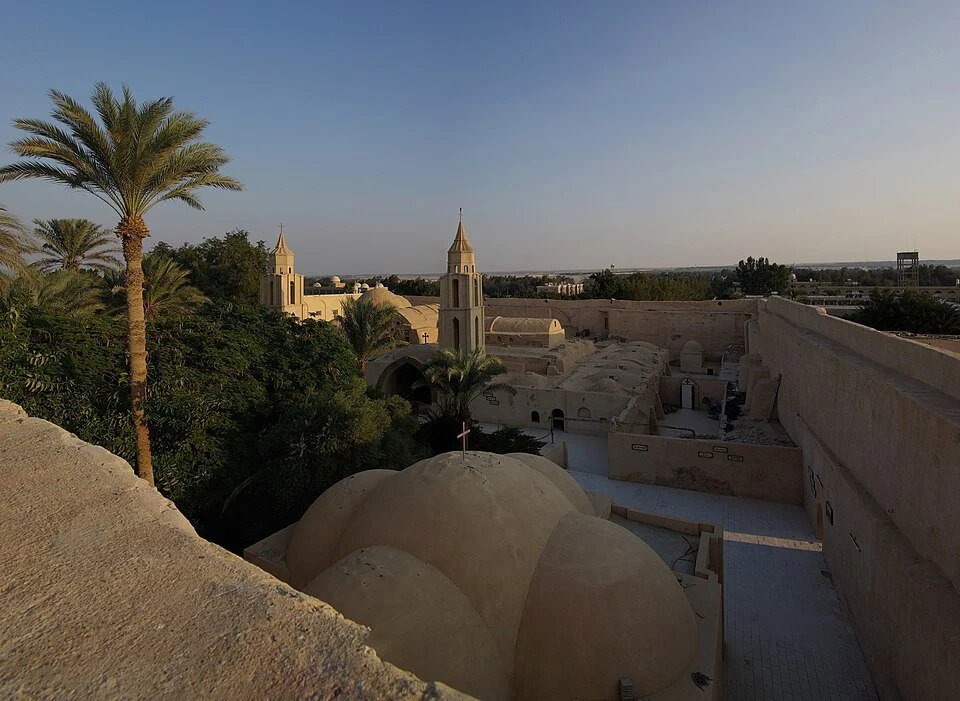

Monastery of Saint Bishoy, Wadi Natrun [Image Source: Wikimedia Commons].
AJR is honored to host this review panel for Christine Luckritz Marquis’s Death of the Desert: Monastic Memory and the Loss of Egypt’s Golden Age (Philadelphia: University of Pennsylvania Press, 2022). You may find all the responses and the author’s response here.
Using Theophilus’ raid of the monastic community and attack against the Tall Brothers at Nitria as its focal event, Christine Luckritz Marquis’ wonderful new monograph, Death of the Desert, argues that “violence was inherent in the Egyptian monastic project from its outset” (p. 5). Luckritz Marquis threads together various narratives of violence from fourth-century historians and the Sayings of the Desert Fathers. She insists that the “biases of these sources are themselves part of the history to be told, but they do not fully control the writings or the historical uses that can be made of them” (p. 3). Throughout the book, she does extensive work to re-imagine these sources in order to challenge long-held narratives about the monastic “Golden Age” and the effects of the supposed barbarian raids. Luckritz Marquis masterfully weaves together multi-layered narratives while simultaneously engaging with the lenses of memory, nostalgia, and race. The result is a distinct and convincing interpretation of this period.
Luckritz Marquis expertly guides her reader through the book’s central arguments in the introduction and on a chapter-by-chapter basis. She lays out in the introduction how the subsequent chapters unfold and explicitly identifies the goal of her monograph: “to offer a new, more textured view of the landscape of fourth-century Egyptian monasticism, while addressing why and how this era has often been misunderstood” (p. 20). Early in the book, she alludes to the title, clarifying that the “death of the desert” was not some product of an ecological disaster or brought about by a barbarian raid but was instead “the death of an ideal as much as anything”—the ideal lost being the “possibility and power projected onto the Egyptian desert and its ascetic inhabitants” (p. 5).
In her first chapter, Luckritz Marquis unpacks the ancient idea of demonic associations with the desert and notes that, before the monastic movement, the desert’s primary inhabitants were believed to be demons. As she observes, “[t]he desert and its associated power belonged to the demons” and the “ascetic inroads into the desert [strove] to claim ownership of a space constructed as Other” (p. 25). Luckritz Marquis recounts how the monastic movement invaded the desert in hopes of controlling it and the monks’ impulse to turn it into a paradisiacal space—a sort of “elusive utopia” (p. 39). Returning to her theme of violence, she writes that the monks exposed themselves to external demonic violence inherent in the desert, as well as their own self-imposed ascetic violence. The conceptualization of the desert within this framework vivifies the context of the monastic movement. She illustrates the integral role the desert setting played in the construction of asceticism and monastic identity.
Luckritz Marquis’ second chapter explores violence in the desert through psalmody and prayer, namely, how they served as weapons against demonic forces. Focusing on cells as sites where a monk’s “entire being might be reoriented toward the divine and away from the demonic” (p. 51), she addresses how items like crosses functioned as apotropaic objects. She argues that prayer’s use as a weapon and protection against demons meant that violence “sat at the heart of ascetic formation,” and furthermore, that “angels offered monks models of divine violence” (p. 71). The monks’ memorization of psalmody served as a repetitive liturgical practice, and the violent imagery of the Psalms informed their ascetic practice. She concludes that such memorizing and reciting yielded a “violent, divine-like embodiment” among the monks (p. 71). Luckritz Marquis’ assessment that violence manifests in the material objects and spiritual practices of the ascetic movement deepens the work of her previous chapter. She demonstrates that just as much as violence became part of the desert space, it is also deeply embedded in the objects and practices characteristic of ascetic life.
The third chapter unpacks the ancient practice of damnatio memoriae. Luckritz Marquis’ strength in this chapter is her ability to work in tandem with other scholars in the field, as she effectively draws on the scholarship of Charles Hedrick, Lauren Hackworth Petersen, and Peter Stewart to situate her arguments within broader discourses of damnatio memoriae. She begins the chapter by examining Rufinus of Aquileia’s account of the destruction of the Serapeum. The latter part of this chapter addresses its title, “Monks and Memory Sanctions,” as Luckritz Marquis traces this phenomenon of damnatio memoriae in monastic life. She argues for the centrality played by both active forgetting and intentionally not forgetting in asceticism. She concludes that outward-directed violence within the monastic movement existed alongside the inward-directed violence of confronting one’s past. This study of damnatio memoriae explores how this forceful shaping of memory occurred at an individual level. While scholarship often focuses on the societal impact of such memory sanctions, she points out that these monks implemented these violent practices on their own personal histories. Her valuable intervention here compels us to consider societal practices—such as damnatio memoriae—and how this phenomenon can occur on the individual level.
In her fourth chapter, Luckritz Marquis outlines Roman ideas of the “Other.” Taking a historical and historiographical approach, her reframing of these raids daringly challenges previous scholarship in the field. She pushes back against the narrative of supposed barbarian raids in the fifth-century CE, particularly those the reconstruction of Hugh Evelyn-White. Instead, she argues that these raids were purposefully reworked into a more familiar framework of barbarian violence in order to safeguard the memory of Theophilus. This analysis of the weaponization of violent stereotypes against the so-called barbarians is effective in pushing scholarship beyond existing paradigms.
Luckritz Marquis’ fifth and final chapter returns to the event with which she began: Theophilus’ raid in Nitria. She returns to her analysis of Palladius’ account and the Sayings of the Desert Fathers. She reiterates her point that the Sayings represent a fifth-century memorial to the previous monastic period. These Sayings were not a “historical window” into the past but rather a “nostalgic remembering” (p. 149). She re-reads the Sayings attributed to Abba Lot, which had previously been deemed anti-Origenist, and instead argues that this text “preserves monastic anxiety about the consequences of being caught mentioning Origen” (p. 152)—a natural response given Theophilus’ raid. She addresses the fraught legacy of Theophilus and, once again, circles back to her thesis that violence is in the origins of the monastic movement. Her concluding point in this chapter is that the Sayings represented a “particular remembering of the past” that “erased unsavory intra-Christian fights and layered new ‘barbarian’ traumas on top” (p. 156). In this way, Luckritz Marquis synthesizes the themes she homes in on throughout the book—violence, memory, and race. She effectively demonstrates that the Sayings can only be understood by considering these three lenses. As a result, she challenges the reader to consider how we can re-read these sources using them.
In her epilogue, Luckritz Marquis appeals to the broader field of Religious Studies and widens her audience beyond just scholars of the ancient world. Luckritz Marquis cogently addresses Death of the Desert’s contribution to broader memory studies and how it fits into larger theoretical discourses of nostalgia. She connects nostalgia with the narrative of violence that she has traced throughout the book: “[N]ostalgia is an innately violent activity…[it] is not just longing for a long past but a violent displacement of historical pasts in favor of a more productive, imagined historical narration” (p. 158). In these satisfying final few sentences, she succinctly concludes her monograph, which is a must-read for anyone interested in understanding not just the late-antique Egyptian monastic movement but also how history deliberately remembers and forgets. Death of the Desert is a reminder that scholars across the field can and should learn from studies of the past.
Ciara Mulcahy is a Ph.D. student in Judaism and Christianity in Antiquity at the University of Virginia.