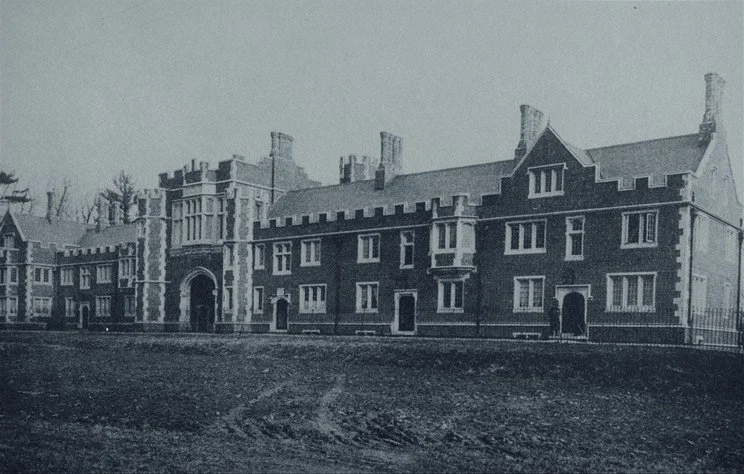
1879 Hall, View from southwest (photo circa 1910).
Princeton University Archives, Mudd Library, Grounds & Buildings, SP 2
This is the first essay in a review forum devoted to Vidas, The Rise of Talmud. Access the full forum here.
I remember, many years ago, knocking on Moulie’s office door on the second floor of 1879 Hall in Princeton, to return a book I had borrowed. It was already dark outside, and late, and Moulie was huddled over an open Yerushalmi, a table lamp illuminating the page. Reading Moulie Vidas’ The Rise of Talmud (Oxford University Press, 2025), I kept thinking of that scene, a symbol of Moulie’s indefatigable dedication to this research. The book is clearly a labor of love. The sensitive readings, the devotion to understanding the text’s terms, the commitment to identifying with precision what makes this work unique and new – these are evident throughout the book, in the empathy that Moulie expresses when he speaks about the amoraim and how they related to the work of their scholarly predecessors, and in his efforts to identify the humans that are folded into this anthological composition and how they conceived of the humanness of their scholarly endeavors. Not every book exudes its author’s love of the subject matter as much as this one.
The Rise of Talmud contends that talmudic literature, and the Yerushalmi in particular, represents a novel intellectual project. Talmud is often characterized as an interpretation of or commentary on the Mishnah in the same way that the Mishnah or Midrash are interpretations of or commentaries on Scripture, and, moreover, that what distinguishes Talmud from earlier rabbinic literature is the literary genre of the sugya and the emphasis on dialectical argumentation. Vidas argues, in contrast, that Talmud is not merely the next step in this interpretive tradition, couched in a new genre, but rather a new intellectual project, one that relates to the traditions of previous rabbinic scholars differently from how it relates to scriptural traditions – and that thus also required unique forms of engagement. The Sages distinguish between scripture, which they understood to be (for the most part) complete and perfect, and rabbinic traditions, which are fragmentary, imperfect, and subject to misunderstanding, corruption, and confusion. Studying rabbinic traditions, engaging with them, making sense of them, tracing their evolution, and revising them therefore entailed, for the Sages within this interpretative tradition, different strategies from those necessary to explicate divine scripture, which assume a more stable and whole work that is knowable in full. The Talmud, in Vidas’ words, develops a “hermeneutics of imperfection.” He writes: “the Yerushalmi construes rabbinic tradition as a thoroughly human product” (306). The book points to the various ways in which the rabbis grappled with the humanness of the rabbinic traditions they inherited and which they themselves continued to transmit.
The book focuses on notions of text, authorship or author function, and citation. The first half of the book argues that “Amoraic scholarship pursued and produced a new understanding of rabbinic teachings as shaped by individuals. Changes in citation formulae reflected an interest in distinguishing the ‘authors’ and ‘tradents’ of teachings” (304). Amoraim, Vidas demonstrates through analysis of terms such as de’ah and ke-da’ateh, shita and mehalefa shitateh, insisted that “the identity of the sage behind the teaching is crucial for understanding it” (304). Sages did not only transmit traditions, but rather any given sage had particular opinions and tendencies and ways of interpreting that were unique to them, and that could be – the Talmudic rabbis assumed – identified, extrapolated, and used to reconstruct halakhic debates and positions on a broader scale. The second half of the book suggests that “Amoraic scholarship was interested in raising and solving textual problems predicated on a construction of the extant corpus of rabbinic teachings as fragmentary and imperfect” (304). In other words – and as Moulie himself acknowledges – the Amoraim were scholars of rabbinic teachings not unlike modern scholars of rabbinic texts, trying to piece together the best version of the text, explain alternative attestations, amend teachings that might be erroneous, identify the scholars behind various traditions, and worry about justified citation practices.
One of the book’s contributions is the fact that it takes the Yerushalmi seriously, not just as a less-developed predecessor of the Bavli (and in particular the Bavli’s stam), but as the earlier of the two Talmuds, engaged in similar though not identical processes of conceptualization and composition to the Babylonian Talmud. The Bavli might remain the most celebrated rabbinic work, but the Yerushalmi was the first of its kind. The Bavli, in a sense, becomes less unique through Vidas’ reading, and “the Talmud” is re-situated within its late antique Palestinian intellectual context, among Origen, Eusebius, Jerome, and Epiphanius, and other contemporaneous scholars.
This book joins the work of Monika Amsler, Mike Chin, Krista Dalton, Emanuel Fiano, Mark Letteney, Jeremy Schott, Rebecca Wollenberg, and others, who have identified this period – the third through fifth centuries, and the fourth century in particular – as one during which scholastic practices were reconceived and new intellectual traditions emerged, and as new forms of expertise developed. Vidas argues that the rabbis participated in broader scholarly and epistemological transitions, and, implicitly, that they were fully part of the late antique intellectual landscape, even or especially in their insular writings. As new scholarly traditions emerged, so did Talmud. And as a range of textual experts asserted their authority, so did the rabbis. Vidas writes: “If Amoraic scholars were competing for prestige and persuasion in settings where textual expertise was greatly valued, we can consider how the development of these new interpretive practices allowed them to claim some of the same types of critical philological expertise in which other elites excelled, while maintaining the unique status of the Hebrew Scriptures as insulated from such inquiries” (308).
I recently co-taught a graduate seminar on the history of Jewish Studies, starting with Leopold Zunz, Immanuel Wolf, and Isaac Marcus Jost in the early nineteenth century. As I read Vidas’ book, I could not help but think about the ways in which this book fits into the traditions of Talmudic scholarship that the Wissenschaft des Judentums scholars developed. The first generation of students who had both yeshiva and university training sought to apply philological approaches from Classical (and theological) studies to rabbinic texts, and much of rabbinic scholarship since then has operated in that tradition. What Vidas suggests in his book is that the ancient rabbis were philologists, and among the earliest philologists and critical scholars at that, who sought to mine earlier rabbinic traditions in order to construct the best versions of them, clarify attributions, draw connections between individuals and texts, discuss textual differences, figure out methods of emendation, and so on. Vidas argues, then, that philology is not (exclusively) a modern, critical, etic tool that we can apply to the study of the Talmud, but rather that it is also an emic approach – and a thoroughly Jewish one – developed as part and parcel of the Talmudic enterprise itself. As I read, I wondered: is this book bridging the gap and blurring the boundaries, at least in some ways, between the scholarship of the (ancient) Talmudic rabbis, later traditional (modern) Talmudic scholarship, and the modern critical academic field of rabbinics today – making the rabbis less quaint and more worldly while simultaneously reminding us that our methods are in fact deeply indebted to the very works we seek to parse (and not so new or innovative after all)?
I recall a session at an AJS conference a few years back about philology and contemporary Jewish Studies. The Rise of Talmud seems to be making an argument that is not only about the rise of Talmud, but also about the state of research in the humanities today. If I had to construct the implicit message, it would be about the potential vibrancy of enlightened philology as a tool for humanistic inquiry and deep contextualization – rather than as narrow-minded antiquarianism that proves the irrelevance of textual study and of the humanities writ large.
The book is dense and detailed, and I often found myself rereading sentences and paragraphs to understand the intricacies and nuances of Vidas’ arguments. It is a book of deep learning. It can be thrilling even for non-academic readers with interest (and some prior background) in rabbinic literature and accessible for scholars in adjacent fields. The book contributes to our understanding of the emergence of Talmud in late antiquity, identifies the uniqueness of this phenomenon, which we might otherwise have taken for granted because of the canonical status that this form ended up taking over the course of Jewish history, and models the scholarly methods it encourages us to champion, rather than discard, in this particular historical moment. It is a monumental achievement.
Sarit Kattan Gribetz is Associate Professor of Religious Studies and Jewish Studies at Yale university.