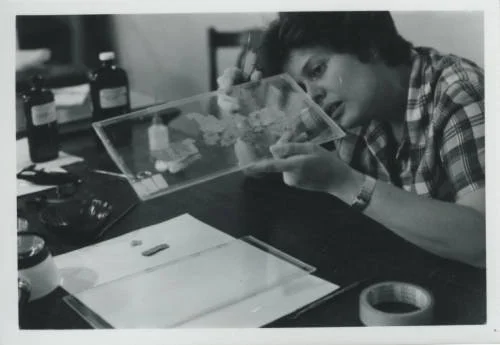
Anita Robinson studying fragments of the Nag Hammadi codices in Cairo, Egypt (1974). Photo courtesy of Claremont Graduate University. Institute for Antiquity and Christianity, School of Religion.
Part Two of a mini-series of reviews engaging Liv Ingeborg Lied and Brent Nongbri’s Working with Manuscripts : A Guide for Textual Scholars. Yale University Press, 2026.
Read Part One here.
For scholars trained on translations and critical editions, the transition to working with manuscripts can feel like something of a daunting leap. Liv Lied and Brent Nongbri’s 2025 volume endeavors to make this step more approachable and, ultimately, more rewarding. Working with Manuscripts is a fundamentally practical companion, in both form and content. The volume addresses a range of issues, including the basic terminology of manuscript study, expectations for working in repositories, and the ethical and legal considerations surrounding the publication of ancient documents. For early-stage graduate students, in particular, and for those who teach and mentor them, the volume offers a clear point of entry into a set of skills that is becoming increasingly essential, especially in an age of expanding digitization and access.
The book is organized into eight chapters, each addressing a different aspect of manuscript work. Following a brief introduction that orients newcomers to the value of manuscripts beyond critical editions and identifies the volume’s early-career audience, Chapter One focuses on manuscripts as material objects. Lied and Nongbri familiarize readers with scripts and handwriting, writing media such as papyrus, parchment, and paper, and the inks and implements used by scribes. The authors also outline the differences between scrolls and codices, explain how codices were constructed, and describe how text is arranged on the page, including marginalia, colophons, and other paratextual features. The chapter concludes by emphasizing the significance of tracking signs of wear, such as thumbprints or sweat, which can reveal which parts of a manuscript were most frequently used.
Chapter Two addresses the problem of finding manuscripts. Lied and Nongbri outline the challenges involved, from shifting shelf marks and multiple naming systems to the often-idiosyncratic organization of catalogues. Through a series of concrete case studies, the authors demonstrate how to track down specific manuscripts using both print catalogues and digital tools such as the Pinakes database and the syri.ac portal. The chapter concludes with advice on how to proceed when the material you seek has been lost or destroyed. In their third chapter, Lied and Nongbri turn to questions of provenance, including the legacy of European colonialism, the ways a manuscript’s origins and movements may shape one’s research questions and publication decisions, the ethical and legal implications of the 1970 UNESCO Convention, and the differing circumstances of working in public, private, and heritage collections.
Questions of access come to the fore in Chapter Four. Following a brief discussion of how to determine if in-person access is necessary or if digital images will suffice, the authors explain how to contact curators, the kinds of hurdles a scholar might encounter depending on status or background, how to budget time and money in light of research needs, what to bring (and what not to bring) into a reading room, and how to proceed if access is denied. In Chapter Five, the authors guide readers in how to work efficiently in situ, including etiquette for interacting with curators, the process of ordering materials, and positioning them for study (with snake weights, gloves, and the like). The chapter then presents four hypothetical case studies, each modeling a different kind of research task, from verifying a textual variant to situating a text within a larger codex, determining the format of a fragment, or reassessing an uncertain reading in a damaged manuscript. The chapter closes by underscoring the importance of taking careful notes and photographs, pacing one’s work, consulting archival records, and remaining attentive to the communal and social dynamics of the reading room.
The sixth chapter encourages readers to organize their research materials as soon as possible after leaving a repository, especially by adding metadata to images and summarizing notes in ways that will remain usable over time. Chapter Seven focuses on best practices for seeking advice and information from other scholars, including making use of listservs and social media, preparing to contact more senior colleagues, and maintaining ownership of one’s ideas in public forums. The eighth and final chapter addresses securing permission to publish manuscript images, citing them properly, and navigating situations in which particular scholars may have priority or exclusive access to certain documents or archives. A brief conclusion reiterates the authors’ hope that working with manuscripts will prove “academically fulfilling and—at a personal level—inspiring, stimulating, and fun” (p. 166).
The volume’s prose is straightforward and conversational, interspersed with short illustrative anecdotes that provide concrete snapshots of the practicalities of working with manuscripts. The volume also includes a helpful glossary, and key terms are conveniently bolded as they appear throughout the text, making it an accessible resource for anyone encountering the vocabulary of the field for the first time. Because of its clear structure and pacing, the book lends itself naturally to classroom use or class visits to manuscript repositories. Each chapter could be paired with hands-on exercises, such as tracing a manuscript’s journey through online catalogues, comparing digital images of the same folio, or drafting a short report on access and permissions policies at a major library. Brief illustrative insets scattered throughout the text could also serve as prompts for student essays or reflection papers.
Lied and Nongbri demonstrate a level-headed pragmatism in their treatment of ethical questions. In the third chapter, for example, they broach one of the most difficult issues in manuscript work: what to do when a manuscript’s provenance cannot be securely established. Rather than furnishing a simple directive, they walk readers through the real options and consequences—to study or not to study, to publish (under the familiar pressures of academic productivity) or to set the material aside on moral grounds. The authors present both sides of the debate, laying out relevant legal frameworks alongside the arguments of scholars who see value in studying unprovenanced materials. In the end, the chapter leaves readers to decide for themselves how to proceed. The effect is not neutrality for its own sake but a kind of ethical pedagogy: the reader learns how to think through these questions, not merely what to think about them.
As a broadly conceived introduction, Working with Manuscripts naturally leaves certain areas unexplored, most notably the rapidly evolving landscape of digital tools, such as handwritten text recognition (HTR), and platforms like eScriptorium. While the use of such tools will likely expand in the coming years, a grounding in the basics of working with physical manuscripts should come first. In this respect, Lied and Nongbri provide a firm and accessible foundation, offering a point of entry into critical but under-taught skills and addressing a long-standing shortage of resources for the teaching and practice of manuscript work.
Julia Hintlian recently received her PhD from Harvard University's Committee on the Study of Religion, where her research focused on Greek, Syriac, Arabic, and Armenian Christian approaches to theological anthropology.