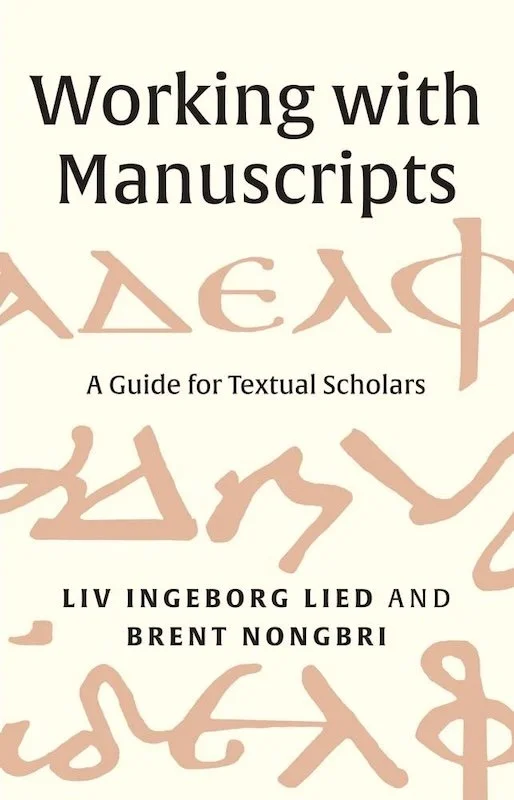
Part One of a mini-series of reviews engaging Liv Ingeborg Lied and Brent Nongbri’s Working with Manuscripts : A Guide for Textual Scholars. Yale University Press, 2026.
Read Part Two here.
In 1999, I flew to Egypt for a summer of dissertation research. I planned to visit monasteries and study Coptic manuscripts at two collections in Cairo. With a letter of permissions in one hand and the contact information for a colleague in Cairo in the other, I thought I was prepared. I was wrong. As the authors of Working with Manuscripts admit in their Acknowledgment’s opening sentence: “This is the book [I] wished [I] had when [I] started working with manuscripts.” (vii) I suspect many mid-career and senior scholars will share this sentiment. That summer, I made perhaps half the mistakes Lied and Nongbri warn about in their book. Thanks to them, researchers no longer have to face my fate. In Working with Manuscripts, Lied and Nongbri provide a comprehensive guide to manuscript research, particularly for scholars in biblical studies, early Jewish studies, and early Christian studies.
Throughout, the book keeps in focus the materiality of manuscripts and the embodied aspects of the craft of manuscript research. Although subtitled “A Guide for Textual Scholars,” this volume insists that we can neither sever ancient text from the papyri, parchment, or paper on which it has been transmitted, nor separate ourselves as scholars from the histories, networks, and institutions that have brought the researcher and the manuscript into contact. As Lied and Nongbri write in the introduction, their “driving force” is “the conviction that knowledge of manuscripts is important for all interpreters of ancient texts” (6).
Written primarily in the second person, the prose is both engaging and accessible. The authors provide tips from their own deep experience with manuscript research, often even mentioning mistakes or regrets as cautionary tales and lessons learned. When relaying these anecdotes, the authors switch to third person voice to recount the experience of either Lied or Nongbri. A glossary at the end of the book defines key terms that appear in bold throughout the preceding chapters (e.g., colophon, majuscule, rubrication). Numerous illustrations bring the authors’ examples and explanations to life. Text boxes effectively provide concrete, detailed examples of methods and research questions. In some chapters these boxes list relevant reference works, while in others they dive deeply into the analysis of a particular manuscript feature or provide templates for emails a researcher may expect to send. Each chapter also ends with a bibliography for further reading. The final result is a brilliant and practical book that deserves a place on all our shelves.
The first three chapters emphasize understanding manuscripts as physical artifacts with meaningful features that extend well beyond the text inscribed upon them. Chapter 1, “Manuscripts as Artifacts,” introduces the reader to the ancient and medieval or byzantine methods of producing manuscripts and to the layout of scrolls and codices. Lied and Nongbri also call attention to the marks of the later use of the manuscript, beyond its moment of creation. They call on the modern reader to note erasures, “corrections,” marginal notes, and even stains or damage in order to ascertain how previous readers used the document and which passages received the most attention.
Chapter 2, “Finding Your Manuscript,” walks us through the often challenging task of locating a manuscript. In addition to explaining the basics (shelfmarks, catalogs, etc.), Lied and Nongbri also devote a section to the vexing question, “How Can Locating a Manuscript Be So Hard?” Codices may be fragmented across multiple repositories, or libraries might have recataloged their collection by giving manuscripts new identifiers, or pages may be lost or destroyed. A separate box lists existing digital tools (with the reminder that many catalogs as well as manuscripts may not be digitized or database-d). The bulk of the chapter works through five examples of locating manuscripts step-by-step.
The authors address some of the global ethics of manuscript research in Chapter 3, “Provenance and Why It Matters.” Lied and Nongbri briefly define provenance and explain the how colonialism has affected ancient and medieval manuscripts. They then outline the basics of international law for the field as well as the definitional and ethical differences in working with public repositories (e.g. national libraries), private collections, and heritage collections. The authors also describe situations in which they themselves worked with a private collection or with a collection that was not transparent about provenance and reflect on how their views have changed. Lied concludes that she no longer “want(s) to contribute to the academic legitimation of potentially looted or illegally exported goods.” (77) Provenance has risen in importance in recent decades, as some scholars (myself included) have argued that research on manuscripts for sale or in private collections raise their market value and incentivize looting and theft in heritage countries such as Egypt, Iraq, and Syria. In addition, gaps in a document’s provenance translates to reduced information about its original context, history of use, etc. This chapter is particularly valuable for independent researchers or students whose education (like mine) did not include any discussion of provenance or its legal and ethical implications. It reflects a change in scholarly attitudes that has begun to make headway in our fields but still has a ways to go (see especially Roberta Mazza’s recent Stolen Fragments [2025])[1].
Working with Manuscripts also tends to the embodied experience of manuscript study. Chapter 4, “Getting Access and Planning Your Stay,” begins with the pros and cons of using digital photographs of manuscripts compared to visiting the physical artifact. While digital facsimiles allow us to zoom in on questionable sections or manipulate brightness and contrast settings, only the manuscript itself can provide some clues to usage (smell, wear-and-tear, weight), and often facsimiles cut off or obscure margins, which can contain valuable information. And of course, many manuscripts have not been digitized. For the visit to a library or archive, the authors walk the reader through the steps to gain access, including how to write a letter to the relevant librarian or curator and how to request a letter of reference from a more senior scholar should the institution require one. They also have valuable tips regarding where to stay and how to nourish and sustain our bodies during the trip. Particularly helpful is a text box breaking down what to bring, organized by “musts,” “maybes”, and “options.” (Though I myself would put walking or running shoes in the “must-have” column rather than the optional one: US researchers in particular need to be prepared for extensive walking and multiple flights of stairs in European and Middle Eastern settings.) The chapter ends with practical advice for reworking your research plans when access to a manuscript is denied.
The next chapter (“In the Reading Room with Your Manuscript”) guides the researcher from the moment she first sets foot in the library or museum (often at security) through to the end of the day. The authors wisely advise scholars to ignore historical photographs of professors hunched over the Dead Sea Scrolls and Nag Hammadi Codices with cigarettes dangling from their lips or fingers; times have changed. They provide four individual case studies for how (and why) we might examine a document in person. Tips on taking breaks, socializing with other researchers, and taking photographs and notes follow. (I endorse their counsel: “Always err on the side of taking too many notes.” (131)) I appreciate the authors’ gentle but insistent recommendations to be considerate of the staff and obedient to their rules, even if they seem irrational to us. On a trip to a collection in Europe a few years ago, I remember the staff requiring us to leave 15-30 minutes before closing; having traveled from across the ocean with a limited number of days in the library, to me every minute counted. I had hoped to stay to the bitter end each day. But arguing or stubbornly staying at my table would have been counter-productive (not to mention rude).
Lied and Nongri embed manuscript studies within a larger set of research practices. Chapter 6 (“Back Home — What Now?”) suggests ways to organize research notes taken in the reading room and advises adding metadata (and meaningful filenames) to manuscript photographs. And of course the advice (which we do not always heed), to back up, back up, back up all of our working files. Chapter 7 provides models for consulting with the wider scholarly community on our work. “Asking for Help” covers online forums, listservs, conferences, and emailing individual experts. Cases range from interpreting an obscured line or passage in a manuscript to requesting feedback on an article draft. The authors wisely caution readers that women scholars often bear much of the mentoring load in academia and warn us to do all our homework on our sources and the scholarship of the person we might contact. (They even include a homework checklist and sample emails.) The final chapter covers one of the most exasperating aspects of manuscript research: “Publishing and Permissions.” Some institutions charge high fees to publish images of their manuscripts. While Lied and Nongbri do a valiant job of describing the obstacles to obtaining images and permissions, researchers new to this area should be prepared for challenges and even disappointment.
This chapter also covers a practice common in Europe decades ago (and still perhaps in existence in a few libraries now), which is reserving manuscripts for particular scholars. I first encountered this in my trip to Cairo, when the Institut français d’archéologie orientale refused my request to view an unpublished codex from the White Monastery. A prominent French scholar planned to publish an edition, and so the work was reserved for them. Fortunately, that scholar was generous (and my French good enough for the correspondence), and I received the permission. The edition of that codex was published in 2013, 11 years after my dissertation defense and 6 years after the publication of my book, both of which referenced the manuscript. I am still grateful for that kindness. The next time I encountered this practice, I was conducting dissertation research on unpublished, codex fragments in a European collection. The library had to get permission from other scholars for me to view some of the folios, as they had been exclusively reserved. Years later, the same library contacted me for another researcher’s permission, because unbeknownst to me, they had reserved the other folios for my use only!
My only caution (not really a critique) is to take seriously Lied and Nongbri’s warnings about how things may not always proceed according to plan. That aforementioned summer in Cairo, for example, I excitedly walked into an institution, with my signed, stamped letter of permissions from the Director, only to discover a new Director, who would not honor his predecessor’s wishes and required me to secure approval from the Supreme Council on Antiquities before gaining access to the manuscripts. Thank goodness I was there for months—not merely a 1- or 2-week stint—and had the time to navigate the bureaucracy. Lied and Nongbri raise the possibilities of obstacles and closed doors in every chapter. Given the detailed guidance and encouraging, optimistic tone of the book, however, the reader may overlook or downplay these admonitions. We absolutely should not.
Working with Manuscripts is an extremely versatile and most welcome book. Independent scholars, students, and established researchers alike will find it a valuable resource. It can be used as a textbook in a course or as a stand-alone handbook for the intrepid researcher. It should find a core audience with people studying the Hebrew Bible, New Testament, early Judaism and early Christianity (and the medieval and Byzantine uses of these materials), since the examples and resources concentrate in these areas. Especially in North America, many graduate students in these fields receive little formal instruction or mentorship in manuscript studies. Even researchers who anticipate working only with published editions should read this book. It will provide valuable context for the work that went into creating the editions, and it may even inspire unanticipated (but delightful) manuscript research.
Caroline T. Schroeder is a professor in the Women’s and Gender Studies department and the Data Scholarship program, faculty fellow in the Data Institute for Societal Challenges, and associate faculty in the History and Religious Studies departments at the University of Oklahoma.
[1] Roberta Mazza, Stolen Fragments: Black Markets, Bad Faith, and the Illicit Trade in Ancient Artefacts (Redwood City: Stanford University Press, 2024).