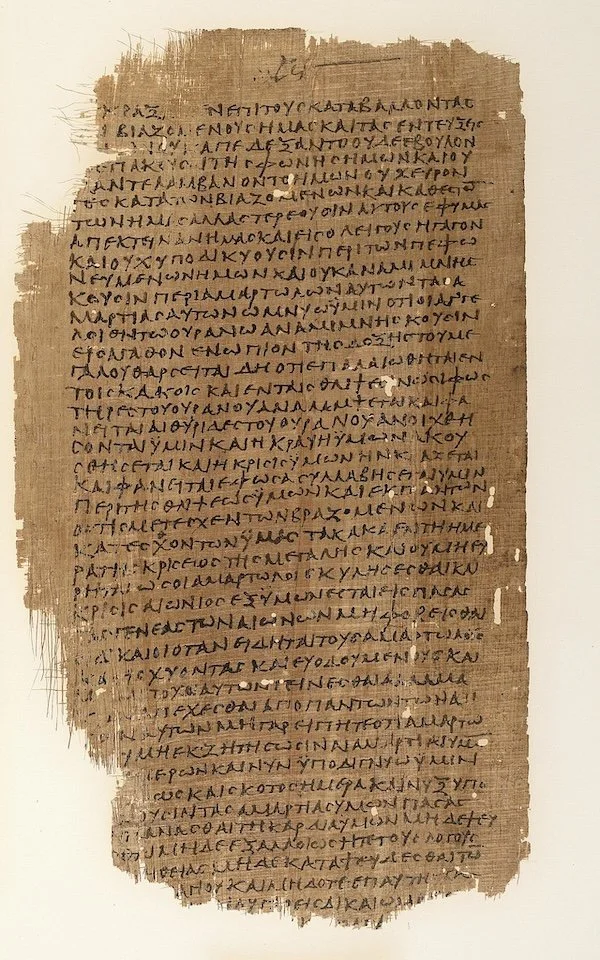
The backside of P.Mich.inv. 5552, showing portions of the Book of Enoch in Greek. Part of the Chester Beatty Papyri.
The Limits of Jewish Identity: Comments on The Posen Library of Jewish Culture and Civilization, Vol.2, Emerging Judaism, 332 BCE–600 CE, ed. Carol Bakhos
I must begin by congratulating Carol Bakhos on this mammoth achievement.
This volume is a goldmine of source material covering almost a millennium of Jewish history. In an anthology like this, one can always imagine different ways of doing it, but different is not necessarily better. The volume contains a vast and diverse amount of material.
The general introduction to the volume states that “it is possible to recognize common threads of concern that shape Jewish culture despite this diversity.”[1] I would like to reflect a little on some of these common threads, and also on the boundaries of Jewish identity and the breaking points. I will not attempt to consider the whole volume here, but will confine myself to the pre-rabbinic period, with which I am most familiar.
Judaism and Hellenism
The word “Judaism” first appears in 2 Maccabees, where we are told that Judas and his followers “strove zealously on behalf of Judaism” (2 Macc 2:21), resisting the measures of Antiochus Epiphanes and the High Priest Jason who were trying to convert the people of Judea to the Greek way of life (2 Macc 4:20). The building of a gymnasium in Jerusalem, we are told, had resulted in “an extreme of Hellenization” and the adoption of foreign ways. The books of Maccabees depict Jason’s reform as an attempt to overthrow the ancestral laws and change the Judean way of life so that it was no longer distinctive.
How well defined was the Jewish way of life before the Maccabean revolt? In most traditional societies, ethnicity is defined by a common homeland and at least a supposedly common ancestry. Beyond that, as Fredrik Barth famously argued, it is the ethnic boundary that defines the group.[2] In the case of Judea, the temple cult assumed exceptional importance, since only one God was recognized. The Torah of Moses was well-established since the Persian era, and some its stipulations (circumcision, sabbath observance, the festivals) had iconic importance. There is little evidence that great concern was attached to the details of the law, but the law was taken to be synonymous with ancestral custom. Ben Sira equates the Law with Wisdom, but his book is primarily a collection of traditional maxims, not an exposition of the Torah. The older wisdom books, Proverbs, Job and Qoheleth, do not acknowledge the Law of Moses at all. Neither does the early Enoch literature, although the stories of Enoch and the Watchers are extrapolated from terse passages in Genesis. We do not know whether, or to what degree, the tradents of that literature observed circumcision and Sabbath. We know from the books of Ezra and Nehemiah that some Judean leaders tried to protect the lines of descent by preventing mixed marriages, but it is also apparent that they were not always successful in doing so. But at least we can take it from the books of Maccabees that by the second century BCE some customs were perceived as traditionally Jewish and others, such as frequenting the gymnasium, were perceived as foreign.[3]
But it was not the gymnasium or the adoption of Greek dress, or even Greek undress, that sparked the Maccabean revolt. Those cultural changes may have offended some people, but they did not seriously threaten Jewish identity. Neither did adoption of the Greek language. Already in the time of Nehemiah some people were upset about the decline of the Hebrew language, but Aramaic proved to be a perfectly acceptable medium of communication. What triggered the revolt was the disruption of the temple cult and the prohibition of key ancestral practices such as circumcision and observance of the sabbath and festivals.[4] Taxes may also have played a part, as Silvie Honigman has argued,[5] but attempt to abolish key boundary markers seems to me to have been the primary consideration in sparking the revolt.
The books of Maccabees are concerned with events in Judea, the homeland of Judaism. The situation may have varied in different locations. For a century before the Maccabean revolt there had been a flourishing Jewish community in Egypt. Jews in Egypt had no problem whatever with the Greek language, or with loyalty to a Greek, Ptolemaic king.[6] While our evidence of their practices is limited, they seem to have maintained important traditional practices. They had a clear boundary marker in their refusal to worship the gods of their neighbors. In most cases they appear to have maintained their loyalty to the Jerusalem temple, even when the exiled High Priest Onias built his own temple at Leontopolis, and even though distance prevented frequent participation in the temple cult. Our knowledge of these Diaspora Jews is dependent on their literature, and we recognize their literature as Jewish because of their pervasive use of traditions known to us from the Hebrew Bible.[7]
The success of the Jewish community in Egypt shows that there was no necessary incompatibility between Judaism and Hellenism. There were to be sure some Hellenistic practices that Jews could not accept, mainly related to idolatry, and Jewish identity required adherence some distinctive traditions and customs. But only boundary markers need to be distinctive. As Barth argued, it is the ethnic boundary that defines the group, not the cultural stuff that it encloses. In practice, this means that a group has to have some distinctive markers, but it can share a lot of cultural stuff with its neighbors. The literature of the Hellenistic Diaspora tends to emphasize Jewish acceptance of Hellenistic culture, rejecting only idolatry, some sexual practices and the exposure of infants. Distinctive practices such as food laws are often given allegorical explanations, to make them more acceptable to cultured Hellenists. Philo notes that “there are some who, regarding laws in their literal sense in the light of symbols of matters belonging to the intellect are over-punctilious about the latter while treating the former with easy going neglect” (Migr 89). Philo is critical of such people, but he does not exclude them from Judaism. Such people may have been exceptional. Distinctive observance of sabbath, food laws, circumcision and the festivals, and association with other Jews in the synagogue, were still the public markers by which Jews were identified.[8]
The Maccabees, and their successors the Hasmoneans, did not repudiate all Greek customs. Hasmonean rulers adopted Greek names. Aristobulus I was known as phil-hellene. The Hasmoneans enjoyed banquets, employed Greek mercenaries and generally acted like Hellenistic kings. Their palaces had Hellenistic style pools and bath-housess.[9] But at the same time they seem to have elevated the importance of Jewish law, especially in matters of purity. The profusion of ritual baths dates from the Hellenistic period.[10] The Hasmoneans themselves did not use graven images on their coins, and they seem to have avoided common Hellenistic pottery probably for purity reasons. It is also in the Hasmonean period that we find literature with a great concern for purity laws in texts such as Jubilees and MMT.[11]
The upsurge in interest in purity laws and in detailed observance of the Torah seems to have come in reaction to the “extreme of Hellenization” in the Maccabean era and especially to the attempt of Antiochus Epiphanes to suppress the Torah. Practices that might have been acceptable in moderation produced culture shock when they were introduced suddenly and forcibly.
The Book of the Watchers in 1 Enoch contains a vivid, if allegorical description of the impact of culture change. The Watchers, the sons of God of Genesis 6, not only seduce the daughters of men but they reveal all sorts of new knowledge, including metal work and the fashioning of arms and of ornaments for women. The also teach the spells and the cutting of roots and the signs of the stars. Much of this information is later regarded as innocuous. A whole section of 1 Enoch is devoted to the stars. But the impact of the sudden revelation means that the world is changed, and this results in “much godlessness” on the earth (1 Enoch 8:2). The reaction to this in the Book of the Watchers is to look to the heavens and to the mysteries of the cosmos beyond the reach of normal human observation. Even new knowledge can be accommodated if it is revealed by figure who is validated by the tradition, as Enoch was.[12] We find a similar development in the writings from the Hellenistic diaspora, where Enoch, Abraham and Moses are all credited as founders of culture and science. Artapanus even credits Moses with introducing the Egyptian animal cults.[13]
The Limits of Jewish Identity
In the wake of the Maccabean revolt different groups reacted in different ways. The Essenes felt obliged to withdraw from the way of the people to protect their purity. The Pharisees also had strict purity regulations. While all the Jewish sects attached great importance to the Torah, they interpreted it differently, and so it became as much a source of division as a source of unity.[14] But it does not seem that any of these groups denied that their compatriots were Jews, however strongly they disagreed with them. What did it take to cause a group to diverge so completely that they were no longer accepted as Jews at all?
The main case where this happened was the rise of Christianity as a separate religion. One might perhaps consider the Samaritans as another example, but they are not included in the communal identities in the Posen volume, and we have much less information about them. There is no doubt that Jesus and his earliest followers were Jews, but despite claims about “the ways that never parted” it seems clear that there was a parting of the ways, even if it was not always clean and decisive.[15]
The Posen volume rightly includes extracts from the Gospels. Jesus is depicting as arguing with Pharisees about the proper interpretation of the Law, but such arguments were part and parcel of Jewish life. The most controversial thing about Jesus in the context of Judaism is his identification as messiah. He himself was notoriously evasive on the subject, but his followers were not. He was not the only Jew in antiquity who was hailed as a messiah. Bar Kochba was allegedly so proclaimed by Rabbi Akiba.[16] But Jesus was the only figure who was still regarded as messiah by his followers after his death. The belief in his resurrection and his ultimate deification would certainly have been problematic for many Jews. Whether they would be altogether incompatible with Judaism, I am not so sure. The idea that the messiah would be “Son of God” had a basis in the Hebrew Bible, in Psalm 2:7 and 2 Samuel 7:14.[17] It was only when Jesus was proclaimed as one in substance with the Father and became the subject of worship that the claims on his behalf became difficult to reconcile with Jewish monolatry, and it is not clear that that happened within the New Testament period.[18]
The exalted status, or cult, of Jesus would have been problematic for many Jews, but I doubt that it was the major factor in the parting of the ways. The mission to the Gentiles, led by the apostle Paul, was probably more consequential. Gentiles had long been welcome to convert to Judaism, but scale is important. Common ancestry of the people as a whole, whether historically well founded or not, was part of Jewish identity. If converts came to outnumber the native born, that changed the character and identity of the community. But in any case, Paul’s converts did not become Jews.
There is a famous story in Josephus’ Antiquities book 20, cited in the Posen volume, which raises the question whether circumcision was necessary for a male to become a Jew.[19] The crown prince of Adiabene, Izates, wanted to convert, but there was concern as to whether his subjects would tolerate the rule of a Jew. The Jewish merchant who had instructed the royal family in Jewish observances said that Izates “could worship God even without circumcision if he had fully decided to be devoted to the ancestral customs of the Jews.” But later another Jew came from Galilee and persuaded the prince that circumcision was necessary. The case of Izates is exceptional in any case, because he was a prince and his conversion had political implications. I would think, however, that the view of the Galilean Jew was broadly typical of Judaism in the first century CE. When Paul told his Gentile converts not be circumcised and not to put their trust in the Law, he was in effect telling them not to become Jews.
The limits of Judaism are also at issue in decisions as to whether some literature should be included. The study of Second Temple Judaism was revolutionized in the 19th century by the discovery of the Pseudepigrapha, beginning with the Ethiopic Book of Enoch. Over the course of the century several pseudepigraphic works were found in monastic libraries, attributed to Old Testament figures (Abraham, Isaiah, Ezra, Baruch) but transmitted in languages such as Ethiopic, Syriac and Slavonic. Many of these writings contained apocalyptic visions. While they were transmitted by Christians, they contained little that was explicitly Christian, and those passages that were explicitly Christian could often be explained as interpolations. A consensus developed, under the influence of such figures as R. H. Charles, that these were Jewish writings, even if they were occasionally modified by Christians. Yet they placed much less emphasis on the Law than did the rabbinic writings and they were largely concerned with eschatology and with the heavenly world. There was always some skepticism in some quarters as to whether these writings should count as evidence for Judaism. There has been a revival of that skepticism in recent years, aided in part by the rise of New Philology, which wants to treat works in the context of the actual manuscripts.[20]
The discovery of the Dead Sea Scrolls showed that at least some of these writings (most sections of 1 Enoch, Jubilees) were composed in Aramaic or Hebrew and were originally Jewish compositions. Many of the Pseudepigrapha, however, are not attested in the Scrolls. The putative dates that have been assigned to many of these pseudepigraphic writings are too late for them to have been included in the Scrolls in any case.
One text that has been especially controversial is the Similitudes of Enoch (1 Enoch 37–71). This is the only section of 1 Enoch not found at Qumran. It consists of a series of visions, many of which feature a figure called “that Son of Man,” “the Righteous One,” or “the Chosen.” J.T. Milik famously inferred from the absence of the Similitudes at Qumran that the composition was late and Christian and suggested a date about 270 CE.[21] This suggestion has been generally if not universally rejected. Many other books that were surely composed before the destruction of Qumran are not attested there, including the books of Esther, Judith, 1 Maccabees, Assumption of Moses and Psalms of Solomon, all of which are likely to have been composed in Hebrew. The absence may have been due to ideological reasons, as was surely the case with 1 Maccabees, or to relatively late composition. Most of the sectarian works found at Qumran that can be dated with any confidence appear to derive from the first century BCE.
The Similitudes of Enoch shows no interest in Torah observance, makes no mention of the temple cult or priesthood, and gives no indication of any sense of Jewish national or ethnic identity.” But even in the Enochic books preserved in Aramaic in the Dead Sea Scrolls, Enoch rather than Moses is the primary mediator of revelation. The Apocalypse of Weeks and the Animal Apocalypse summarize what we know as the biblical tradition, but the latter, remarkably, fails to mention the giving of the law in its account of the theophany at Mount Sinai (1 Enoch 89: 28–35). It is often argued that the lack of interest in Moses is simply a reflection of the pseudepigraphic setting of Enoch in the pre-diluvian period. But the choice of pseudonym and setting is not incidental. By choosing as its hero an ante-diluvian figure, who supposedly lived long before Moses and the emergence of Israel as a people, the authors chose to identify the core revelation and criteria for judgment with creation rather than with a specific revelation to Israel. In contrast, the Book of Jubilees claims that the Mosaic Law was normative from the beginning, throughout the antediluvian and patriarchal periods.
The Similitudes never say that the Son of Man will come on earth. The conspicuous absence of any reference to the incarnation of the Son of Man in the Similitudes, and the fact that he is never identified with Jesus, makes it difficult to believe that this text was originally composed by a Christian. Moreover, when Enoch ascends to heaven at the end of the Similitudes he is greeted by an angel who tells him “You are that son of man who was born for righteousness dwells on you” (1 Enoch 71:14). This is usually taken to mean that Enoch is identified with the Son of Man he had seen in his visions. It is hardly conceivable that a Christian writer would have written a passage that admitted of that interpretation. This seems clear proof that the Similitudes were not composed by a Christian, even if Ethiopian Christians found a way to adapt them to Christian belief.[22]
The Similitudes is not represented in the Posen volume. I do not know whether the omission is deliberate or incidental; even a huge anthology like this cannot include everything. I hope it is incidental. To deny the Jewish origin of a work like the Similitudes is to suppress an aspect of pre-rabbinic Judaism because it would later prove more congenial to Christians than to rabbinic Judaism. The volume includes extracts from other disputed pseudepigrapha (2 Enoch, 3 Baruch, Apoc Abraham, all dealing with heavenly journeys). The editor seems to have opted to cast a wide net. I think she should be congratulated for this. The volume is the richer for it.
John J. Collins is emeritus faculty at Yale University.
[1] Debora Dash Moore and James E. Young, “Introduction to the Posen Library of Jewish Culture and Civilization,” in The Posen Library of Jewish Culture and Civilization. Vol. 2. Emerging Judaism, 332 BCE –600 CE, ed. Carol Bakhos (New Haven: Yale, 2025), lxi.
[2] Fredrik Barth, Ethnic Groups and Boundaries (Boston: Little, Brown and co. 1969)), 10–19,
[3] See my book, The Invention of Judaism. Torah and Jewish Identity from Deuteronomy to Paul (Oakland, CA: University of California, 2017), and Yonatan Adler, The Origins of Judaism. An Archaeological-historical Reappraisal, AYBRL (New Haven: Yale, 2022).
[4] John J. Collins, “Temple or Taxes? What Sparked the Maccabean Revolt?” in Revolt and Resistance in the Ancient Classical World and the Near East. In the Crucible of Empire, ed. J. J. Collins and J. G. Manning (Leiden: Brill, 2016), 189–201.
[5] Sylvie Honigmann, Tales of High Priests and Taxes: The Books of the Maccabees and the Judean Rebellion against Antiochus IV (Oakland: University of California, 2014).
[6] See especially Erich Gruen, Heritage and Hellenism: The Reinvention of Jewish Tradition (Cambridge, MA: Harvard, 1998).
[7] See further John J. Collins, Between Athens and Jerusalem. Jewish Identity in the Hellenistic Diaspora. 2nd ed. Grand Rapids: Eerdmans, 2000).
[8] See e.g. Juvenal, Satires 14.96–106; Josephus, Ag. Ap.2.282.
[9] See Tessa Rajak, “The Hasmoneans and the Uses of Hellenism,” in eadem, The Jewish Dialogue with Greece and Rome.AGJU 48 (Leiden: Brill, 2001), 61–80; Eyal Regev, “The Hellenization of the Hasmoneans Revisited: The Archaeological Evidence,” Advances in Anthropology 7(2017): 175–96.
[10] Stuart S. Miller, “Stepped Pools, Stone Vessels, and Other Markers of ‘Complex Common Judaism,’” JSJ 41 (2020): 214–43.
[11] Collins, The Invention of Judaism, 97–113.
[12] Philip Alexander, “Enoch and the Beginnings of Jewish Interest in Natural Science,” in Ancient Jewish Sciences and the History of Knowledge in Second Temple Literature, ed. Jonathan Ben-Dov and Seth Sanders (New York: New York University Press and Institute for the Study of the Ancient World, 2014), 25–49.
[13] Collins, Between Athens and Jerusalem, 37–50.
[14] Collins, The Invention of Judaism, 107–112.
[15] See Adele Reinhartz, “Slip-Slidin’ Away: Rethinking the ‘Parting of the Ways,” in Negotiating Identities. Conflict, Conversion, and Consolidation in Early Judaism and Christianity (200 BCE–600 CE), ed. Karin Hedner Zetterholm, Anders Runesson, Cecilia Wassén and Magnus Zetterholm (Lanham, MD: Lexington, 2022), 103–28. For “the ways that never parted” see Adam H. Becker and Annette Yoshiko Reid, The Ways That Never Parted (Tübingen: Mohr Siebeck, 2002),
[16] J.Tacanit 4.8. Peter Schäfer, “Bar Kokhba and the Rabbis,” in The Bar Kokhba War Reconsidered; New Perspectives on the Second Revolt against Rome, ed. P. Schäfer (Tübingen: Mohr Siebeck, 2003), 1–22.
[17] Adela Yarbro Collins and John J. Collins, King and Messiah as Son of God (Grand Rapids: Eerdmans, 2008).
[18] See the discussion by Larry W. Hurtado, How on Earth Did Jesus Become a God? Historical Questions about Earliest Devotion to Jesus (Grand Rapids: Eerdmans, 2005).
[19] Ant 20.34–48; Jewish Culture and Civilization vol. 2. 206–07. See my essay, “A Symbol of Otherness. Circumcision and Salvation in the First Century,” in John J. Collins, Seers, Sibyls and Sages in Hellenistic-Roman Judaism. JSJSup 54 (Leiden: Brill, 1997), 211–35.
[20] See my essay, “The Pseudepigrapha and Second Temple Judaism,” in Fountains of Wisdom. In Conversation with James H. Charlesworth, ed. G. S. Oegema, H. W. M. Rietz and L. T. Stuckenbruck (London: T&T Clark, 2022), 311–22.
[21] J. T. Milik, The Books of Enoch: Aramaic Fragments of Qumrân Cave 4 (Oxford: Clarendon, 1976), 91–96.
[22] See further J. J. Collins, “Setting the Stage. The Variety of Judaism and the Origin of Christianity,” in Negotiating Identity, ed. Zetterholm et al., 18–21, and the essays in Enoch and the Messiah Son of Man. Revisiting the Book of Parables (Grand Rapids: Eerdmans, 2007).