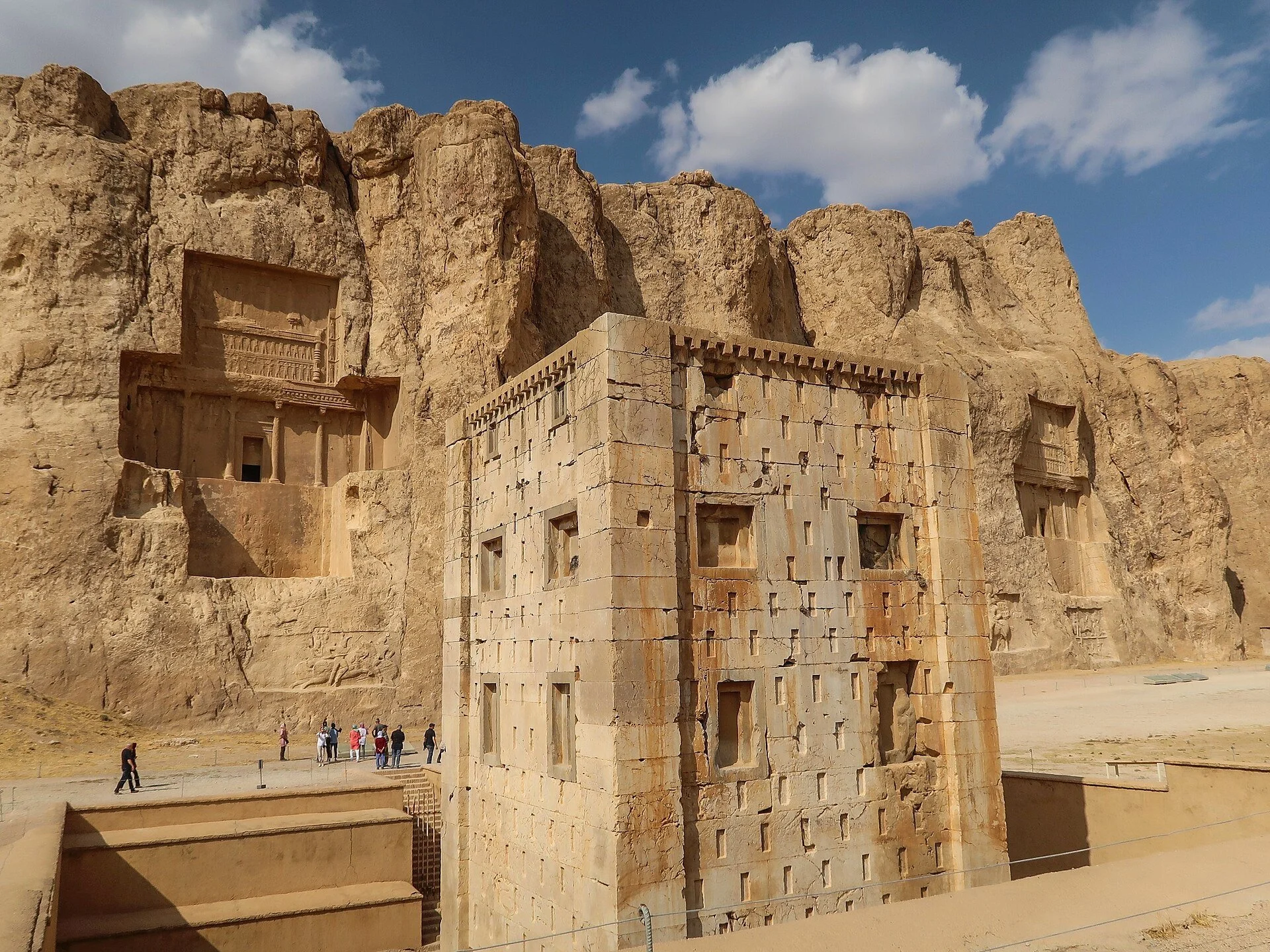
Naqsh-e Rustamnecropolis in Iran via Wikicommons
Jewish Cultures and Material Artifacts: Comments on The Posen Library of Jewish Culture and Civilization, Vol.2, Emerging Judaism, 332 BCE–600 CE, ed. Carol Bakhos
In the conclusion of his 2010 book, Were Jews a Mediterranean Society? Reciprocity and Solidarity in Ancient Judaism, Seth Schwartz asserted that one of his “fundamental assumptions” was “that ancient texts are not windows to the past but artifacts of it,” and “[a]s such, they [the texts] are never transparent and cannot speak for themselves.” [1] If one were to marry Schwartz’s perspective—understanding texts as opaque artifacts—with discussions of other types of excavated objects more typically described as artifacts (including wall paintings, lithic inscriptions, lamps, papyri, tefillin, bowls, and amulets, among many other things), a similar logic emerges that makes the anthology of the Posen Library of Jewish Culture and Civilization so distinctive. In this grand volume, everything is an artifact and everything (appropriately) requires guided interpretation. Indeed, Carol Bakhos and her entire editorial team have gathered into this work one of the richest and most diverse collections of artifacts, both in forms of redacted texts and archaeologically attested objects, amassed to this point in English translation and prose, inclusive of hundreds of pages of analysis and annotation. Through editors’ careful introductions, contextualization, and connections, this volume invites readers to explore and interpret textual and archaeological artifacts anew, demonstrating how it is always possible to tell new stories (or histories) about old things. The results are exciting, generating opportunities for academics and lay readers to reexamine known evidence and develop novel insights into Jewish cultures from 332 BCE to 600 CE.[2]
Indeed, I argue that the strategic inclusiveness of this Posen volume is one of its most innovative and powerful features. First, the anthology fundamentally challenges regnant scholarly concerns about Hellenistic and Roman orientations of ancient Jewish life by incorporating broad ranges of data, including texts and inscriptions from the Babylonian and Sasanian worlds, which are often ignored in sourcebooks and collections.
Second, editors’ expansions of artifactual categories that they incorporate in the volume—including ample examples of architectural structures and objects once found in ancient homes, theatres, marketplaces, synagogues, and cemeteries—equally reshape concomitant perspectives on ancient Jewish cultures.
Third, the capaciousness of the anthology, which represents the multivocality and diversity of Jewish populations during a thousand-year period of concern, undermines vestigial Judaism/Hellenism and Israel/diaspora binaries that continue to dominate most discussions of Jewish life and history in antiquity, while laying the groundwork for students, lay readers, and academics to develop richer understandings of chronological and geographic variegations within and among ancient Jewish cultures from areas around the Mediterranean through Mesopotamia. I highlight below aspects of the anthology that demonstrate these features and their contributions to current scholarly debates.
Geographic scope
One notable aspect of this anthology relates to its geographic reach: it places greater emphasis on Sasanian Babylonian and Mesopotamian materials than do analogous works. Several anthologies and sourcebooks in the field, many of which I have assigned to students, primarily cull works of Hellenistic and Roman writers—including abundant passages from Josephus and Philo, pseudepigraphic and apocryphal sources, and certainly, and importantly, texts of the Dead Sea Scrolls library—to offer a broader literary background for the emergence of Jewish populations from within the Greek and Roman worlds from the late Achaemenid through Hellenistic, Roman, and Byzantine periods. And when excerpts from the Babylonian Talmud also appear in such works, they are rarely presented alongside literary and epigraphic comparanda that derive from surrounding Iranian cultural zones. In the Posen anthology, however, an entire subsection is dedicated to the discussion of “Parthian and Sasanian Iran,” within a broader section dedicated to “History and Memory.” This subsection, written by Shai Secunda, introduces readers more substantively to the world of Babylonian rabbis and their works by unusually contextualizing their emergence from within empires and societies dominated by Arsacids (Parthians) and Sasanians (including Iranian Mazdeans or Zoroastrians). This method of curation and inclusion offers a critical example of one of the ways that the editors have expanded the scope of the corpus beyond more conventional boundaries.
Certain features of this subsection are particularly noteworthy. For instance, while it incorporates relevant texts of Philo and Josephus, and necessarily excerpts passages from the Babylonian Talmud (Bavli), which reflect upon relationships between regional Jews and Sasanian kings and queens, it also reveals, in more nuanced ways, how variable were attitudes of sequential Sasanian rulers toward their demographically diverse subjects, including Jews.
It does so by integrating texts and commentaries of Iranian or Zoroastrian works, such as that of the Dēynkard, as well as Kartīr’s lithic inscription at Naqs-e Rustam (Posen, vol. 2, 210). For instance, Kartīr’s inscription from the third century CE, boasts of how under Kartīr, “from province to province, place to place, and throughout the empire, the services of Ohrmazd and the gods increased,” after “Jews and Shamans and Brahmans and Nazares and Christians and Baptists and Manichaeans were struck in the empire” (Posen, vol. 2, 210). Kartīr’s hyperbolic claims are typical for this genre of conquest inscription, which recurs throughout all periods and regions in antiquity.[3] This specific text, nonetheless, raises important questions about potential variabilities in Jews’ social positions during different periods of Arsacid then Sasanian hegemony. Does Kartīr’s inscription, for instance, genuinely document a nadir for Jews under his directed rule, or do his words merely reflect the leader’s political posturing? Does it appropriately classify Kartīr’s actions as novel and targeted “correctives” to historical practices of religious coexistence in Sasanian lands, or does his inscription endeavor to cast his otherwise traditional policy in innovative terms? Were the positions of Jews under Kartīr’s rule, indeed, closely tied to those of their so-called Baptist and Manichean neighbors, or not at all? Such questions merit careful consideration about Jews (eventually including Babylonian rabbis) in Arcasid and Sasanian societies, even if one inscription cannot singlehandedly yield definitive answers to them.
This section also raises important questions about other dimensions of Jewish life under Sasanian rule. For instance, Jews’ daily activities of igniting lamps, braziers, and ovens to illuminate or fumigate their homes or places of worship, or to cook or bake for their families, would have been unremarkable within Hellenistic or Roman cultural orbits. Yet identical behaviors were more complicated for Jews living in geographic zones dominated by Mazdeans or Zoroastrians, who held distinctive theological views about fire and beliefs concerning its appropriate management.[4] The associated subsection therefore offers a critical means to demonstrate how distinctive were the worlds inhabited and sustained by Jews of the east, particularly in Sasanian Babylonia, from those of Jews living within broader Hellenistic and Roman societies.
Syntheses of archaeological and material evidence
Bakhos and her editorial team synthesize discussions of additional types of literary texts and archaeological findings in other ways more unusual inside compendia of Jewish materials. One subsection that typifies this enmeshment includes that of “Life Cycle and Ritual Observances.” Editors frame the topic with rabbinic discussions of life cycle events, including birth, circumcision, marriage and divorce, but present them as fully embedded within diverse legal frameworks and practical contexts that are attested archaeologically.
Alongside rabbinic materials, they also introduce important papyrological documents related to topics of marriage, inheritance, and divorce, including examples found in the Babtha archive (from the second century CE) and a Get from Masada (first century CE), with their translations and accompanying photographs of the actual documents. This section thus offers readers important opportunities to explore potential concordances and dissonances between different strains of rabbinic and non-rabbinic Jewish law and legal practices in the first centuries CE, and particularly as they apply to family law and daily life. Pairings of translations of papyri with adjacent photographs, moreover, encourage readers to regard the papyri as living artifacts of material culture (rather than as mere legal records), deeply connected to the real historical people, who once owned them. The latter historical actors include women, whose agencies and actions are harder to discern from literary sources, such as rabbinic texts, which were composed and redacted by men.
Other wonderfully enmeshed presentations of archaeological evidence and literary texts appear in sections concerning medicine and magic (pp. 746–780), also situated within “Life Cycle and Ritual Observances.” While the editors-in-chief of the anthology, in their introduction, caution against eliding categories of magic and medicine, many scholars today, including Megan Nutzman, Lennart Lemhaus, and Heidi Marx, among others, regard these classifications as elastic and mutable.[5] Editorial decisions to juxtapose so-called “magical” and “medical” artifacts in the anthology allow readers to make their own informed decisions about their respective taxonomies, terminologies, and interpretations. The “medicine” subsection, for instance, is dominated by literary discussions, through which the reader finds useful rabbinic instructions about cures for worms (b. Shabbat 109b) and the critical role of locust eggs for ear health (y. Shabbat 6:10, 8c). Photographs of healing amulets are also included. But in a subsequent section dedicated to “Magical Texts and Artifacts,” readers confront the contents of crucial artifactual remains from the Sasanian world that contextualize the world of the Bavli and its editors—the so-called Aramaic incantation bowls from Mesopotamia—as well as the semantic contents of some Syro-Palestinian lamellae (thin metal sheets inscribed for ritual purposes). Review of the epigraphic and iconographic contents of these bowls and amulets offers complementary insights into the sufferings and real-life challenges of Jewish individuals, families, and communities from the Levant and Babylonia who commissioned and ultimately deposited these bowls and metal inscriptions. The personal immediacy of these artifacts remains striking, particularly in contrast to the heavily redacted rabbinic corpora that traditionally frame studies of Jewish life in similar places.
Also worth noting is that this Posen volume includes a designated section that exclusively addresses visual and material culture (pp. 781–908). While Lee Levine has published an entire volume on Judaism and visual culture, printed thematic anthologies and sourcebooks rarely incorporate meaningful discussions of archaeological materials, let alone alongside colorful plates and photographs that depict them.[6] As visual artifacts, like textual ones, do not speak for themselves, the editorial introduction and organization of this section usefully guides readers through subsequent presentations of information about archaeologically attested buildings and objects associated with Jews in antiquity. Not only does this section incorporate evidence from synagogues and tombs, the latter of which form the preponderance of archaeological evidence for Jews around the Mediterranean in later periods, but it also includes examples of domestic architecture (of palaces and private houses) and objects of daily life.
This section also presents updated archaeological findings whose discoveries post-date the completions of preceding anthologies. Several photographs, for instance, document the western complex from Upper Herodion, including the theatre box and associated structures, which were excavated only in the past two decades. The section on synagogues likewise incorporates drawings and images of floor mosaics, including those from Sepphoris and elsewhere, uncovered decades ago, alongside photos of more recently uncovered mosaics, such as those from the synagogue in Ḥuqoq. This chapter, therefore, offers an opportunity for readers to review canonical archaeological sites, well known to students of Jewish history, as well as more recent findings from areas around the Galilee and elsewhere. Discussions and depictions of artifacts associated with the everyday, which range from tunics, to lamps, hairnets to louse combs and mirrors, moreover, play critical roles in this subsection, additionally bringing color and relatability to studies of Jewish daily life in antiquity.
Certain parts of this section of the anthology occasionally slip into traditional patterns of scholarship, tending to disproportionately represent archaeological evidence from modern Israel rather than that from other geographic areas, including North Africa, Asia Minor, or Greece, as well as Syria, Egypt, or Italy. These patterns inadvertently but implicitly serve to reinscribe polemics concerning the centrality of Levantine Jewish life to all Jewish cultures in antiquity and beyond. The subsection that addresses archaeological findings from synagogues, furthermore, is separated by hundreds of pages from textual evidence concerning similar topics. While online presentations of the same materials will evade these challenges by hyperlinking them, their disconnection in the printed text deprives readers of juxtaposing archaeological and textual evidence for common institutions. These patterns, however, remain atypical of the section, which otherwise magnifies the role of archaeology for improved discussions of Judaism throughout antiquity more generally.
Old binaries, new models
Multiple features of the Posen Anthology, as indicated above, yield three broader outcomes for the study of ancient Jewish cultures and history. The first of these is the volume’s deconstruction of decades of received study concerning oppositional natures of Judaism and Hellenism. It accomplishes this in two ways. First, the anthology demonstrates how fully enmeshed were Jews in a post-Hellenized-Romanized world, whether in the Levant, or in other parts of Europe. This effort helps to aggressively undermine historically prevalent two-dimensional “influence” models about cultural interface (as promoted in 2 Maccabees and other ancient works), which have proven painfully difficult to extricate from twenty-first century scholarship.[7] The anthology also reinforces this perspective through its more comprehensive emphasis on discussions of the Sasanian world. The volume demonstrates to lay readers a fact that specialists have understood for years: that Jewish texts and practices that emerged from within the broader Sasanian world requires contextual evaluation as much as those from areas farther west. The resulting picture of Jewish life in antiquity, as developed here, is one of inextricable cultural enmeshment and regional variability rather than static and selective interactivity.
A second major outcome of the scope, scale, and thematic capaciousness of this anthology includes its displacement of traditional binaries, including those of “center/diaspora,” to meaningfully organize studies of ancient Jewish cultures. Scholars increasingly critique persistent uses of the term “diaspora,” for multiple reasons, including its subordination of Jewish cultures outside of the land of Israel to those identified inside of it. While, in certain subsections of the volume, editors include terms of “center” and “diaspora,” the bigger picture remains clear: realities on the ground were far more complex than simple categorical binaries can accommodate.[8]
One final and significant feature of the volume is its ultimate contribution to studies of Jewish history and cultures of the durée. In the introduction, Bakhos and Schwartz define culture: “in its anthropological sense, to denote human social behavior in general—the socially transmitted knowledge and behavior patterns shared by a group of people….it is the set of ideas rituals, beliefs, and attitudes that underly the various relationships constituting society” (p. lxxiii). Does the volume imply, through this conception and alongside the use of the singular term for culture (rather than cultures) in the title, that there is, indeed, a singular ancient Jewish culture to investigate? I tend to think not. This volume, it seems, substantively demonstrates how it is possible to study Jewish cultures (to borrow David Biale’s preferred terminology) as a plurality, while allowing readers to consider—in their own analyses—what might be the unified or unifying elements that draw Jews from different regions, of different life experiences and statuses, into common cultural webs.[9] It becomes the reader’s responsibility to decide whether Jews participated in one or more cultures simultaneously, synchronically as much as diachronically. Bakhos and the other editors have invited us—or compelled us—to consider these important questions anew.
Karen B. Stern is a Professor at Brooklyn College and the Graduate Center, City University of New York.
[1] Seth Schwartz, Were Jews a Mediterranean Society? Reciprocity and Solidarity in Ancient Judaism (Princeton/Oxford: Princeton University Press, 2010), 175.
[2] Examples of comprehensive works include German and English editions of Emil Schürer, Geschichte des judischen Volkes im Zeitalter Jesu Christi (1875–1904); and Emil Schürer, The History of the Jewish People in the Age of Jesus Christ I–III, revised by G. Vermes, F. Millar, and M. Goodman, Edinburgh (1973–87); for art and archaeology also see E.R. Goodenough, Jewish Symbols in the Greco-Roman Period I–XIII (New York: Pantheon, 1953–1968). Neither of these projects were designed to appeal to lay readers in comparable ways; they retain more limited chronological and geographic scope.
[3] Examples of this type of boasting are found in earlier periods in Persia, such as in the multilingual inscription of Darius I from Mount Behistun in the Kermanshah Province of Iran (520 BCE), which offers a correction or an “authorized” version of historical events. Concerning the latter, see Paul J. Kosmin, “A New Hypothesis: The Behistun Inscription as Imperial Calendar,” Iran 57.2 (2018): 235–244.
[4] Incidentally, inclusion of an image of a Zoroastrian fire temple in this section—either as an excavation photograph or a digital reconstruction— would have assisted and broadened this discussion of Jews and fire practices by illustrating the architectural and cultic dimensions and frictions of Jewish life in Persia.
[5] Examples include: Megan Nutzman, Contested Cures: Identity and Ritual Healing in Roman and Late Antique Palestine (Edinburgh: University of Edinburgh Press, 2022); Lennart Lemhaus, “Competition and Compassion: Medical Knowledge among Rabbis, Patients, and Healing Experts in Late Antiquity,” in Ephemerides Theologicae Lovanienses 101.3: A Cry for Help: Ancient Perspectives on Disease and Healing in Dialogue and Conflict, edited by Maria Rescio and Joseph Verheyden (Leuven: Peeters, 2025), 559–586; see also Kristi Upson-Saia, Heidi Marx, and Jared Secord, Medicine, Health, and Healing in the Ancient Mediterranean (500 BCE–600 CE): A Sourcebook (Berkeley: University of California Press, 2023). For complementary reviews of topics related to magic and medicine see the edited work of David Frankfurter, A Guide to Ancient Magic (Leiden: Brill 2023).
[6] Lee I Levine, Visual Judaism in Late Antiquity: Historical Contexts of Jewish Art (New Haven, Yale University Press, 2013).
[7] Concerning related points see Morton Smith, “Goodneough’s Jewish Symbols in Retrospect,” JBL 86.1 (1967): 53–68.
[8] Broader discussions of these topics in Cynthia Baker, Jew (New Brunswick: Rutgers University Press, 2017), 71, 93, 100.
[9] David Beale, ed. The Cultures of the Jews: A New History (Schocken 2002).