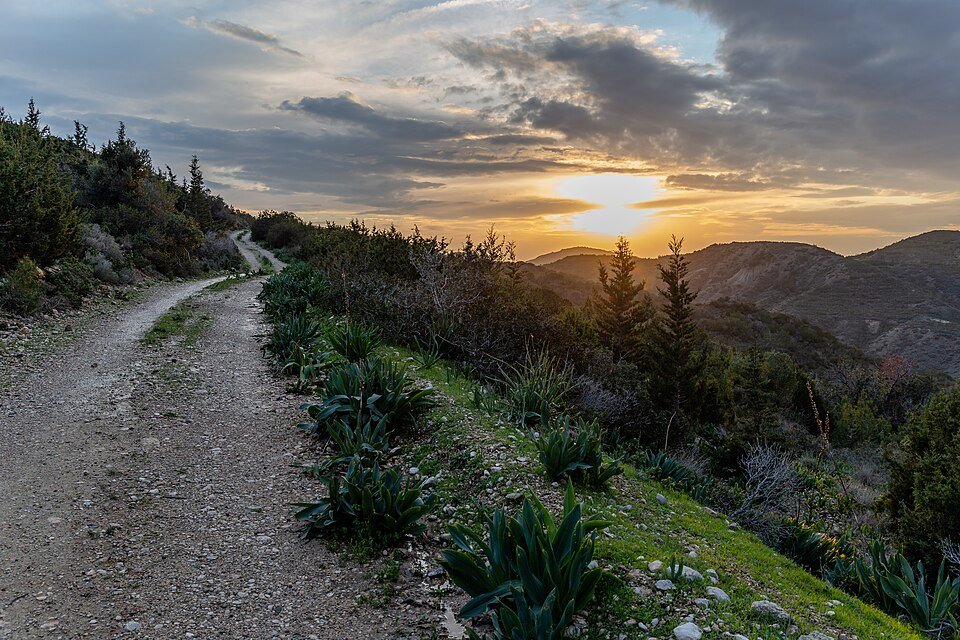

Karpaz, Northern Cyprus [Image: Wikimedia Commons].
This essay was part of a 2025 NAPS Conference Book Review Panel devoted to Earthquakes and Gardens: Saint Hilarion’s Cyprus by Virginia Burrus. Read the full forum here.
Earthquakes and Gardens is a geopoetic intervention into the field of late antique hagiography. Using the idea of recursive connection to a locus—a place—that is also a time, a feeling, a sensation—Burrus invites us to see other connections beyond ancient hagiography and into other quasi-historical imaginariums. For example, I am reminded of Italo Calvino’s Invisible Cities, in which Marco Polo is tasked with reporting his travels to Kublai Khan. Having heard many fantastical stories of unreal places, Khan presses Polo, stating that there is one city of which he never speaks, Venice, to which the latter states that “to distinguish other cities’ qualities, [one] must speak of a first city that remains implicit.”[1] In other words, there is a place or two in each of us that remain forever referential points of comparison, a point that all travelers directly or indirectly know. Burrus’s work drives us to turn towards what that might mean not only for Hilarion, the subject of the vita, but also for its author, Jerome, and, in turn, us, led by Burrus as our guide down less trodden hagiographic paths.
Now, contrary to expectations, the desert does not play this role for Hilarion, for it ends up too crowded with the impact of his own holy reputation and miracles. Only through wandering flight from the press of humanity does Hilarion finally fill the void in his heart on Cyprus in his “sheltering in place,” an isolated garden in the destroyed ruins of polytheistic religion. Yet, instead of a triumphalist story of Christianization, Burrus asks us to see something more subtle. In its place, we may read the text in terms of a kind of dissolving assimilation, since Hilarion’s saintly identity mirrors tropes of classical cult hero worship, not doing so to dominate or convert his competition, but rather to embrace its ruins as giving him the one thing he could not obtain elsewhere: solitude.
Now, in being a place-centered reading, Burrus’s work shows us how much ink has been spilt describing Paphos as the sanctuary home of Aphrodite, goddess of Love. By his own words, Jerome describes Paphos as “the city in Cyprus made famous by the poets’ songs, which has on several occasions been destroyed by earthquakes and whose ruins alone now provide evidence of what it once was.” Burrus reminds us that we are not seeing fallen Paphos through Hilarion’s eyes, but Jerome’s in 385 CE, as it was a stop on his own post-Rome travels; thus, he is inviting us to see it as a vision of repetitive decay.[2] The famed and ruined city of Aphrodite is thus made to balance with Hilarion’s secretive and restorative hermitage garden on the mountain. According to Burrus’s reading, this is also a fragmented place of generative multiplicity as a locus amoenus, or “pleasant place,” a literary trope for contemplation.[3] Moreover, Hilarion’s garden is discovered, not made, near a ruined temple with demonic voices that are “the lingering presences of ancient gods.”[4] Yet this is no ghost story, but rather an assimilation of saint into a non-human framework. Here, in a kind of Daoist meditation within a mix of wild and rewilded trees, Hilarion was most happy away from societal burdens that deprived him of his qi (chi). It is here that he wanted to be buried, a desire ultimately thwarted when his body was brought back to civilization, yet his soul persisted in that Cypriotic garden.
It is this fragmentation—both literally and figuratively—of Hilarion that allows Burrus to take a more theoretical turn that invites exploration into the agency of fragments of stories as a meditation on the generative capabilities of destruction itself.[5] To sit with the chaos of decay and destruction is to recognize the act of letting go of concepts of stability and control, a point that haunts much of human memory work, namely the ever persistent fight against entropy. To read for hagiographic fragments is to resist the privileging of the text as a whole, making it a radical invitation for us to take up in the ways we do scholarship.
Through six experiments in artistic fragmentation, Burrus invites an Ahmedian kind of “queer use” of using “small bits of [the] text” in ways not intended or expected by the original author, Jerome, nor his audience, including ourselves.[6] As Burrus reminds us, such meditation embraces decay to find ways to subvert and play with the concepts of beginning and end, notions too linear and contained in traditional readings of texts. Thus, it is also Ahmedian in its “queer phenomenology,” showing how objects in the vita can be seen functioning as “orientation devices,” helping us register new proximities and shape ideas about how to inhabit spaces, as well as seeing “who or what we direct our energy and attention toward.”[7]
Here, in what remains, I will touch briefly on Burrus’ insights with an extended metaphor that helps me wrap my mind around her work here, namely thinking of Jerome’s layers of construction of Hilarion’s story as building a kind of nest. This is because a nest is the recycling of materials out of destruction and death that gives way for new life.
First, in step one, we may begin with the material gatherings for Hilarion’s nest: the poetic history of Paphos, the resting place of a goddess.[8]
That Paphos was made famous from the songs of various poets makes it an excellent site for the building materials of Hilarion’s nest.[9] Paphos is well known as the birth-landing home of Aphrodite and sanctuary for her adornment, but as Burrus’s work truly invites us to see, it is most remarkable as the goddess’s place of sojourn and rest. That Jerome has Hilarion nest with bits and pieces of the island’s classical past reinforces the importance of the location, even in its decayed state—because the holiness of a place exceeds human occupation and recognition. This is why Burrus can evoke a disguised Aphrodite in the story of Hilarion as one of her poetic iterations, forever coming to Paphos-place-of-rest.[10]
After sourcing materials, then with step two comes the building of the nest’s foundation: namely, the curated histories of earthquakes that connect Hilarion in time and place.[11]
The seismic activity that gave Paphos its disaster reputation paradoxically makes it a good foundation for Hilarion’s nest. Through Burrus’s careful attention to scholarship, we can see both the present and historic reality of this destructive tendency in the city’s location on the tectonic plates that make the Cyprian Arc. The realness that is situated behind the verisimilitude of such quakes sticks, affectively, helping weave Hilarion into a near-specific place and time in larger memory projects that arise from natural disasters that formulate themselves into mythic memory. As such, Burrus helps us recognize that earthquakes remind us that all material things are sensitive and vulnerable to movements of the earth.[12]
After the foundation is set, then comes step three, the weaving and shaping of the nest: this is seen through observation of the ways in which ruins persist as desirable hyper-objects for Jerome-qua-Hilarion, reconstituting past with present and future.[13]
As Burrus’s work helps us see, Jerome engages in deliberate deposition of cultural spolia in the process of crafting Hilarion’s garden nest. In creating Hilarion’s story-walls with the recycled objects of Paphos’s past, Jerome mixes the non-Christian and Christian alike out of the ruins in ways that entice us to wish we too could see this no-place that is both no-where and in our imaginations at the same time.[14]
Next, step four brings the lining and the camouflage of the nest: the remoteness of Hilarion’s garden provides its protection.[15]
Just as birds both soften their nests and hide them in plain sight, Hilarion’s nest-as-ruin is softened with vegetation, and its access is removed from most human invaders. This is necessary not only for Hilarion’s mental health, but also for the non-human life that grows in the absence of the human, just what Chernobyl has provided for the many species that make their homes in the fallout zone today. As Burrus helps us see, Hilarion’s story here is part of a larger late antique phenomenon, which she calls hagiogeography, “the writing of holy habitats—in which remoteness is the crucial but elusive element.”[16] Hilarion achieves such desired remoteness because of his garden’s extreme interiority, rough terrain, and supernatural hauntings, making it a most inhospitable place.[17] Yet this remoteness also heightens Hilarion’s own nearness to us through Jerome’s vita, for in book form he may reside in many of our own homes, in a camouflaged place on our bookshelves, in persistence even as the saint himself has dissolved.
Step five is about maintenance and reuse: Hilarion’s entropic “little garden” (hortulus) maintains itself as a holy place beyond human limitations.[18]
As Burrus helps us see, Hilarion’s garden defies normative expectation and function, for it does not represent an attempt to engage human control and possession, but rather the garden molds the saint himself from the inside by its own wilding.[19] So it is that we are left to contemplate what happens to Hilarion’s garden, like all other gardens, which persist outside of human will and intention—namely, becoming sacred as a borderland that supports biodiversity.[20] Thus, gardener, guardian, even a transplanted pioneer species, Hilarion through Burrus becomes a meditation on how to be in the world, finding companionship in the land and all that lives upon it.
And finally, as there are six meditations and only five steps to nest construction, so I add a sixth step for literary nests, namely the role of the reader of ancient hagiogeographies.[21]
If literature can inspire a desire for travel, Burrus is careful to remind us of Jerome’s ambivalence about it, as he does not mean to present a travelogue to imitate; rather, Jerome privileges his own text as a vehicle for pilgrimage, making himself a kind of new Homer of an Odyssean Hilarion.[22] And yet, it was Jerome’s own inexactitude about its location that would spur others to attempt to find Hilarion’s garden hermitage.[23] Thus, Burrus’s work here becomes a meditation on human desire of such places—fueled by a nostalgia that eludes complete grasp, but also a call to pay greater attention to where we presently shelter and the precarity of others where they shelter, too.[24]
To conclude, the benefits of Burrus’s place-centered reading are numerous, inviting greater attention to place, centering it as a main character in our study of hagiography. In doing so, it can become a locus of desire for the reader, inspiring feelings of nostalgic longing that are eased but not erased by travel itself, mostly because, as Burrus helps us see, you must find those points of connection wherever you shelter. And so, in decentering traditional approaches through small bits of reading, Burrus’s work shows how such texts can reveal more universal concerns like the necessity for rest and solitude, as well as the recognition of the precarity of life itself. Yet, if “place is possibility,” then Earthquakes and Gardens invites us to meander through texts and geographies without being beholden to normative ways of reading and, indeed, even travel.[25]
Midori E. Hartman is an Adjunct Professor of History at the University of Delaware.
[1] Italo Calvino, Invisible Cities, trans. William Weaver (Picador/Pan Books Ltd, 1974), 69.
[2] Virginia Burrus, Earthquakes and Gardens: Saint Hilarion’s Cyprus, Class 200: New Studies in Religion (Chicago and London: The University of Chicago Press, 2023), 19-20.
[3] Burrus, Earthquakes and Gardens, 24.
[4] Burrus, Earthquakes and Gardens, 24-25.
[5] Burrus, Earthquakes and Gardens, 26.
[6] Sara Ahmed, Queer Use: On the Uses of Use (Durham: Duke University Press, 2019), 199.
[7] Sara Ahmed, Queer Phenomenology: Orientations, Objects, Others (Durham: Duke University Press, 2006), 3.
[8] “Poetry and Place,” in Burrus, Earthquakes and Gardens, 37-53.
[9] They are good “building materials” because ancient poems are by nature fragmented, either intentionally or through textual decay; Burrus, Earthquakes and Gardens, 37-41.
[10] Burrus, Earthquakes and Gardens, 51. Burrus’s exploration of the fragmentary repetition of “To Cyprus, to Paphos,” a place both real and unreal, which orients past, present, and future, makes it resonant with Calvino’s Venice for Polo.
[11] “Curating Earthquakes,” in Burrus, Earthquakes and Gardens, 54-71.
[12] Burrus, Earthquakes and Gardens, 57.
[13] “Life in Ruins,” in Burrus, Earthquakes and Gardens, 72-89.
[14] Burrus, Earthquakes and Gardens, 73-84.
[15] “Geographies of the remote,” in Burrus, Earthquakes and Gardens, 93-113.
[16] Burrus, Earthquakes and Gardens, 94.
[17] Burrus, Earthquakes and Gardens, 102-103, 113.
[18] “Entropic gardens,” in Burrus, Earthquakes and Gardens, 114-130.
[19] Burrus, Earthquakes and Gardens, 115-116.
[20] Burrus, Earthquakes and Gardens, 120-122, 127-128.
[21] “Literary cartographies,” in Burrus, Earthquakes and Gardens, 131-147.
[22] Burrus, Earthquakes and Gardens, 131-132, 134.
[23] Burrus, Earthquakes and Gardens, 136-142.
[24] Burrus, Earthquakes and Gardens, 146-147.
[25] Burrus, Earthquakes and Gardens, 154.