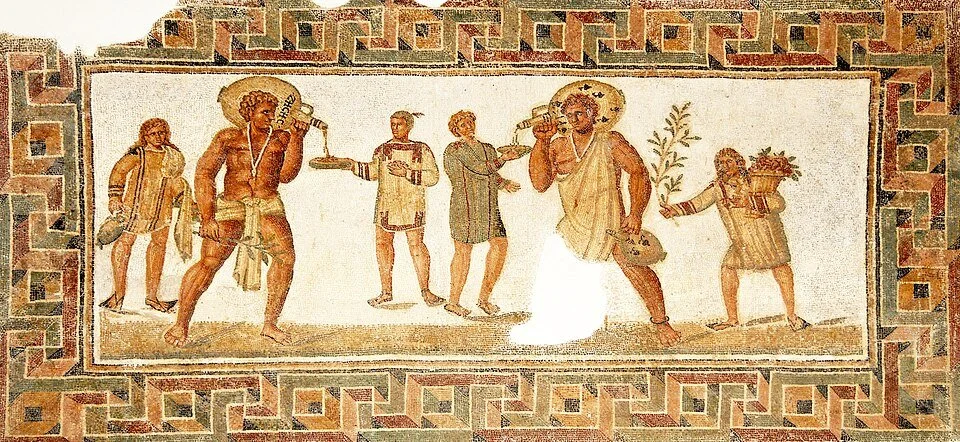

Roman mosaic from Dougga, Tunisia (2nd/3rd century CE). Image source: Wikimedia Commons.
This essay was part of a 2025 SBL Book Review Panel devoted to Strike: Labor, Unions, and Resistance in the Roman Empire by Sarah E. Bond. Read the full forum here.
In my master’s program, as I was just beginning to sort out that I wanted to get a doctoral degree and that maybe biblical studies was the field for me, I worked part-time at the Howard Gottlieb Archival Research Center, at Boston University. HGARC, as it’s called, holds a large collection of materials from Martin Luther King, Jr., an alumnus of the school, and I got the chance to spend ten to fifteen hours a week with boxes of materials shared by King with the university. I walked through that solid steel, secured door that first day on the job with visions in my head; as I entered a small room with neat blue boxes, I imagined them full to the brim of speech drafts, sermon notes, handwritten correspondence, all coming from the pen of King himself. After all, I had seen King’s leather briefcase perched in place of honor on the top shelf the day I interviewed. And there were a few pieces like that.
While this will not surprise many historians, it really did shock me as a graduate student that the vast materials in the archive are largely mundane, day-to-day materials. Mostly, I worked on the Montgomery Improvement Association (MIA) papers. The Montgomery Improvement Association, which was formed to oversee the Montgomery Alabama bus boycott in 1955, was formed not by MLK having a revelation sitting in his office at Dexter Avenue one day, but by a group of people, especially Jo-Ann Robinson, president of the Women’s Political Council, and E.D. Nixon, head of the local NAACP. Robinson and Nixon organized the one-day boycott that ended with a meeting, at Holt Street Baptist Church, at which preachers, teachers, and the community decided to transform the one-day protest into an ongoing one. After the decision was made, they organized, formed the MIA, and set up committees. So many committees. There were carpools to be organized, funds to be raised and distributed, walkers to escort, and lawsuits to be filed. There was a lot of work to do, and that work required a lot of people.
So, these blue-grey archival boxes mostly held not speeches and sermon notes from King, but the minutiae of progress and the detritus of change. Meeting minutes, bulletins, newsletters, financial documents, typewritten lists of names and phone numbers of persons who had cars and were willing to drive, and committee membership rolls. Pamphlets, flyers, yellowed news clippings, and more meeting minutes. So many meeting minutes. If you have ever done any good governance work in the academy or an advocacy group or a nonprofit or for local government, you know there are so many meeting minutes. In these scraps of paper, I learned how change happens and how movements are made. And I learned that it is people, not a personality, who bring about change. The way I think about my work as a historian and biblical scholar changed drastically with that experience, even as many of the books I encountered in my field continued to focus on “great individuals” (mostly men), and their “great ideas” (mostly traditional Christian theological topics). And I continue to approach my work in the past and my practices in the present trying to pay attention to ordinary people and their ordinary documents, their lives, and their worldviews.
Prof. Sarah Bond has modeled for us how to navigate the challenge of writing about ordinary persons who are often nearly invisible in ancient literature, and she has demonstrated the still rich possibilities of attention to history from below, here marshaled towards a labor history of the Roman empire in the ancient Mediterranean. The breadth and depth of this book is impressive. Covering a millennium and a half (with flashbacks even further back to Egyptian necropolis workers in 1157 BCE and flash-forwards to the medieval period), Bond includes a wide range of literary, epigraphic, papyrological, and other material and textual sources from a wide geographic range. Bond tells a complex and compelling story of pockets of collective action, ranging from work stoppages to advocacy, from demonstrations to open revolt. At the same time, Strike is clear-eyed about these moments of collective action; this is not a rosy recovery of a never-existent past that labor movements should look to for easy solutions to labor exploitation today. Bond also tells a complex and compelling story of minor capitulation and major setbacks, of legal machinations, political pressures, coerced and compelled labor, and violent crackdowns.
This book has either confirmed for me or convinced me about a few directions our fields of biblical studies, classics, and history should follow. First, “labor historians of the modern era should engage with Roman antiquity in more meaningful ways” (p. 11). To limit labor history to the era of capitalism is to limit our scholarly understanding of the possibilities for collective action, human agency under constraint, and mutual aid and community care. To participate in such a narrow scope of labor history is to also narrow our scholarly imaginations for what Ashon Crawley calls “otherwise possibilities.”[1] Second, scholars of the ancient Mediterranean, including scholars of early Christianity, will only benefit from further expanding our understanding of the ancient Roman economy, which continues to move in a direction of recognizing its complexity, global embeddedness, and entanglements with religion. Our work on the ancient Mediterranean economy should also expand to include the complex, globally embedded, and religiously entangled lives, choices, and worldviews of the ordinary persons who lived within that economy (not just its wealthiest and most elite). To read this book, with its clear prose, is also to participate in a dizzying, even disorienting process; In Strike, Cicero’s bombastic rhetoric on enslaved and freed persons gets equal billing with the bylaws of a religious association from Tebtynis in Egypt. Once I adjusted, though, I loved this reorientation towards including but decentering the elite literary sources that are so often seen as our best and only sourcebook for understanding the past and juxtaposing them with evidence from and by less-than-elites. Third, I think Bond demonstrates that there are better balances to be struck between two streams of scholarship on the ancient Roman economy: the big-data approach of New Institutional Economics, and Kim Bowes’ call for micro-history and a return to the local, the small, and the overlooked as part of a compelling critique of the dominance of NIE.[2] As macro-labor history as Strike is, it is comprised of dozens of micro-histories, of complaints and compliments to regional and imperial authorities from associations, to individual letters, to the fates of less-than-elite individuals and collectives. This is especially clear in Bond’s treatment of the wide variety of enslaved experiences in the Roman Empire, particularly the use of manumission as a coercive tool to encourage others’ labor (p. 53). Can we begin to tell micro-economic stories that will help expand our understanding of the Roman economy and of early Christianity, and what macro-level histories can we assemble with those micro-histories?
I would like to raise three sets of questions that I hope will start our conversation together.
1. How do we sort through such a wide variety of evidence, especially in regards to its rhetoricity? This question has stakes beyond sorting out “what is fact and what is fiction about [early] Rome” (p. 42). Bond both includes some of these literary, legal, and other elite sources as data for learning about labor collectives in the Roman empire, and acknowledges the rhetoric of many of these sources. It might be Callistratus saying young people in turbulent cities incite mobs (p. 90), or Suetonius saying Augustus was harsh on the “lawlessness of the actors” (p. 96), or Cicero’s invectives against enslaved persons, but it is clear there are elite ideologies filtering much of our evidence about labor and collectives in the Roman empire. How does Bond make choices about how to source some of these resources for ascertaining the “fact and fiction” of Roman history, and where to best employ the feminist practice of “reading against the grain?” Several anxieties return regularly across a wide variety of texts in these elite sources, including anxiety over foreignness, sedition, lack of piety, commitment to the empire, or a propensity to mob behavior and violence. Bond begins to make some claims here, at one point noting, “State paranoia over some types of assemblies does seem a consistent worry in periods of resistance” (p. 88). When should we be thinking about these invectives as sources for thinking about ancient collectives acting more radically, perhaps posing real risk to imperial power? And when should we be thinking about more modest possibilities related to immigration and associations, associations meeting without getting formal permission, practicing their piety to their particular deities, committing to supporting to one another, and acting in common for their community good and advocating regional authorities? I think these less radical sets of actions are also a part of labor history and examples of collective action. Invectives about foreign infiltration, sedition, lack of piety, lack of commitment to empire, and a propensity to mob behavior and violence might reveal more about elite tools of propaganda and social control, deployed alongside violent crackdown and inequal application of laws.
2. Second, and relatedly, I wonder how other ideological frameworks might intersect with rhetoric around labor and collective actions, particularly the recurring anxiety about mob violence and enslaved persons, foreigners, and other socially marginalized persons? Here contemporary conversations and theoretical framing some might prove helpful. I am thinking particularly of Jeremy Williams book, Criminalization in Acts of the Apostles: Race, Rhetoric, and the Prosecution of an Early Christian Movement, which deploys insights from black studies, critical race theory, and feminist theory to study rhetoric of criminalization Acts of the Apostles. His book, which shows how “Roman officials and militarized police criminalized, prosecuted, and incarcerated people in the first and second centuries CE. He argues individuals and groups have been, and still are, prosecuted for specious reasons – because of stories and myths written against them, perceptions of alterity that render them subhuman or nonhuman, the collision of officials, and financial incentives that foster injustices, among them.”[3] How might reading rhetoric of criminalization alongside invectives against labor collectives help us better understand not only Acts of the Apostles, but a broader set of literature that might further refine Bond’s emerging labor history?
Bond rightly notes that the artisans in Acts 19 are portrayed as frustrated by the economic impact of Paul and his followers in Ephesus, “which spread to the populace and was transformed into religious outrage as well” (p. 118). Bond makes a great point that the writer of Acts might have had in mind Julain law on associations, undergirding the traded accusations and anxiety about the crowds “being charged with rioting” (19:40). This is labor rhetoric, but it is also rhetoric of criminality; the anxiety of being called riotous is a powerful motivator here, so we don’t just have economic motivations of silversmiths, but we have the powerful and anxiety producing accusations of rioting, and who the real rioters are, and who the real seditious folks are. Acts is itself very anxious about mobs and riots, particularly in providing rhetorical cover in arguing that for as many troubles as Paul gets in, it is never really his fault or that of the Christians. It is Jews and followers of other deities that are the real “troublemakers.” Acts of the Apostles has an agenda that is eager to both represent collective economic action (when it is the good Christians doing it at the beginning,) and to denigrate the wrong kind of collective economic action/labor practices (when it is the bad silversmiths, or folks making an enslaved girl with a demon do prophecy work for them). And this agenda is not either economic anxiety or religious fervor, but both at the same time, deployed, as Denise Buell has argued, to craft the identity of a new ethnē, Christian, by using racializing rhetoric. The agenda of Acts is not innovative in this respect, and Acts might even be right to be worried. After all, as Bond notes, Jews, Isis followers, and Christians all get accused of being “disruptive, illegitimate, or superstitions” (p. 101). Instead, Acts mirrors rhetoric from the more elite sources to adjudicate theological rivalries with other non-elite groups under risk and constraint from those in power who can deploy legal, political, economic, and theological pressure against them. I think that writing a complex history from below requires such intersectional reading strategies, which helps us to treat non-elites as complex individuals with complicated motivations.
3. Lastly, and I think of critical importance, especially for the Early Christianity and the Ancient Economy section of SBL, is the call for further discussion of the role of religion in Bond’s labor history. Bond notes the importance of religion, especially in associations: “there were always links between commerce, religion, and associations,” (p. 25) and elsewhere, ““Herein lies the strength of the underlying associative networks expanding throughout the Mediterranean at the time: associations were flexible socioeconomic and religious units for creating trust, mitigating risk, providing security, and fostering camaraderie” (p. 79). On the whole, though, these links remain underexplored in Strike, leaving plenty of room for future work for scholars in history, classics, and biblical studies. How would Bond begin to offer some ways forward for further exploration of the role of religion in labor history, particularly ancient labor history?
I think this needs to be a multilayered conversation. On the one hand, religion is both used by elites for regulatory function, bureaucratic specialization, and legal structuring, and by non-elites to inspire collective action or to provide social cohesion. But sometimes, non-elites are also deploying religion in their associations for regulatory function, bureaucratic specialization, and legal structures. And elites also practice religion through their collective action (even when that collective action is violent) and to provide social cohesion. We should be careful not to ascribe to elite piety solely cynical motivations for social control of the masses, and we should be careful not to ascribe to non-elite piety a kind of purity of practice that is more genuine. The theological motivations and imaginaries of members of collectives are as complex as people are. Preparing this response, I was often reminded that our conversations about ancient collectives are not just about the long past; I kept thinking of all the connections with the present between elite rhetoric around collective actions in the US right now, whether it is governmental invectives about “foreign infiltration, sedition, lack of piety, lack of commitment to empire, and a propensity to mob behavior and violence” deployed about protestors at ICE detention facilities or at the No Kings march. And I am reminded that a Department of Homeland Security recruitment video deploying biblical citation and a collar-wearing Lutheran pastor getting shot in Chicago with “less-than-lethal rounds” while praying at an ICE facility are both instantiations of Christian belief and practice, the former in an overtly white Christian nationalist mode, and the latter in a liberal Protestant tradition of collective action. Both videos, whether of political propaganda or media protest coverage, demonstrate the complex intersections of religious, political, and economic history.
Jennifer Quigley is Associate Professor of New Testament at Candler School of Theology at Emory University. She is the author of Divine Accounting: Theo-economics in Early Christianity (Yale University Press, 2021) and the co-editor with Catherine Keller of Assembling Futures: Economy, Ecology, Democracy, and Religion (Fordham University Press, 2024).
[1] Ashon Crawley, Blackpentecostal Breath: The Aesthetics of Possibility (Fordham University Press, 2017), 2.
[2] Kim Bowes, “When Kuznets Went to Rome: Roman Economic Well-Being and the Reframing of Roman History” Capitalism: A Journal of History and Economics 2.1 (2021): 7-40.
[3] Jeremy L. Williams, Criminalization in Acts of the Apostles: Race, Rhetoric, and the Prosecution of an Early Christian Movement (Cambridge: Cambridge University Press, 2023) 1–16.