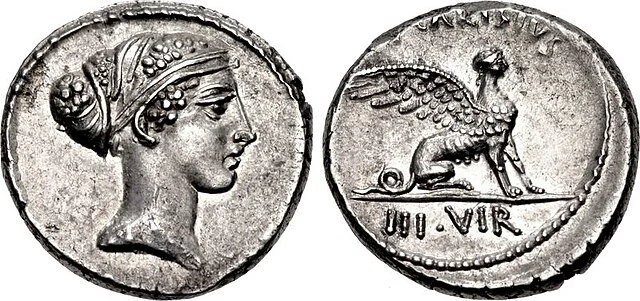
T. Carisius. 46 BC. AR Denarius (17mm, 4.05 g, 4h). Rome mint. Head of Sibyl Herophile and seated sphinx. From the Alan J. Harlan Collection. Ex Numismatica Ars Classica 40 (16 May 2007), lot 558 via Wiki Commons.
For almost 1,000 years, Jewish and Christian writers crafted Greek poetic oracles and attributed them to an ancient prophet, a sibyl. From the second century BCE to the seventh century CE, Sibylline Oracles became a space in which these writers interpreted their scriptures, commented on contemporary political and economic events, worked out their theologies, claimed their place within Homeric and Hesiodic literary traditions, transformed Greek mythology, composed hymns, and reflected on the nature of time itself. And all of this was conveyed through the powerful, long-lasting voice of a woman.
Despite the religious, historical, and literary significance of these prophecies, they have gone under-examined by scholars. Several factors may explain this: they stand between the disciplines of classical and biblical studies, employing Greek that sometimes feels unfamiliar to certain biblical scholars and of an inferior metrical quality to classicists; early modern scholarship exposed them as forgeries rather than authentic prophecies; there may even have been some historical unease with (or disinterest in) an authoritative woman as the mouthpiece for Jewish and Christian theology.
While the 20th and 21st centuries saw some monograph-length studies of individual books of the Sibylline Oracles, or volumes on sibylline oracles across antiquity, “Listen to the Sibyl” is the first edited volume devoted entirely to the Jewish and Christian collection of surviving sibylline prophecies. Emerging out of a 2022 Nangeroni Meeting of the Enoch Seminar, this volume presents a new interdisciplinary analysis of the Sibylline Oracles. Comprising twenty chapters and an introduction, the book assembles contributors at every career stage—from early- and mid-career scholars to established and emeritus researchers—representing nine countries and a range of fields, including ancient history, classical studies, biblical studies, and early modern reception..
The book is divided into four major sections. The first, “The Sibyl in History/The Image of the Sibyl,” begins with three essays by longtime experts on the Sibylline Oracles in their ancient contexts. John Collins’s chapter is first, considering why ancient Jewish authors chose to write in the name of a sibyl and how they innovated among other sibylline oracles. Erich Gruen compares the sibyl and Cassandra, focusing on Lykophron’s Alexandra. David Potter analyzes the history and development of sibylline personalities and their appeal to ancient audiences from the fourth century BCE to the third century CE. The next essay, by Francis Borchardt, turns to myths about the sibylline collection in the context of book history, arguing that the fictional sibylline library in turn generates a material sibylline library. The first section concludes with a chapter by Ashley Bacchi, who suggests that the persona of the sibyl invites a feminist recentering of history from the margins.
The book’s second section contains four essays on “The Sibyl between Cultures.” Luke Neubert locates Sibylline Oracles 3 in the context of Egyptian and Syrian history, arguing that it presents a previously unexamined perspective on the Sixth Syrian War. Stefan Krauter reassesses the political implications of the Roman sibylline books (libri Sibyllini) during the late Republic and early Principate, arguing that they are comparable to Jewish and Christian apocalypticism. Daniel Smith reads the Sibylline Oracles through the lens of exotic appeal in the Roman empire, arguing that the sibyl’s claim to Babylonian origin constructs a form of exotic authenticity. Olivia Stewart Lester analyzes Sibylline Oracles 6 as a case study for the inadequacy of the “parting of the ways” model for describing Jewish and Christian Sibylline Oracles, as well as for describing Judaism and Christianity themselves.
The third section of “Listen to the Sibyl” divides into two halves, both focused on poetics. “The Poetics of Sibylline Verse” begins with an essay by Jane Lightfoot, which examines the motif of truth in the Sibylline Oracles and its connections to credibility and authenticity. This is followed by a chapter from Robert Hall, who suggests that passages from Sib. Or. 5 often taken to be Christian interpolations could be more fruitfully studied as riddling enigmas. In the third essay in this section, Simon Goldhill analyzes the use of counterfactuals in the Sibylline Oracles, arguing that they demonstrate a larger tendency, more intense in the Christian sections, to emphasize divine certainty and determinism.
The second half of the poetics section turns to “The Poetics of the Sibylline Universe.” Oliver Parkes explores Jerusalem as a site for reconsidering the eschatological poetics of the Sibylline Oracles, arguing that Jerusalem allows the sibylline writers to move beyond temporal and spatial boundaries. Helen Van Noorden also considers sibylline eschatology, reexamining the battle of the stars in Sib. Or. 5 alongside Aratus to theorize interaction between Jewish and Christian Sibylline Oracles and other ancient literary traditions. The poetics section concludes with an essay by Max Leventhal, who contends that by adapting the story of Babel via gematria, Sib. Or. 11 makes a larger claim about the intelligibility of the cosmos and the translatability of divine revelation.
The fourth and final section centers on “Sibylline Afterlives,” demonstrating the significance of the Sibylline Oracles through history. Mariangela Monaca surveys sibylline books from the Roman to the medieval eras, asserting that they present a particular vision of history. Jesús Nieto Ibáñez presents Christian Sibylline Oracles and their reception as indicative of a broader tendency towards the “Christianization” of Greek prophecy between the second and fifth centuries CE. Lorenzo DiTommaso offers a full survey of Christian Sibylline prophecies (outside of the Sibylline Oracles) from Late Antiquity through the early modern era. Xavier Lafontaine attempts to reconstruct the gap between the composition of the Sibylline Oracles and their survival in fourteenth- and fifteenth-century manuscripts; with a special focus on Byzantium, he analyzes late antique comments on the Sibylline Oracles and their manuscript history to explain the persistent interest in these prophecies. Finally, Jean-Michel Roessli traces the reception of Sibylline Oracles in seventeenth- and eighteenth-century England, finding that they had defenders not only among theologians and philologists, but also scientists; Roessli argues that the reception of Sibylline Oracles provides evidence for the interconnectedness of natural philosophy and theology in this period.
The Sibylline Oracles offer much to students and scholars of antiquity, and the contributions in this volume draw out their significance in various ways. “Listen to the Sibyl” illuminates the historical importance of these texts from the Hellenistic to the early modern eras. Several essays reaffirm, especially, the relevance of the Sibylline Oracles for the political and cultural history of Ptolemaic Egypt and Rome. While often framed as predictive, these poetic prophecies speak carefully about their own present circumstances, offering snapshots of the political and economic dimensions of different moments throughout almost a millennium.
The Sibylline Oracles also demonstrate the literary sophistication of ancient Jewish and Christian writers, who consistently employ Greek hexameter poetry and often move with ease into the streams of other Greek literary traditions around them, including the reception of Homer and Hesiod. While the Sibylline Oracles have much historical interest, they are works of literature. By devoting a section of this volume to poetics, we assert that the Sibylline Oracles merit scholarly appreciation as carefully crafted Greek literature. The literary sophistication of the Sibylline Oracles extends to their creative rewritings of scripture; those interested in Jewish and Christian scriptural interpretation and production will find much to explore in these Greek oracles.
In choosing the title for this volume, the editors have sought to emphasize the centrality of the sibylline voice in the Jewish and Christian oracles. The endurance of Sibyl’s authoritative voice invites analysis by students and scholars interested in gender and antiquity. Throughout the collection's literary, theological, and historical complexities, the one unifying constant is the sibyl herself, an ancient and respected woman prophet.
Finally, the new reception histories presented in this volume also cement the importance of Sibylline Oracles within early modern intellectual history, reminding us of an era before the fracturing of our modern academic disciplines. It is this fracturing that has, in part, hindered our appreciation of Sibylline Oracles; “Listen to the Sibyl” is an attempt to overcome that intellectual fracture and make the rich resources of this prophetic collection available to new generations of audiences.