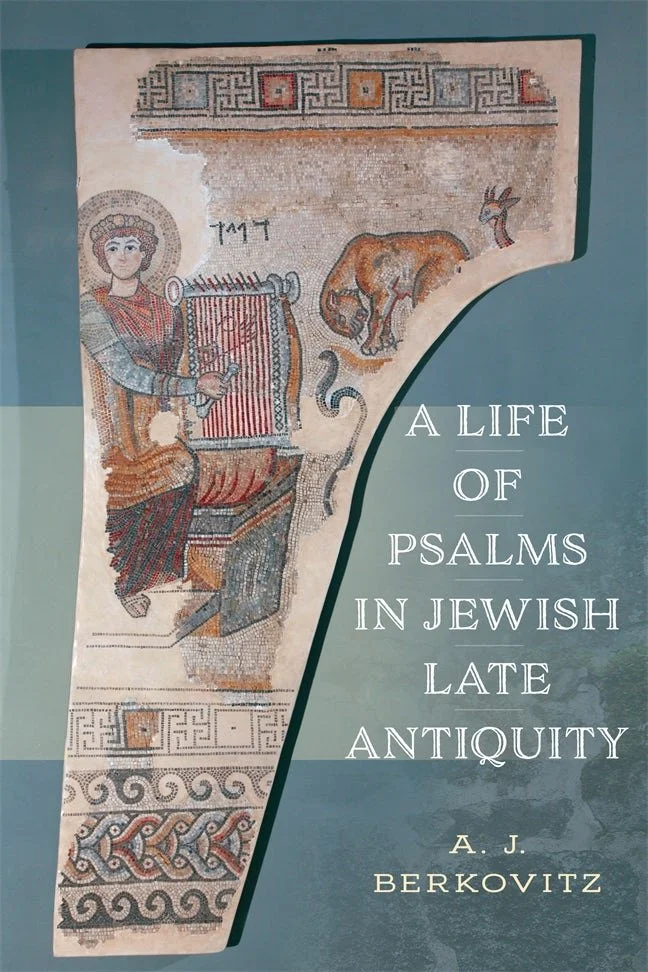
The book of Psalms is a unique book among biblical literature. It does not presume to speak for God, as in prophecy, nor does it attempt to describe the past through narrative. Instead, the book of Psalms invites its readers to take on the persona of a speaking “I” or a collective “we”. With the frequent use of the first-person, the book of Psalms compels its audience to participate in the words being spoken, to encounter them through performance, and to imagine themselves in the voice of the speaker. The Psalms, then, are not just a series of prayers to study or exegete, but a prism for reflecting a varied set of embodied, human experiences.
A.J. Berkovitz, in A Life of Psalms in Jewish Late Antiquity, takes these experiential aspects seriously and asks the question: “How did Jews encounter the Psalms?” (11). He moves the question of reception away from strictly exegetical approaches that look for a history of interpretation within a world of ideas, and towards how Jews in Late Antiquity encountered physical scrolls of psalms, how they incorporated them into their liturgical practices, and how psalms played a role in practical religion (e.g., piety and magic). The exegetical emphasis in Rabbinic literature gives the sense that the sole approach to these texts in Jewish late antiquity was through the lens of interpretation, but the Psalms had a larger life than that within this corpus. The words in the scroll were heard and spoken, the scrolls themselves were touched and handled, and they were repurposed onto amulets and magic bowls for practical and personal purposes.
Berkovitz organizes this book into four chapters, each dealing with a different aspect of these encounters. There is a sort of unmarked organization in the book, with Chapters 1 and 2 focused on physical Psalms scrolls, and Chapters 3 and 4 focused on the performance of the Psalms in various contexts.
In the Chapter 1, Berkovitz lays out the evidence for physical scrolls and their dimensions in Rabbinic literature. He first surveys Psalms scrolls from Qumran to the Medieval period with an eye for size, format, spacing, and layout. Since there are no manuscripts of the Psalms from the rabbinic period that Berkovitz examines (approx. 200–600 BCE), the task for identifying the scrolls of the rabbis is left to a close reading of arguments and clues left in narrative texts. Berkovitz identifies several interesting features. It does not appear that the Psalms were encountered on a single scroll, but on five separate scrolls, likely separated into the traditionally defined “book” divisions (Pss 1–41; 42–72; 73–89; 90–106; 107–150; see b. Qidd. 3a and Jerome SC 592: 323–327). Through this collection of scrolls, the Psalms could be considered a single, unified unit, and one could develop an idea from the Psalms by working through all five books (Lev. Rab. 4:7), or one could work solely from a single, smaller scroll (Gen. Rab. 75:1). Not every reader of the Psalms would have access to every scroll, and individual libraries may have included only a selection, perhaps even one (as Berkovitz [31-32] suggests for R. Reuben in Gen. Rab. 75:1). Line spacing and word divisions related to the word hallelujah are also discussed here (b. Peṣah 112a; p. Meg. 1:11 72a).
Building off these observations of material scrolls, Berkovitz examines “scenes of reading” in Chapter 2, where rabbis and other characters interact with physical texts in ways that move beyond exegesis and interpretation. Reading’s effects on its subjects varies when performed in different social contexts, whether that is for leisure, scholarship, personal transformation, or for piety’s sake. The very act of reading the Psalms was assumed to be transformative, called the “potion of life,” for both rabbinic and non-rabbinic Jews (b. Avod. Zar. 19b). As in Christian contexts, the book of Psalms had a role as a pedagogical tool, with reading as a shared, group activity meant to signify an elite mode of interacting with a text. Such reading practices served to compel their listeners to ethical or religious action (Kallah 21). Reading the Psalms also involved linear reading, starting from one end of the scroll and moving forward, and these sequences serve as a means of determining meaning (b. Ber. 7b; b. Ber. 9b). In one case, the historical disjunction created by David’s kingship in Ps 2 and his flight from Absalom in Ps 3 offers an opportunity for interpretation, not a dismissal of an incoherent text (b. Ber. 10a). Berkovitz concedes, however, that few would have access to scrolls as readers, since the production of these scrolls was a costly endeavor.
Berkovitz moves away from physical scrolls in Chapter 3, and here discusses the use of Psalms in daily psalmody. Though access to Psalms scrolls was limited due to economic constraints, content from the Psalms could, however, be encountered through hearing liturgies and recitations. Rather counter-intuitively, the liturgical use of the Psalms in regular, daily liturgy was not assumed by early Jewish communities, and its uses in both daily and occasional practices was something to be renegotiated by the rabbis up to and into the Geonic period. Though memories of the performance of psalms in the temple (however accurate they may be) is acknowledged (see, e.g., m. Tamid 7:4), this did not necessarily translate into practice. In many cases, individual verses from the Psalms were introduced to already fixed prayers, such as the Amidah or the Priestly Blessing (p. Ber. 1:1 2c; Soṭ. 39b-40a). Piyyutim, especially, showed “an ornate and scripturally omnivorous style” (85) in integrating verses from the Psalms. The Ashrei (based on Ps 145) is the only case that Berkovitz identifies where an entire chapter became part of the daily liturgy (b. Ber. 4b). Apart from the performance of the Psalms, validation of non-psalmic liturgies is often based on verses from the Psalms (see, e.g., the use of Ps 29 in t. Ber. 3:25; b. Meg. 17b; p. Ber 4:3 8a). Berkovitz offers several reasons for this return to the Psalms as a source of daily liturgy: the precedent of seasonal psalmody (e.g., the Hallel during Passover), an increasing conceptional connection between the synagogue and the temple, and the contemporary use of the Psalms in early Christianity.
Psalms were used not only for set daily prayers, but also for all sorts of personal and non-institutional practices that originate in non-exegetical contexts. For heuristic reasons, Berkovitz makes a careful distinction between piety and magic uses of the Psalms, defining the former as focused on internal realities and the latter as focused on external realities. Rabbinic practices are not sui genesis, and practices performed by non-religious elites ultimately made their way into rabbinic practice and were incorporated within Judaism’s legal system. Practices such as performing psalms at midnight or keeping awake by reciting psalmody are justified by appeal to biblical characters, such as David and Jacob, and references to the Psalms (e.g., b. Ber. 4a; Gen. Rab. 74:11). Individual verses could be repeated continually as a type of mantra (Ps 46:8 and 84:13), or as part of deathbed piety (Ps 23:5; 32:6, 21; 84:11; 116:15). Though psalms play a role in the pieties of both Jews and Christians, a different focus is found in both: Jewish practices focus more on trust and assurance, while Christian practices focus on confession and penitence. Reciting the whole book of Psalms also appears as a communal practice outside the practice of a fixed liturgy. As part of magical practices, verses from Ps 91 enacted protection and healing, and similar verses are also well-attested on amulets and magic bowls. Many of these experiences originate outside of the prescriptions of the Rabbis, and attest to a wide range of encounters with the Psalms.
The book is clearly written, and the argument itself, though introducing varied and often complicated sources, is marked well and easy to follow. Berkovitz shows an impressive command of literature on Rabbinic literature, but also folds in Christian writers from Latin, Greek, and Syriac contexts, epigraphic evidence, and archaeology. Throughout the book, Berkovitz is clear about his methodological approaches and the boundaries of the evidence he chooses to evaluate. In some cases, this leaves readers with a good frustration and wishing that he had covered more evidence. He does not, for example, treat the use of psalms in seasonal liturgies, but promises further studies on the topic.
In his discussion about the materiality of literacy, Berkovitz’s work complements recent work by scholars of the Hebrew Bible and Early Judaism on how the physical shape of biblical scrolls plays a role in the development and reception of these texts.[1] For many of these, the timeline ends at 70 ce or shortly thereafter, and the task for later periods is left for specialists in other disciplines. Berkovitz’s book, and hopefully others like it, continue the conversation on scrolls and their readers, identifying ways that the world of late antiquity shapes the reception of these same scrolls.
In A Life of Psalms, Berkovitz provides a new way of looking at the evidence for the Psalms in the lives of Jews in late antiquity. Texts, especially those that relate prayer and liturgy, are not idle or passive objects in religious communities. Berkovitz’s analysis of the Psalms provides a biography of the Psalms as an active and engaged conversation partner in the development of Jewish liturgical theory and practice.
Spencer J. Elliott is a FWO Postdoctoral Researcher at KU Leuven, Belgium. spencer.elliott@kuleuven.be
Bibliography
Mastnjak, Nathan. Before the Scrolls: A Material Approach to Israel’s Prophetic Library. Oxford University Press, 2023.
Gayer, Asaf and David M. Carr. “Text Density, Scroll Carrying Capacity and Pre-Biblical Sources: How a Hellenistic Period Shift in Text Density is Relevant to Hypotheses about the Formation of the (Hebrew) Bible.” ZAW 136 (2024): 32-58.
Longacre, Drew. “The Materiality of Ancient Hebrew Psalm Collections.” AABNER 3 (2023): 159-176.
White-Crawford, Sidnie. Scribes and Scrolls at Qumran. Eerdmans, 2019.
Tov, Emanuel. Scribal Practices and Approaches Reflected in the Texts Found in the Judean Desert. STDJ 54. Brill, 2004.
[1] See Asaf Gayer and David Carr (2024), Nathan Mastnjak (2023), Drew Longacre (2024), Emmanuel Tov (2004) and Sidnie White-Crawford (2019).