![[Wikimedia]](https://commons.wikimedia.org/wiki/File:American_Elm_at_Phillips_Academy,_Andover,_MA_-_May_2020.jpg)
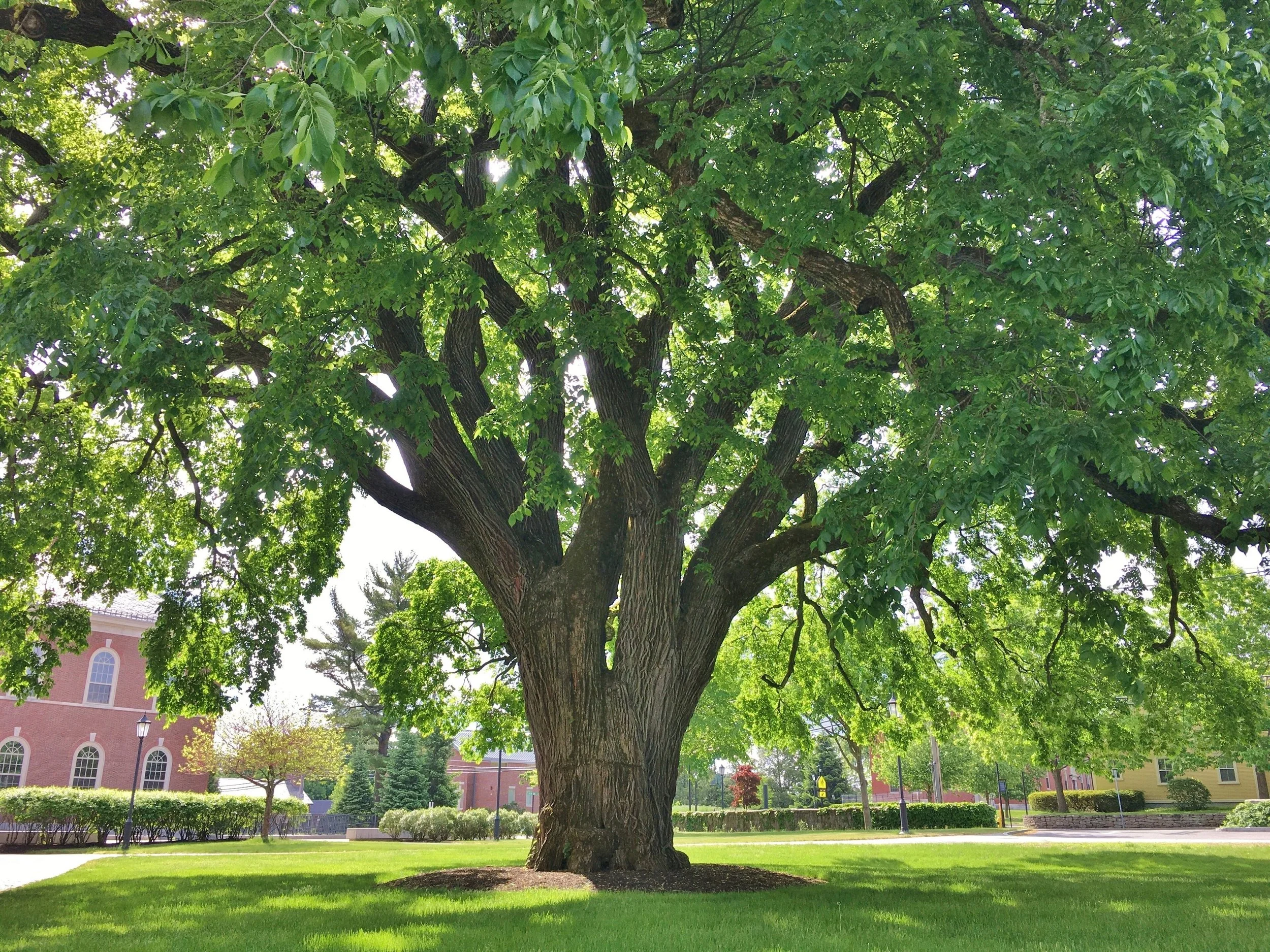
The Great Elm at Philips Academy Andover [Wikimedia]
The First Round of Questions: Vocation and Teaching Religion
I wish I could say my move to secondary education was grounded in thoughtful reflection or a profound sense of calling that I’d known and honored my whole life. Instead, it was a kind of serendipitous accident that required a big leap of faith. Of course, so are most of the fun things that life sends our way.
I’ve always loved teaching. Before I went in for my doctorate, I worked for an ed-tech company writing high school curricula, and found it generally amusing. Some of the work was a little snooze-worthy, churning out banks of multiple choice questions for English composition exams. Others felt more fun, like writing World Religions and Intro to the Bible classes. But after that, I had some basic exposure to teaching at different levels.
I have, though, always loved teaching and learning in the world of religious studies. I do root for my disciplinary home team, maybe even more than the average. All of my degrees have been in Religious Studies. I did my BA, MSc, and PhD in Religion, finishing up with a doctorate from Princeton University. Ever since entering college, I had wanted to teach Religion at the university level, as I figured it was the only way I wouldn’t have to leave the subject matter I loved. To me, “religion” captures the greatest extremes, the deepest recesses, and the highest ambitions of human thought and action. Other subjects just don’t feel the same.
I also—and I think this is getting to the heart of why I ended up in the right place—love the first round of questions that people come up with, when they start thinking about religion seriously. What happens when we die? Why doesn’t God come to earth more often? Is there magic that works? These were the questions that sent me barreling through as much of my undergraduate course of study as I could manage. And as I advanced in school, and became more and more specialized in my focus and subject material, these were the questions I missed directly asking and answering as often as I once did.
At Princeton, I did a little teaching here and there. I TA-ed with some wonderful professors on campus. I also taught Classical Mythology with a team at East Jersey State Prison, learning with incarcerated men who showcased thoughtfulness, intellect, and commitment to asking those primary, fundamental questions, and not giving up until they had answers.
By the end of my graduate program, I knew with a certain desperation that I wanted to teach religion anywhere that would have me, but that the options were evaporating into thin air. The job market seemed Halloween-levels of spooky, and I finished my doctorate in 2021, at the height of the pandemic. Somebody mentioned secondary school teaching to me, and I envisioned a life of churning out English composition multiple choice questions and sighed. (Now, with the benefit of my current position, I know this is absolutely nothing like what teaching English actually represents, but in the interest of honest storytelling, I admit my misinformed mindset).
But then two very strange things happened. I met Michael Legaspi, then-chair of the Philosophy and Religious Studies department at Phillips Academy Andover, who came to speak at a conference on early Judaism at Princeton. Then I spoke to Alex Kocar (who is here on this very panel) a graduate of my doctoral program, who was teaching at a preparatory school in New Jersey. Both of them revealed the beginnings of a world that I didn’t quite know existed—the teaching and learning about religion that can happen with teenagers, particularly at independent schools.
Getting to Know the Job: Life at a Boarding School
When the job here at Andover popped up on the SBL jobs board, I became an obsessive researcher of all things independent and boarding schools. Had this article existed at the time, I would have had read it six times, each time hoping there would be a new clue as to what the job actually was. And I got more excited as I learned what I could. Here’s some of what I wish I knew:
Your students know each other, almost too well: Boarding schools are similar to colleges in that they are residential communities of learners. But they are quite different, in that the kids are younger, more excitable, and forced into mandatory social activities and interactions that mean they all get to know each other. Classrooms are full of kids who not only have tons of questions, and are bright young kids, but who are also friends, frenemies, crushes, and rivals. This enlivens the classroom in ways that are very unusual, and often intellectually productive (with some goofy days built in).
You may (though may not) need to teach outside your discipline: Many independent school faculty teach in the disciplines they would at the college level, though some have to pick a different disciplinary stream—most often, with an advanced degree in the humanities, people move into Departments of English or History.
The job at Andover, as it turns out, was a little unusual. The job I was looking at was in the Department of Philosophy and Religious Studies, which not every school has. At other schools, religion classes, to the extent that they are offered, would be offered within English, History, or Social Science departments. In the case of Andover, the classes they wanted me to cover were in the arena of what I’d always wanted to teach: Hebrew Bible, New Testament, Intro to Islam. They were a little outside my self-described research specialty in Second Temple Judaism, but hey, close enough, right? And so, though it was not exactly the material I pored over in graduate school, it was an opportunity to learn and grow.
I’ve definitely had to stretch as a teacher—when you work at the introductory level, you are trusted to introduce a lot of things you might not feel like a specialist in. The rule of thumb at my school is that if a teacher has done college-level work in a subject, they’ve got enough under their belt to brush-up, study, and be able to introduce it to the kids. So, I’ve taught classes I never thought I would: Asian Religions, Existentialism, and (my brain-child) Baseball and Philosophy.
You’ll often, though not always, design your own curricula: I should also note that I have designed all my own curricula from the moment I arrived here at Andover (with the exception of some team-taught courses). This is not entirely typical, as the balance between shared and independent curricula varies between schools. It is not uncommon for faculty at independent schools to pick up pre-designed classes, or share a course design among a course group. In my case, I have had the tremendous joy (though, when buried under course planning, I have been known to use less laudatory terminology) of charting my own course, both in the conception of classes, and in the creation of day-to-day class plans.
You have to do more than just teach: I learned in the interview process that I would have to do more than teach. I spoke to faculty who judged my skills in residential life settings, like dormitories. Did I know how to clock when a kid was struggling? Did I actually, truly, want to listen to teenagers tell me random details of their lives one evening a week, on dorm duty? I also spoke with people who work in athletics, who checked on my level of interest in sports (high!), as well as my level of skill (low!), and proposed placements for me accordingly.
You have to like teenagers, and think they are fun: The focus on student life was also not a quirk of the interview process, but a fundamental feature of the job. I don’t mean to scare off any curious readers, but I think it’s helpful to state plainly that if you don’t think teenagers are kind of fun to be around, you will not like secondary education. As my colleague Andy Housiaux puts it, “a big part of the job is just hanging out with 15 year olds: listening to them, helping them think through things, not taking their ridiculousness personally, etc.” It turns out, luckily, that I really enjoy that part of the job. Those that don’t have a more difficult time.
In Practice: Life as a Scholar and Teacher
In the interview process, most importantly, I spoke at length with the members of the Department, all of whom were thoughtful pedagogues and brilliant subject-area specialists. I came to recognize that this was a community of scholars who have dedicated themselves to the art of introducing students to religion, and who took very seriously the responsibility of being a young adult’s first conversation partner in the questions that drove me mad as an undergraduate. And I wanted, very badly, to be one of them.
I did get the job, and gleefully ran around the interior of my house (remember: the pandemic!), over and over again. It took until we were packing our boxes for me to remember that I’d agreed to take a job in a place I’d never been before, to be given a house I’d never seen, and to put my things in an office—in fact, I realized with a sinking feeling, did I even have an office? I’d interviewed over Zoom, and realized I was basically hoping for the best, and had committed my partner and child to something kind of random. When we showed up on campus, and got the keys to a lovely home, and had a colleague throw open the door to an office in which I could put my zillions of books, I wept a little with relief.
But the real sense of rightness came in the classroom. That first year, I taught Hebrew Bible; Judaism, Christianity, Islam; and an elective born out of my experiences teaching at East Jersey State Prison, in which we read the Oresteia alongside texts on incarceration and justice. My students were bright, able, and enthusiastic. They can’t (or, maybe, to be more accurate to teenager-hood, won’t) read the length and difficulty of sources I’d imagined peopling my college-level syllabi with, but I realized that I didn’t quite miss it. Because when I asked them to read the Book of Job, or a snippet of William James, or to watch a documentary on the recitation of the Qur’an, they were bowling each other over trying to get their points in edge-wise, always seeking answers, in the blithely courageous way of youth among friends.
When it comes to scholarship, my school has been very supportive of my life as a scholar, though not in the ways that happen at the university level. I do teach a lot (4 classes per term), and course releases for pure research are not really part of the job here. But research trips, conference attendance, summer grants for research of curricular interest, even sabbaticals over the course of a career—all of these are supported by my institution. I am the sort of person who is very happy to pursue scholarship as a very advanced hobby, one that is in direct conversation with my day-to-day job. To that end, I am an associate with Harvard’s Department of Classics, which allows me library access and to engage with scholars and research in real time. But I do think it’s important to be direct that most secondary school positions will not make intentional space for research, as might happen at some research-focused colleges or universities.
That said, I’ve been amazed at how generative this context has been for my work as a scholar. I published my dissertation as a book, and I’ve published articles in the field of Second Temple Judaism—that much is maybe not shocking, given my training. But my writing voice and sense of inquisitiveness has also opened up and changed, courtesy of shooting the breeze about new things with teenagers all the time. So, I have written a popular piece for Biblical Archaeology Review, a pedagogy article for the Classical World, and even have an article under review on 19th century baseball. I am also currently working with an American religionist and colleague, Austin Washington, on a project identifying an enormous collection of antiquities here on campus as a 19th century Museum of the Bible. I am a braver, more curious scholar because of my time teaching here.
I have an unusual experience—there are not many jobs like the one I have, as liberal-arts style Departments of Philosophy and Religious Studies are not part of every independent school. All the same, I wish I’d known more about this kind of pathway as a graduate student. It would have saved me a white-knuckle drive from New Jersey to Massachusetts, not quite sure what I was getting myself into. But I also think it would have encouraged me to approach my graduate education with more curiosity, and to better recognize the rich and expansive world of teaching religion.
Elena Dugan teaches in the Department of Philosophy and Religious Studies at Phillips Academy Andover. She is the author of The Apocalypse of the Birds: 1 Enoch and the Jewish Revolt Against Rome, as well as articles on religious studies, pedagogy, and the ancient world. Email her at edugan@andover.edu.