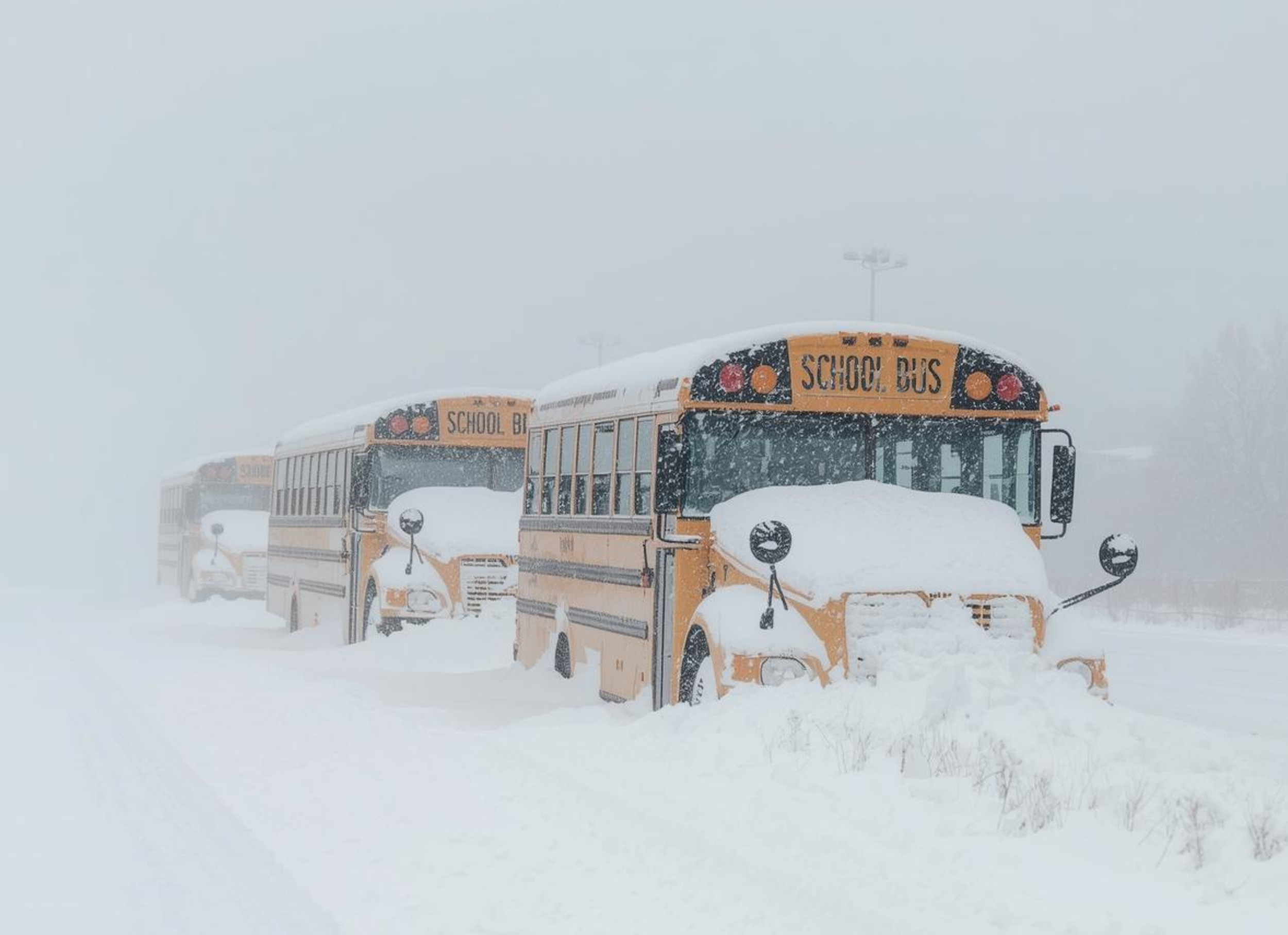
Sunday, January 25, 10:30am. It’s a bitterly cold morning, and a torrent of snow falls outside the window of my home office, blanketting the city beneath my apartment building with hills of fine powder. I worry that I might lose power, or that my car might not be able to get over the snowy streets in the morning. But more than anything, the severe weather event signifies one thing above all: the frigid hope against hope of a snow day. I am, you see, in my second semester teaching at an all-girls private Catholic high school in Westchester, NY. The distinct quality of this hope, which the teachers feel with an intensity second only to that of the students, says a lot about the nature of my shift from college to high school teaching.
I loved teaching at the college level, but the pressures of the academic job market made it such that the emphasis of one’s working life was writing. A snow day represented an opportunity to shave off a few hours of teaching and commuting from my day to spend more time writing. It didn’t really feel like a day off at all—only a couple of cancelled meetings that freed up a few more hours to spend on my monograph. But today, on the brink of what is looking like my first high school snow day as an adult, it feels as if I am participating in a human experience. I am sensitive to the limitations of this job—I still have to teach what I was going to teach, and now I need to reorganize my plan for the week. As much as I clawed a bit of time back, I will repay it in the coming days. It is also true that my preference is to spend at least part of my days off working on research and creative projects. But I do so now out of an increasing sense of writing as a positive part of my life rather than a professional requirement on which my life depends.
If the professional transition has enabled me to enjoy a snow day in a way I hadn’t been before, it is in part due to the time spent with children who have not yet been worn down by years of work-as-survival. They are, on the whole, impressively hard-working themselves, but they seem capable of enjoying a day off in a way that I have forgotten. They don’t look through a Monday in pajamas to see a Tuesday in anxious back-to-work traffic. They are capable of living in the moment, not necessarily imagining Sisyphus happy, but rather compartmentalizing the moments of relative ease when the slope flattens for a while and the burden lightens briefly. It is remarkable how quickly one recalls life in the flow of this childhood temporality, once one has swept off the snowbank of adult work. The peculiar delight of the snow day crystalizes that childhood feeling for me.
How, if this blessed snow day comes, would I spend it? Ideally, I would work on personal writing for 2 hours, which is probably the maximum amount of time I could spend on it given the demands of work and life. I’m currently writing a novel that I postponed starting for many years because of my focus on academic publications. I would also want to spend 2 to 4 hours doing teaching work. On my docket is preparation of two new units, on The Great Gatsby for 10th grade and The Crucible for 11th grade, which, I have come to understand, involves identifying a series of benchmarks to hit while reading a book over a period of weeks. This kind of course planning is much less rigid than a college-level syllabus and has had the effect of leaving me feeling perpetually unprepared. It is made a bit more challenging by the fact that I am not professionally trained to teach the canon of English literature, considering that my PhD focused on Latin literature and environmentalism. So even if I have read most of the books I am teaching at one point or another, I have felt somewhat out of my depth as I learn how best to teach texts in my own language, at once so close and so far from me. I don’t currently have any grading to do, because it is the first week of the new semester, but in the previous week I had about 18 hours of grading to do outside of my teaching day over a two-week stretch. I have 66 students across my two grade levels, and I have a similar spike in grading about once a month. Given a Monday off, I would ideally finish preparing a week-long poetry unit I am doing for both my sections before turning to map out the major benchmarks of the Gatsby unit.
The extra day off does feel like a gift for myself-as-writer. It requires intentionality to keep up written productivity when your career doesn’t depend on it, but I have been able to do so. I can probably spare a maximum of 8 hours a week on writing if I am intentional, and the contingencies of life don’t get in the way. At the very least, I usually aim to write 400 words a day Monday through Friday, in a process I have written about elsewhere.
The relationship between my writing and teaching is different now. At my school, there is an understandable emphasis on pedagogy, and while professional development is required and supported, it is usually PD in the service of work in the classroom. I could rhetorically justify my writing as being relevant to my work as a teacher, but I’m not especially motivated to do so. The rhetorical gesture of the teacher-scholar no longer feels representative of my experience. To be sure, the process of writing does help me in my capacity as a teacher of writing. My writing process has slowed considerably, and I allow myself to take more time on sentences because I no longer feel the ticking clock of productivity in the same way. As a result, I feel more capable of responding to the finer points of style in my assessments of student work. There is a bit more joy in my writing process than there used to be, and that communicates in my teaching. The time I take on a snow day to cultivate my own creative work is good for morale. Writing has always been a positive process for me, but it is especially so now that my professional future in the academy no longer hinges on my ability to quickly and unrelentingly generate monographs and articles.
Still, despite the immense challenges of this job, I think my sense of hope is starting to grow like a plant to new sources of aspiration. In a way, my career feels less like a snow day than it used to. I am fortunate to teach where I do and am grateful for it. But it does not feel as though I won the lottery, which is what my job as an academic felt like most days. Being a pre-tenure academic felt like waiting to begin the real part of your career. But here, it is the case that I havebegun, and that I am welcome. After all, the lottery ticket of the academic job often comes with immense sacrifices in terms of location, salary, and separation from loved ones. Jobs in other sectors exist too, of course, but I nevertheless feel somewhat liberated knowing that I am free from the possibility of falling into what Chris Caterine called a “tenure-trap job.” [1] At the same time, I have finished up an article on raw materials in Ovid’s Metamorphoses, am revising a chapter of my dissertation for a handbook, and pursuing different creative writing paths.
I can use part of my day off to think intentionally about how else I want to get involved in my school and where I want my career to go. Eventually, I would like to teach some Latin and Greek again, or teach environmental humanities classes in line with my dissertation work, or get involved in administration. I was frankly champing at the bit to teach books in English rather than in translation, but it is funny how, to paraphrase Vergil, unexpected things can be a joy to recall (forsan et haec olim meminisse iuvabit, Aeneid 1.203). I have always had what a former mentor called The Administration Gene and, while in academia, I kept an open mind about future forays into leadership positions. Here in my new role that path feels more possible and less up to fortune, which makes my career feel more like something over which I have some ownership. This also applies to my new choice over where I can live. I had given up hope of remaining close to New York City, but now I have a lovely apartment just 45-minutes from Grand Central Station.
I am a relatively new teacher. I started at the beginning of the academic year, so most of what I have to say are first impressions. The possibility of a snow day—which has become a reality in the process of my writing this, as school is officially canceled—also offers the prospect of a momentary return to the pacing of graduate student life, and a chance to catch my breath. For all my enjoyment of this new calling, the work falls fast and hard, burying you in a heap of professional and emotional responsibilities. The gift of a day to dig myself out of this snowbank is welcome, especially when it feels like you can rest in a community of tired and dedicated people deserving of a break.
[1] Chris Caterine, Leaving Academia: A Practical Guide (Princeton University Press, 2020), 48.
Del A. Maticic teaches English at School of the Holy Child, Rye. He has a Ph.D. in Classics from NYU, and his research focuses on problems of materiality and environmentalism in Latin Literature. His co-edited volume, Working Lives in Ancient Rome, was published by Palgrave MacMillan in 2024. He is @maticiceronian on Bluesky and his email address is d.maticic@holychildrye.org.