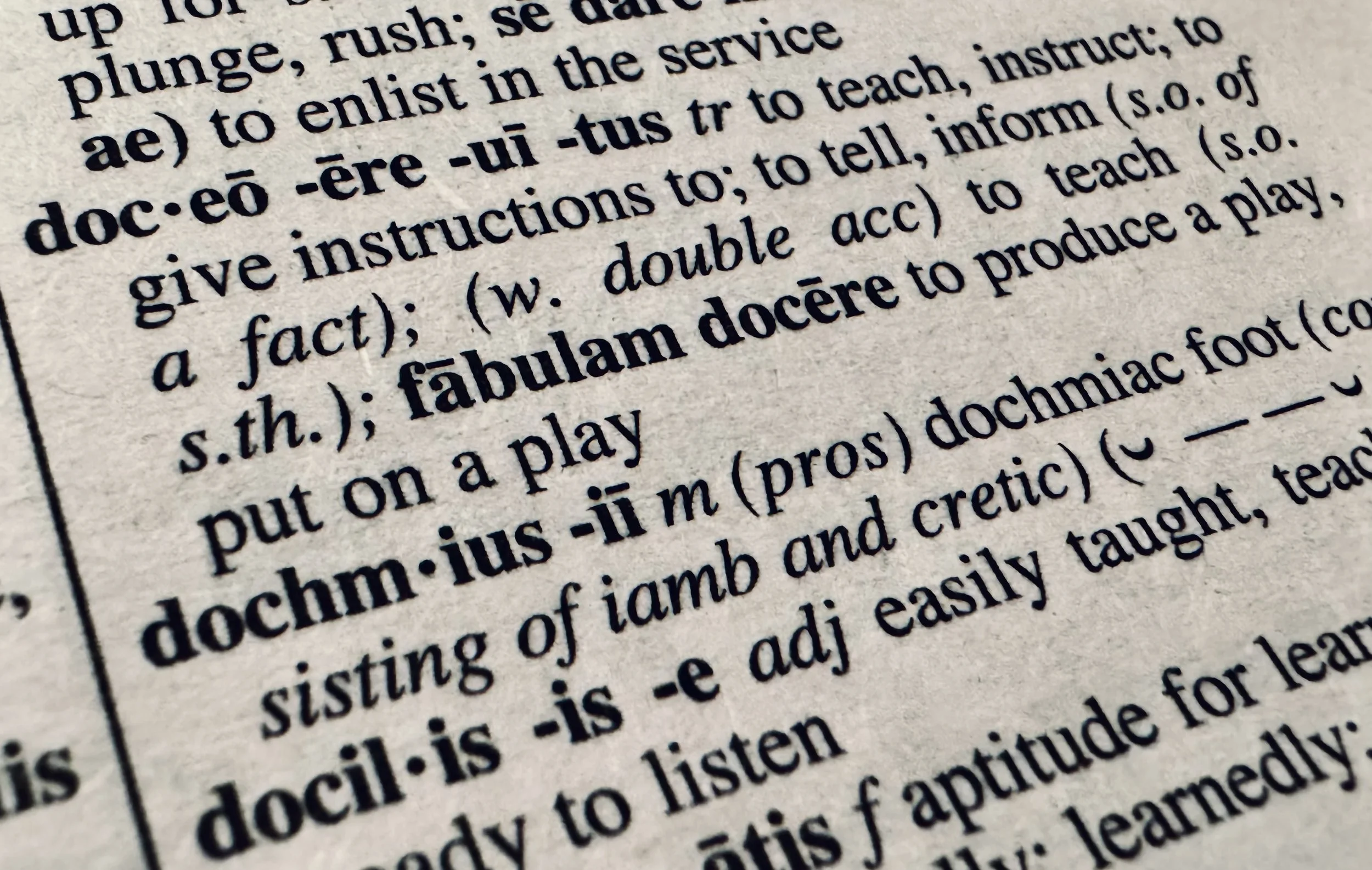
Early in my graduate studies, a professor once quipped about an application I was writing, “anyone can teach λῡ́ω, λῡ́εις, λῡ́ει; you have to show that you’re special.” Whatever the truth of the statement for academic applications — evidently hyperbolic since only a tiny fraction of people actually know ancient Greek, and still fewer can competently teach conjugation — it represents a troubling assumption of many academics: techniques of pedagogy, especially at the introductory level, are too pedestrian to befit the true life of the mind.
At the time, I might have agreed, but now, more than a decade later, I believe that teaching beginners is the indispensable craft, “without which others are unable to exist” (sine qua aliae artes esse non possunt).[1] Academics can thrive in secondary instruction; their skills transfer well to both the classroom and the administrative environment undergirding it.
Moving to the Classroom
I completed my PhD during the COVID-19 Pandemic and initially wrestled with the decision of whether or not to pursue a secondary teaching career. Trained as a classicist with a focus on Late Antiquity, I felt a sense of sunk cost as I anticipated a high school or middle school routine. What had it all been for? Would I find fulfillment without reading and research? Could I not have avoided years of unnecessary schooling and jumped right into the classroom? I knew from experience that I loved classroom teaching, but I was unsure of how I would fare with younger students. Torn, I was finally pulled towards secondary teaching by “the yoke of necessity”;[2] my first child had just been born and geographical constraints on my job search left me with few other viable options.
I soon found that my concerns were misplaced. After testing the waters with a one-year part-time Latin teaching position, I took the plunge with a full-time job in a nearby high school. Since I am the only Latin teacher, I have had the pleasure of teaching all levels of Latin, as well as an elective Greco-Roman Mythology class.
Surprises and Challenges
I had naively assumed that my years of graduate training and teaching experience would accelerate my path to occupational certification in New Jersey, but the process dragged on for several years. I was also surprised by the amount of time taken up with an alphabet soup of administrative procedures: PDPs, SGOs, GCNs, IEPs, 504s, etc. Frequent faculty and departmental meetings can be tedious, and, with five distinct courses to prepare for, I feel the burden of “work with work upon work.”[3] But all these tasks become easier with experience, and with each passing year, I have more time to focus on what matters most: teaching students.
It is in the classroom that my graduate training has been the greatest boon. Of course, building a lesson around one of my dissertation chapters would be neither appropriate nor beneficial in achieving curricular goals. Still, the rounded training of a Classics PhD and the skills needed to produce quality research transfer surprisingly well to good pedagogy. Research into second language acquisition shows that students learn best when they interact with so-called “authentic texts,” i.e. genuine texts that reflect a meaningful cultural and literary context.[4] The wide reading and interdisciplinary training of a Classics PhD is perhaps the best preparation for selecting, adapting, and creating materials that reflect the products, perspectives, and practices of the ancient world.
At the same time, secondary teaching has strengthened me as a scholar and communicator about the humanities. Few things focus the mind on conveying the essentials like explaining concepts to pure novitiates. Imagine discussing the “Homeric Question” with a class of high schoolers who know nothing about the Trojan War aside from a vague idea of a wooden horse. Or try describing patria potestas to a room of sixth graders. The much vaunted academic “elevator pitch” is less contrived and more rewarding with the added challenge of engaging a room of young students.
Teaching has even honed my command of areas of research expertise. My dissertation drew primarily on late antique letters. With the addition of Pliny the Younger’s writings to the AP Latin curriculum, I have been excited to write a new curriculum on epistolary themes, reading, selecting, and adapting ancient letters with my students. I have developed lessons that guide students to analyze dossiers of letters, to find nuances of “epistolarity” in Pliny’s letters. It has been gratifying to see students develop insights on their own, even as I delve deeper into corners of imperial Latin literature that I had previously only glanced into.
A Research Agenda in Pedagogical Practice
When I first entered secondary education, I thought that my teaching career and scholarly endeavors would continue apace on two separate tracks. Separately from my teaching, I wrote a book chapter, delivered a conference paper, and reviewed a book, but I quickly realized that the demands of my work and personal life would make a steady regimen of research difficult.
This realization initially led to disappointment: was I no longer an academic? I began, however, to reframe my mentality and expand my notion of what constitutes an academic product. If academic work is work that draws on scholarly expertise, how could developing curricula, lesson plans, and classroom activities not be conceived of as scholarly work? If peer review is a prerequisite for academic value, why would evaluation by other educators and administrators not be validating? It may not qualify as research in the traditional sense, but I consider my pedagogical practice and the materials that I produce in the course of teaching to be an extension of my academic life. I would like to continue to conduct research in the form of papers, reviews, articles, etc., but I now see scholarly activity as more intimately entwined with my teaching endeavors.
PhDs and the Humanities Pipeline
Today, colleges and universities are diverting resources from or shuttering entire classics departments. University of Chicago historian Clifford Ando recently lamented that his institution, like others, is deprioritizing a wide swath of fields rather than pursuing the university’s mission of “sustain[ing] inquiry and training into all things that touch on human existence.”[5] Pushing back on this trend will require all hands on deck, and competent and driven secondary teachers of classical languages early in the pipeline are all the more important, since their high school students will be the ones who form a large portion of undergraduate classics majors and minors. If we as academics do not value teaching at every level, how can we expect society to value the humanities?
PhD training equips teachers for the tasks demanded of instructors in the evolving world of secondary education: selecting, adapting, and creating “authentic materials,” nimbly teaching interdisciplinary content, and writing new curricula based on wide reading and new research. But secondary-turned academics are indispensable not merely for their banausic training and credentials. At their best, scholars of the humanities embody love of learning and wisdom over mere appearance and sophistry. Where institutions of learning tilt toward test-prep and job training, PhD-trained teachers must fight to keep alive a humanistic appreciation of learning for its own sake.
Jonathan Warner teaches Latin at Millburn High School in New Jersey. He received his PhD in Classics from Cornell University in 2020 where he wrote his dissertation, “Soldiers of Caesar and Christ: Martial Imagery and the Ethos of Church and State Service in Late Antiquity.” His research interests include the Roman empire in late antiquity, epistolography, military literature and history, and pedagogy. He can be reached by email at jonathan.warner@millburn.org
[1] Veg. Mil. 3.pr. “O uiros summa admiratione laudandos, qui eam praecipue artem ediscere uoluerunt, sine qua aliae artes esse non possunt!” Vegetius was of course writing of military science, but I believe the sentiment aptly applies to introductory language pedagogy, albeit for different reasons.
[2] Aesch. Ag. 218, “ἀνάγκας ἔδυ λέπαδνον.” Of course, the choice was far less impious and tragic than that of Agamemnon.
[3] Hes. WD 382, “ὧδ᾽ ἔρδειν, καὶ ἔργον ἐπ᾽ ἔργῳ ἐργάζεσθαι.”
[4] For a summary and discussion of second language acquisition research on this topic, see Judith Shrum and Eileen Glisan, Teacher's Handbook: Contextualized Language Instruction, 5th edition (Boston, MA: Cengage Learning, 2016): 188-194.
[5] Clifford Ando, “The Crisis of the University Started Long Before Trump,” Compact Magazine, August 14, 2025: https://www.compactmag.com/article/the-crisis-of-the-university-started-long-before-trump/