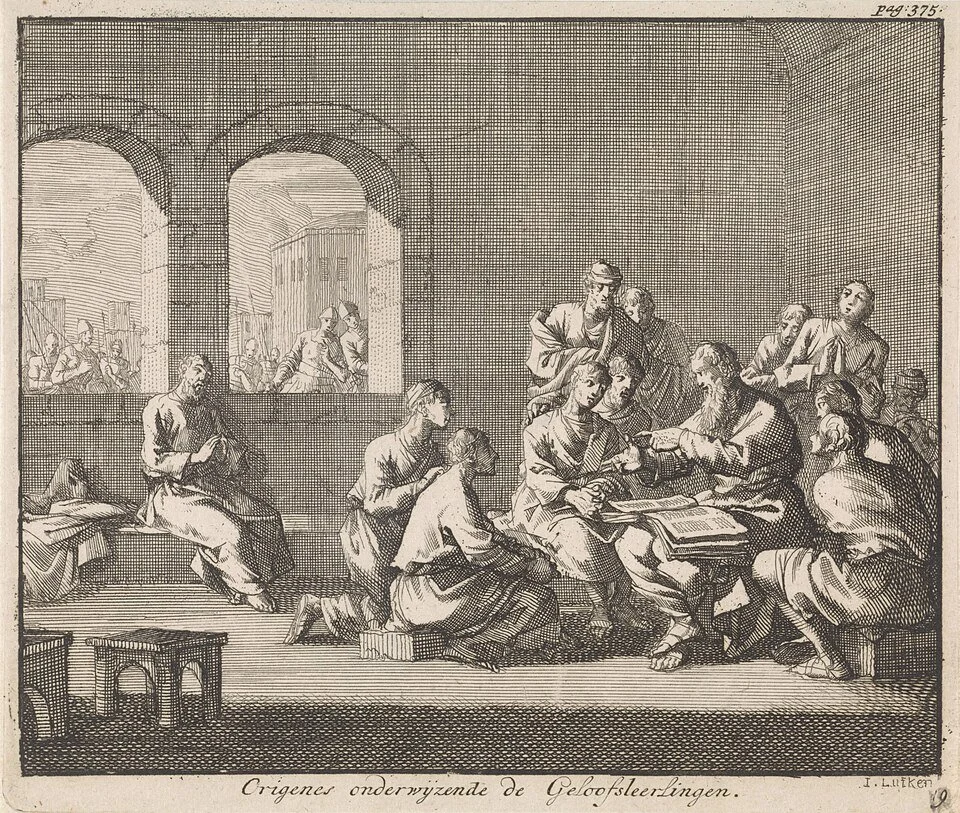

Jan Luyken, Origen teaching students (1700) [Wikimedia].
This piece is part of an ongoing forum devoted to the publication of A New Translation of Contra Celsum. See more here.
If Joseph Trigg and Robin Darling Young, the latest translators of the Contra Celsum are right, then our Origen was known in the Alexandrian philosophical school circuit for two works whose titles place their author squarely within the genre of late antique political theology: On the Demons and That the King is the Only Maker.[1] It is a pity that the vicissitudes of antiquity and its transmissions did not bequeath us their content, as they would doubtlessly shed light on the debates that lay at the heart of the historical emergence of Neoplatonism. We can discern, nevertheless, that their pairing cannot be accidental; the topics fit squarely within a proto-scholastic landscape indelibly marked by Aristotelian quandaries concerning the monarchy of God. As Erik Peterson put it, “in the divine monarchy, the single rule of the ultimate single principle coincides with the actual hegemony of the single ultimate possessor of this rule.”[2] The issue at stake was how to apply the concept of governance to the unification and plurality of things within the cosmos. What happens to that divine hegemony when its governance is delegated to intermediary beings, such as the guardians of the cities? As an ancillary of metaphysics and philosophy in late antiquity, political theology was concerned with the legitimacy of the public cult of the gods.[3]
At least for That the King, we can say that such a work would almost certainly have envisaged Plotinus and his theory that all things emanate from the One, but, as it were, “not directly so.” In his beautiful recent book, Cities and Thrones and Powers, Stephen Clark suggests that the “King” here is Nous, whose reign applies equally to the minds of men as to the ideal city to which any serious reader of Plato’s Laws in late antiquity would have aspired.[4] As Porphyry adds, That the King was dedicated to a “Gallienus,”[5] a figure located firmly within the intimacy of this very same philosophical circle – a circle which took oaths that, in swearing its members to the secrecy of its leader, Ammonius, blur the lines between the way we often categorize “religion” and “philosophy.” This Gallienus became sole Roman Emperor in 260 and was thereupon initiated at Eleusius, gesturing towards an “alternative to the empire’s growing Christian movement, one more suited to the philosophical temper.”[6] Besides his stint in Antioch to give audience to the Emperor Severus’ mother, Mammaea, Origen’s proximity to the engines of political power is difficult to tease out and based on limited evidence such as Porphyry’s testimony, cursory detail in Eusebius’s History, or the fragments of Origen’s letters. Such a path to Origen’s political thought, however, ignores Porphyry’s most important clue: the association of That the King with an “aside”-work, On the Demons. In fact, precisely this connection between political theology and demonology pervades Origen’s masterpiece, Contra Celsum, especially books 5, 7, and 8. In retrieving this work for the 20th-century, therefore, we gain a resource for rethinking political theology through the eyes of the pre-Constantinian Church’s most authoritative teacher.
Contra Celsum is the earliest and most comprehensive testimony to the Christianization of the word daimones. A short glance at what might be called Origen’s definition of daimōn demonstrates how enmeshed this category was with the theological and the political: daimones are, more often than not, those who keep the law of sin rather than the law of God.[7] Originally synonymous with theós, the word daimōn for Celsus would have applied to the panorama of mythological gods and goddesses, including the inferior forms that governed different aspects of nature.[8] Plotinus would have agreed. But in Origen, the terms daimōn and angelos are restricted to a class of mobile, largely incorporeal rational natures whose moral worth is not fixed but who shape (false) liturgical acts and influence calamitous world events such as floods and other natural disasters.[9] According to Origen, Christians refuse to swear by the emperor’s Fortune (tychē) because this fortune signifies a demon.[10]
In Contra Celsum, Origen deepens this association between incorporeal intermediaries and what we typically classify as constituting the political. One way we see this is in his redefinition of the very concept of “law.” He held, for instance, that the customs of a particular city, “nation” (ethnos), or land cannot be equated with the law of nature, what the Stoics of his day would have understood as the universal nomos. In a sense, Origen’s move was an intellectual slight of hand, for his opponents did not wish to equate local customs with natural law but rather to suggest that the former is a constituent element of the latter. But Origen’s rhetorical effectiveness lay in his bifurcation of this “nomos” from the teaching of Christ, which he viewed as the Logos and so the pedagogue of all creation. Thus, Origen presented the idea that the moral life could be measured by proximity to the Good, rejecting the foundation of Platonic dogmatic intellectualism on which so many of his contemporaries depended for ethical theory. The implication was that individuals had to discern the defects of their “local” or national system in relation to the universal law embodied in Christ’s teaching and actions. In Origen’s vision, that universal, messianic law would one day come to encompass all of rational existence.[11] Erik Peterson and others wrestled with the right terminology to describe this, suggesting that nationalism and its political theological legitimation was thereby “overcome” in the surprisingly orthodox thought of Origen of Alexandria.[12] For this reason, too, Marco Rizzi argued that Origen is the first ancient thinker to connect free will to the far more murkier problem of the subjective conditions that each human being must face in trying to attain salvation and self-knowledge.[13] Whether Origen consistently avoids the same trap of isolating and fixing persons in relation to their subjective—in this case “civic” or even “national”—conditions of bodily life is an open question.[14] But what is clear is that his vision of measuring political systems in relation to the law of Christ prohibits integralist solutions to Church and State because he deems every form of political arrangement as potentially malleable to the whims of wayward and bitter “ethnic” daimones. For its capacity to provide a theoretical underpinning to the dignity of all human persons, Origen’s thought might be better ranged next to consociationalist models of political assembly.[15] And yet as an eschatological thinker, Origen also poses something of an obstacle for the latter. Just as his contemporary Plotinus, Origen aspires towards a cosmopolitan citizenship, the implication of which is a kind of world-religion to ensure a moral unity. This unity would deter what Plato described as “the truth that every polis is, by a law of nature, engaged perpetually in an informal war with every other polis.”[16] This comes out most clearly in his reflections on the possibility of humanity being united under a common law, which, against Celsus, he holds as an actual possibility, albeit unreachable in the bodily condition.[17]
For Origen, as for most Platonists since Varro (116-27 B.C.E.),[18] the political is embodied in self-governing, mostly self-sufficient societies. These embodiments are the means by which human beings associate with the cosmic pattern that provides proper order and function to the diversity of material and immaterial creatures emanating from the One. Possibilities of association were concentrated in historic knots of language, ethnicity, agriculture, and law—what modern translators have anachronistically but not altogether misleadingly called “nations”—because, as Celsus held, “from the beginning different parts of the earth were allotted to different overseers and authorities.”[19] Good Platonists held that the “nations” (ethnē) ought to live according to the will of these powers. This system is the very meaning of Celsus’s True Logos: the law that encompasses all the nations is the “ancient logos which has existed from the beginning, which has always been maintained by the wisest nations and cities and wise men.”[20] But for Origen, the Logos is a pedagogical engine external to each human being and yet adapted to their subjective bodily conditions. His twist to late antique political theology is to view those conditions as sites of conflict between good and bad demons, as either hindrance or help to perceiving the law of the Logos.[21] That is why Celsus could ridicule Christians who refuse to participate in sacrifices to the demons performed according to the local laws. For the daimones are not present just in sacrificial customs, but they are there whenever we eat, drink, and even breathe the very air around us.[22] Celsus was drawing on Platonic tradition going back to Plato’s Laws,[23] which prescribed honors to be rendered to successive forms of superior beings: gods of the underworld, gods of the superior world, daimones, heroes, ancestors, and finally, one’s parents. Rule, in other words, was channeled through distinctive spirits who were themselves obedient to their own eternal patterns. Later Platonism, including its reception in Islamic philosophy, would construe this as a collective society of obedience to the One over all things.
Through Philo, Jewish and Christian thinkers pressed this tradition into the service of reflection about their own religious monotheism by focusing on the concept of divine monarchy and insisting that “one does not honor the servants instead of the king.”[24] Perhaps in part because Paul viewed sacrificial ceremonies as communion with demons (daimonia: 1 Cor 10:14-22), Origen could write in response to Celsus that “we do not render the customary honors to the beings to whom, Celsus says, earthly things have been entrusted, since ‘no man can serve God and mammon’ [Matth 6:24] … whether ‘mammon’ means one thing or many.”[25] Thus, Celsus could repudiate the Christians for “revolt in the metaphysical world, but as such [Celsus is also accusing them of] revolt in the political order […] [because, he implies,] whoever destroys the national cults is therefore in the final analysis also destroying ethnic particularities, and at the same time attacking the Roman Empire, in which there is room for the national cults as well as for the ethnic particularities.”[26]
Peterson’s representation of Celsus’ argument raises an important point about the role of ethnographic argumentation in Origen’s Contra Celsum. Origen, instead of advocating for the eradication of daimones or underscoring their essential ethnocentricity, organizes the presiding daimones in varying degrees of proximity to the good: “each one is handed over to angels who are more or less stern and whose character varies in proportion to the distance they moved from the east.”[27] Some have wondered whether this is a proto-racist moment in Origen’s thought, as it suggests a hierarchy of moral value inherent to the diversity of ethnicities, with “Israel” at the top.[28] But Origen’s essentialism here needs to be understood in relation to his construction of “Judaism” and its history. Celsus had denigrated Judaism while holding it as a viable non-Christian option. To a degree, Judaism fit Celsus’ model of the local demonic governors: Jahweh was one among the “national” gods. Origen, in turn, had to demonstrate the legitimacy of the Jewish people and, to avoid the impression that Christianity was a start-up religion, establish historical links with it.[29] Thus, he envisioned that the ethnos that clung to the Logos of the Creator God is Israel: first the Jewish people and then, as Israel waned, it is reconstituted by the Christian Church called from the nations. Human and angel subsist on the same continuum of rational creatures. Origen endowed that continuum with a self-determination that permits creatures to resolve their punishments and move closer to the Logos throughout history. As he envisions it, “the barbarians would also be converted to the word of God and would be most law-abiding and mild. And all other worship would be done away and only that of the Christians would reign. One day it will be the only one to reign, since the Logos is continually governing more souls.”[30]
This universalistic passage is tinged with Christian triumphalism. It is a fascinating specimen of the interpenetration of what we can call the political and the religious. Cognates of the verbs krateō and nemō occur, evoking division, judgement, and rule. The image of the Logos “governing” souls recalls at the philological level Celsus’ doctrine of the political, of the “demonic” rulers presiding over different regions and peoples through “law.” Origen’s vision of a cosmopolitan citizenship does not consist in a worldwide state but rather a worldwide morale, a global ethos of resonance with the Logos. Or, as implied by his use of the word “cult” (thrēskeia) above, it we are dealing here with what Stephen Clark would call the Plotinian vision of a world religion.[31] We arrive there through what Erik Peterson called the “overcoming” of national boundaries and the replacement of rational souls under the governance of the Logos. There is no question that for Origen this replacement very much coincides with what Guy Stroumsa called “the end of sacrifice in antiquity.” For it is precisely this word thrēskeia that Origen associates with the bloody sacrifices offered to the pagan gods and the moral evils required to satisfy these menacing deities.[32] Indeed, in Origen’s idealized vision, Christians viewed these daimones as patently incompatible with the demands of biblical monotheism. What, then, is his riposte, the “origenian” political programme? As Lorenzo Perrone remarked, if Contra Celsum disappoints when it comes to the practical instantiations of “Christianity” as Origen fashioned it, it is because in his view, ethical progress is what displays the true effectiveness of Christianity.[33]
A few details can be surmised from Contra Celsum, however. Against the cosmic background sketched in this essay, some of Origen’s tantalizing details about Christians and political life take on a heightened significance. When at the beginning of the treatise he argues that Christians have a God-given right to break the Roman laws against illicit associations, his reasoning is that “just as it would be right for people to form associations to kill a tyrant, who had seized control of their city, so too—since the Devil and Falsehood reign as tyrants—Christians form associations, against the devil, in opposition to his laws, in order to save others, whom they might persuade to abandon that law, which is like that of the Scythians or a Tyrant.”[34] What is perhaps most preposterous to Celsus is the idea that a being capable of opposing God would set himself up to divert reverence and observance away from the true law;[35] nothing, in his view, could violate the natural order on a grander scale. But the rhetorical effect of Origen’s claim here lies in its Stoic root, namely “the notion that positive laws which contravene natural law are not laws in any sense of the term.”[36] Origen’s point is that the laws which attempt to force Christians to act contrarily to the precepts of Jesus are unlawful, instruments rather of the demons who greedily demand the sacrifices of those under their charge. This is what Caspary identified as Origen’s “dialectical theology of politics”[37]: to rebel against the Empire and its illicit legislation is to fight the devil; but the Empire can also be an instrument of providence for the spread of the gospel,[38] the process of drawing rational creatures to the Logos, and thus the abolition of evil.
In Origen’s political theology, the concept of “natural law” is really a concession to debate Celsus on his own terms. He wrests his non-Christian opponent’s cosmic-political framework away from its dignity as patterned on eternal law and frames it instead as a consequence of the fall. The “ethnic” or “national” daimones, then, are assumed into his narrative of progress by which rational creatures are healed through gaining proximity to the Logos. By posing the Logos as the organizing principle around which national communities are formed, Origen mitigates the hegemony of natural law. He relocates the context for ethics not in Platonic intellectualism but in subjective perception of the Good – conditions that would have to include one’s national and epistemological contexts in tension with the universal dignity of intellectual creatures. Origen’s treatise beckons for new linkages to be made between natural law, ecology, and world religions based on his revolutionary demonology and angelology.
Samuel Pomeroy (Ph.D., University of Leuven, 2019) is an Assistant Teaching Professor in the Religious Studies Department at the University of Tennessee, Knoxville, U.S.A. His courses cover World Religions and Judaism, Christianity, and Islam. Prior to Knoxville, he worked at the Exzellenzcluster Religion und Politik, WWU Münster.
[1] Porphyry, V. Plot. 3.30-32. The revised Loeb text relies on the edition in the Oxford Classical Text series: Plotini Opera. Tomus III. Vita Plotini. Enneades i-iii (editio minor), eds. Paul Henry and Hans-Rudolf Schwyzer (Oxford: Clarendon, 1964, revised 1982); Plotinus. I. Porphyry on the Life of Plotinus and the Order of his Books. Enneads I. 1-9, trans. A.H. Armstrong, LCL 440 (Cambridge, MA: Harvard University Press, 1989). The debate on the identity of this “Origen” concerns the triangulation of the testimony of 1) Porphyry’s Life of Plotinus mentioned in the previous footnote, 2) a fragment (Harnack fr. 39) of Porphyry’s Contra Christianos, and 3) the passage in Eusebius, Hist. Eccl. 6.19.4-8, from which this Contra Christianos fragment comes. These passages root “Origen” in Ammonius’ Neoplatonic school. See Richard Goulet, “Porphyre, Ammonius, les deux Origène et les autres,” Revue d’Histoire et de Philosophie religieuses 57.4 (1977), 471-496 and Aaron P. Johnson, “Philosophy, Hellenicity, Law: Porphyry on Origen, Again,” Journal of Hellenic Studies 132 (2012), 55-69; earlier, René Cadiou, La jeunesse d’Origène. Histoire de l’École d’Alexandrie au début du IIIe siècle (Paris: Beauchesne, 1935), 424.
[2] Erik Peterson, “Monotheism as a Political Problem,” in Theological Tractates, trans. Michael Hollerich, Cultural Memory in the Present (Stanford, CA: Stanford University Press, 2011), 69 = Erik Peterson. Theologische Traktate, ed. Barbara Nichtweiß, Ausgewählte Schriften 1 (Echter: Würzburg 1994 [1951]), 25.
[3] Not until Vico does “political theology” take on the sense of a religione civile, a programmatic binding force that corresponds to a cunning, rationalistic Christian providentialism. See Gisela Schlüter, “‘Religion Civile’ vor Rousseau. Vico: Eine begriffsgeschichtliche Recherche im primo Settecento,” Archiv für Begriffsgeschichte 40 (1997/1998), 105-122.
[4] Stephen R.L. Clark, Cities and Thrones and Powers. Towards a Plotinian Politics (Brooklyn, NY: Angelico Press, 2022), 141.
[5] Porphyry, V. Plot. 3.30.
[6] L.S.B. MacCoull, “Gallienus the Genderbender,” Greek, Roman, and Byzantine Studies 40 (1999), 234.
[7] Cels. 7.69. References to the Contra Celsum come from Origène, Contre Celse, introduction, texte critique, traduction et notes, ed. Marcel Borret, SC 132, 136, 147, 150 (Paris: Les Éditions du Cerf, 1967-1969) and occasionally, Origen, Contra Celsum, trans. with an introduction and notes, trans. Henry Chadwick (Cambridge: Cambridge University Press, 1953, reprint 1965).
[8] For background, see Gilbert François, Le polythéisme et l’emploi au singulier des mots θεός, δαίμων dans la littérature grecque d’Homère à Platon, Bibliothèque de la Faculté de Philosophie et Lettres de l’Université de Liège 147 (Paris: Les Belles Lettres, 1957).
[9] Cels. 8.31; see further Henri Crouzel, “Le démonique dans l’œuvre d’Origène,” in Figures du démonique, hier et aujourd’hui, Collection générale 55 (Bruxelles: Presses universitaires Saint-Louis Bruxelles, 1992), 31-61.
[10] Cels. 8.65.
[11] See the crucial Cels. 8.72.
[12] Erik Peterson, “Das Problem des Nationalismus im Alten Christentum,” in Frühkirche, Judentum und Gnosis. Studien und Untersuchungen (Darmstadt: Wissenschaftliche Buchgesellschaft, 1982), 58. See my “Angels of History. Origen and Eusebius as Paradigms for the Theology of History in Erik Peterson, Jean Daniélou, and Karl Löwith,” in Origeniana Tertia Decima. Origen and Philosophy, eds. Alfons Fürst and Samuel Fernández, BETL 338 (Leuven: Peeters, 2024), 777-791.
[13] Marco Rizzi, “Freedom and Justice: Origen on Man’s Dignity in History,” in Natur und Normativität (Pontes: Münster, 2010), 31-44.
[14] See the criticism of Origen’s doctrine of “ethnicity” in Mathijs den Dulk, “Origen of Alexandria and the History of Racism as a Theological Problem,” JThS 71.1 (2020), 164-195.
[15] I draw this language from Gary Chartier, Christianity and the Nation-State (Cambridge: Cambridge University Press, 2023), 195.
[16] Plato, Leges, 1.625e-626a.
[17] Cels. 8.72.
[18] See Peter Van Nuffelen, “Varro’s Divine Antiquities: Roman Religion as an Image of Truth,” Classical Philology 105.2 (2010), 162-188.
[19] Cels. 5.25.9-13.
[20] Cels. 1.14.27-29.
[21] Interestingly, later, Proclus, In Platonis Timaeum I, 20d (in Proclus Diadochus. In Platonis Timaeum Commentaria, ed. E. Diehl [Leipzig: Teubner, 1903], 76,30-77,3), adduces the Platonist Origen as holding that the Atlantis myth could be allegorically interpreted as a war between good and evil demons.
[22] Cels. 8.25.1-4.
[23] Plato, Leges, 4.717a-b.
[24] Erik Peterson, “Monotheism as a Political Problem,” 74 (AS 1, 29-30).
[25] Cels. 8.56.
[26] Erik Peterson, “Monotheism as a Political Problem,” 88 (AS 1, 44-45).
[27] Cels. 5.30. “The east” is a fount of beatific light.
[28] See the Den Dulk article cited above in note 14. Following a spurious etymology, Origen has “Israel” = those “seeing” God. See Cels. 2.14-15 for Celsus’ taxonomy of “national” theologies and their respective “sciences.”
[29] For examples and outline of this argumentation, see Louis Feldman, “Origen’s Contra Celsum and Josephus’ Contra Apionem: The Issue of Jewish Origins,” VC 44 (1990), 105-135.
[30] Cels. 8.68, trans. Chadwick modified.
[31] Compare on this point Peterson, “Das Problem des Nationalismus,” 57, and Clark, Cities and Thrones and Powers, 155-160, 190-197.
[32] Cels. 7.69-70; Guy Stroumsa, The End of Sacrifice. Religious Transformation in Late Antiquity, trans. Susan Emanuel (Chicago, IL: The University of Chicago Press, 2012).
[33] Lorenzo Perronne, “Christianity as ‘Practice’ in Origen’s Contra Celsum,” in Origeniana Nona. Origen and the Religious Practice of his Time, eds. G. Heidl and R. Somos, BETL 228 (Leuven: Peeters, 2009), 293-317.
[34] Cels. 1.1.
[35] Cels. 6.42.
[36] Gerard E. Caspary, Politics and Exegesis. Origen and the Two Swords (Berkeley, CA: University of California Press, 1979), 136.
[37] Caspary, Politics and Exegesis, 139.
[38] Origen treats the Pax Augusta as praeparatio evangelica in Cels. 2.30.