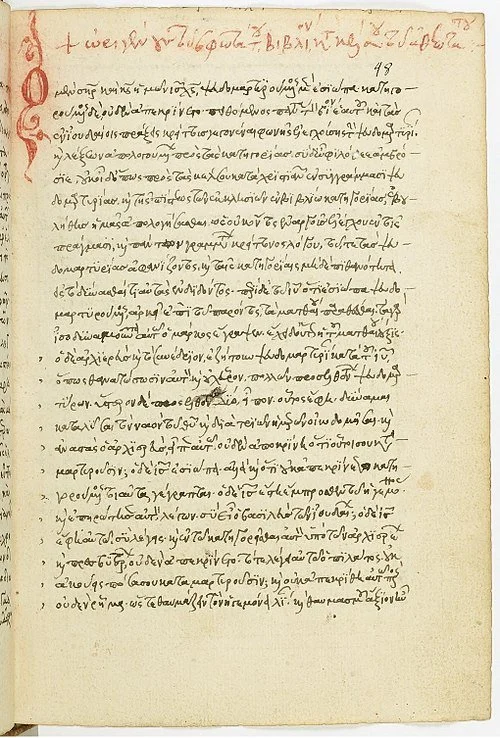

Adversus Celsum libri VIII in Manuscript Grec 945 (15th century) [La Bibliothèque nationale de France (BnF) / Wikimedia Commons].
This piece is part of an ongoing forum devoted to the publication of A New Translation of Contra Celsum. See more here.
In their introductions in this journal to their magisterial translation of Contra Celsum, Robin Darling-Young and Joseph Trigg emphasize the scale of Origen’s achievement. I echo their view that the work is a masterpiece of philosophy, theology, and political theory. I also appreciate the fact that, through Origen, some of Celsus’ own ideas have survived. In this short tribute to Origen and his translators, I suggest that, among much else, Origen shows paradoxically how strong a mainstream polytheist’s case could be against Christianity in the second century, and how even a brilliant apologist could struggle to meet it.
Compared with the wealth of philosophy in Contra Celsum, Origen has relatively little to say about mainstream cult and religiosity, and what he does say is scattered throughout the work.[1] The fact that mainstream religion is evidently not Origen’s main target, however, makes it more likely that he does not significantly misrepresent Celsus’ views.
Celsus apparently saw himself as a regular Greek polytheist. He speaks positively of many gods who have appeared to worshippers over time and have a track record of benevolence, and of mainstream cults that are ancient and widely practiced.[2] Origen, like other Christian apologists, struggles to neutralize these conventional arguments from antiquity and past form. He argues that Christianity also has ancient roots, especially in prophecy (8.45–46), and points out that not everyone accepts the oracles of the common gods (7.3), but these are hardly decisive arguments for Christianity against other cults. He claims that there is now an ‘untold number’ of Christians (3.24), but he cannot have thought – nor expected anyone else to believe – that Christians came close to equaling polytheists in number.
Origen acknowledges that Celsus holds nuanced views about established cults. Celsus respects the antiquity of Egyptian religion (8.58) but not its animal worship (3.17). He thinks that Mithraism has valid but also irrational aspects (e.g. 1.9, 622). He does not think (as some Christian apologists claimed polytheists believed) that statues of gods are actual gods (1.5). Origen claims that stories about Jesus’ miracles are better evidenced than stories, for instance, about the miracles of Aristeas (3.27, choosing a distinctly weak Greek example, though admittedly one that Celsus himself had mentioned), but he accepts that the only reason to believe either is testimony, and there is testimony to both.
Celsus believes that human reason can assess, for instance, whether a being is a god fit for worship or a phenomenon is a divine sign (e.g. 3.26–29), and he points out that being a wonder-worker did not make Jesus a god (3.29). He holds in contempt the dictum he attributes to Christians: “Do not ask questions, just believe (pisteuein)” (1.9). Origen is in a delicate position in responding to this, because he wants to affirm the importance of accepting revelation while also giving human reason a significant role in the development of faith and knowledge of God. Like other apologists, he does not find it straightforward to explain how Christians can call people to the belief aspect of faith ab initio, while also valuing the reason of the gnostic. Origen proposes that trust and belief are appropriate for ‘simpler’ Christians while the more intellectually gifted and educated seek knowledge of God. Such a solution would surely have shocked the first generation of Christ-confessors, for whom pistis conferred righteousness, sanctification, and salvation, and still strikes many Christians today as problematic.
In many respects, Celsus and Origen had much in common. Celsus also held a nuanced view of the role of pistis in religion. He affirms the importance of putting one’s trust in the gods and accepting, on the witness of tradition, that certain claims about them are true (e.g. 2.8, 54, 70, 75–78; 3.24; 4.6; 6.29; 8.24). He is interested in how worshippers assess what about a tradition is worthy or trust or belief and what is not, or not literally (e.g. 6.42, 8.68, cf. 4.6). He argues commonsensically that if Jesus had wanted to establish his credibility after the resurrection he should have appeared to more people, including some who had been skeptical of him before his death (2.70, 2.75). Among sound bases for belief, he accepts antiquity, the weight of testimony, the writings of those widely regarded as wise, and widespread experience (e.g. 1.14–18, 2.75) – all criteria that appealed to Origen too. Origen disagreed with the content of Celsus’ beliefs, but he must have been aware that he largely shared Celsus’ view of the legitimate grounds for religious pistis.
These brief observations offer just a taste of what Origen reports about Celsus’ religion, but they point to the strengths of Celsus’ argument, from a second or third-century standpoint, and the limitations of Origen’s counter-attack. One could make a similar case for the strength of the arguments Celsus puts in the mouth of his Jewish witness against Christianity. Modern Christians and students of early Christianity alike are sometimes tempted to regard early Christians’ case against the cults that surrounded them as compelling, and Christianity’s success as based at least in part on that strength. Not the smallest contribution of Contra Celsum is that – brilliant, creative, and honest thinker that Origen was – it provides some significant evidence of the strength and sophistication of the religious mainstream of his day, and reminds us that any assessment of Christianity’s eventual ‘triumph’ over Mediterranean polytheism must take its strengths, as well as its weaknesses, into account.
Teresa Morgan is McDonald Agape Professor of New Testament and Early Christianity at Yale University. Her research centres on the history of ideas and mentality across ancient history, New Testament, and early Christian studies. She has written widely on ancient Greek, Roman, and Christian education, ancient Mediterranean ethics, and Paul, and is currently finishing a four-volume study of the history and theology of early Christian faith.
[1] On the religion of Celsus see further Teresa Morgan, “Origen’s Celsus and imperial Greek religiosity” in James Carleton Paget and Simon Gathercole eds., Celsus and His World (Cambridge: CUP. 2021), 149-77.
[2] Morgan (2021): 152–55.