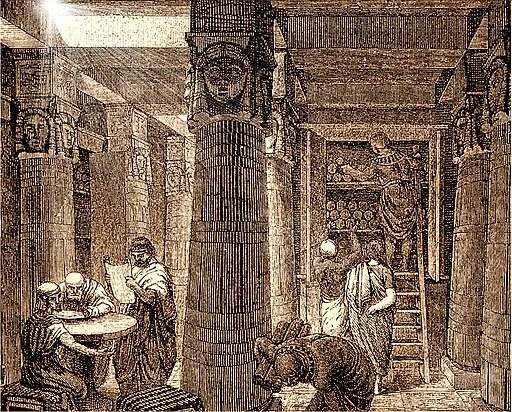

O. Von Corven, Library of Alexandria, (1890) [Wikimedia].
This piece is part of an ongoing forum devoted to the publication of A New Translation of Contra Celsum. See more here.
At the outset of his majestic response to the attack leveled against Christianity by the second-century philosopher Celsus, Origen begins with a reflection on the silence of Jesus before his accusers (Mt 26:62-63, 27:12-14; Mk 14:60-61, 15:4-5; Lk 23:9). The brief justification offered by Origen for his own detailed defense has a legal and rhetorical flavor but also introduces, somewhat obliquely, a range of philosophical concerns: the contest of the true and the false, the nature of argument and evidence, the role of persuasion and its limits. It is a fitting preface to Origen’s exacting and exhaustive investigation of the claims put forth by Celsus – a dialectical examination of a challenge to the truth and efficacy of Christian faith.
Joseph Trigg and Robin Darling Young posit the unabashedly philosophical character of Celsus’s challenge and Origen’s response as the basis of their project. The uncompromising emphasis of the translators on the shared Platonic background of the antagonists sharpens our appreciation of the issues under discussion as well as the singular importance of Origen’s achievement. This orientation accords precisely with the portrait of Origen that emerges in the “Thanksgiving Address” – a unique testimony offered by a student and traditionally attributed to Gregory “Thaumaturgus,” the pioneering bishop of Asia Minor and spiritual ancestor of the great Cappadocian theologians of the fourth century. This substantial account allows us a precious vantage on the nature and dynamic of philosophical training under Origen, a multi-faceted process of intellectual and spiritual formation based on the centrality of the master-pupil relationship and designed as preparation for investigation of the Bible. My own attempt (2018) to decipher the intricacies of that document turned time and again to the thoroughly Platonic foundation of the educational process described there; no less striking is the deep reliance on a tradition reaching back to Philo of Alexandria, Origen’s Jewish predecessor in the attempt to establish common ground between Plato and Scripture.
Trigg and Darling Young take the Platonic character of Origen’s composition yet a step further and speak of it in terms of a work of political philosophy. It is precisely this orientation that Trigg describes in his essay as the goal of “transforming ordinary people into citizens of the heavenly Jerusalem, Plato's otherwise unrealizable best politeia.” This refers undoubtedly to the stirring conclusion of the Contra Celsum (8.74-75) that itself converses with the closing words of Book 9 of Plato’s Republic. This is an exciting and compelling way to read Origen’s work, raising weighty questions not only about the author’s self-understanding but also about his legacy and influence. A single example must suffice: how did Origen’s spiritual grandchild, Eusebius of Caesarea, understand this ecclesiastical-political ideal? Would the Constantinian shift (or revolution) demand an attendant transformation of the Christian vision of the Platonic politeia?
Finally, a brief observation on the relationship of this new translation of Origen’s Contra Celsum to its predecessor, the graceful translation by Henry Chadwick, envisioned during the dark years of the Second World War and published in 1953. Chadwick, an acknowledged doyen of twentieth-century Patristic scholarship, brought a certain philosophical awareness to his translation, particularly in his sensitivity to Origen’s familiarity with Stoic terminology and logic. Nevertheless, during these intervening generations, there have been enormous advances in the appreciation of the philosophical currents in the Hellenistic and Roman worlds, perhaps especially in the development of Platonism. Chadwick’s translation, moreover, predated the remarkable flowering of the study of Late Antiquity with its commitment to a perception of the Church Fathers (as well as the Rabbis) as members of a larger and pervasive cultural continuum. The new translation by Trigg and Darling Young is deeply rooted in our developing understanding of Origen – theologian, exegete, and philosopher – as a participant in this wide-ranging intellectual and spiritual discourse. It promises to be an invaluable aid and true gift to our own and future generations of scholars and students.
[1] The best translation of the work is by Michael Slusser in his (1998) volume on Gregory Thaumaturgus for the Fathers of the Church series. Earlier translations by S. D. F. Salmond (Ante-Nicene Fathers, vol. 6) and W. Metcalfe are widely available in the public domain.
David Satran is a professor (emeritus) in the Department of Comparative Religion of the Hebrew University. His teaching and research range from Jewish literature of the Second Temple Period through the intersection of Christianity and Greco-Roman philosophy in the fourth and fifth centuries. His current interests include Dante, Chekhov, and George Orwell.