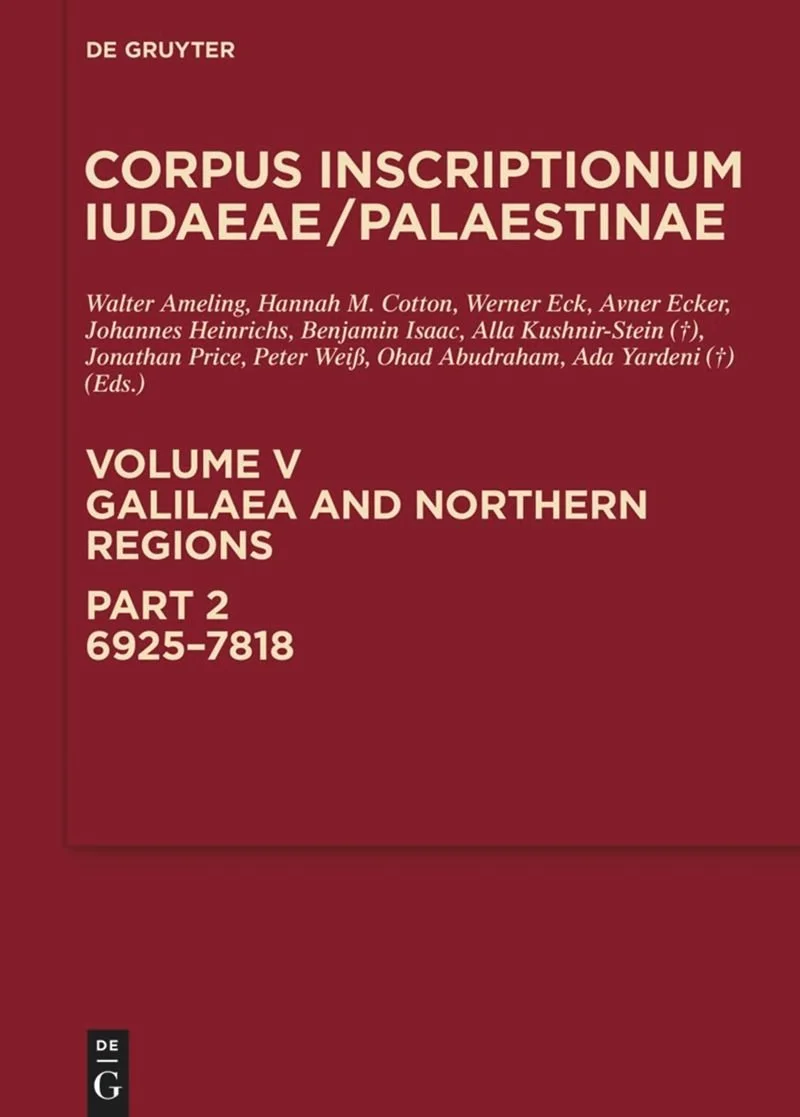
Corpus Inscriptionum Iudaeae/Palaestinae, Volume V: Galilaea and Northern Regions. 2 Parts. Edited by Walter Amerling, Hannah M. Cotton, Werner Eck, Avner Ecker, Johannes Heinrichs, Benjamin Isaac, Alla Kushnir-Stein, Jonathan Price, Peter Weiß, Ohad Abudraham, and Ada Yardeni. Berlin: De Gruyter, 2023.
This volume, which exists in two parts, is the fifth in the series Corpus Inscriptionum Iudaeae/Palaestinae (CIIP), which is an intended corpus of nine total volumes containing all inscriptions from the modern-day territory of ancient Judea and Palestine dating from Alexander the Great’s conquest to the Arab subjugation of the region. Among the contents are epigraphs from the territory of ancient Galilee and the entirety of modern-day northern Israel from the Mediterranean Sea to the Sea of Galilee with the exceptions of inscriptions from the Golan Heights and Scythopolis. The former are not included because the Golan Heights plateau remains disputed territory, the latter are not in this work because many inscriptions from the city remain unpublished by the excavator. The intended audience for CIIP 5 consists of scholars specializing in the study of early Judaism, early to late antique Christianity, and the early Islamic period. However, given that every inscription is translated into English, non-specialists interested in any of these time periods in this location will benefit from this epigraphic collection.
At the outset of the work, the editors explain their intentions for this collection, namely, to publish every known inscription to date from Galilee and northern Israel, with the exceptions noted above. This is followed by a comprehensive “Table of Contents” (pp. xi–xxiv) and four other useful “front matters,” including “Author’s Sigla,” “Abbreviations,” “Diacritical System,” and a key to transliterations of non-Greek and non-Latin ancient languages in which the inscriptions in the work were composed: Armenian, Aramaic, Syriac, Georgian, and Hebrew (p. xlvii–xlxi).
The main portion of the two-part volume consists of the presentation of almost 2,000 inscriptions, which the editors have arranged geographically from north to south. Thus, Part 1 begins with epigraphs from the Upper Jordan Valley (pp. 1–17) and Part 2 ends with inscriptions from Tel Shalem (pp. 1985–2000). When epigraphs stem from the same location, the editors have arranged their presentation from west to east. Because territories of many ancient cities remain unknown, the editors present many inscriptions in light of their association with modern towns and cities. When discussing epigraphs from a single location such as Gischala (pp. 169–83), they arrange their presentation by inscriptional content such as dedications, funerary inscriptions, etc.
Concerning the individual epigraphic entries, the editors follow the presentation of earlier volumes in the corpus. To this end, to take an example at random, as they begin a new site such as Nazareth (pp. 1352–55), the editors provide a concise discussion of the site, its history, and archaeological remains where possible. As for the individual inscriptions from a given location, they provide a number, title, and, when possible, a date for each epigraph, along with a description that includes its provenance and archaeological context. Occasionally, an image is included. Next, the editors present the inscription’s original text, a transliteration of it in some cases, a fresh English translation of the text, a short commentary about the epigraph, and a bibliography on it. One important note about these entries is that, as far as they were able, the editors have conducted autopsies or personal inspections of the inscriptions so as to provide readers with the most accurate descriptions and interpretations of the epigraphs in question. Finally, at the end of Part 2, the editors provide an index of personal names (pp. 2003–92) and a map (p. 2093) with a key to locations on it (pp. 2095–98).
To offer an example of an inscription particularly illuminative for me, I would point to CIIP 7173, a funerary inscription dating at least to the late second century CE found in a Jewish catacomb near the ancient synagogue from Beth She‘arim. The epigraph is in Greek and engraved on the right side of the lintel of a door to a burial cave and the letters of the inscription were filled with red paint, some of which is still visible. It reads, “Of Socrates” (Σωκράτους). This text is not the only thing on the lintel. To its left in the center of the lintel, there is a human head with long hair. What is more, someone has incised a seven-branched menorah on the left side of the lintel beside the image. This small one-word epitaph and the images associated with it underscore the complexity of life in the territory that this volume covers: it is a funerary inscription written in Greek marking the tomb of a Jewish man who was named after the famous Greek philosopher Socrates. Moreover, whoever was responsible for this burial cave did not think that the carved image of a human face on his funerary monument was improper or impious, despite the prohibitions in the Torah against making images (cf. Lev 26:1; Deut 4:16; 27:15). For biblical scholars and historians of antiquity, such evidence demonstrates the complexity of ancient Jewish practices (remember this catacomb was near the synagogue!) and the need to interpret them contextually, not in light of modern notions about what the Bible means.
In short, this new volume, like all the others in the series, is indispensable for those who want to know more about the culture, cultic devotion, and ancient communities that once lived in this part of the Mediterranean World from the time of Alexander the Great to the Arab conquests.
D. Clint Burnett is a visiting scholar at Boston College.