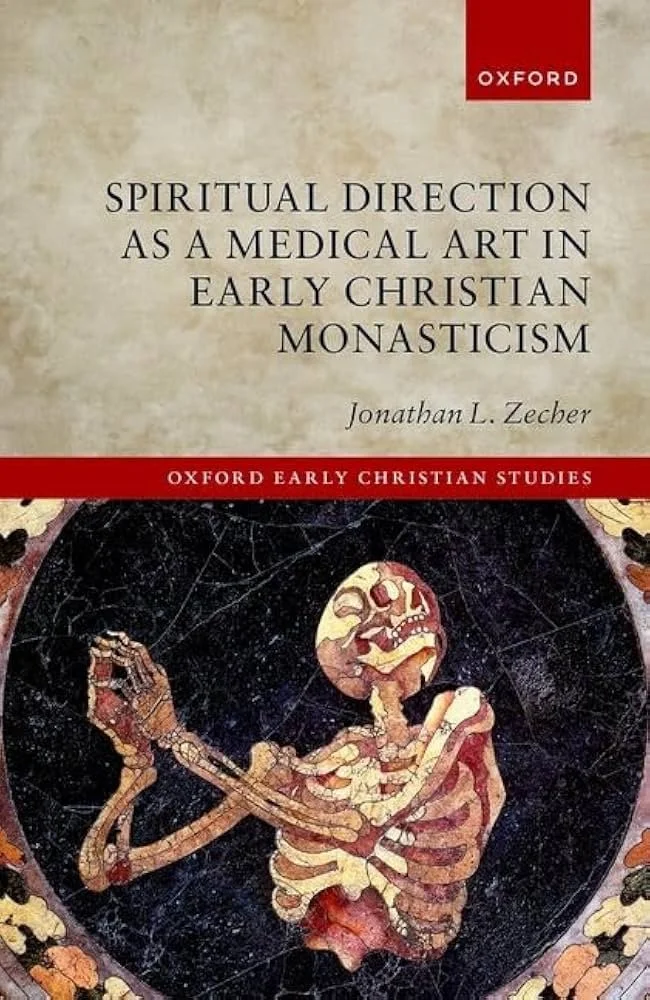
Jonathan L. Zecher. Spiritual Direction as a Medical Art in Early Christian Monasticism. Oxford University Press, 2022.
Ascetic authors throughout late antiquity gleaned descriptions from contemporaneous, non-monastic sources for detailing the challenges of monastic living. Military, maritime, and mercantile imagery—to name only a few types—suffuses these writings. In Spiritual Direction as a Medical Art in Early Christian Monasticism, Jonathan Zecher argues that ascetic writers drew fruitfully from the field of medicine and the healing arts. Zecher contends that “asymmetrical relationships” of spiritual direction were constructed according to both “(1) a logic of practice and (2) a means of representing expertise” in monastic texts shaped by key “discourses, practices, and even institutions of late antique medical arts” (p. 2). In the first part of the book, Zecher locates late-antique Galenic medical literature and the development of its structures in monastic works about recognizing and repairing unwanted spiritual conditions. Chapters in the second part analyze monastic literary constructions of the spiritual director’s role through references to the late ancient figure of the physician. These chapters also trace the limitations that medical and related metaphors placed on monastic relationships.
The first part of the book begins with an introduction that charts the course of the work and clarifies Zecher’s use of terms. Zecher employs a “biopsychosocial” model to interpret both Galenic and monastic assessments of health problems as the result of interior “psychological” and exterior “social” as much as embodied physiological causes. Zecher also briefly discusses how health is embedded in external factors such as society and environment in what he calls a “bioecology” of a person’s body and soul intertwined with their world.
Chapter One introduces the literature that delimits, describes, and advocates Galen’s and his followers’ visions of the “medical arts” and their best practices. Zecher presents this chapter as a primer for readers unfamiliar with Galenic literature or Galen’s competitors and conversation partners in the field of classical medicine. But the chapter also serves as a load-bearing apparatus for the book as a whole. The facets of Galenic medical literature glossed in Chapter One provide context for subsequent arguments, and the following chapter introductions include a footnote reference to which numbered sections of the first chapter are relevant. This chapter also briefly explains how late ancient Christian authors would be conversant with such medical models through the standard educational models of the period. A readthrough of Chapter One could be rewarding for most readers, but Zecher also helpfully encourages those who already grasp the material or simply wish to skip ahead to lunge past this chapter towards his central arguments.
The remaining chapters in Part 1 describe the “logic” underlying monastic practices of spiritual direction, underscoring the echoes of Galenic medical art. Chapter Two shows how Evagrius of Pontus’s uses dream-analyses as a key indicator of monastic health. Zecher examines Evagrius’s blend of demonology and Galenic interpretations of the causes of lustful and wrathful dreams. The chapter also shows Evagrius’s indelible influence on later monastic writers, notably John Cassian.
The third and fourth chapters examine Cassian’s Conferences and Institutes, respectively, tracing how he uses the imagery of medical techniques as scaffolding for defining monastic practice for a spectrum of practitioners ranging from neophytes to spiritual directors, especially those tasked with guiding confessors to surmount their own counter-productive thoughts. Cassian further medicalizes the Evagrian program to assess dreams for monastic edification. On this foundation, Zecher demonstrates convincingly how Cassian adapts Galenic methods of nosology to classify lists of vitia (vices); and develop appropriate courses of treatment for each cataloged vice.
In Chapter Five, Zecher shows how John Climacus, the author of the Ladder of Divine Ascent, adapts Galenic models of pathology to prescribe treatments for the passions, addressing bodily, spiritual, and communal challenges within the monastic community. Throughout the book, Zecher reads his subjects through the lens of “psychophysiological inter-affectivity,” (p. 184) but he notes that the Ladder stands out for how closely it maps to contemporary affect theories.
Part 2 opens with a short interlude introducing Paul Ricœur’s approach to metaphor as “meaningful components of semantic discourse” which “say something about reality.” (pg. 202). Zecher’s readings in the following chapters deploy Ricœur’s theory alongside his continued use of the biopsychosocial framework. Like the first chapter of Part 1, Chapter Six steps back from monastic literature to show how late ancient “marketplace” competition among physicians structured their own self-presentations and modes of care. Zecher furnishes examples of well-attested techniques by which doctors established relationships to better serve their clientele. He then returns to close readings of primary Christian ascetic sources to argue that they consciously modeled their own structures of authority upon “worldly” doctors’ systems of winning, keeping, and ultimately releasing patients.
Turning to the Longer Responses of Basil of Caesarea, Zecher identifies how Basil presented the superiors of ascetic communities as “spiritual physicians” who compete against Galenic medics for market share. He argues that Basil supplements a Galenic understanding of the biopsychosocial causes of illness with additional options for therapies grounded in a theology whose truth, hidden from the secular doctor, gives ascetic Christians the competitive edge.
Zecher then returns to Cassian and John Climacus to uncover how both authors use restrictions imposed by the physician as a metaphor to innovatively restructure monastic practices and relationships. Within this account, Cassian conforms the spiritual director’s bedside manner to late ancient medical guidance on when and why to stop treatment. He also draws out how Cassian alters traditional limits placed on care through the application of metaphors from other sources like the art of bushwhacking and wilderness survival. In the final chapter, Zecher illustrates how John Climacus strategically interweaves a variety of metaphors to adjust the image of a professional healer. For example, Climacus depicts monastic duty in relation to the physician in the Ladder, but he also compares it to the work of a judge, king, shepherd, or prison warden. Through the mixing of metaphors, Zecher argues, John evokes a specific and highly developed vision of the spiritual director’s role and responsibilities.
Spiritual Direction as a Medical Art in Early Christian Monasticism moves across a dizzying breadth of material. Despite the broad scope, Zecher traces common themes that unite the project’s elements, seen particularly in his analyses of Cassian and John Climacus. Zecher’s close comparison of the writers’ use of Galenic and other ancient medical arts builds on recent works, including especially M. Chin “Cassian, Cognition, and the Common Life,” in Ascetic Culture (ed. Leyerle & Young, 2013), P. Tzamalikos, The Real Cassian Revisited (2012), N. Kasumi Clements, Sites of the Ascetic Self (2020), and H. R. Johnsén, Reading John Climacus (2007). The scope of the present book demands close attention from the reader, and occasionally, the theoretical terms could be more thoroughly integrated. But it is a testament to Zecher’s work that each part of the book could stand on its own, making it suitable for the classroom. In the end, Zecher’s study offers a useful introduction to medical patterns across monastic literature for general academic readers, and for specialists, a definitive analysis of medicalizing language in select authors.
Thomas Waldrupe is a PhD candidate in Religious Studies at the University of North Carolina at Chapel Hill, studying how early Christian monastic literature paradoxically urges readers to both withdraw from and relate to others.