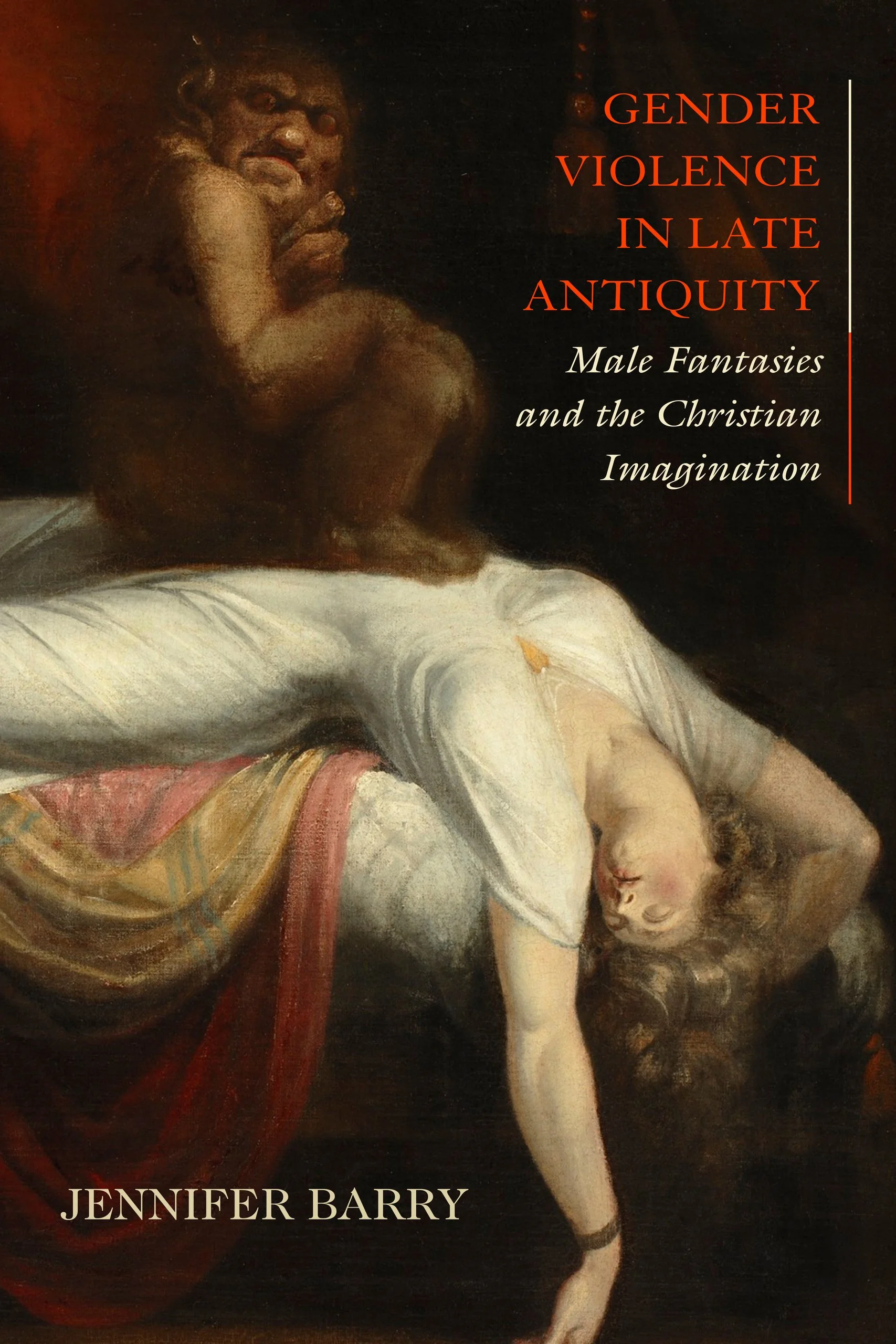
Jennifer Barry. Gender Violence in Late Antiquity: Male Fantasies and the Christian Imagination. Oakland: University of California Press, 2025.
Jennifer Barry opens her new monograph, Gender Violence in Late Antiquity: Male Fantasies and the Christian Imagination, by invoking Sara Ahmed’s notion of the “Feminist Killjoy.” The “Feminist Killjoy” is a person who refuses to remain silent about systems of injustice, even when speaking up often marks them as disruptive or difficult. Barry uses this figure to describe her own critical method: rather than accepting early Christian accounts of gendered violence at face value, she confronts and exposes the assumptions embedded within them, including the ways these narratives serve the interests of their male authors. In this sense, the “Feminist Killjoy” models Barry’s effort to interrupt interpretive habits that normalize, aestheticize, or overlook violence against women. Using this as a foundational framework, Barry argues that early Christian authors used representations of gendered violence to think through broader questions about Christian identity, bodily suffering, holiness, sexuality, and the boundaries between the human and the monstrous. Drawing on feminist and horror theory, she examines not only what these texts say about women but also how they construct women’s bodies, suffering, and voices as objects of fear, fascination, or theological reflection. Accordingly, Barry reads a wide range of early Christian and Greco-Roman literature to show how male-authored narratives utilize violence against women to negotiate religious and cultural anxieties, while also restricting women’s agency and obscuring the perspectives of women themselves.
In the first three chapters, Barry considers the different ways gendered subjects were used rhetorically to construct proto-orthodox theology. The final four chapters turn to hagiographical literature and trace male fantasies embedded within these narratives.
Chapter One, “Bodies in Conflict,” examines how gendered violence underpins the construction of male reputations. Barry argues that male authors deliberately deploy tropes about women to advance their arguments, only to discard those female bodies once they have served their rhetorical purpose. In particular, she shows how late ancient authors drew on biblical tropes of gendered violence to defend against accusations of heresy. Accordingly, the chapter centers on the writings of Athanasius of Alexandria and Pseudo Martyrius, placing them in dialogue with narratives such as the Levite’s concubine in Judges and Jezebel in 1–2 Kings. For example, Barry systematically documents how Athanasius utilized the gory narrative of the Levite’s concubine to his own end in his Encyclical Letter. Specifically, Barry highlights how he drew parallels between the language of pollution and corruption used to describe the unnamed woman and the danger of heresy to the church. She writes: “The symbolic, and literal rape of the church would not be lost on his audience” (p. 34).
Barry’s focus on hidden figures in Chapter Two, “Forgotten Bodies,” demonstrates one of the book’s greatest strengths: its attention to the overlapping structures of power that shape the representation (and reality) of gendered violence. Barry’s analysis of Monica in Augustine’s Confessions foregrounds an unnamed enslaved woman who is used to propel the narrative and highlight Monica’s virtuous nature. Here, Barry convincingly argues that Augustine diminished the humanity of women (particularly, unnamed women and nameless enslaved women) in favor of using them rhetorically to advance his theological agenda. The chapter explores how idealized portrayals of female suffering, especially in Augustine’s City of God, intersect with themes of domestic violence, victim blaming, and female martyrdom.
On this foundation, Barry turns to consider “Impossible Bodies,” exploring how virginal holiness became tied to fantasies of purity, obedience, and bodily control. This chapter draws on a remarkable range of sources not limited to hagiographies or canonical literature. Namely, Barry features a close examination of the apocryphal Protoevangelium of James to explore tensions surrounding Mary’s virginity. Barry suggests that the two virginity-related trials Mary undergoes in the Protoevangelium were written in response to growing concerns about her virginity and served to reassure readers of her perpetual virginal status. The chapter ultimately serves to highlight “how holiness, female chastity, and violence intersected in complicated ways” (p. 102). Furthermore, Barry poignantly leaves her reader considering: If Mary, the Mother of God, could not escape the interrogation of the Church Fathers (and their fantasies regarding chastity and intactness), how could any other female saint avoid being subjected to those same fantasies?
The title of Chapter Four “Revenge Fantasies,” is Barry’s name for a specific subgenre of early Christian literature that she identifies as scenes or texts centered around divine, sometimes retributive, ailments that had the potential to put the image and reputation of a saint at risk. First, she traces Christian revenge literature during the pre-Constantinian period and then turns to focus on male, hagiographical revenge fantasies. In her discussion of the hagiography of Saint Syncletia of Alexandria, Barry offers her readers a particularly striking example of this literature. In this hagiography, Syncletia’s body is slowly consumed from within by worms. Notably, the worms first attack her mouth in an apparent attempt to silence her. Unlike the worms that torment some male saints, the worms consuming Syncletia’s flesh do not dissipate, ultimately complicating the interpretation of her death and prompting readers to wonder whether her illness was a product of moral failing or righteous suffering. Barry makes a convincing case that the gendered language of these hagiographical fantasies places the saintly female body at risk, concluding that “visions of divine revenge reveal how failed Christians, especially reproductive bodies, were punished” (p. 105). The next chapter, “(Bad) Romantic Fantasies,” similarly focuses on this specific subgenre within hagiographical literature. Barry shows how the authors of these narratives of romantic fantasy exploit the everyday horrors faced by women to help construct visions of violent holiness. She points both to Christian literature such as the Acts of Thecla and to ancient Greek novels. This chapter contributes significantly towards her broader thesis that hagiography generally relies on suffering female saints.
Barry foregrounds what is at stake within these late ancient narratives of gendered violence in the chapter, “Dreams of Mothers.” She opens the chapter by asking the question: “what do contemporary readers do with such violent fantasies?” (p. 149). To answer the question, Barry walks her reader through how to approach a text within the framework of feminist historiography and highlights feminist reading strategies, as well as their connection to trauma theory and womanist scholarship. Together, these approaches allow Barry not only to expose harmful interpretive strategies and call attention to these male fantasies, but also to “find the gaps and fissures in those fantasies so that modern readers of past texts can find reading strategies that resist harmful ideologies” (p. 150). This chapter offers an especially useful guide to feminist historical scholarship that will be helpful for both advanced undergraduate and graduate students.
The last chapter, “Nightmares of Fathers,” explores hagiographical horror fantasies, focusing specifically on The Life of Mary of Egypt. Using feminist horror theory and ancient dream theory, Barry considers the modern-day effects of these ‘nightmares’ and explores the possibility of productive feminist horrors. Barry stresses how horror-filled hagiographies can produce a “productive counter-discourse that acknowledges the longer history of the discursive violence hagiographies have produced” (p. 192). Barry effectively shows her reader how hagiography’s violent gender scripts can be exposed, unsettled, and reread as sites of resistance, even when they remain saturated with misogynist fantasy.
Overall, Barry’s analysis is deeply interdisciplinary, weaving together insights from classical studies, ancient history, and religious studies. She also integrates postpositivist feminist theory with trauma theory, gender theory, literary theory, and womanist scholarship in a compelling, accessible way. One of Barry's most significant contributions lies in her insistence that “the objectification, victim-blaming, and erasure of female autonomy seen in these ancient texts continue to resonate with modern issues surrounding gender-based violence” (p. 200). Refusing to artificially divide these late antique texts from modern discourses, she concludes with an evocative call for readers “to be more critical of the cultural narratives that sustain violence…” (p. 200). Although her focus is early Christianity, the book’s many interventions will be of interest not only to scholars of late antiquity, but also scholars in many other fields of study.
Joseph Foltz is a Ph.D. student at the University of Denver. His research primarily explores the historical reception of the Apocryphal Acts in late antique and medieval Christian art.