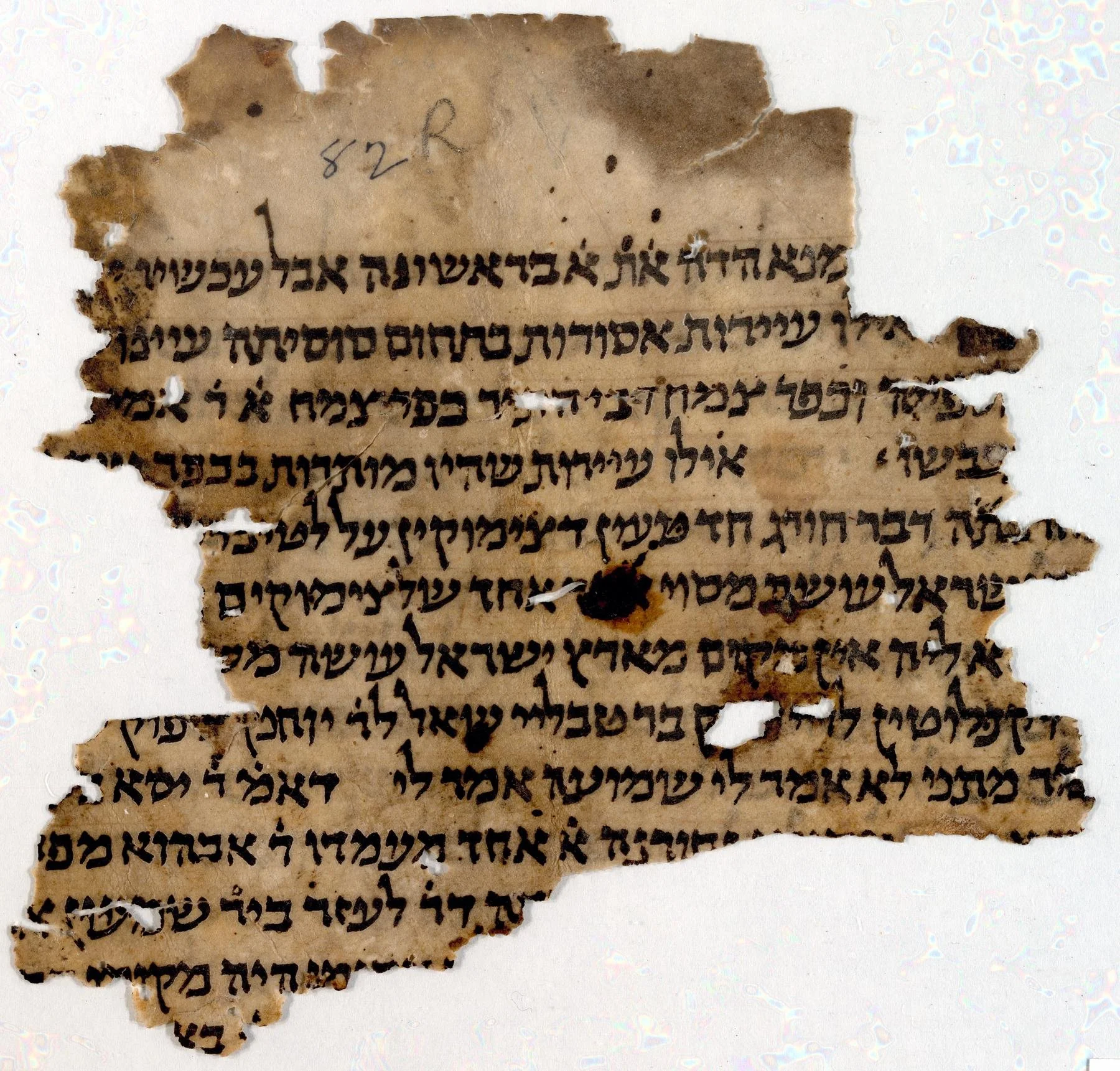
Halper 82 Talmud Yerushalmi, Zera'im, Demai 2:1; 2:2-3
This is the third essay in a review forum devoted to Vidas, The Rise of Talmud. Access the full forum here.
“The following chapters show how Amoraic scholars developed a sophisticated set of interpretive practices, articulated ideas about attribution and citation, and engaged in compositional practices premised on the notion that rabbinic teachings were shaped by individual sages and reflected their individual characteristics (21-22).”
This is what Moulie promises in his introduction. And he delivers. Big Time.
He meticulously documents various phenomena such as changes in modes of quotation (that are no longer linked just to authority, but rather to an antiquarian search for the origins of traditions, even when the traditions themselves are conceived as "wrong"); new insistence on marking the first source of a citation (while in earlier, Tannaitic literature, traditions are ascribes to one tradent, and seldom traced back to mythical times עד הלכה למשה מסיני); the attribution of a consistent “shitah” to a sage; and the explanation of halakhot based on the biographies of the sages, their opinions and even their place of residence.
I love the book, and not only because I love Moulie. To show that this is not merely personal bias, let me briefly describe what he actually does in the book, and especially what he does differently.
Moulie uncovers a new world of distinctions between the Yerushalmi and the Tannaitic literature. We’ve missed these distinctions because the Yerushalmi is usually studied as a supplement—either as a continuation of the tannaitic literature (revising traditions) or as a precursor to the Bavli (proto-sugyot).
When differences are addressed, they tend to be sought in one of two directions: either the development of modes of interpretation and midrash, or the development of dialectics and the sugya. In both cases, we essentially affirm a single narrative: a shift from a simpler, embryonic model to a looser, more developed one.
Another focus in scholarship has been the canonization process and the increasing concentration of later sages on the Mishnah and its interpretation—in both cases we are content with a fairly predictable evolutionary story.
Moulie aims much higher. He searches for something more fundamental and at the same time more elusive: the very concepts of tradition and innovation. He executes this through a highly sophisticated engagement with the Yerushalmi’s terminology. This is a complicated and demanding work (I have been trying to do the same with Tannaitic Midrash for years and still am not sure how to do it right), and Moulie possesses the rare ability to translate terminology into cultural history without being reductive. His analyses of terms like שיטה, כדעתיה, אית תנאי תני, לית כאן, and more are exemplary.
Foucault’s “What is an Author?” is usually cited as support for the notion that there was no concept of authorship in the premodern world. But as Moulie pointedly notes (p. 22), Foucault actually presents the fourth century CE as a watershed moment, with Jerome as his central figure. Moulie stays in the fourth century and doesn’t stray far from Bethlehem, but he brings our friends R. Yohanan, R. Abbahu, and R. Abun into the story. As is well known, Foucault gives no space to Judaism (aside from Saint Philo). Moulie does for this essay what Boyarin did for The History of Sexuality—letting the sages in. And like Foucault, Moulie shows how the author is produced by a set of discursive practices that he sets out to reconstruct.
As an aside, I’ll add that even the very idea of authorship of biblical books seems to emerge for the first time in the Yerushalmi. Moulie briefly discusses, at the beginning of the book (pp. 24–26), the general rabbinic lack of interest in the authorship of the biblical books. But it’s worth noting that the interest that does exist begins specifically in the Yerushalmi. In Tannaitic literature we find questions such as whether Moses wrote the final verses of the Torah, or whether Ecclesiastes stems from Solomon’s wisdom or was written through divine inspiration, etc. But it is only in the Yerushalmi that we find a full-blown discussion of authorship—who wrote what: “Moses wrote the five books of the Torah, and then wrote the section about Balaam and Balak, and he wrote the book of Job” (Yerushalmi Sotah 5:5). By the time we get to the Bavli, a full list of biblical authors already appears (Baba Batra 14b-15a). But the very idea of “X wrote Y” begins right here.
Moulie challenges a common scholarly worldview and a common scholarly practice—both of which are not only widely accepted, but nearly taken for granted in current research.
The worldview is that rabbinic literature lacks any notion of individualism in both the Hellenistic and the Christian sense. Here is a strong but pretty representative expression of that view:
“In the rabbinical writings, not only are there no hagiographies to promote the ideal of a lived life as paradigm, but also there are barely any collections of a rabbi’s particular views to create a named portfolio by which to evaluate or compare any other views. The Talmud’s view of an engagement with society or culture is not one of Bildung or consistent growth of character or experience, but a series of morselized encounters between the halachic man and the problems of life. It is a very particular religious identity that contrasts both with Greco-Roman and with Christian expectations of how a life is to be told. So, then, the lack of biography in the rabbinical texts of late antiquity is a silence that goes to the heart of the construction of a post-Temple Jewish self” (Goldhill, Simon. "Why Don’t Jews Write Biography?." Being Christian in Late Antiquity: A Festschrift for Gillian Clark (2014): 13-38, 32)
The claim that “there are barely any collections of a rabbi’s particular views that amount to a named portfolio” is exactly what Moulie challenges through his discussion of shita, which is quite literally a “portfolio” of a sage’s positions. I have also explored the notion of the rabbinic halakhic self and its intricate relationship to broader discourses of self-formation in Late Antiquity. After Moulie, we will have to tell this story in a much more nuanced and diachronic way.
The scholarly practice he challenges is even more deep-rooted: the assumption about the division of labor between philology and history. Complaints about the “Jerusalemite-US (and sometimes Europe) rift” in rabbinic scholarship are exaggerated and too simplistic in most areas, but when it comes to the Yerushalmi, these are quite accurate. One can compare the grand project The Talmud Yerushalmi and Graeco-Roman Culture with textual projects on terminology, philology, and redaction such as those of Lieberman, Rosenthal, Moskowitz and Moshe Assis.
Yitz Landes, in an article for the volume Moulie co-edits on currents in Yerushalmi research (Teuda 2026), writes that recent philological tools now enable broader inquiry, as we finally have lexical studies that allow for systematic analysis. But that is a necessary condition, not a sufficient one. What is also required is the right perspective, method, and lens. Moulie once remarked that Epstein’s מבוא לנוסח המשנה is a work in history of the book—mistakenly read as a philological treatise. Bridging the gap between these two is precisely what this project is all about.
And there is something else I cannot elaborate on, nor am qualified to, but I nevertheless want to put here for further discussion: we are accustomed to thinking about the history of authorship and interiority in the context of postmodern thinking on the death of the subject. But today we face an AI reality in which one no longer needs Nietzschean or Foucauldian philosophy to witness thinking without a subject or an origin. In this sense, deep, specific and careful reflection on the complex, non-necessary, and dynamic relations between a composition and an author is more important, even pressing, than ever.
And now I must fulfill the duty of criticism, so let me return to an old debate between Moulie and me—namely, how much credit to give the Tannaim. In my view, more than the book is willing to grant. From the vantage point of the Yerushalmi, the Tannaitic sources may appear small — a matter of perspective. I am here to make sure they receive their due. So the honor of the Aggadists and of the Bavli was already taken care of, it time to look after the Tannaim. But seriously, I wish to show that the distinction between tradition and innovation—not only appears in the Tannaitic study house but was articulated there as such.
Take, for instance, the four testimonies of R. Hanania, the deputy high priest, in Mishnah Eduyot chapter 2, and the conclusions drawn from them by R. Akiva—once phrased as הוסיף “he added” (which clearly does not refer to adding eyewitness testimony from the Temple, but rather to a legal ruling derived from that testimony), and once as מדבריו למדנו “from his words we learned.” A third anonymous inference is cited with לפי דרכך את למד. In the parallel mishnah in Pesahim 1:7, there is an addition by R. Meir to R. Akiva’s first inference, which builds on both the testimony and the inference, phrased as מדבריהם למדנו “from their words we learned.”
Here is Moulie’s account on the Mishnah in Pesachim:
“For our purpose here, what is important is that R. Aqiva’s addition is also formulated as a statement of tradition, that it is presented as an account of what the priests did in the past rather than an analytical comment on Hanania’s teaching. Neither R. Aqiva nor the Mishnah necessarily deny that there is an innovation here; still, they present innovation not only as the true meaning of the tradition, but as indistinguishable from it. The same passage, however, also records a different kind of note: R. Meir’s comment that we can learn or derive further significance from the words of Hanania and Aqiva. This comment is explicitly interpretive, but such comments are rare in the Tannaitic corpus, and even this comment is interested in the law, not in reconstructing R. Aqiva’s or Hananiah’s opinion.” (pp. 29–30)
I beg to differ. Both “he added” and “from his words we learned” serve as markers of distinction between tradition and inference. In the Mishnah, “he added” הוסיף always refers to a legal ruling, not testimony—there is no confusion on that front. Thus what we have here is actually a differentiation between types of inferences-from-tradition by R. Akiva: an inference from one case (“the priests never refrained from burning the meat…”) to a similar case (“they never refrained from lighting the oil…”), is indicated by “he added” הוסיף; while an inference from an event (“I never saw a skin being removed”) to a halakhic rule (“they should remove it with its skin”), is indicated by “from his words we learned,” מדבריו למדנו.
The point is not only that tradition becomes a source for halakhic discussion in the study house, but that the Mishnah goes out of its way to mark clearly the differences between a sage appearing as transmitter (R. Ḥanania) and as interpreter of tradition (R. Akiva, R. Meir).
Here’s a more specific example: several Tannaitic texts distinguish between transmitted tradition and personal opinion. In Tosefta Sotah ch. 6 and parallels we find: “Rabbi Shimon ben Yochai said: There are four things that Rabbi Akiva used to teach לדרוש, and my words seem preferable to his.” Four midrashic disputes follow; four disputes where R. Akiva's statements are quoted, and then R. Shimon's own interpretation is given. What all these derashot of R. Shimon share is a clear apology for Israel: “Heaven forbid" the the biblical righteous would commit this or that sin. The ideological disagreement is clear. But what does R. Shimon mean by repeatedly saying “I prefer my words to those R. Akiva’s”? This formula— נראים דברי , “X’s words are preferable” —is typically used to decide between the views of prior sages. So what’s going on here?
Let us first ask why does R. Shimon specifically refer to R. Akiva? After all, other Tannaitic opinions are also cited and R. Shimon reacts to all of them. See his reservation in the first debate: “Could someone of whom it was said, ‘for I have chosen him, that he may instruct his children…’ be guilty of idolatry, incest, and bloodshed?”. As Lieberman ad loc justly notes, “This phrasing suggests that R. Shimon is contradicting all previous views” for R. Akiva himself only spoke about idolatry! (in the parallel text in Sifre Deuteronomy 31, only R. Akiva is cited, but this seems like a shortened version—transferred to the Sifre due to the first drasha on Ishmael which suites the context there of “Shema Israel”).
All the views cited are critical about the biblical figures, so why address explicitly only R. Akiva? It must be the case that R. Shimon is himself transmitting R. Akiva’s tradition, while the others come via different channels. In other words, R. Shimon is functioning here in three distinct capacities: transmitter of his teacher’s traditions, independent interpreter, and arbiter among views. And this distinction is explicitly marked: “he teaches דורש… I teach… I prefer.”
And if you object that of course one prefers one’s own view, I will refer you to the opposite case: Mishnah Kilayim 2:11– “All are permitted except for Greek gourd. R. [says]: also cucumber and Egyptian beans, and I prefer their view to mine.” Rabbi, the great collector and compiler, appears in dozens of baraytot as saying that the word of one sage are preferable (נראין דברי רבי פלוני) in one context, and of another in another context. This is well known and was one of the factors that led Ḥanokh Albeck, in his מבוא למשנה, to analyze the Mishnah as an anthology. But what is noteworthy is that Rabbi can apply this same logic also to his own words, as we have seen (Compare Bavli Niddah 53b: אָמַר רַבִּי: נִרְאִין דְּבָרָיו מִדְּבָרַי, שֶׁהוּא — מְתַקְּנָהּ, וַאֲנִי — מְעַוְּותָהּ. “Rabbi said: The statement of Rabbi Shimon ben Elazar is preferable to mine, as he fixes her (situation) and I ruin it.") This too only makes sense if we assume a conceptual separation between the sage as a tradent and as a halakhist.
The praise of tradition and awareness of innovation can and do coexist. See, for example, Israel Levin’s beautiful essay “On Plagiarism and Originality in Medieval Hebrew Poetry in Spain,” (על 'גניבת השיר' ועל המקוריות בשירה העברית בספרד בימי הביניים) where he shows how—even in a world of fixed models, styles, and themes that were not to be altered—criteria to recognize originality were developed. Again, an extremely relevant topic for our AI-bondage era.
None of this actually contradicts Moulie’s innovation—after all, “birth” is always a metaphor. What we’re really talking about is a series of shifts, and Moulie persuasively demonstrates the major innovations found in the Yerushalmi in relation to the Tannaitic literature on matters of Torah, Self, and the formation of the scholar.
Ishay Rosen-Zvi is Professor in the Department of Jewish Philosophy and Talmud at Tel-Aviv University.