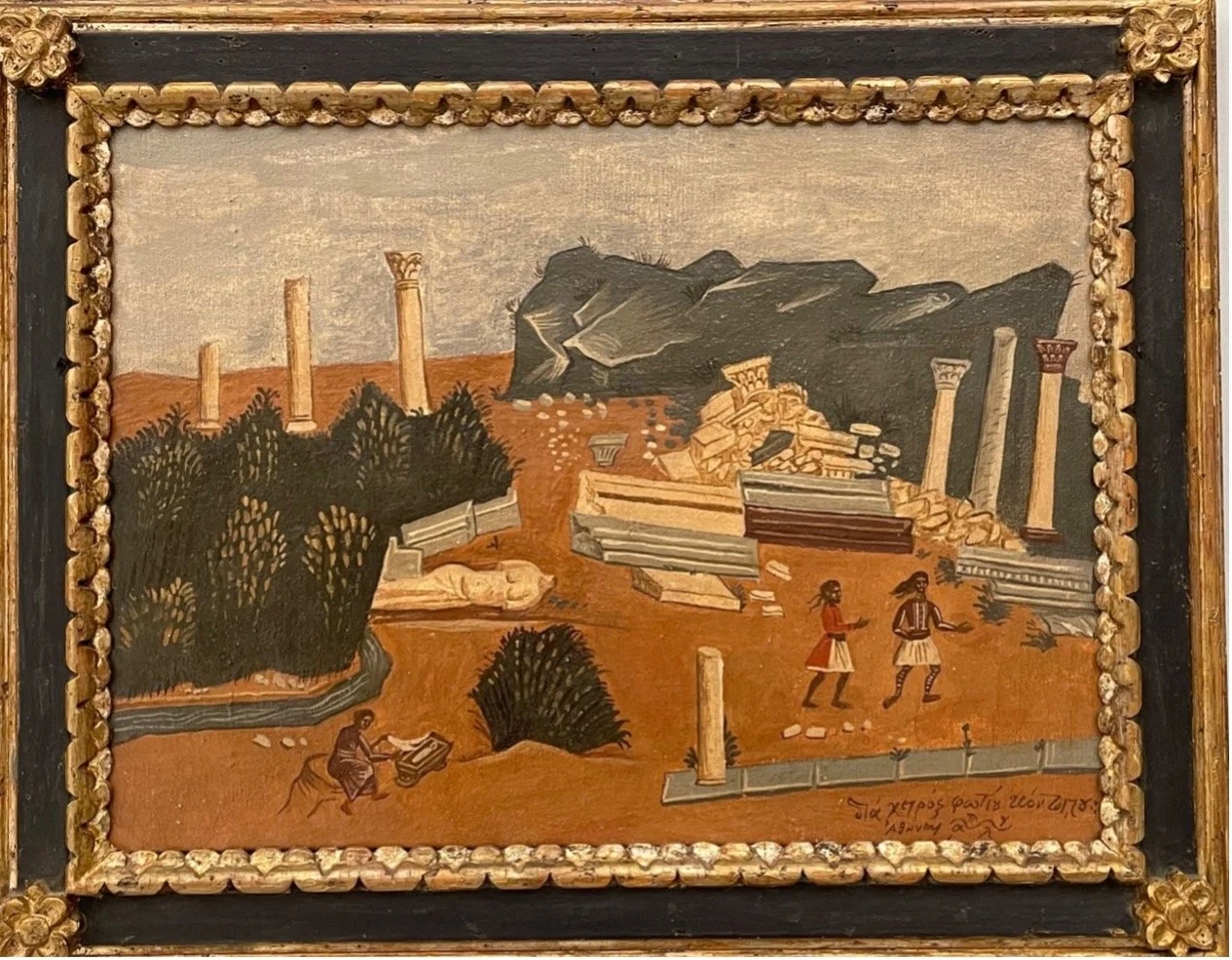
Fotis Kontoglou, The Three Epochs of Hellenism (1933; National Gallery, Athens).
This essay was part of a 2025 NAPS Conference Book Review Panel devoted to Earthquakes and Gardens: Saint Hilarion’s Cyprus by Virginia Burrus. Read the full forum here.
Introduction
In Earthquakes and Gardens, Burrus pulls a few short lines from the very end of Jerome’s Life of Hilarion and applies immense analytical pressure to them. It is a mode of historiography as spoliation. Fragments of the hagiography are placed alongside and nested within a range of modern material. Thinking with Burrus about the pedagogical power of the ruins we historians use to build our histories, I will focus on two related questions evoked by this affecting book: first, why do encounters with ancient ruins have such a power to throw us back upon ourselves, prompting us to view ourselves as part of their history? And, second, what is the significance of this power for how we scholars understand and narrate the religious histories of late antiquity? Put another way, what are the methodological and even ethical implications of this self-reflective move in historiography?
I: Learning the Ruins Lesson with Burrus
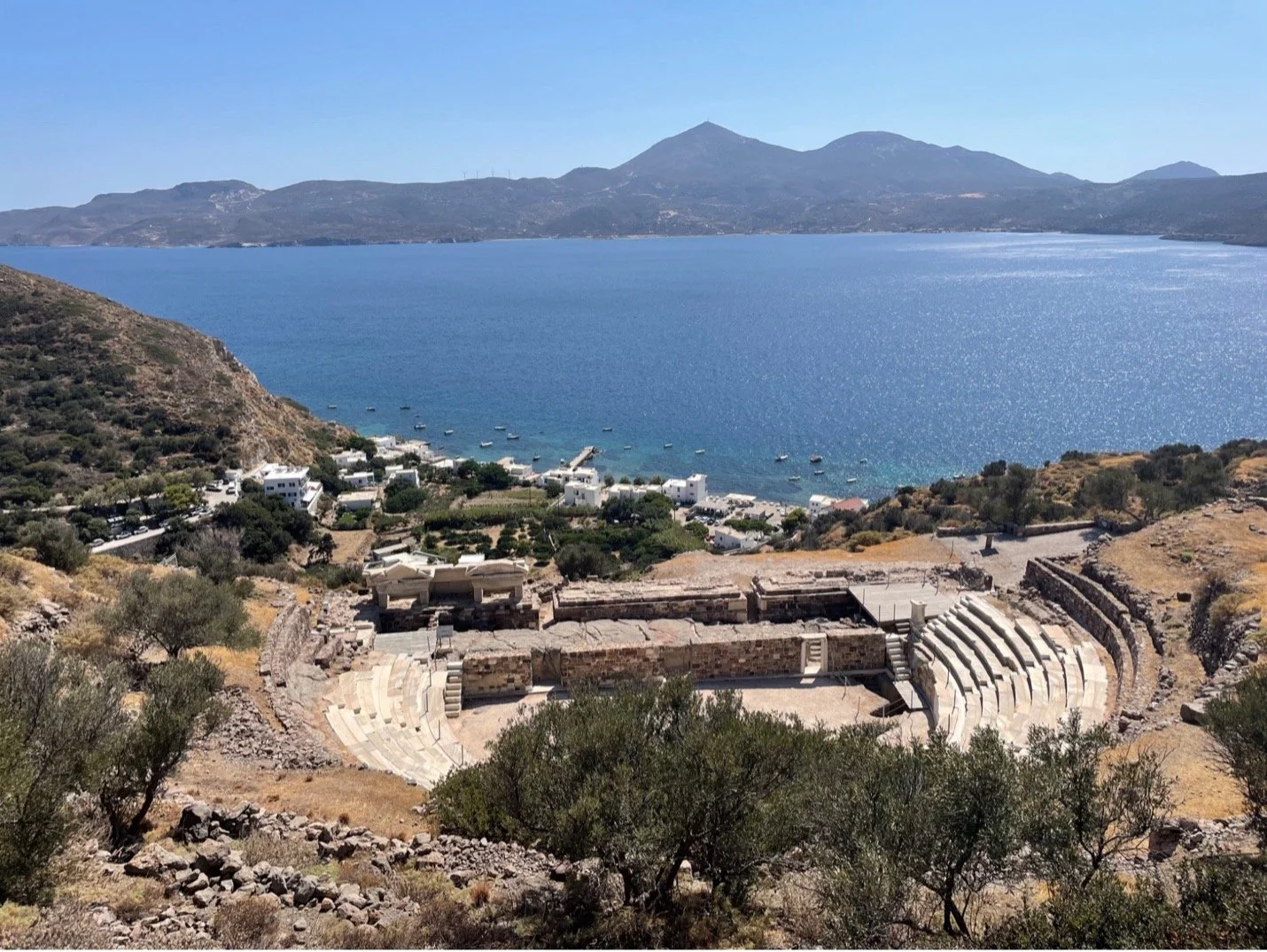
The Roman Amphitheatre of Ancient Milos (photo by author).
It wasn’t until recently that I had the opportunity to see for myself the ruins that are so central to the stories we tell about the ancient Mediterranean. Sitting among the reconstructed rubble with time to observe, I have been struck by the effects ruins have on passersby. On the island of Milos, I trekked down to the Roman amphitheater and sat in the audience for a quiet moment alone. The view of ships coming into port was stunning. I then discovered that I was not alone.
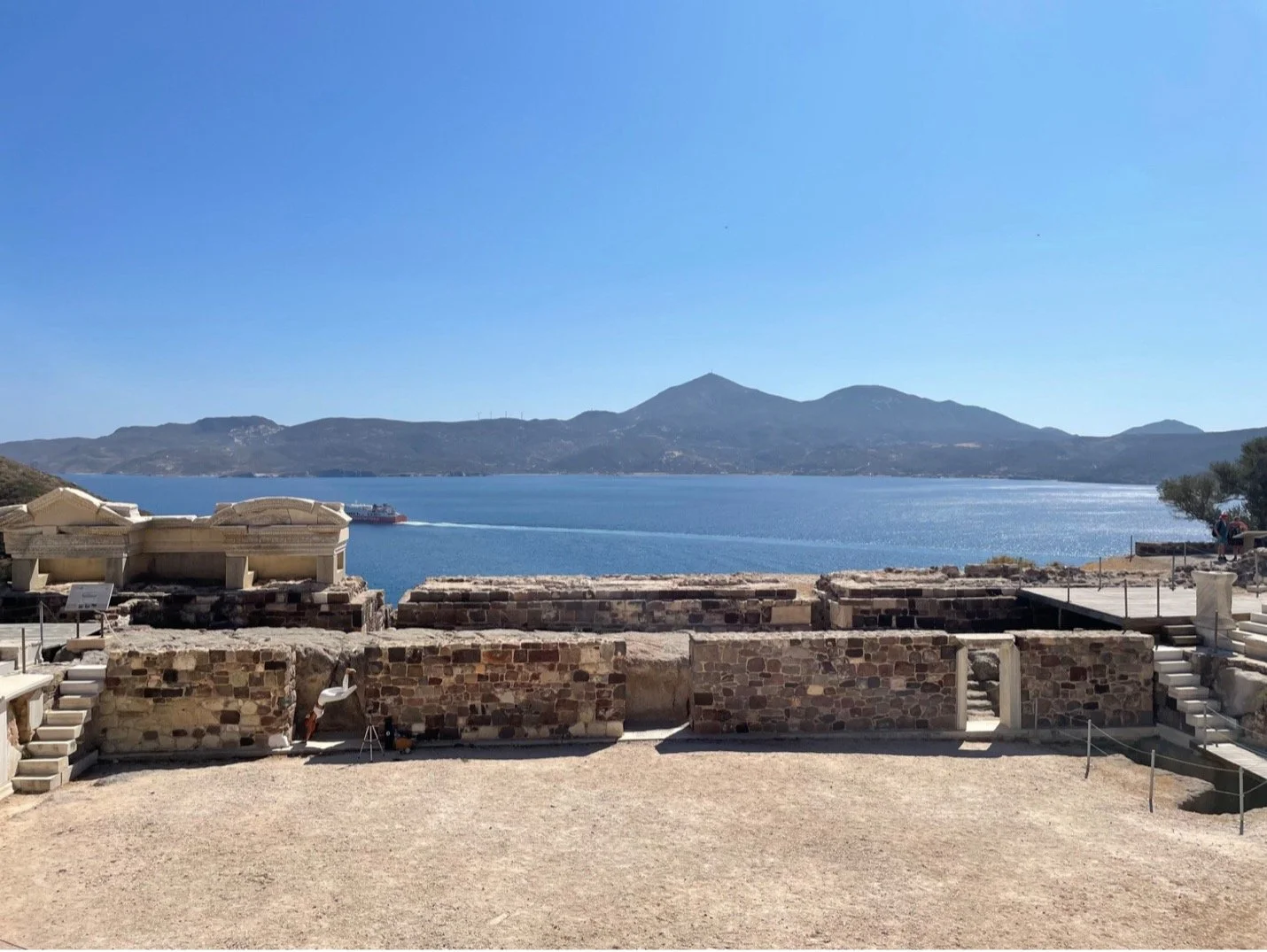
Roman Amphitheatre of Ancient Milos, with influencer (photo by author).
A fitness influencer was doing yoga poses in front of a cell phone on a tripod. On another occasion, at the top of Mt. Lykavittos, I watched tourists line up for selfies from the outcropping that gives a perfect view of the Akropolis. It is as if the tallest spot in Athens was designed for us to survey the juxtaposition of the city’s past and present.
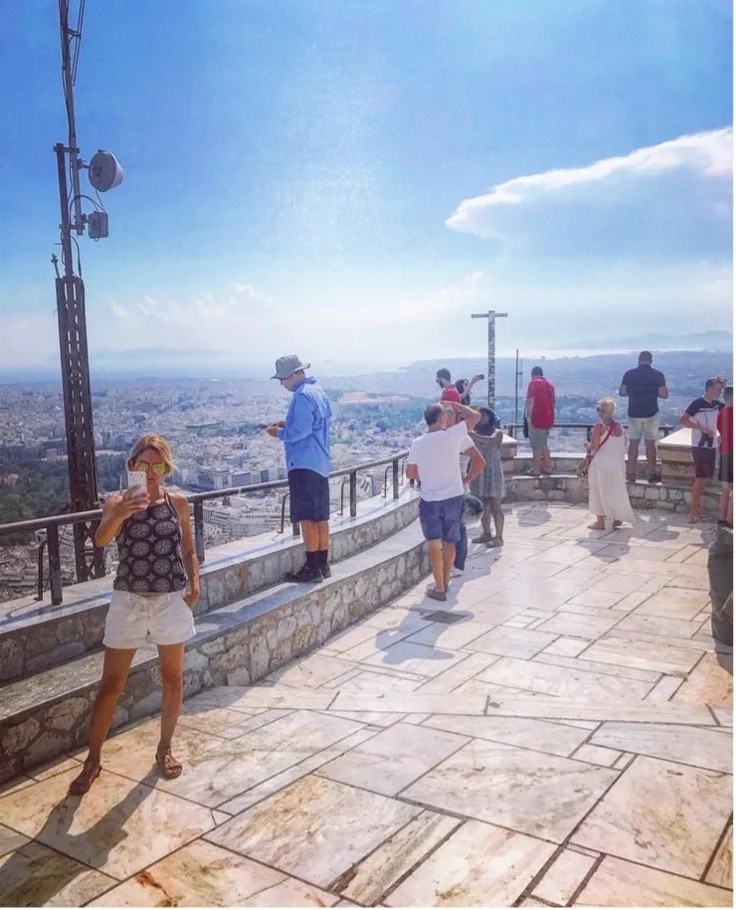
Tourists taking selfies with Akropolis in background, atop Mt. Lykavittos in Athens (photo by author).
It is, then, as if the sight of ruins beckons our participation, prodding us to do something with ourselves in relation to what we are seeing.
And lest I seem like a dispassionate observer, let me confess my own idiosyncratic reaction to ruins: for a time, I was in the habit of taking pictures of myself that included, in the background, tourists taking pictures of themselves near ruins:
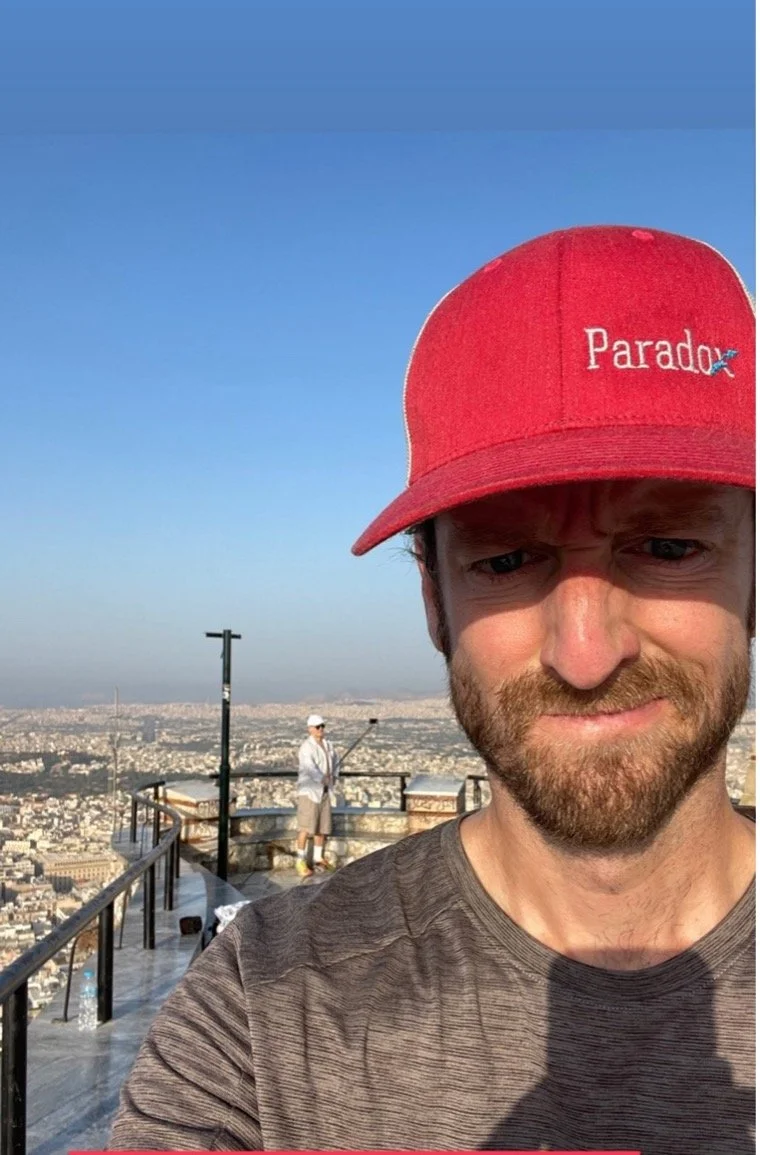
The author, taking a selfie of tourists taking selfies, atop Mt. Lykavittos in Athens.
Why did I do this? Perhaps it was an attempt to position myself beyond the power of these sites that coaxes us into unoriginal acts of repetition. Then again, perhaps I was even more under the spell of ruins than the subjects in my background? Here I am now, writing about myself in relation to ruins, presenting evidence of my self-reflexive photography to others for consideration, holding out fragments of the past mediated through my voyeurism of how others interacted with them. What is the lesson here?
In her chapter titled “Life in Ruins,” we look with Burrus (who is looking with Jerome) at Hilarion’s Paphos – a place which, according to the hagiographer, “now only by the traces of ruins shows what it once was [nunc ruinarum tantum vestigiis quid olim fuerit ostendit].” Not a ruin, Burrus emphasizes, but the traces of ruins. A place that is known, encountered, only through the vestigia of its pasts. Drawing upon literary critic Susan Stewart’s book, The Ruins Lesson, Burrus observes how all that remains of Paphos, in Jerome’s telling, is “the ruin of a ruin” through which “the palimpsest of earlier meanings and uses shines.”[1]
It is this shine – the glare coming off a piecemeal past – that I found most striking in Burrus’s discussion of ruins. The histories we encounter in fragments shimmer with a range of possibilities: the possibility of knowing more about worlds that have disappeared, of knowing more of worlds that may yet come into being, and also of knowing our own world differently. But these ruins lessons are by no means straightforward. The reactions and postures and creative possibilities that ruins evoke from us are as much a reflection of our own cultural values and concerns as they are an index of the values and concerns of the past carried by the objects themselves. Is the shine coming from the ruins themselves? Is it generated by our perception of them? Turning toward the desire for ruins among Renaissance humanists, Burrus tells us that early modern viewers “were invited to discover in fallen landscapes ‘backgrounds not only to the past but also to the present.’ The question of precisely what lessons were to be learned remained open: what mattered most,” Burrus concludes, “was the self-reflective gesture.”[2]
A salient example of this self-reflective gesture for Burrus is found in Dutch painter Maarten van Heemskerck’s Landscape with Saint Jerome (1547).
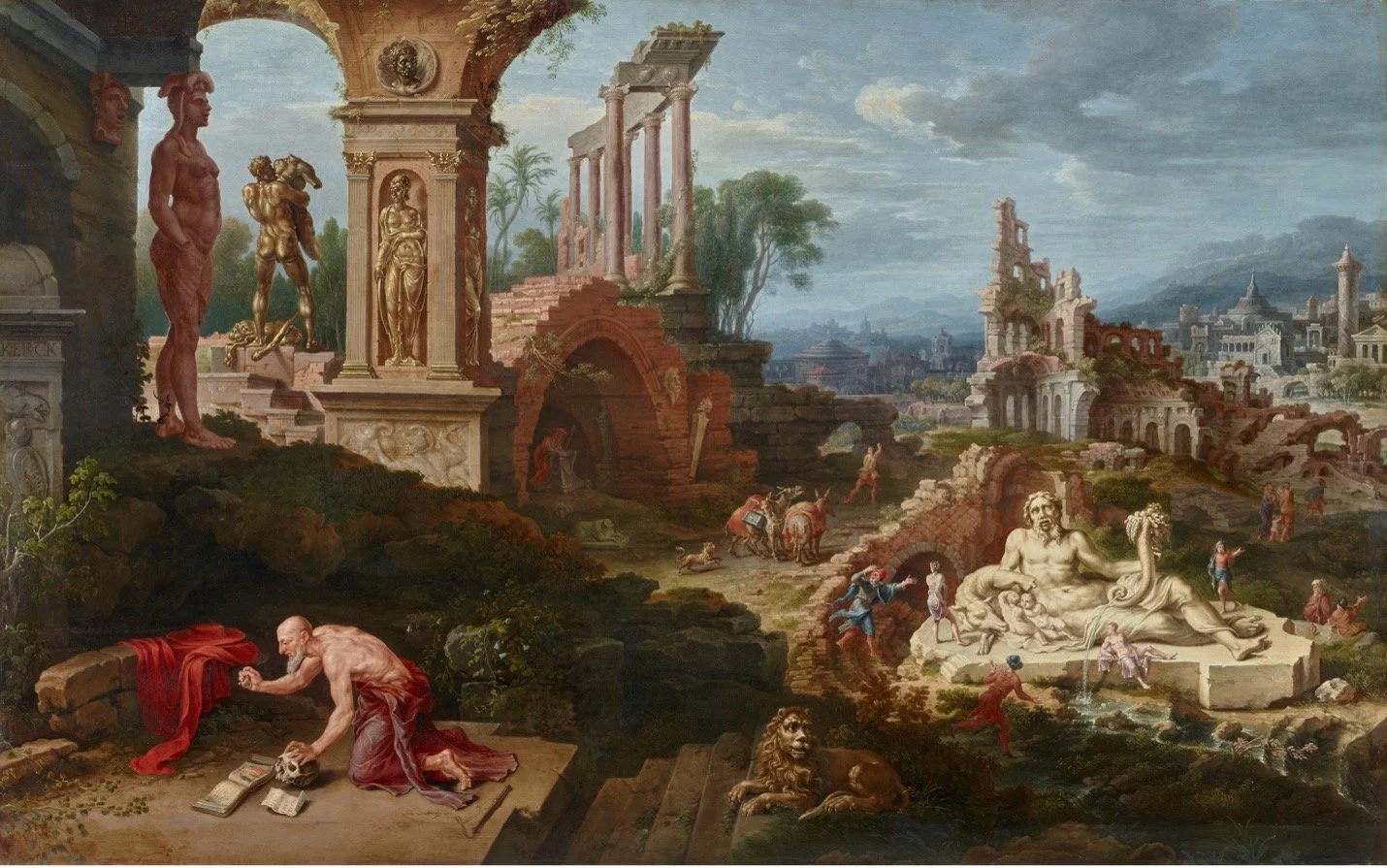
Maerten Van Heemskerck, Landscape with St Jerome (1547; Liechtenstein Collection).
Burrus notes how Jerome’s body is, here, “like the landscape, caught up in a process of ruination, the end point of which is suggested by the skull in his hand. Moral, intellectual, and spiritual goals are the ones that matter.”[3] Van Heemskerck captured Jerome in the moment of self-reflexivity. Surrounded by ruins, goaded by them perhaps, the saint turns from the decay of his physical surroundings to his own thoughts of mortality that they evoke. The viewer, too, is beckoned to participate in this gesture. Perhaps no artist has more fully captured the self-reflective turn in response to ruins than Henry Füseli in his The Artist’s Despair Before the Grandeur of Ancient Ruins (1778-80).
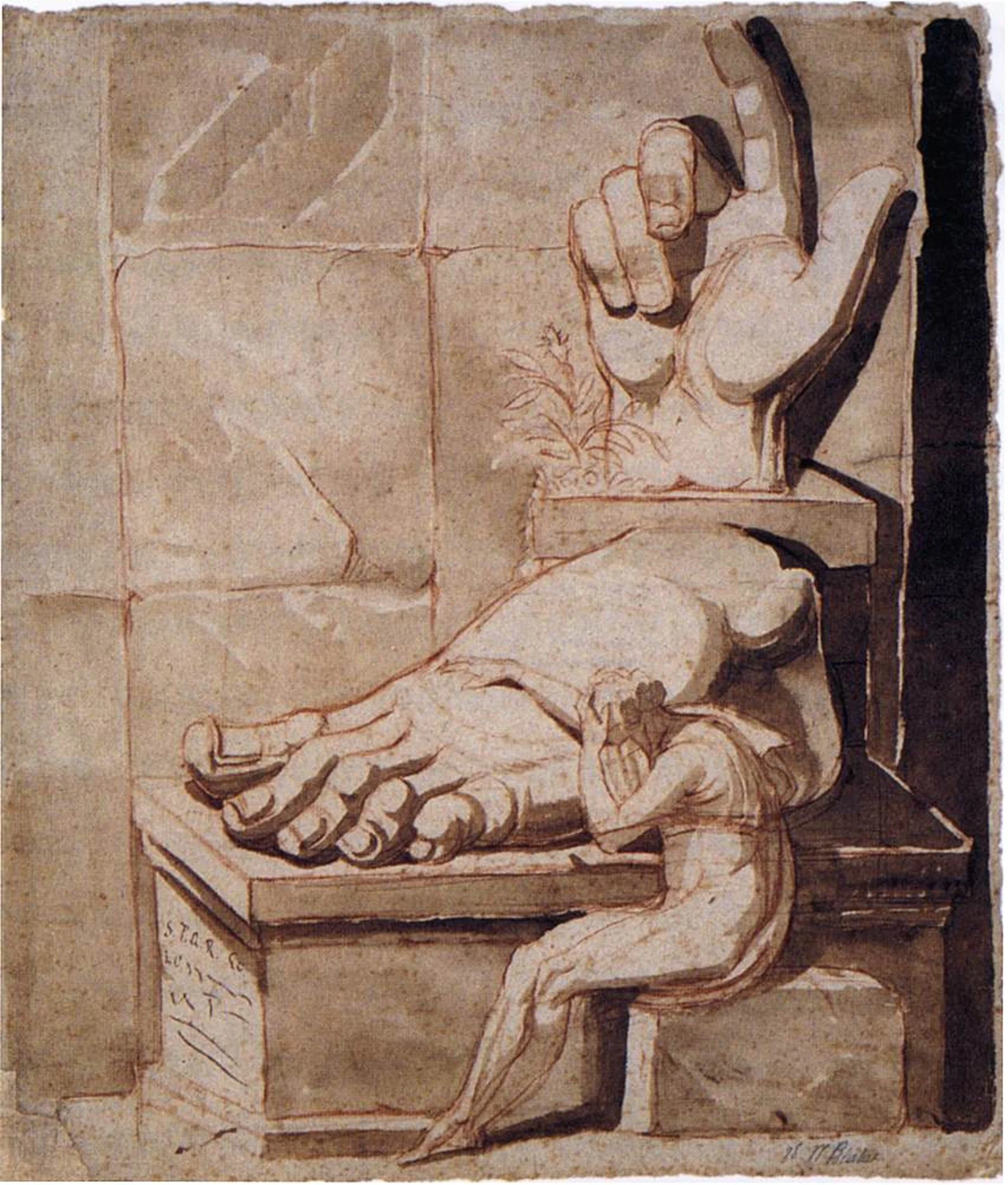
Henry Fuseli, The Artist’s Despair Before the Grandeur of Ancient Ruins (1778-80).
Here, the viewer’s response is no longer refracted through a saint surrounded by more recent ruination. Instead, the artist himself is the guide for the proper emotional, moral, and intellectual orientation to the encounter with ruins. It begins, first, with despair. The artist exhorts the viewer to understand ruins as the remnant of some irretrievable and grievous loss.
Burrus situates these earlier artistic traditions alongside Ledelle Moe’s 2019-21 exhibition at MASS MoCA, titled When. One of the works in this exhibition, titled Memorial (Collapse) (2019), featured three giant heads resting with their cheeks to the ground.
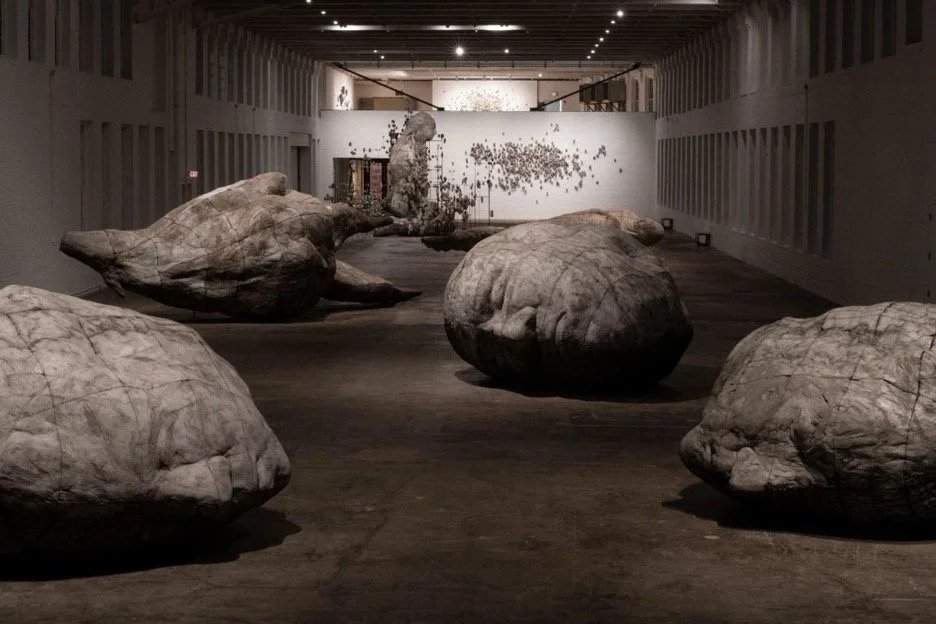
Ledelle Moe, Memorial (Collapse) (2019); from When (2019-21; Mass MOCA).
“Suggestive of fallen stone-carved statues honoring some culture’s ‘great men,’” Burrus writes, “on closer inspection they turn out to be hollow shells pieced together from fragments of concrete, like pottery sherds from an archaeological site restored to a semblance of former wholeness.” Burrus then poses two opposing questions in response: “Is this an iconoclastic message for the makers of monuments? .... Or is it an iconic witness to those lives always already discarded and fallen?”[4]
Through this juxtaposition of the fetish for ruins among Renaissance artists and Ledelle Moe’s more ambivalent intervention, Burrus prods us to consider the ethical implications of the self-reflective gesture generated by our encounter with ruins: Is it that, in seeing ruins, we see both undoing and becoming simultaneously? A bright horizon and its definitive closure? Perhaps more pressingly: Are there better and worse ways to be students of the ruins lessons? How should the fragments of the past to which we are drawn, from which we historians pull our narratives about the past, direct our gaze? “It may be,” Burrus concludes, “the ruin of a ruin, the echo of an echo, the trace of a trace, that moves us most powerfully. Is the thing disappearing, or is it emerging? … Perhaps it is both.”[5] This seems to be the crux of Burrus’s meaning behind the “self-reflective gesture”: that irresistible friction produced by the joining of permanence and impermanence, durability and ephemerality. Burrus is not interested in a posture of pure melancholia toward the ruin – like Fuseli, paralyzed by nostalgia for a Golden Age that never was. Rather, in her forward-looking gaze, Burrus seems to point our eyes through Jerome’s ruins toward future worlds within which those pieces might find new homes. A spoliated future.
II: The Ruins Lesson and the Study of Late Antiquity
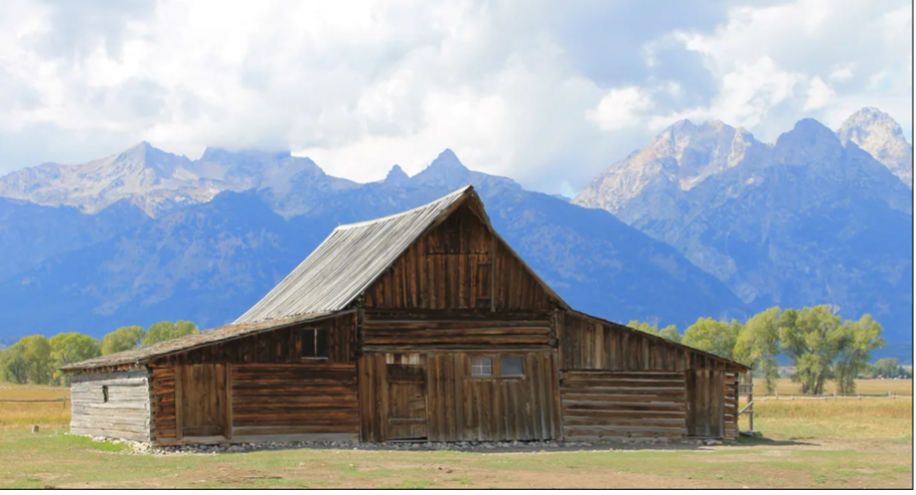
The “most photographed barn in America” according to Atlas Obscura. Built in the early 1900s, outside of Jackson Hole, WY.
Burrus’s suggestion that the ruin of the ruin, the trace of the trace, moves us most powerfully, calls to mind one of my favorite passages in Don DeLillo’s novel White Noise. Toward the beginning, two characters drive from their small, college town to see a regional tourist attraction. Along the drive, they encounter multiple billboards announcing their destination: THE MOST PHOTOGRAPHED BARN IN AMERICA. From the parking lot of the site, they follow a preset path that leads to a viewpoint for photographing the barn. After a long silence, one of the characters says to the other:
“No one sees the barn….Once you’ve seen the signs about the barn, it becomes impossible to see the barn….”
….
“Being here is a kind of spiritual surrender. We see only what others see. The thousands who were here in the past, those who will come in the future. We’ve agreed to be part of a collective perception. This literally colors our vision….They are taking pictures of taking pictures.”
….
“We can’t get outside the aura. We’re part of the aura.”[6]
This passage haunts me when I think about my own travel to ancient sites. It’s not only a question of how our encounters with ruins are shaped by space. As a result of that, it is also a question about how our experience and therefore our understanding of the past is shaped by space. In an essay for the New York Times titled “Take a Photo Here,” novelist and critic Teju Cole channels DeLillo and considers how travel has now become synonymous with photography. We go places, he observes, in order to take pictures of places. More than that, we go places to take the same pictures “in the same way.” On a visit to Rome, Cole found himself scrolling images of the Roman Forum on social media, noticing how the space is framed in such a way that the perspective is repeated over and over and over again: “A visitor might think she’s simply experiencing a set of archaeological ruins or a natural feature of the landscape,” Cole writes, “but is in fact subject to whatever the tourist board, landscape designer or architect has prepared for her.”[7] Cole suggests that visitors to the ruins of the Roman Forum can’t get outside its aura because their forced vantage point, the repetition of their photographs, makes them participants in the aura more than observers of it.
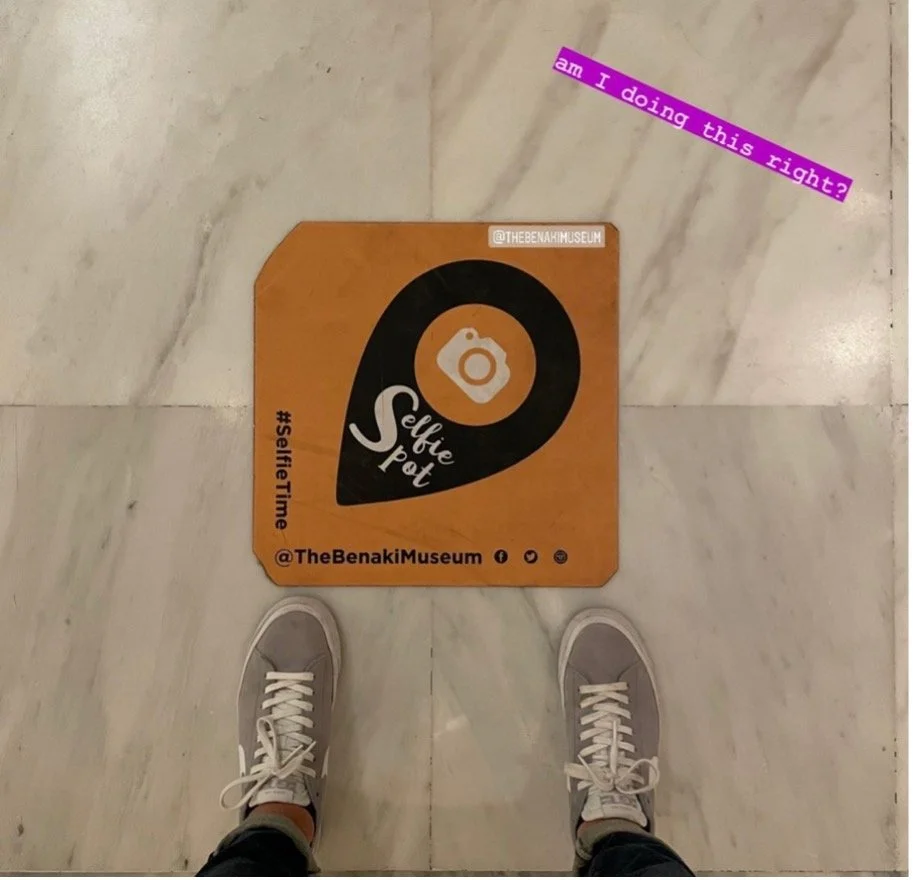
The author taking a photo of a designated “Selfie Spot” at the Benaki Museum in Athens, Greece (which he then posted to Instagram).
There is a second unsettling for me, then, when I consider how the writing of history, as a sort of spoliation, might itself be akin to “taking pictures of taking pictures.” Am I seeing the late ancient past in my evidence or am I seeing its aura? How would I know the difference? And why is it that I often find my reflection in the fragments I choose? Maybe I ask these questions because there are days in my own scholarly writing that I feel myself walking the path to a preset location in order to take a photograph that Burrus, for example, has already taken before me with better framing and sharper focus. But this makes sense: the ruined sites, the spoliated fragments through which we encounter and interpret the past, are always inevitably framed for us before we frame them. And why wouldn’t this be true for scholars as much as for tourists? If Burrus is correct, and it is the ruin of a ruin that compels us toward the self-reflective gesture, and that it is the aura of the spoliated fragment that draws us into the writing of history, then her argument seems to be not a rejection of our participation in the aura but rather a kind of generous attentiveness to the aura. Burrus models an honest accounting of how we help contribute to and participate in that aura as scholars.
Like DeLillo’s barn, the fragments of the past out of which historical narratives are built acquire a shine from their previous uses, and we see this shine at least as much as we see the thing itself. This is the question posed to the historian by the evidence they marshal. I wonder if the impulse with which my hand reaches for my phone to take a picture at the Akropolis is generated from the same psychic space as the scholarly impulse to analyze certain texts and objects in certain ways. What is it about this site, this space, this passage, this past that hails me in this way? How might the turn to self-narration help or hinder, clarify or obscure, the analysis of what we are looking at and why we are looking at it?
I read Jerome now always with Burrus, with whom I first encountered him. As I am drawn to re-read him, I am drawn to re-read Burrus and at a deeper level myself – how I came to read Jerome with Burrus in the first place. At the end of Earthquakes and Gardens, Burrus concludes, “To learn to know and love one place is not to know and love all places, but it is to be capable of knowing and loving other places. It is to be able to glimpse something wondrous in the situatedness of all that becomes. So it is that Hilarion’s Cyprus could teach me to know and love the places I was in, and the places I was in could teach me to know and love Hilarion’s Cyprus.”[8] I take this to be Burrus’s final word on the ruins lessons and the intellectual purchase of the self-reflective gestures they prompt. It is, in her account, a theological posture grounded in the particular placedness of our intellectual production. It is to accept an invitation to think with late antiquity, even within late antiquity, more than about it. Burrus proposes that we can do this by positioning ourselves with “sympathy rather than alienation, curiosity rather than judgment, a sense of affinity rather than suspicion.”[9] These are affective and ethical orientations, even aesthetic ones, as much as they are historiographical ones. In this way, Burrus has used the self-reflective gesture as a strategy for spoliating the confessionalism of patristics as a field – repurposing its pieties, practicing an otherwise ad fontes that imagines the flow of history moving in unexpected and unintended directions as opposed to those teleological channels that all too often flow into triumphalist agendas.
Conclusion
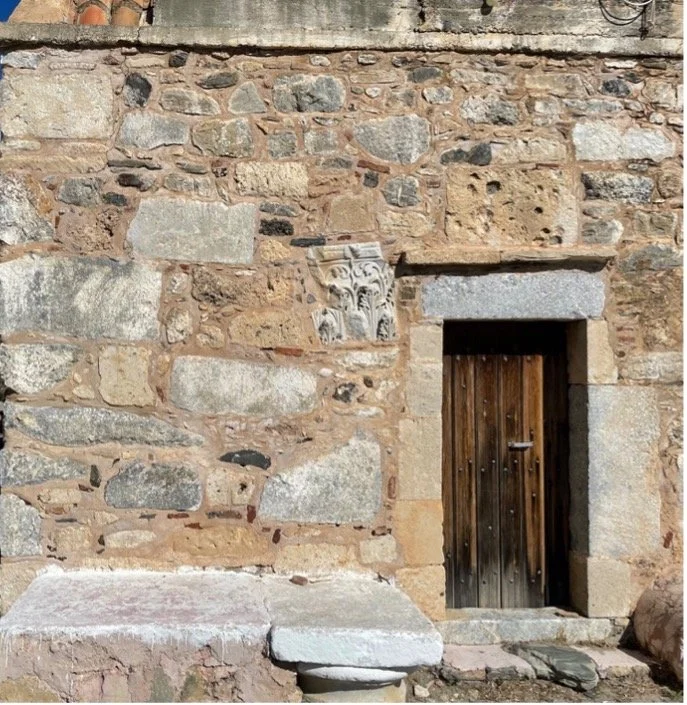
Spolia in the Church of St. John in Lentas, Crete (photo by author).
Rainer Maria Rilke once wrote that “Space reaches out from us and translates the world.”[10] What I have been trying to examine here is that the spaces we encounter in the late ancient past seem to prompt self-reflective gestures in ways that are not dissimilar to the placards at tourist sites telling us to “take a picture here.” To know the spaces we study, we must, as Rilke writes, “throw inner space” around them. As I think about the role that the self-reflective gesture has played in our field—the recent work of Mike Chin and Maia Kotrosits comes to mind— and as I think about Burrus’s career-long contribution to this kind of intervention, I am wondering if I have been reading DeLillo wrong on the Most Photographed Barn. It has been my assumption that our repetition is cause for despair, for scorn, or at least for resistance to the ways that spaces seem to shape our behavior unconsciously toward repetition. But what if DeLillo isn’t condemning the process of becoming part of the aura? What if it is arrogant to assume that we are ever capable of doing more than this? In the pleasure of this kind of placedness, in letting space reach out from within to shape the spaces encountered beyond, participation in the aura enables us to see more, not less, than the thing itself. And isn’t this the point of spoliated architecture? To find beauty in varietas? This is my ruins lesson, learned from Burrus, to whom my thinking has been indebted these many years, long after I stepped out of the space of her classroom – a space that continues to reach out through me to translate the late ancient world that I see.
John Penniman is an associate professor of religious studies at Bucknell University. His current book project, titled The Hands of God: Drugs and the Revelation of Divine Power in Early Christian Practice, focuses on the relationship between ancient pharmacology and early Christian ritual. John also serves as an editor for the new book series, Theoria: Sightlines into Late Ancient Religion, with Fordham University Press. He spends most summers in Greece hunting for ruins of the Greek god of medicine, Asklepios.
[1] Burrus [quoting Stewart], Earthquakes and Gardens, 72.
[2] Burrus [again, quoting Stewart], 80. Or, as Maia Kotrosits has also suggested, the social utility of ruins is found in their capacity to “provide endless fodder for collective self-reflection” (Kotrosits, The Lives of Objects [University of Chicago Press, 2020] 53).
[3] Burrus, Earthquakes and Gardens, 81.
[4] Burrus, Earthquakes and Gardens, 84-85.
[5] Burrus, Earthquakes and Gardens, 84.
[6] DeLillo, White Noise (Viking 1985), 12-13 (emphasis added).
[7] Cole, “Take a Photo Here,” The New York Times (June 27, 2018).
[8] Burrus, Earthquakes and Gardens, 154.
[9] Burrus, Earthquakes and Gardens, 155.