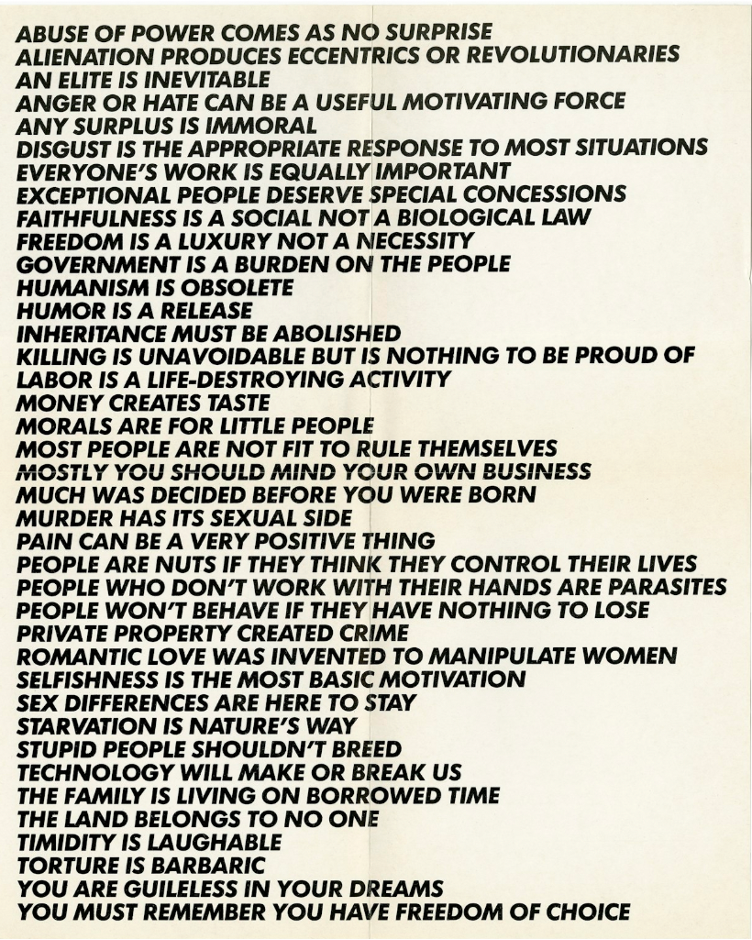
Dimensions 8-1/2 x 8-1/2 x 1/2 inches book
Medium offset lithograph on paper Accession Number LIB2000.432.1-.2
Copyright © Jenny Holzer / Artists Rights Society (ARS), New York
Credit Line: Rosemary Furtak Collection, Walker Art Center Library
This essay was part of a 2025 SBL Book Review Panel devoted to Strike: Labor, Unions, and Resistance in the Roman Empire by Sarah E. Bond. Read the full forum here.
In 1982, artist Jenny Holzer’s truisms were broadcast in NYC in the pixelated message that read in white letters across the black background of an electric billboard in Times Square. Picture it: on a massive screen on a street corner, you read, in sans serif font and all capital letters: ABUSE OF POWER COMES AS NO SURPRISE.[1] Prof. Sarah Bond is perpetually unsurprised at abuses of power, yet she is also perpetually ethically aggrieved by them. Her new book, Strike! is grounded in an ethical interest in the historical abuses of power on two levels: the abuse of power in the ancient Mediterranean world, and the witting or unwitting power of historians to write out of the record of the ancient Mediterranean the possibility of resistance, organizing, and the agency of laborers.
Strike! analyzes labor in antiquity, aggregating data from the sixth century BCE to the sixth century CE, with a focus on the Roman imperial period. In Bond’s words, “This book is an effort to recover the histories of ancient labor organization, mobilization, and resistance from below in the Roman Mediterranean” (p. 6). Strike! draws the reader’s eyes continually drawn back to workers—whether enslaved; those who suffer infamia, the topic of Bond’s book Trade and Taboo; or those who work in more elite collegia and professions. Yet Bond cannot tell the full story without including “Rome’s emperors and political power players” (p. 7). She explores how these elites sought to control and surveil laborers and their associations. As she puts it: “We will track the volatile ways in which the state used its own tools of enforcement as a means of keeping certain collectives from assembling, growing, organizing, and challenging its own authority. These strategies will be familiar to many today: the use of police forces and soldiers to squelch popular movements, the operations of state surveillance, and the passing of anti-assembly legislation under the guise of patriotism” (p. 7).
Strike! moves around the corrupting sea of the Mediterranean—Carthage, Lugdunum (Lyon), Rome, Thessalonikē, Antioch, Alexandria—and is in fact interested in corruption. We meet a broad range of people: Goths, mangones (slave dealers), servi publici (state-owned enslaved persons), purple dyers, parabolani (funeral workers and stretcher-bearers), the technitai of Dionysus, charioteers and pantomimes, and the bakers. We meet the emperors, senators, and bishops and glimpse their fear of and exploitation of the organizing skills of certain kinds of workers. We meet philosophers, Christians, Jews, the Vestals, followers of Cybele. Strike! also introduces us to many kinds of sources, including legal materials, epigraphic evidence in stone and bronze, papyri, with special focus on what we usually call voluntary associations and in ancient Latin were often known as collegia. The trash literature of Suetonius’s Historia Augusta makes its way into the data; so too the orations of Libanius, the letters of Julian, and even, for those concerned with Christian Testament literature, the Acts of the Apostles. That is to say, this broad book is ecumenical in its sources and aware of the lumpiness of our data. Strike! copes with the different rhetorics of various literary sources, the conventions of epigraphic evidence, the tendency of law to prescribe in ways that sometimes occlude what was happening in communities and sometimes reveal by opposites: no one would legislate against X unless X was occurring. Bond’s tour de force aggregation of sources works together to enliven our understanding of the organizing tactics of laborers and the abuses of power in antiquity. At the same time, she recognizes that none of this is a window onto antiquity. All of it requires the work of reconstruction and subtle readings for the conventions—phrases, titles—and the mechanisms of persuasion—hyperbole, construction of the other—that our sources employ. The work of reconstruction, in turn, has a larger ethical purpose.
While I was writing this review, I was also reading Kelly Hayes’s and Mariame Kaba’s Let This Radicalize You: Organizing and the Revolution of Reciprocal Care. Some scholars have argued that ancient Christ-followers’ associations were mutual aid associations, the poor giving to the poor out of their temporary, minor surpluses.[2] Let This Radicalize You and Strike! resonate. Kelly Hayes writes: “To understand the past, we must investigate the stories we were not told, because those stories were withheld for a reason. We must search out all the pieces we weren’t meant to find, the things that disrupt the narratives we’ve been given.”[3] We have seen this hard historical, archival work of late in the critical fabulations emerging from photographic and other archival evidence, under the pen of Saidiya Hartman in Wayward Lives, Beautiful Experiments.[4] We have seen them in the questions about Black madness and religion that brought Judith Weisenfeld to the painful archival work represented in Black Religion in the Madhouse: Race and Psychiatry in Slavery’s Wake.[5] We can see it in a recent chapter by Greta LaFleur, who takes the two- or three-line eighteenth- and nineteenth-century newspaper reports of self-castration to ask whether we can glimpse “a vision of trans feminine possibility”—even if this possibility is not easy or always happy—“in the eighteenth-century North American colonies or nineteenth-century United States.”[6] Or we can look to the work of Daniela Valdés, who has been chair of the advisory board for the Digital Transgender Archive, who has painstakingly read through carceral archives and newspaper reports to reconstruct the lives of working-class Black and Brown non-gender conforming people.[7] Strike! offers hard historical, archival work toward otherwise possibilities[8] of understanding the ancient Mediterranean world.
In Let This Radicalize You, Kaba writes of those whom she calls “the butterflies,” those who “always had a ready quote by Fanon, Malcolm, Che, or Marx” and who offered excellent critiques but built nothing. Instead, she encourages us to ask, as a mentor asked her: “Who are the people to whom you’re accountable?”[9] Why do we do our work? For whom?
Strike! speaks to a broad readership, both scholarly and a curious public, giving resources for thinking about organizing and community, about labor and withholding labor, about how people who come together to build power frighten those for whom abuse of power is a daily practice. Strike! a successful thought experiment in the laboratory of Mediterranean antiquity, tracing evidence of resistance, as well as its surveillance and co-optation. Strike! has the potential to contribute historical contexts to the work of organizers—the book is more data and an irritant of evidence of women, enslaved persons, low-status workers, and resistance for those whose thoughts turn so often to the Roman Empire to fantasize about it as an easy time of male power and about imperial might. In searching for examples of both labor and resistance in the Roman Empire, the book also joins forward-thinking historians of other regions and time periods. When reading Prof. Bond’s account of Gothic and Visigothic laborers for the Roman Empire—the Gothic soldiers under the service of Theodosius, in particular—my mind kept coming back to Vincent Brown’s Tacky’s Revolt: The Story of an Atlantic Slave War. Brown’s study of resistance to enslavement and imperial power in Jamaica allows us to see global circulations of hierarchies and tactics of resistance. The revolts of the late eighteenth century were conducted by enslaved people who had military training, tactics, knowledge, and skills. What some might characterize as an uprising from 1760-1761 in Jamaica, under Brown’s pen, becomes a global story:
Indeed, many American slave revolts might be seen as extensions of African wars. Casting them as such does more than assert the importance of Africa in the making of the Atlantic world; it helps to reveal how complex networks of migration, belonging, transregional power, and conflict gave the political history of the eighteenth century some of its distinctive contours. Recognizing slave revolt as a species of warfare is the first step toward a new cartography of Atlantic slavery.[10]
Similarly, Prof. Bond’s story of resistance, her work of writing with the central gaze focused on low-status workers, reveals the power of these acknowledged collegia and unsanctioned collectivities amid the larger wars and power struggles of the Roman and early Byzantine empire.
Both of Prof. Bond’s books, Trade and Taboo and now Strike!, are urgent reading for the study of New Testament and ancient Christianity. After all, even if the early Jesus movement was not a collegium or voluntary association per se, its instantiations have been fruitfully analyzed in light of collegia, which are often simultaneously religious, social, economic, and cultic. And we know from Josephus and others that this Jesus movement arose in part out of political resistance, prophets marched people into the Judean desert only to be killed by Roman soldiers, their messages of resistance of power in popular collectivity inimical to the encroaching of Roman cohorts, procurators, tax farmers, and others. Those who have used the study of so-called voluntary associations to enhance our understanding of the earliest Christ-followers ekklēsiai or koinōniai have focused on work, trade, networks, movement, and the size of voluntary associations. I think of the work of John Kloppenborg, Rick Last, Richard Ascough, Philip Harland, and Jennifer Quigley’s analysis of the theo-economics of such groups. I think of scholars who have built upon the work regarding associations to foreground where the Christ movement does and does not encourage participation of women, the poor, and the enslaved—scholars from Mitzi Smith to Anna C. Miller to Minta Fox to Joe Marchal.
In New Testament studies, we might too quickly pass over the status of Lydia as a purple dyer, the instructions two disciples to go out two by two carrying nothing with them, the silversmiths in Ephesos as idolatrous complainers, the hard physical labor of itinerant work, or Acts’ invention of Paul as tent-maker, a noble role of hard work and self-sufficiency. There is more to be found in these stories, as Prof. Bond shows, particularly in her discussion of silversmiths and their associations in chapter 5, titled “Strikes, Riots, and Associations in the Roman Imperial Period.”
But what about the impact of Strike!, how it opens up new understandings? In line with my understanding that curses and so-called magical ritual materials are relevant for our understanding of New Testament texts (which also contain curses) and ancient Christian practices, I want to tell you how Strike! has opened up new questions for my engagement with recently published curses.
Curses have often been read as private documents that allow a steam valve-like release of emotion—the releasing of the constraints of desire, to reference the title of Jack Winkler’s brilliant 1990s book.[11] Scholars of so-called magic have long characterized some cursed tablets under the taxonomy of commercial rivalry.[12] Many laborers are cursed: a lachanopolēs or greengrocer in late antique Antioch, a tavern-keeper in Athens, a mime in Corinth, and the animals of charioteers in Antioch and in Caesarea Maritima. Such curses need to be read in light of the data and analysis Prof. Bond provides in Strike!.
It is these latter two roles—mimes and charioteers—that particularly leapt out at me differently as I read Strike!. Prof. Bond emphasizes how charioteers entertained but also were used by imperial power, and how they inspired riots and controversy again and again in late antiquity. How/might this book help us to see these commercial and entertainment rivalries in another light? Maybe we can read them differently in light of Bond’s work on collegia and labor, and Sara Ahmed’s work on emotions as a political and collective phenomenon: disgust toward immigrants, say, stoked by a government.[13] (That is, the historiography of Stoic bros has limited us to thinking about the passions as a matter of private and philosophical self-discipline: am I master [used deliberately] of my emotions, able to stand unbuffeted in the world? Or, more specifically to our evidence: as an enslaver, am I able to extirpate my passions and to conduct the whipping of an enslaved person with calm, as Galen has it? Am I able to extirpate my passions and not to fall into grief at the loss of beloved children, as Cicero’s discussants struggle out in the Tusculan Disputations? But we have inadequately noted that these seemingly private passions are therapeutically treated not on one’s own, but in philosophical community and discussion.)
As I have been reading newly published curses, I would scratch by hand in my notebook: relevant for Strike! to ask: What would Sarah Bond do? is to open up interpretive possibilities in our ancient sources. Bond’s book returns several times to the entertainment industry in antiquity, including riots over mimes and their expulsion from Rome under Augustus (pp. 99-101) and the information that “In 413 CE, Honorius wrote to a tribune in Carthage ordering that female mimes who had previously been freed from service should be called back to provide pleasure to the people on festival days” (p. 175). That is, over centuries, mimes could be politically dangerous, offering Jimmy-Kimmel like critiques of the imperial family, but they were also politically expedient, popular entertainers for the populace. This broad context helped me to make some sense of a recently published curse from the Fountain of the Lamps at Corinth, found within a basin from a late-fourth to mid-fifth century CE context.[14] It fulminates against a female mime named Elpidia (Erpidia), daughter of Martyria—and thus, given onomastics, is likely evidence of a late antique Christian woman in the theater. Sunk in the waters of the partially destroyed Fountain, the bedrock roof collapsed, the curse is not pretty. It reads in part:
[Face A] I adjure your mighty power: cut the heart out of Elpidia, put her to death. By all the gods I adjure the nymphs: (20) at once chop up Elpidia, put her to death, whom Martyria bore. . . . [Face B] I call on Hekate of the heavens, the runner of the mountains, . . . . bring (her) down in sickness, weigh her down, cut the heart out of her, put her to death, chop up [- - -] (45) Elpidia …. I adjure the holy nymphs who are merciless to the negligent ones: put to death, cut the heart out of Elpidia, whom Martyria bore, put Elpidia to death. . . .[15]
The condemnation of this mime to Hekate, to the nymphs, to the gods of the underworld makes more sense in relation to Bond’s analysis of contestations between organized labor groups, on the one hand, and the potential power of entertainers (as well as their condemnation and denigration) in the context of political power.
Bond’s Strike! particularly came to mind when I read the many circus curses in the new volume Magica Levantina, a long-awaited publication of thirty-seven curses and one amulet from late antique Caesarea Maritima and Antioch and environs. A late fifth- to early seventh-century CE curse found in a drain near the meta prima of Antioch’s hippodrome made more sense in light of Strike!’s seventh chapter, “Athletic Factions and Popular Rebellion.” This chapter provides rich documentary and literary evidence of the power of circus performers, and the political clout of the various “teams” of the Blues, the Greens, etc. The middle of this Antiochene curse reads:
I call upon you, the great god, the one sitting upon the throne of glory. Hear me, lord Marmaraōth. I thank you, master, mighty Abeēth |11 … bal. And you are Kokor, the interpreter, hymned …; Maskelli Maskellō … Force, Scourge, Necessity, mantounoboēl |12 … phrōx phrōx. Michael, Gabriel, Erphael (= Raphael) and the frightful and glorious names and your power, help to enforce this restraining spell and releasing spell, and make firm and secure all that is inscribed |13 on this tablet against all the horses of Hilarios, the ones in the faction of the Blue and Red color, and against all the charioteers receiving and mounting them. … phthōrizō iō Iaō Abrasax Phonoboubēth Iaō ia Iaō Iaō ē iii yyy ooo. Let also your power obey me |17 … for the fetters of this restraining spell or releasing spell, which are not undone by thunder and lightning and earthquake and tremors and rain and thunderbolts and sun and … |18 … and any inscribed amulets or releasing-spells or purifications, but bind, bind down, bind firmly, hinder, restrain, cast, cast down, bend, bend down |19 … stupify all the horses of the faction of the Blue and Red color. <… against all> the horses, so that they not exit (the starting gates), against Libanos called < > and against Phoberos and against Euprepes … and against |21 … and the remaining horses, those on the right and left and inner right and inner left, equine colts that press, that are disciplined, that are strong and vigorous, that are wreathed. |22 … and against Sambatios the charioteer, also known as Stephanos, nicknamed the Apamean, and against all the charioteers receiving and mounting all |23 the horses of Hilarios in each race and at each gate and at each gateway in the sixteen races about to be carried out in this city, the city Antioch of Calliope, |24 tomorrow, the appointed third day, or the following day, the appointed fourth day, or on whatever day … Hear me. For let your angels and your counselors and your assistants and powerful headmen desert (them) | 27 … let …kalias perish and let Ablanathanalbas fall down and let …ramousa perish and let Akrammachamari fall down and let the seven words(?) that he spoke over the sea(?) perish |28 as well as the seven that he spoke over the earth, and let the great name over the Cherubim fall down, and let the throne fall down and no longer arise. For I am Thōagameoth. I call upon |29 you … and impede and lay hold of the feet and strength of all the horses of Hilarios the captain or of anyone in this city. And make everything that is inscribed on |30 this tablet secure and firm. … against everyone, (both) those whose names I made clear by inscribing them and those whose names out of ignorance I did not inscribe |31 … everything inscribed on this restraining spell and releasing spell that I cast against all the inscribed horses …|31… bind …[16]
How/might Bond’s book help us to see a curse like this differently? First, because of her scholarship, we can see that calling down so many forces against some poor horses and Sambatios the charioteer a.k.a. Stephanos a.k.a. the Apamean is not just about games, or individual competition. It is about the powerful political role of these human and non-human agents—a charioteer, and horses within the cities of the late antique Mediterranean world. We can understand better how a charioteer and his horses, how organized groups of charioteers, organize in service of or resistance to imperial power. Because of Strike!, we can note the range of beings called upon, including “Force, Scourge, Necessity. . . . Michael, Gabriel, Erphael (= Raphael) and the frightful and glorious names and your power, help to enforce this restraining spell and releasing spell, and make firm and secure all that is inscribed |13 on this tablet against all the horses of Hilarios, the ones in the faction of the Blue and Red color, and against all the charioteers receiving and mounting them.” Because of Strike! we can notice the ranks of non-human agents differently: How (does the human commissioner) assume that non-human agents are organizing themselves? How does the ritual expert and the one commissioning the curse understand and ask for the absence and fall of these powerful forces: “For let your angels and your counselors and your assistants and powerful headmen desert (them)” “let the great name over the Cherubim fall down, and let the throne fall down and no longer arise”? That is, in this curse that calls upon Cherubim, Michael, Abrasax, Iaō, and others, we find something beyond Judaism, Christianity, and paganism; we find something that traduces our categories of religion vs. labor vs. politics. We find that charioteer labor and organizing inspires a ritual response at the highest levels. Bond’s insights regarding associations, organizing, and resistance need not be limited to human actors, but also extend to horses… and to divinities. That is, Strike! can and should be extended to texts and to thought worlds that we might normally bin under “theology.”
Bond explicitly connects labor struggles of the ancient Mediterranean and those today. Her “Conclusion: Uniting Ancient and Modern Laborers,” states: “Defaming and then marginalizing groups and movements as antipatriotic, conspiratorial, self-serving, and even violent threats to public order has always been a way of justifying the extreme actions taken to disband and disempower them” (p. 187). Antiquity is a laboratory which we both reconstruct and from which we can draw different tactics and diachronic affiliations—“touching across time,” to borrow Carolyn Dinshaw’s famous phrase, aimed at queer affinities in medieval studies.[17] In Bond’s words, “Studying the labor organization, unions, and state tactics taken against associations or informal groups in the Roman Mediterranean allows the people of the present to apprehend the longue durée politics behind the freedom to assemble” (p. 187). Such a sentence is particularly poignant at this time in the U.S., when a president has called the National Guard to challenge free assembly in cities with large minoritized populations, and in which the free assembly of encampments and protests on university campuses prompts the administration of those institutions—and the decision tree or responsible persons are hard to discover—to bring in campus and city police against students and other protesters, and even to surveil with drones.
Most of us here are laborers in an industry[18] with quasi-utopian potentials for transformation and new epistemologies, and an industry that emerged and was supported by forms of white supremacy, imperialisms, and enslaved bodies. How do we want to be responsible to that history, and also to organize ourselves toward something better? As Ruth Wilson Gilmore has said—and her work is aimed at the urgent issue of racism and incarceration—“freedom is a place,” and we are the ones who imagine and enact its geographies.[19]
Bond is a historian who contends with courage with these larger issues, ghosts in the room, specters in the field.[20] One of the things that I love about Bond’s work is that abuse of power comes as no surprise to her—this is the theme, after all, of much of her work. Yet abuse of power is met with her tenacity to offer other histories, of those who have less power, of those who manage to live otherwise, or to try. Bond’s work as a historian is driven by her search through the data of the ancient Mediterranean world to discover better means of sociality, better mechanisms for sharing goods, loftier ideas regarding governance, and hopes for human possibilities.
Laura Nasrallah is the Buckingham Professor of New Testament Criticism and Interpretation at Yale University.
[1] See this Instagram Post as well as the Walker Art Collection site.
[2] See e.g. Steven Friesen, “Poverty in Pauline Studies: Beyond the So-called New Consensus,” Journal for the Study of the New Testament 26.3 (2004): 323-361; Susan Holman, God Knows There’s Need: Christian Responses to Poverty (Oxford University Press, 2009); Richard Last and Philip Harland, Group Survival in the Ancient Mediterranean: Material Conditions and Mutual Aid in Associations (T & T Clark, 2020).
[3] Kelly Hayes and Mariame Kaba, Let This Radicalize You: Organizing and the Revolution of Reciprocal Care (Haymarket, 2021) in “Introduction: Remaking the World,” 3.
[4] Saidiya Hartman, Wayward Lives, Beautiful Experiments: Intimate Histories of Riotous Black Girls, Troublesome Women, and Queer Radicals (W. W. Norton, 2019).
[5] Judith Weisenfeld, Black Religion in the Madhouse: Race and Psychiatry in Slavery’s Wake (New York University Press, 2025).
[6] Greta LaFleur, “Trans feminine histories, piece by piece, or, vernacular print and the histories of gender,” in Emma Heaney, ed., Feminist Against Cisness (Duke, 2024), 101.
[7] Valdés “argues that the mass midcentury criminalization of cash poor Black and Brown gender nonconforming people via low-level crimes and status offenses, especially disorderly conduct and juvenile delinquency, served as a carceral laboratory for mass incarceration during the War on Drugs.”
[8] See e.g. Ashon Crawley, Blackpentecostal Breath: The Aesthetics of Possibility (Fordham University Press, 2016).
[9] Mariame Kaba, “Introduction: We can only survive together,” 8-10.
[10] Vincent Brown, Tacky’s Revolt: The Story of an Atlantic Slave War (Harvard University Press, 2022). 4. See also Brown’s work on mapping, an interest that overlaps with Prof. Bond’s, especially her commitment to the Pleiades Project.
[11] Jack Winkler, The Constraints of Desire: The Anthropology of Sex and Gender in Ancient Greece (Routledge, 1990).
[12] See e.g. chapter 4 of John Gager’s Curse Tablets and Binding Spells, titled “Businesses, Shops, and Taverns,” or Jessica Lamont’s “A New Commercial Curse Tablet from Classical Athens,” Zeitschrift für Papyrologie und Epigraphik 196.4 (2015): 159-74
[13] Sara Ahmed, The Cultural Politics of Emotion (Edinburgh, 2004).
[14] David Jordan (posthumously; with Jaime Curbera), “A Curse on a Mime Actress in Corinth,” Hesperia 92.4, (October-December 2023): 723-746, here at p. 724: at least this is the date of two lamps found in the same context, but note the challenge of dating since many objects were brought up from the mud and water in buckets. Jaime Curbera and Jessica Lamont will soon publish another curse tablet from this context.
[15] Corinth inv. no. MF 1969-118. Translation and Greek at Jordan/Curbera, “A Curse on a Mime Actress in Corinth,” pp. 727-31. See also a curse against a pantomime dancer in Caesarea Maritima; IAA G-88/1994, CT 7 or curse 2 in Robert W. Daniel and Alexander Hollman, Magica Levantina (Sonderreihe der Abhandlungen Papyrologica Coloniensia LII; Brill, 2025), but note that pantomime and mime are fundamentally different arts even if both involve dance and often engagement with mythological themes.
[16] Daniel and Hollman, Magica Levantina, 259-80 (curse 28 = Princeton University Art Museum inv. no. 2011-141).
[17] Carolyn Dinshaw, Getting Medieval: Sexualities and Communities, Pre- and Post-Modern (Duke, 1999).
[18] The American Association of University Professors (AAUP) is involved in labor organizing and support in the industry of higher education, as well as publications and legal representation on the topic.
[19] Cited in Let This Radicalize You, 82.
[20] On specters and ghosts in the field, see inter alia, the work of Denise Kimber Buell; see also Caroline Johnson Hodge, Timothy A. Joseph, and Tat-Siong Benny Liew, ed., Divided Worlds? Challenges in Classics and New Testament (SBL Press, 2023).