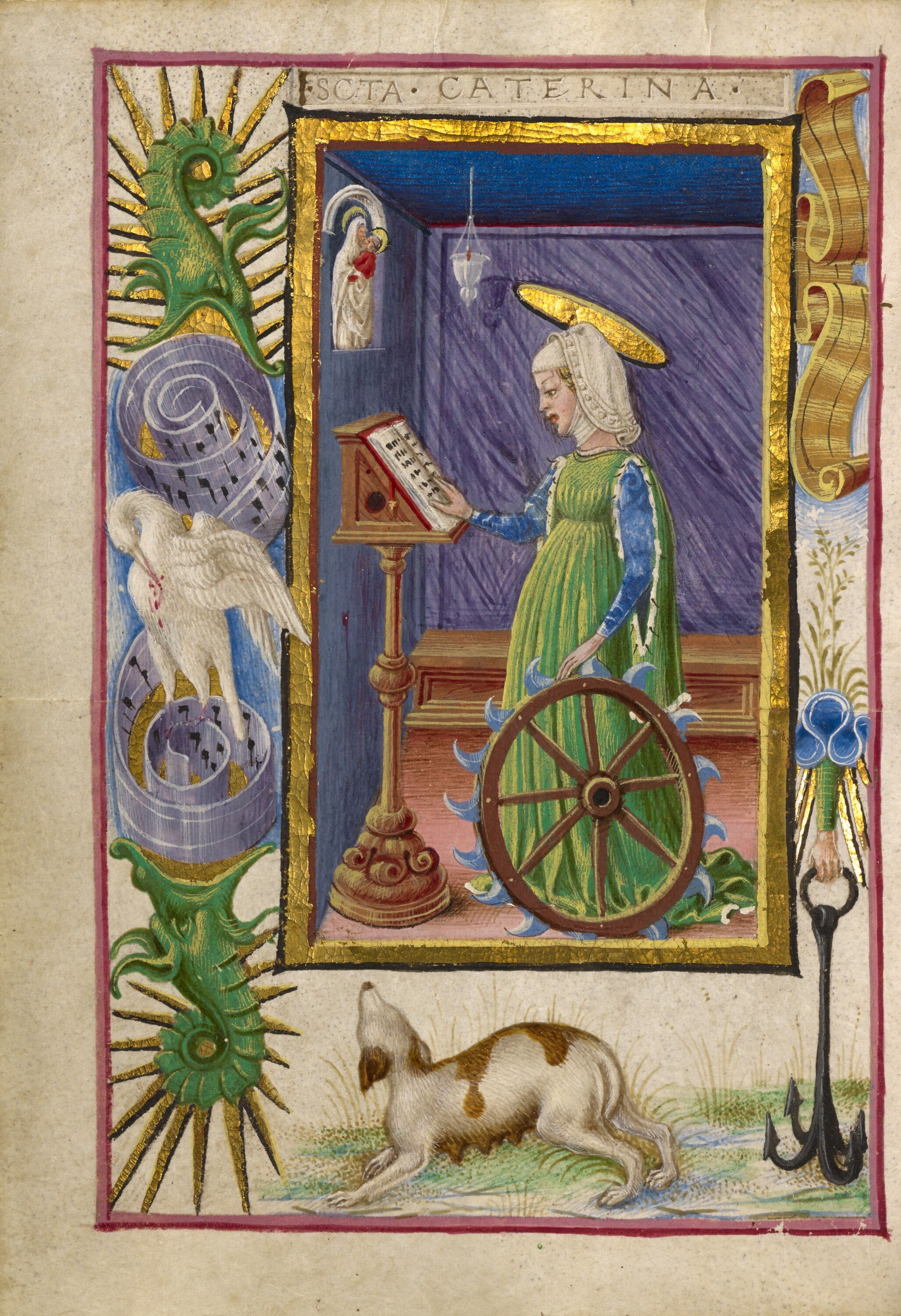
Taddeo Crivelli (d. ca. 1479), illuminator, Saint Catherine of Alexandria, The J. Paul Getty Museum, Los Angeles, Ms. Ludwig IX 13, fol. 187v.
This essay was part of a panel at the 2025 Annual Meeting of the Society of Biblical Literature celebrating the work of Elizabeth Castelli. Read the full forum here.
Let me begin with an expression of sincere gratitude to Travis Proctor and Shaily Patel, co-chairs for the “Inventing Christianity” program unit, for organizing this panel— and to my friends and colleagues who took the time to write such thoughtful and beautiful papers.
As colleagues have noted, Martyrdom and Memory is now old enough to drink, having come into the world twenty-one years ago. When it first appeared, the SBL “Violence and Representations of Violence” program unit graciously organized an “author-meets-critics” panel for the book, which took place in 2005 and was a wonderful experience. Our panel today feels very much like a salutary bookend to that earlier event.
In responding to these papers, I have not followed the order in which they appeared on the program, but I have rearranged them in order to try to highlight and feature their contributions to our broader discussion about martyrdom in early, late ancient, and contemporary Christianity.
Let me start with Julia Nations-Quiroz, whose paper extends our discussion in three significant ways: first, she moves us fully into the post-Constantinian world (with examples from sermons by John Chrysostom and Augustine); second, she leads us into the realm of material culture (focusing on fifth-century ivory reliefs from Rome); and third, she introduces a critically helpful interpretive frame, which she calls “the martyrial lens.” Working with fourth-century homilies, fifth-century devotional objects, and a new interpretive frame, Julia argues persuasively that “in the late antique period it is the idea of martyrdom, and not the fact of it that is of central importance.”
There are several elements of the argument that I want to explore further. When discussing Chrysostom’s homily On Saint Barlaam (delivered at his martyrium—and we should talk about the role of sacred places more in relation to martyr commemoration!)—, Julia draws our attention to the metaphors of spiritual warfare that Chrysostom deploys. In his framing the congregation’s own spiritual agon, the absence of a worldly and human persecutor does not mean the Christian is therefore unassailed and free—rather, the Devil is the new persecutor, worse than any imperial tyrant—and the space of the assault is no longer a matter of public spectacle (e.g., the arena) but instead in an interiorized space—the human heart, in which the demonic assaults by means of “the unnatural and wicked thoughts that swell there [in your heart].”
Moreover, Chrysostom places a strong emphasis on the affective impact of being born at the wrong time. Noting his congregation’s trembling, yearning, and sadness at the absence of opportunities for martyrdom—is this a late-ancient form of FOMO?—he assures them that they can still weep, just as the martyrs of old can bleed. If weeping is a form of exteriorization, it is nevertheless related to the internal experience of melancholy, gloom, and regret. If the martyrs of the past expressed their piety primarily through some combination of physical submission and endurance, Chrysostom calls the Christians of his own moment to express their testimony and martyrdom through moral imitation, the curtailment of desire, and the disciplining of the interior.
This focus on interiority makes its appearance in Augustine’s sermon too: “It’s within oneself, when all is said and done,” preaches Augustine, “that the great contest takes place, where the theatre of conscience is located [I love that image!], and where, moreover, the chief spectator is the inspector of conscience.” An old-school way of talking about this sort of shift is the movement from martyrdom to asceticism, as the “age of martyrs” gave way to the “age of monks,” as some scholar or another’s book from the 1940s might have put it. But I think it’s even more than that— it’s also the displacement of one form of bodily piety with another, as well as the elevation of the affective and moral as the site of contestation. In the process, what is visible and what is legible changes.
And it is here that the turn to visual culture is, I think, so important. While Martyrdom and Memory made some halting gestures in the direction of material and visual culture—exploring objects from the later cult of Thecla (and I have my late and much beloved colleague Natalie Boymel Kampen to thank for pushing me to think about visual culture in the book!)—Julia has made a more significant contribution to expanding our archive, for which I am very grateful.
Julia asks us to contemplate three ivory reliefs as they would have likely been affixed to a box or some sort of container—an object to be held or put on display, a container for some other sacred object—a relic, perhaps, or a host. She focuses on one panel, which features both a rapt Thecla listening to Paul preaching and a curious image of Paul apparently subjected to stoning—a detail that does not align with narrative details in the Acts of Paul and Thecla or other traditions surrounding Paul’s experience of physical punishments. Julia reads this image as an attempt to retheorize martyrdom in this historical moment, drawing attention to “faithfulness up to death, not death itself.” I think this is a plausible reading. Having not studied the image in question, nor explored the scholarly glosses on it that might exist, I am a bit of a naïve reader here—but I wonder whether one might not read the image in light of Elena Martin’s arguments about Augustine’s project of abstraction, which Julia discusses briefly. That is, I wonder if stoning might not stand in for persecution and martyrdom tout court in the iconography—as a kind of throwback to the figure of Stephen as the protomartyr and his stoning holding a primary place in the collective memory of Christians.[1] (I acknowledge this is likely a naïve over-reading of the image, but I float it as a possibility.)
Tina Shepardson’s paper also expands our horizons in several different ways: into sixth-century miaphysite Christianity, into Syriac sources (which reminded me to lament the fact that I forgot to learn Syriac!), and a new interpretive frame, what Tina calls “the poetics of suffering.” She also gestures toward the longue durée of her sixth-century sources, noting that their “success in expanding their vocabulary of suffering and persecution” provides the foundation for contemporary Syrian, Coptic, Ethiopian, and Armenian Orthodox Christians’ capacity to retain and nurture the Christology of their theological forebears.
Tina’s careful re-narration of the history of the theological itinerary from the Councils of Ephesus to Chalcedon to Constantinople is humbling in its intricacy, and a reminder of how much I don’t remember about the institutional history of theology! But it’s also important for reminding us all how these arcane debates over heresy and orthodoxy, hosted by emperors and duked out by bishops and intellectuals, depended upon the idea of the martyr and what Tina calls the “poetics of suffering.”
I was especially struck by the detail that miaphysite Christians imitated martyrs through other forms of suffering and their endurance—exile, for example, or pandemic, war, or natural disaster—and although Tina doesn’t put it exactly this way, these modes of suffering actually expand the terrain of what might be classified as “violence”—so not just the violence of the arena, but the violence of social death via exile, uncontrolled contagious disease, the calamity of political violence as it is embodied in war, and also nature’s own amoral violence. Moreover, there are details in Tina’s paper—the beating of Patriarch Flavian of Constantinople at the second Council of Ephesus and his subsequent death or the violent death of John of Tella, imprisoned at Antioch—that suggest that there are multiple ways in which “martyrdom” comes to be expanded, refined, and reoriented—not only through an interiorized moral reckoning or abstraction (as Chrysostom and Augustine might have it), but also through using “martyrdom” as a way to account for or organize and make sense (via a poetics of suffering) of the expansion and diversification of modes of violence and suffering.
I want to come back to the last part of Tina’s paper when engaging with Paul’s, so just a placeholder here to appreciate how Tina links her scholarship to her pedagogy in discussing teaching two days after the death of Charlie Kirk.
Paul Middleton’s provocative contribution, “Do Martyrs Matter in Martyrdom?” invites us to attend to the ways in which narrativization lies at the heart of “martyrdom,” and he does so provocatively by raising the very contemporary example of the figure of Charlie Kirk, killed on September 10 of this year at a public event staged on a university campus in Utah.
When Charlie Kirk died, I was fully expecting that he would be hailed by the political right (and the current regime) as a martyr, and indeed the process unfolded quite quickly, both in print and pixels (in the words of pundits) and in real/ritual life, in the eulogies spoken at his funeral. Paul has pulled together salient representative examples demonstrating this translation of Kirk from political provocateur to political martyr. Paul goes on to analyze the ways in which this narrativization of the events of September 10 participates in a complicated and paradoxical politics of victimhood. I am reminded, in his citation of Professor Lilie Chouliaraki, of a book from a couple of decades ago by political scientist Alyson Cole, The Cult of True Victimhood: From the War on Welfare to the War on Terror, which explored the double-edged figure of “victim” in US politics.[2] Chouliaraki’s analysis is in some sense the mirror image of Cole’s project. Where Cole shows how the role of “victim” functioned as a refused stigma in American politics from the 1990s through the early twenty-first century, Chouliaraki argues that “reverse victimization” paradoxically transforms the powerful into the victim and the marginalized into the persecutor.
We see this happen when those who argue for Charlie Kirk as martyr start deploying startling analogies—Charlie Kirk as Socrates, for example—in order to repackage him as an emblem for a whole series of political values that are purportedly under attack. This highly ideological repackaging happened quickly and rather weirdly: as Tina Shepardson noted in her paper, a tenure-track professor at her institution received a termination notice after posting a comment about Kirk’s death on her personal Facebook account, and this colleague was not alone in her experience. Columbia University—or “across the street,” as we call it from our vantage point at Barnard on the west side of Broadway—flew the US flag at half-mast for several days after the death of Kirk, explaining to the student newspaper that the University “follows federal guidance as a matter of practice.”[3] Columbia Professor of Journalism Helen Benedict recently wrote a scathing takedown of the decision, attributing it to a more general capitulation to the Trump administration.[4] Conservative political leaders in some states are calling for statues, memorials, and other material commemorations of Charlie Kirk on college and university campuses, threatening to penalize campuses that do not cooperate.[5] Meanwhile, the president of my institution published an op-ed in the New York Times just days after the Charlie Kirk murder, arguing that “we need more like him,” an argument critiqued in the letters section of the Times a few days later by my colleague and novelist, Jhumpa Lahiri, the College’s AAUP chapter (which I serve as president), and several other random readers of the Times.[6] The rush to canonize Charlie Kirk provides us a real-world, immediate example of the power of narrativizing martyrdom, as numerous analysts and commentators have emphasized.[7]
Here, we might want to notice how martyrdom reads differently depending on the victim’s relationship to power. In a conversation I recorded just two weeks or so before this meeting, I discussed this point with colleague and What Matters Most podcast host John Martens, where we talked about Emmett Till, the fourteen-year-old African American boy lynched in Mississippi in 1955, and about the four U.S. Catholic churchwomen raped and murdered in El Salvador in December 1980 by members of that country’s National Guard.[8] It reminds me of a short article by writer and critic Gabriel Josipovici, which I engaged as a sort of caution in the chapter on collective memory in Martyrdom and Memory:
Others have suggested that the question [of the potential dangers of embracing “memory” uncritically or without consideration of the ethical impact of doing so] is one of proportion, as does the writer and critic, Gabriel Josipovici, in a brief but very suggestive essay, "Rethinking Memory: Too Much/Too Little." Contrasting dialogic/communal memory with monologic/mythic memory, Josipovici argues that "when communal memory-dialogic memory-breaks down or disappears, myth rushes in to fill the gap." Here, "myth" bears the connotation of "invented past," as convenient as it is unreliable. Meanwhile, communal/dialogic memory in this argument is the stuff of history, preserved and transmitted through a process of exchange and debate. It occupies the middle ground (in Josipovici's schema) between two other perilous entities: "too much memory" (paralyzed or compulsive memory, which is to say, myth) and "too little memory" (forgetfulness, amnesia).[9]
There are more details to unpack in the mythologizing of the Kirk story: the bullet that penetrated Kirk’s neck was reported by some to have struck bone and therefore not passed through his body to strike and wound anyone else. The physical “fact” became the basis of arguments about a miracle. Meanwhile, despite the confession of a lone shooter, pundits on the right spoke with certainty that “they” had come for Charlie Kirk.
We could, of course, talk more about other murders that transmogrified into martyrdom: about Cassie Bernall, about Matthew Shepard. I would especially want to highlight the differences in the framing of the memorials. For example, in the aftermath of Matthew Shepard’s murder, I attended a memorial at the Cathedral of St. John the Divine in Morningside Heights and, a few days later, a memorial march down Fifth Avenue. In both cases, there was a formidable presence of NYPD—ostensibly for “safety,” but with an overlay of discipline and threat. The official and institutional responses to declarations of martyrdom invite our attention and careful parsing.
Ellen Muehlberger’s paper was the most surprising of the papers, in my view, approaching my work by setting Martyrdom and Memory in a broader matrix, connecting it to my “first book in New Testament studies (let the reader understand)” alongside later work on time and gender in the Panarion of Epiphanius. This paper was such a gift for a variety of reasons: first, it opened with a kind recognition of institutional labor (professional society service and those many, many tenure and promotion letters… for what it’s worth, I always say that letters of recommendation are my best genre). But since I spend a lot of my time these days questioning many of my life choices—especially in the current political environment, I’m grateful for the shout-out from Ellen. Thank you.
The more substantive way that I experienced this paper as a gift is this: Ellen’s reading made connections between several different projects of mine, quite disparate kinds of work over a long period, and indeed, she saw connections of which I had not been conscious. But now that she has said it—that the arc of the argument has to do with the perdurance of a Christianness/Christianity grounded in repeated assertions of timelessness, stability, and orthodoxy…and the structures by which such assertions come to be, including those implicating the category of gender— now that she has said it, I see my work in new and unexpected ways! It is a privilege to be read so carefully and creatively, and I am very grateful for it.
Elizabeth A. Castelli is Professor of Religion at Barnard College at Columbia University.
[1] See, for example, Shelly Matthews, Perfect Martyr: The Stoning of Stephen and the Construction of Christian Identity (Oxford University Press, 2010).
[2] Alyson M. Cole, The Cult of True Victimhood: From the War on Welfare to the War on Terror (Stanford University Press, 2006).
[3] Spencer Davis and Emily Pickering, “Columbia lowers flags to half-staff following Charlie Kirk assassination,” Columbia Spectator, September 17, 2025.
[4] Helen Benedict, “Capitulation at Columbia: Fear and Loathing under the New Rules,” TomDispatch, November 11, 2025.
[5] Eric Berger, “The right wants Charlie Kirk memorials across the US – but is it just an attempt to capitalize on his killing?” The Guardian, October 20, 2025.
[6] Laura Ann Rosenbury, “Barnard President: Now is the Time for Colleges to Host Difficult Speakers,” New York Times, September 17, 2025. Note that the article’s title changed during the course of the day, running for several hours as “Barnard President: Charlie Kirk Challenged College Students. We Need More Like Him.” For letters to the editor in response, see “Struggles for Free Expression on Campus,” New York Times, September 23, 2025.
[7] In our instantaneously mediated world, some of the most trenchant critique emerged via podcasts: Matthew Sitman and Sam Adler-Bell, “Know Your Enemy: Death, Power, and the Charlie Kirk Memorial,” Dissent Magazine Blog, September 29, 2025; Patrick Blanchfield and Abigail Kluchin, “Bonus Episode: Marytrdom, Mourning, an the Legacy of Charlie Kirk,” Ordinary Unhappiness, September 29, 2025.
[8] “Who Is a Martyr? A Conversation with Dr. Elizabeth Castelli,” What Matters Most, November 19, 2025.
[9] Elizabeth A. Castelli, Martyrdom and Memory: Early Christian Culture Making (Columbia University Press, 2004). See Gabriel Josoipovici, “Rethinking Memory: Too Much/Too Little,” Judaism 47 (1998): 232-39.