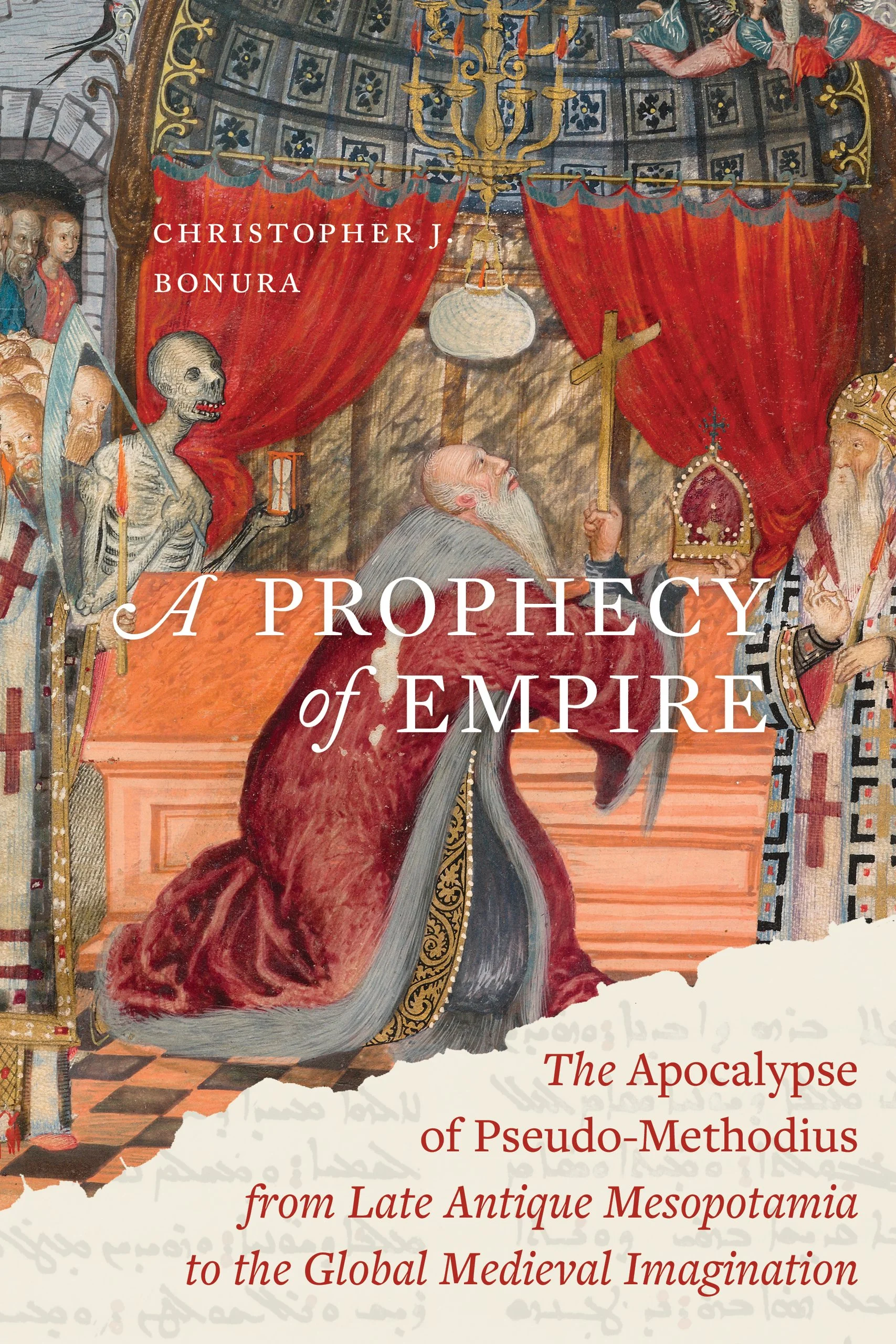
Christopher J. Bonura. A Prophecy of Empire: The Apocalypse of Pseudo-Methodius from Late Antique Mesopotamia to the Global Medieval Imagination. University of California Press, 2025.
The Apocalypse attributed to Methodius was well attested in Greek and Latin sources by the early eight century. Its medieval readers approached the text as a genuine vision of the fourth-century Greek bishop, Methodius of Olympus. By the nineteenth century, scholars such as Ernst Sackur recognized that the text was a pseudepigraphon and treated it as arising in a ninth-century Byzantine milieu. A series of discoveries in the late nineteenth and early twentieth centuries suggested that the Apocalypse was originally composed in Syriac, but until the late twentieth century, it was studied largely in the context of medieval Byzantine apocalyptic literature.
Christopher Bonura’s new monograph, A Prophecy of Empire, offers a comprehensive study of the Apocalypse of Pseudo-Methodius within its Syriac literary, theological, and political context. On this foundation, Bonura traces the trajectory of its reception from its original Mesopotamian milieu and its gradual transmission and translation westward. Bonura argues that the Apocalypse of Pseudo-Methodius is best read as a piece of political theology emerging in an East Syriac context following the Umayyad Caliphate’s consolidation of power in the late seventh century. This political theology gives the Christian Roman Empire a positive eschatological role and is reinterpreted as the text leaves northern Mesopotamia and moves north and west. Bonura divides his monograph into three parts. First, he discusses the context of Pseudo-Methodius as a Syriac text from early-Umayyad Mesopotamia. Second, he explains the content of Pseudo-Methodius as pro-Christian Imperial political-theological eschatology. Third, he traces the reception of this political-theological eschatology across the Mediterranean, Slavic, and Western European world up into th early modern period.
In the first chapter of part one, Bonura addresses the dating of the Apocalypse and its political context. Bonura argues that the text is a response to the consolidation of Umayyad power following the Second Fitna by ‘Abd al-Malik between late 691 and early 694 CE. His argument relies on a comparison with other Syriac sources for this early period such as John bar Penkāyē’s Book of Main Points and the Chronicle of the Year 1234. Next, Bonura turns to the author’s Christological affiliation and geographical location. He dismisses the traditional view that the text’s original composition took place on Mt. Sinjar (a center of Miaphysite Christianity in northeastern Iraq), an assumption based on the title given to the Apocalypse in one Syriac manuscript. Instead, he argues that Mt. Qardu (an East Syriac center on the border of modern Iraq, Syria, and Turkey) is the more likely site of the text’s composition on account of its prominent place in the Apocalypse’s narrative. This leads Bonura to suggest that the author was most likely an East Syriac Christian rather than a Chalcedonian or Syriac Orthodox Christian, as has generally been assumed. Bonura supports his contention by pointing to the author’s almost exclusive reliance on Syriac rather than Greek sources, indicative of an East Syriac author situated on the frontier between the Sassanian and Byzantine Empires. The third chapter situates the Apocalypse in the history of Christian eschatology, particularly the interpretation of the Book of Daniel, since the Book of Revelation was not included within the canon of New Testament literature among Syriac-speaking communities until the seventh century. Bonura demonstrates that this author was influenced by a distinctly Syriac reading of Daniel, originating in Aphrahat’s Fifth Demonstration, who understands the Roman Empire as Daniel’s fourth kingdom, which will hand its authority to God at the end of time.
In the second part of his book, Bonura first explains how the author recounts the history of the world up to his present, the late seventh century. The author of the Apocalypse, informed by his reading of Daniel, presents imperial power as divinely ordained. As Bonura demonstrates, the Apocalypse details three successive kingdoms before the emergence of the fourth kingdom, founded by Alexander the Great and ultimately instantiated in the Roman Empire. The second chapter of part two turns to the prophetic portion of Pseudo-Methodius. Bonura shows how its depiction of the Last Emperor, who ultimately returns imperial power to God, parallels figures found in the writings of Aphrahat and the Syriac Alexander Legend. These parallels, absent from Greek apocalypses, further strengthen the case for interpreting the Apocalypse in its Syriac context.
Bonura dedicates the final section of the book to tracing the influence of Pseudo-Methodius on later texts by analyzing the manuscript tradition. According to this account, the Syriac and Greek recensions of the Apocalypse countered prevailing interpretations of Daniel. Earlier commentators, such as Hippolytus, understood Daniel as undermining confidence in the future of a “Christian” Roman. While Bonura shows that Pseudo-Methodius did influence other Syriac texts, its political theology and the figure of the Last Emperor in particular were not widespread. In the Greek context, however, its political theology came to define the eschatology regnant in the late empire, bolstering nostalgia for previous strength and undergirding imperial aspirations. Following the capture of Constantinople in 1453, the Apocalypse continued to circulate, stoking hopes of an imperial revival.
The next chapter traces the Apocalypse’s transmission and influence beyond the Greek-speaking world as it was translated into Armenian, Coptic, Arabic, Ge’ez, and Slavonic. In these contexts, translators often emended the Apocalypse to expand the political theology of the original text, maintaining the centrality of the eastern Roman Empire while including a broader net of peoples. The final chapter surveys the pervasive influence of this text on writers in the Latin West. Here, the Apocalypse offers a competing interpretation of eschatology and imperial ideology, rivaling models found in the writings of Augustine and Jerome. Eventually, supporters of the Papacy and the Holy Roman Empire would deploy the Apocalypse as a counter to their critics. This key move facilitates the integration of Pseudo-Methodius into Joachite eschatology by both advocates of Church reform and apologists for the Empire.
Christopher Bonura’s treatment of Pseudo-Methodius’ origins and return to the text itself, shorn of centuries of interpretive baggage, lays a new foundation for future scholarship on this generative source. In addition, his translation of the critical edition of the Syriac text, included in the appendices, is the first complete translation to appear in English, providing access to readers with and without skills in Syriac. Beyond this monograph’s significance as the most comprehensive and up-to-date work on Pseudo-Methodius, Bonura’s work intervenes in several fields. He contributes to scholarship on apocalyptic literature through his careful reading of how advocates for and critics of imperial power interpreted this text. One of his most critical contributions is situating the Apocalypse within Syriac theological and political thought and the broader Christian apocalyptic imagination. Bonura carefully documents both the continuities and discontinuities between the text’s Syriac origins and its later global context. This book participates in ongoing scholarship on Syriac literature in conversation with the broader late antique landscape. Ultimately, Bonura models a practice of late antique history that transcends the (largely linguistic) disciplinary boundaries of the academy, offering a rich narrative of Pseudo-Methodius and its original interpretive contexts. More comprehensive treatments of the text’s various paths of reception, made possible by Bonura’s work, will further deepen our understanding of how this text shaped later views of imperial power. Second, the careful focus on political theology invites future study of the additional contributions of Pseudo-Methodius to apocalyptic thought, including, as Bonura acknowledges, its image of Islam and moral vision for Christians.
Evan Bradley Schafer is a PhD student in the History of Christianity at the University of Chicago Divinity School.