
A photo of a pomegranate tree with a sun star that was submitted to Click Community [Image courtesy of the author].
If we are to individually tailor our responses, how can we figure out what sort of feedback someone is seeking?
Read MoreA photo of a pomegranate tree with a sun star that was submitted to Click Community [Image courtesy of the author].
A photo of a pomegranate tree with a sun star that was submitted to Click Community [Image courtesy of the author].
If we are to individually tailor our responses, how can we figure out what sort of feedback someone is seeking?
Read MoreIn The Story of Sacrifice, Liane M. Feldman offers an innovative reading of the pentateuchal Priestly source, taking on two of the most entrenched dichotomies in biblical studies: (1) ritual vs. narrative and (2) literature vs. history.
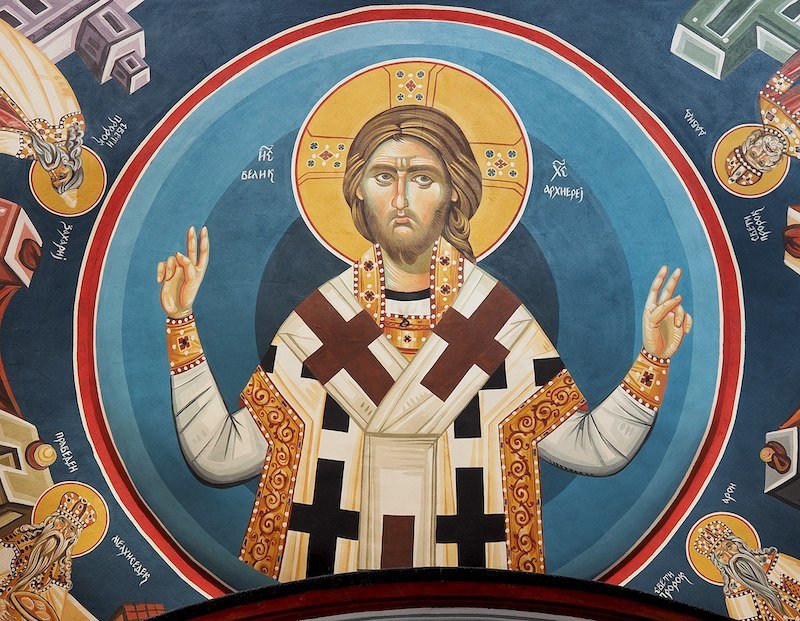
Read MoreChrist Pantokrator, Fresco from the Nativity of the Theotokos Church in Bitola, Macedonia (image courtesy of Wikimedia Commons).
Christ Pantokrator, Fresco from the Nativity of the Theotokos Church in Bitola, Macedonia (image courtesy of Wikimedia Commons).
Leaving behind the old redactional-stages approach (that has tempted many scholars through today), we are really forced to think about what “Jewish” and “Christian” should mean as identity or boundary-categories in the world of this text. Clearly it is too simplistic to lop off the Ascension section as “Christian” and call the Martyrdom section “Jewish,” since the Ascension participates in innumerable ways in a Jewish apocalyptic ascent framework, while the Martyrdom section is deeply enmeshed with the Ascension.
Read MoreThe emphasis on the abnormal aspects of Mary’s childbearing prompts reflection on whether the text conveys a real birth of a real man, or an appearance which circumvents the usual modes of human entry and human being in the world.
Read MoreAdditionally, Isaiah as a character is, I think, modeled as a Matthean Christ-figure in certain respects: both are positioned as part of a prophetic critique of ruling powers, tempted by some kind of evil entity to renounce something and gain earthly status, and killed with a wooden instrument. The charge of prophesying against Jerusalem is crucial in the trials of Jesus and Isaiah. The title ‘the Beloved’ is also emphasized uniquely in Matthew’s gospel with a citation from the Book of Isaiah (Matt 12:18).
Read MoreAJR is pleased to host a series of articles on new scholarship on the Ascension of Isaiah. These articles all originated as papers presented at the BRANE Collective’s Primary Text Lab III, on Wednesday, June 23, 2021.
Read MoreDetail of a miniature of the martyrdom of Isaiah, BL MS Royal 17 E VII f. 36v
Detail of a miniature of the martyrdom of Isaiah, BL MS Royal 17 E VII f. 36v
I like to think about apocalyptic rhetoric far more than I like to think about apocalypses: that is, what is a particular text doing vs. what is this text? So when I think about Ascension of Isaiah my question is: What is this particular text doing for readers and audiences?
Read MoreApocryphal Book of the Ascension of Isaiah in Ge‘ez [20th century], British Library, EAP357/1/11, https://eap.bl.uk/archive-file/EAP357-1-11
Apocryphal Book of the Ascension of Isaiah in Ge‘ez [20th century], British Library, EAP357/1/11, https://eap.bl.uk/archive-file/EAP357-1-11
Although it is often described as an apocalypse, the Ascension defies simple categorisation. As a result, it invites capacious conversation about the categories that modern scholars use to understand ancient texts and about how scholars study texts with expansive histories across historical, linguistic, and religious contexts.
Read MorePieter Brueghel the Elder, Right side in detail from The Tower of Babel (1563). [Wikimedia]
Pieter Brueghel the Elder, Right side in detail from The Tower of Babel (1563). [Wikimedia]
What does it mean to be labeled a foreign language speaker in late antique Christianity? How was one’s status as a native or non-native speaker determined? Was such a person considered a heretic? A barbarian? A Christian of equal standing? A saint or a demon?
Read MoreWassily Kandinsky, Improvisation No. 30 (Cannons) (1913) Art Institute of Chicago [Wikimedia]
Wassily Kandinsky, Improvisation No. 30 (Cannons) (1913) Art Institute of Chicago [Wikimedia]
Wasserman posits that Jewish apocalyptic works are better understood as myths about relationships in the divine realm. These writings do not share a common worldview (especially two age dualism) or theological system, but rather premises about the structure of the world.
Read MoreAJR continues its conversations series with an exchange between Rhiannon Graybill and Jill Hicks-Keeton on Graybill’s new book, Texts After Terror: Rape, Sexual Violence, and the Hebrew Bible (Oxford University Press, 2021).
Read MoreJoseph Mallord William Turner, Snow Storm - Steam-Boat off a Harbour’s Mouth, 1842 © Tate CC-BY-NC-ND 3.0 (Unported)
Joseph Mallord William Turner, Snow Storm - Steam-Boat off a Harbour’s Mouth, 1842 © Tate CC-BY-NC-ND 3.0 (Unported)
Echoing the atomsphere of Mark, Thate left his book intentionally unfinished. As a whole, The Godman and the Sea covers a wide range of scholarly debates surrounding the Markan narrative
Read MoreThe Gemma Claudia, Roman (ca. 49 C.E.), Kunsthistorisches Museum, Vienna. [Wikimedia]
The Gemma Claudia, Roman (ca. 49 C.E.), Kunsthistorisches Museum, Vienna. [Wikimedia]
By deftly combining textual analysis and historical considerations, Cole walks the readers through more than forty of Cicero’s writings (from his political orations, philosophical treatises, and personal letters) written between the late 70s and the late 40s BCE. Cole’s analysis demonstrates how Cicero introduced, experimented, and negotiated a new conceptualization of deification in Rome.
Read MoreGuercino, Saint Paul (ca. 1591-1666 CE) [Wikimedia]
“The demonstrably late date of Targum Chronicles – and its affinities with the Jewish Aramaic translation of some other biblical books – suggest that some Jews were interested in carrying on a tradition of translation that no longer rendered the text of the Hebrew Bible into their mother tongue.”
Read MoreSara Parks, Gender in the Rhetoric of Jesus: Women in Q (Lanham: Lexington Books/Fortress Academic, 2019)
[Please note: the author of this review completed the index for Gender in the Rhetoric of Jesus on a freelance basis. The author did not perform any research or editing for the book.]
In this compelling monograph, Sara Parks combines two scholarly interests that have not been brought together before: studies of Q, a hypothetical source that explains the material shared by the Gospel of Matthew and Luke, and studies of the historical Jesus’ relationship to women. Parks argues that Q uses a unique literary device, which she terms “parallel gender pairs” (e.g., the Parable of the Lost Sheep and the Parable of the Lost Coin; she also refers to them as “gendered pairs”), to treat male and female listeners with a certain kind of equality. Although this literary device does not appear in any extant Hellenistic or early Jewish literature, Parks finds echoes of it in some of the texts that follow Q. Others have taken note of the gendered pairs, especially as they occur in the later gospel of Luke (e.g., Turid Seim, Alicia Batten, Kathleen Corley, Amy-Jill Levine, Luise Schottroff), but disagree about the implications of these sayings for women. The key argument of Parks is that, through these parallel gender pairs, Q intentionally delivers the same teaching to men and women, but not in a way that disrupts gendered social expectations. In this, she skillfully avoids feminist supersessionism—a tendency to claim that Jesus initiated Christianity in ways that promoted the equality of women over and against an oppressive and patriarchal Judaism.
Gender in the Rhetoric of Jesus includes seven chapters. Chapter 1 introduces the interest in the parallel gender pairs, the scholarly debates about their implications for women, and the ways that the project employs historical-critical and feminist methods. Introductory material continues into Chapter 2, where Parks outlines the issues that have been central to the study of Q, including the process by which “Q became a text” (29). Here, Parks offers key assertions about the social context of Q, including its Galilean provenance, its interest in Jesus’ teachings along with its lack of interest in his biography, and its rural, agrarian, Jewish demographic (31). This chapter may be of particular interest to those who question what Jesus might have said to and about women, but who may not be familiar with the nuances of Q scholarship.
In Chapter 3, Parks contends that there are substantial differences between the context of the parallel gender pairs in Q and the texts of the New Testament. Parks reviews and engages the scholarship about the gender pairs in the early Jesus movement, and ultimately concludes that the picture for women is complicated: “Q treats women equally in certain specific ways and not in every way” (66, emphasis original). The gender pairs do signal an intentional inclusion of women in the Jesus movement, but they do not necessarily overturn gendered divisions of labor or traditional social roles.
In Chapter 4, Parks divides the parallel gender pairs into two major categories: binary sets of parables and briefer binary phrases.
Parks offers nuance to this taxonomy, however, by differentiating three possible ways that the texts indicate gender: gender implied, gender overt, or gender overt and implied. Gender implied refers to paired sayings in which the gender of the protagonists is not indicated directly but is implied indirectly by other elements usually associated with gender, such as tasks traditionally performed by men or women. Gender overt pairs make direct references to the gender of the protagonists.
Chapter 5 asks another question: “Were There Gendered Parable Pairs before Jesus?”. According to Parks, the answer is “no.” After examining the Hebrew Bible, Apocrypha, Pseudepigrapha, and various Greek texts, Parks argues that parallel gender pairs represent a rhetorical innovation that originated with Jesus. Despite several “close calls,” these comparisons indicate that “the poetic synonymous parallelism in Hebrew literature, the double injunction in the pseudepigraphon Joseph and Aseneth that cannot be dated prior to Q, or the posited wordplay of the scribes, do not provide convincing origins for Q’s gendered pairing” (122).
Chapter 6 moves forward in time by examining later texts such as the undisputed letters of Paul, the canonical gospels, the book of Acts, and texts from beyond the Jesus movement including De Vita Contemplativa, Joseph and Aseneth, and That Women Too Should Study Philosophy. Although the gender pairs represent a rhetorical innovation made by Jesus, Parks’ comparative readings of these texts demonstrate that the pairs did not appear ex nihilo; other texts from within the 1st century Jewish and Roman context are discussing and debating ways that women might be considered equal.
The final chapter notes that Gender in the Rhetoric of Jesus is the first book-length work in English that studies the parallel gender pairs. Parks argues that this innovative rhetorical technique “should play a much greater role in our investigations into where women and gender fit” within the early Jesus movement (151). Several of these pairs have been attributed to Luke based on the view that this gospel was more inclusive of women, but Parks’ work shows that some of the pairs more likely originated in Q, raising important questions about why the gendered pairs were diminished as Christianity persisted.
Throughout this book, Parks offers a nuanced analysis of the parallel gender pairs in Q. By demonstrating the uniqueness of these gender paired sayings, Parks draws thoughtful conclusions about their function within the broader context of Q. The pairs demonstrate that men and women are equal with regard to their spiritual inclusion and eschatological agency, even as socially gendered roles are maintained. Parks’ work clarifies long-standing questions about what these sayings might mean for women in the Jesus movement, and provides an important contribution to the study of Q and the study of Jesus’ treatment of women.
Hilary Floyd is a PhD student at Drew University in the area of Bible and Cultures. Her work focuses on the New Testament and early Christianity, especially the parables and the relationship between economic context and interpretation.
Capture of Jerusalem by Nebuchadnezzar, miniature by Jean Fouquet, courtesy of Wikimedia
Capture of Jerusalem by Nebuchadnezzar, miniature by Jean Fouquet, courtesy of Wikimedia
“I contend, however, that the impetus to reconstruct a historical account of ‘what really happened’ has significantly undertheorized the differing ways in which biblical texts both recount and shape the very idea of destruction of Jerusalem.”
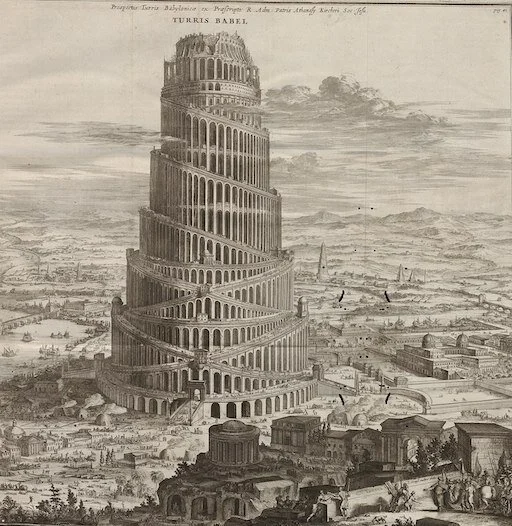
Read MoreAthanasius Kircher, Turris Babel (Image courtesy of Wikimedia Commons)
Athanasius Kircher, Turris Babel (Image courtesy of Wikimedia Commons)
“From my first book to my most recent, comparison (and its pitfalls), both within Judaism and without, has been a constant preoccupation as I continued to focus on texts of legal interpretation, and to struggle with how best to translate the rabbinic texts upon which I was commenting and to what extent either should inform or presume the other.”
Read MoreAJR continues its #conversations series with a call and response between Christine Luckritz Marquis and Tracy Lemos on Lemos’ Violence and Personhood in Ancient Israel and Comparative Contexts (Oxford University Press, 2017).
Christine Luckritz Marquis:
Tracy Lemos’s Violence and Personhood in Ancient Israel and Comparative Contexts contributes to the burgeoning study of violence and religious history. Deftly engaging and critiquing her field of specialization (biblical and ancient near east studies), Lemos situates her own work among often overlooked anthropological approaches to personhood. While she highlights the usefulness of certain philosophical approaches (common among North American and European scholars), she emphasizes the greater value for social historians of engaging anthropology on personhood, due in part to its attention to communal behavior and willingness to activate comparisons. Such positioning allows her to make synchronic comparisons that highlight the commonalities of cultures even as she notes the particularities of the Israelite community. The underlying ethic of her project is a call to her scholarly comrades to care more for people suffering than objects broken, whether those of the past or those of our own present.
Throughout the book, Lemos challenges her readers to address how notions of personhood inform and are informed by experiences and enactments of violence. She asserts that notions of personhood are most visible when the status of a human being is denied through acts of dehumanization. Israelites and neighboring communities used physical violence “to demarcate lines of personhood, to shift the status of a human being from that of person to that of non-person, and to highlight the superior status and claim to personhood of the one inflicting the violence upon someone else” (4). For the Israelites, in particular, “masculine dominance” animated social ordering not only in times of war, but also in daily life (18).
Having traced the contours of scholarship on personhood in her introduction, Lemos offers her own definition of personhood as “a social recognition of value” marked by the attribution or denial of legal rights and status through ritual performances (11). Equipped with this definition, she moves through multiple types of people with a focus on their embodiment to explore how personhood was constructed by Israelites in relationship with their larger ancient West Asian context.
She begins, in Chapter 2 by exploring how foreigners were treated amongst Israelites. Via a wide swath of evidence – from biblical texts, to reliefs and royal inscriptions, to legal and treaty documents – she explores the mutability of personhood that was central to Israelites, their Levantine neighbors, and the larger ancient near east. While outright denial of personhood is scarce in her sources, as she highlights, animalizing language was used to describe and debase foreigners (39-40). With careful attention to nuance, she differentiates animal comparisons that might be harmless from those meant to articulate and mark as less than human.
She also points out that such descriptions often escaped the bounds of language, especially in the context of war, resulting in brutal acts of humiliation and mutilation that left little doubt of the abused individual’s non-human status. Wading through horrific examples of violence, Lemos convincingly shows that such praxes were ritual performances, recognizable to communities of ancient West Asia. They negated the victim’s status as human while simultaneously actualizing the abuser’s personhood. That is to say, as she shows so well throughout the book, acts of violence created and destroyed personhood. Given the highly vulnerable nature of personhood, it is not surprising that she finds examples not only of foreigners, but also of native Israelites occasionally experiencing acts of dehumanization within their own community.
With a larger background context of masculine dominance established (linked to enacting of violence and delineation of personhood), Lemos moves in the next several chapters through various subjugated positionalities – women, enslaved individuals, and children. In Chapter 3, she carefully exposes how subordination did not necessarily negate the personhood of women. Transgressions, especially those of a sexual nature, by women and the resultant response of the father/husband and larger community underscore how “partial and tenuous” women’s claims to personhood were (64). In severe cases, punishment might devolve into such mutilation that it resulted in animalization of the woman’s body, ritually marking her through violence as no longer a person.
Moving from daughters and wives to the enslaved, Lemos argues in Chapter 4 that who was enslaved influenced the degree to which they were ascribed any personhood. Israelite men who might find themselves enslaved due to debt were far more apt to retain their personhood than a male who was perpetually enslaved. Having already shown the limitations to personhood that women might suffer, Lemos underscores the more tenuous situation in which all female enslaved individuals found themselves. But the enslaved foreigner, regardless of gender, was the only type of slave who was utterly denied any personhood both legally and socially. While she does not use the term, it is clear that intersectional realities produced multiply oppressed individuals with little to no personhood ascribed them.
Chapter 5 turns to yet another precariously situated body, that of the child. As Lemos pours over available evidence and potential interpretations, she makes clear that all readings indicate that children lacked personhood. Exploring the sacrifice and cannibalism of children, Lemos distinguishes children from all the other subjugated positionalities she addresses in the previous chapters. Even the enslaved foreigner, for example, could have been granted personhood in their own land, but children throughout the ancient West Asia could not. Lemos also argues that child sacrifice occurred among the Israelites, despite its limited mentions within extant texts. In her view, such limited mentions of children actually further underscore how much an afterthought the entire existence of children often was.
True to her chosen methodology, Lemos turns in her final chapter to comparing ancient Israelite constructions of personhood to several recent American contexts: Abu Ghraib, the prison industrial complex, and police maltreatment and murder of Black and Brown people. Moving through each case, she shows how a notion of personhood built around dominance and violence by a hypermasculinized few is always fragile and precarious for all. Given the many dark and violent examples Lemos engages, she ends her compelling argument on a positive note. Framing an alternative model of dominant personhood on the protest actions of Bree Newsome, she asserts that just because personhood has often been constructed through abuse and dehumanization throughout history does not mean it must be so. She closes by encouraging her readers to construct personhood around mutual recognition and respect towards building a more just and equitable world.
Overall, Lemos makes a compelling case for understanding personhood among Israelites and in the broader ancient West Asian world as constructed through violence that subordinates some while creating a dominating status for others. Her attention to multiple experiences across so many types of evidence is part of what makes her argument so successful, but one of the few places I wanted more nuance was in mapping the differences between enslaved individuals. In her (justified!) desire to counter scholarship that flattens the horror of enslavement by merely equating it to labor, Lemos firmly asserts that enslavement was very different. But her own evidence betrays that there was more slippage between the categories than she allows. Other laborers also suffered subordination and abuse alongside the enslaved. As she herself notes, laborers and enslaved individuals both might find themselves in precarious situations, and the very existence of debt enslavement makes clear that a laborer, subject to whom he worked for, might easily be manipulated into an enslaved status. While I agree with her arguments that we must not make claims that erase the horror of enslavement, I think her claims would have been strengthened further by highlighting how labor was more like enslavement in some cases than enslavement was merely like labor status. I only raise this small point because it aligns with the critical impact of her book: when personhood is scaffolded by violent dominance of some at the expense of many others, everyone’s worth is precarious and we all fail to flourish like we could.
Tracy Lemos:
First, I would like to thank Christine Luckritz Marquis for the careful and thoughtful review of my book that she offers. It is always gratifying to read a conscientious engagement with one’s work. I was trying to do something rather unusual in this book, which was to assess a social phenomenon in two very different times and places. While there has been increasing interest among biblical scholars in examining how biblical texts have been received and interpreted in contemporary communities, that was not what I was doing here. I wanted to use biblical texts, together with archaeological evidence and a range of sources from elsewhere in ancient West Asia, to reconstruct the phenomenon of dehumanizing violence in a particular region and period of time—the first millennium BCE—and then compare that reconstruction with the same phenomenon as we see it in another place and time — namely contemporary America, especially the city streets where police officers shoot unarmed African-American men, prisons where incarcerated individuals are subjected to dehumanizing violence, and Abu Ghraib in Iraq, where American soldiers treated the bodies of prisoners like animal bodies.
Luckritz Marquis is certainly right that this book is mostly synchronic in method when it comes to my examination of Israelite and other ancient West Asian sources. The reason for this is that the interconnections I outline between dehumanizing violence, masculinity, dominance, and personhood are hardly limited to one century or two of ancient West Asian history. My objectives in the work were to demonstrate that these connections existed and were extremely pervasive in the cultures of ancient West Asia, as well as to examine how different social groups—foreigners, Israelite men, Israelite women, enslaved individuals, and children—were affected by these interconnections. But I also argue that in certain social contexts in the contemporary world the violence-domination-personhood nexus is still very much prevalent. One could state, then, that the book has both synchronic and diachronic elements, as it entails a comparison of societies in antiquity with a contemporary society.
I am very pleased that my reconstructions of the patterns of violence in ancient Israel have generally been very well received and that Luckritz Marquis found my book compelling on the whole. Still, she did offer one main criticism, regarding my assessment of slavery, and it is an apt one. The context for my assessment was that many scholars have tried to put a “silver lining” on biblical slavery, painting it as a kinder, gentler sort of slavery, so kind and gentle it was barely even slavery at all. I wished to refute this tendency. Our sources make very clear that slavery in ancient Israel could involve rape or coerced sexuality and beatings, even fatal ones, not to mention body control and compelled physical labor. It was also a highly stigmatized social position. The Israelites did not understand slavery to be just another form of labor. But I may have perhaps been so focused on detailing the violence of slavery that I did not emphasize enough how other forms of labor, too, could be exploitative and easily lead into debt slavery.
On the other hand, I do think we need to derive our conclusions from the sources we have, which in the case of slavery are not just the Bible but the Samaria Papyri and other inscriptions, and a large set of material from neighboring cultures. It is certainly true that male and female day laborers and tenant farmers were economically marginalized and could be exploited. Nonetheless, slavery was seen by the Israelites themselves as a different and more catastrophic status, involving limitations and body manipulations to which laborers were not necessarily subject. Thus, while I do accept Luckritz Marquis’s critique that I should have recognized the potential exploitations of labor, it is important to highlight that the Israelites understood slavery as a separate status from other forms of labor and that they ascribed different levels of personhood to different categories of slaves—male versus female, Israelite versus foreign. Certain categories of slaves were offered the potential to regain their personhood but others seemingly were not. For example, a male Israelite debt slave, according to legal texts, was due certain protections and could revert to having the full personhood of other Israelite men if and when he was freed. Contrast this with the treatment of enslaved foreigners, who seem not to have been seen as persons and were not expected to be manumitted after a set term. In the end, then, although I do agree that my discussion of the personhood of enslaved individuals would have benefited from greater nuance at certain points, I contend that my overall arguments in the chapter still stand.
In my next book, I wish to extend my research on violence while shifting my methodology in certain ways. As a starting point, I will examine how Judeans responded to the ravages of imperial violence in the Babylonian and Hellenistic periods and, more specifically, how they responded to being the victims of dehumanizing violence. I will then compare this to the responses to dehumanization we see in several modern contexts. In other words, this work will include the comparative aspect of my 2017 book while delving more deeply into the nuances of Israelite and Judean experiences with violence in two specific historical periods. My goal in this project is to present an analysis of dehumanization from which scholars in a variety of disciplines can benefit. Dehumanization is an incredibly complex phenomenon, after all, and I am fully convinced that scholars of antiquity have a great deal to contribute both to the cross-cultural and transhistorical study of violence in general, and to the study of dehumanizing violence, in particular.
T. M. Lemos is Professor of Hebrew Bible in the Faculty of Theology at Huron University and a member of the graduate school faculty and a faculty affiliate of the Centre for Transitional Justice and post-Conflict Reconstruction at Western University in London, Ontario. In 2022, she will be Gerstein Distinguished Visiting Professor in the Anne Tanenbaum Centre for Jewish Studies at the University of Toronto. She has published two monographs and co-edited three volumes, including the forthcoming Cambridge World History of Genocide, Vol. 1: Genocide in the Ancient, Medieval, and Premodern Worlds, as well as numerous articles and essays on a wide range of topics.
Christine Luckritz Marquis is a historian of late antiquity and Associate Professor of Church History and Director of the Masters of Theology at Union Presbyterian Seminary.
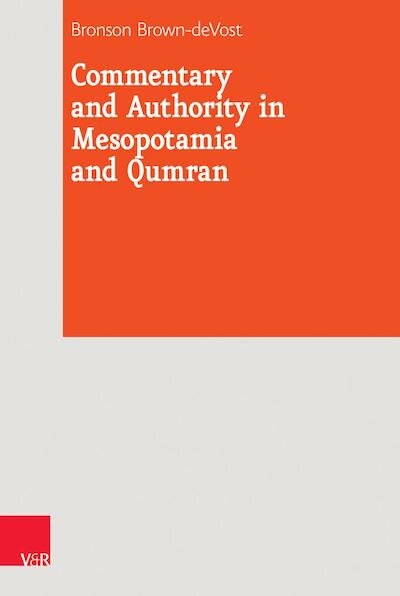
The author’s conclusions led me to wonder about an angle of comparison that had been addressed only obliquely: Are the commentary texts from Mesopotamia and Qumran actually doing the same kind of commenting? Should the function of a text affect the generic comparisons we make with it?
Read More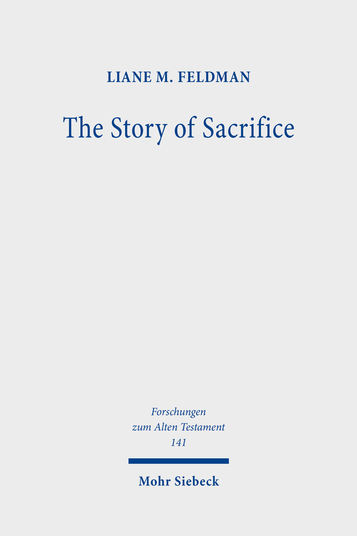


![Wassily Kandinsky, Improvisation No. 30 (Cannons) (1913) Art Institute of Chicago [Wikimedia]](https://images.squarespace-cdn.com/content/v1/5449167fe4b078c86b41f810/1609962640997-3MBGSGUU9XHIBF1Q3OJZ/601px-Vasily_Kandinsky%2C_Improvisation_No._30_%28Cannons%29%2C_1913%2C_1931.511%2C_Art_Institute_of_Chicago.jpg)


![Guercino, Saint Paul (ca. 1591-1666 CE) [Wikimedia]](https://images.squarespace-cdn.com/content/v1/5449167fe4b078c86b41f810/1625346930471-3KOGD69T3Y7CC1IPPOE9/Saint_Paul_MET_DP810223.jpg)



_-_Google_Art_Project.jpg)
,_1913,_1931.511,_Art_Institute_of_Chicago.jpg)

